
I just don’t sleep anymore.
That’s what she said. In between pickleball matches. And all the other ladies nodding in agreement. Like it was just a fact of life now.
And while the temptation was real, I kept my mouth shut.
Because… where would I even start?
With her working under fluorescent office lights all day long? With her not seeing natural morning light in who knows how long? (Maybe never) With the glass of wine I know she has most nights to relax? With the all-day-long job stress, which she talks about constantly? Her late dinners?
OR maybe that she plays pickleball several times a week. At night. So after an 8+ hour stressful workday she’s under more (horrible) lighting, adding more stress to her body.
But nobody asked me. And honestly, who wants unsolicited Dietitian opinions on a Saturday afternoon at pickleball. Not her. Not even me 😂
So I stayed quiet.
Knowing that, lucky for you, I can let it all out here.
If you’re one of those women who’s been waking up between 3-4 a.m. for months (or years) and just calling it “midlife” — this post is for you.
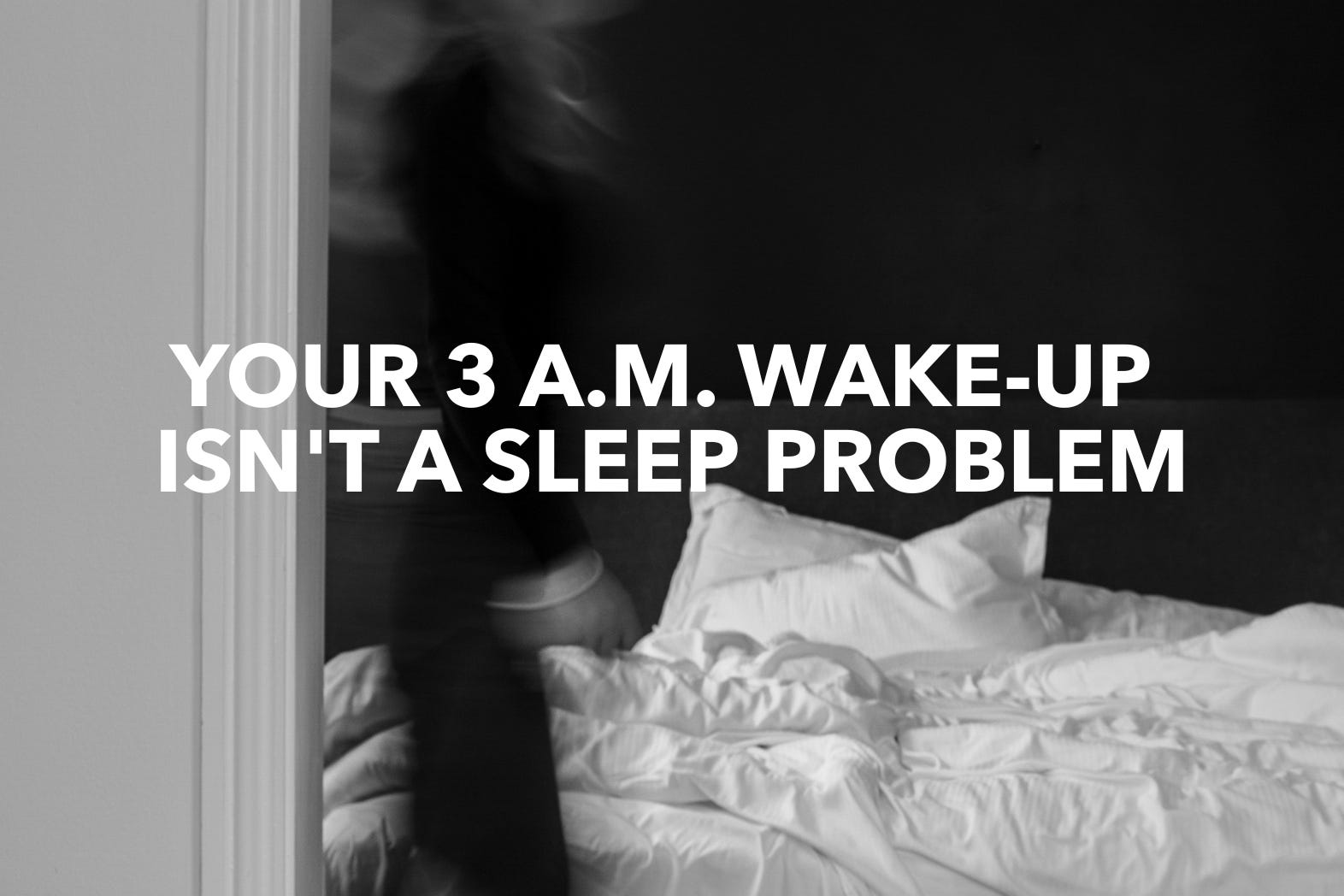
So let’s get this out of the way first: your 3 a.m. wake-up is not a sleep problem.
It’s a signal.
It’s your body, in the only quiet window it has in its entire 24-hour cycle, telling you that something in the previous day isn’t working.
The wake-up is downstream. The wake-up is the consequence.
The wake-up is information.
And if you’ve been treating it like an insomnia problem — with melatonin, magnesium, blackout curtains, white noise — and it’s not getting better, it’s because you’re trying to solve at 3 a.m. something that was set in motion at 3 p.m. the afternoon before.
Let me explain what’s actually happening in your body at that hour, because once you understand it, what to do about it gets a lot more obvious.
The story begins with our friend cortisol. Yes, cortisol is your friend. And yes, it’s also your stress hormone, but it does a lot more than just keep you in fight or flight.
It runs on its own daily rhythm. In a perfect world it peaks in the early morning to wake you up, tapers down through the day, and bottoms out at night, so melatonin can take over and put you to sleep. High AM, low PM.
The way cortisol is supposed to work during stress is also pretty simple: a stressor shows up, your body releases cortisol to respond, the stressor passes, cortisol comes back down. Spike, resolve. Spike, resolve. That’s a healthy stress response.
The problem with the day you’re actually living is that the stressors don’t pass. The Zoom meeting ends and the next one starts. The inbox doesn’t empty. The work email comes in at 8 p.m. The news is on 24/7. Your phone is going. Your kid hasn’t texted you back. There’s a constant low-grade pressure to be on. The store never closes.
The signal that’s supposed to tell your body “okay, threat is over, you can come down now” — it never gets sent.
So cortisol stays up. Not because you’re in midlife, but because it’s doing exactly what it’s designed to do: respond to demand. The problem is the demand doesn’t end.
Over time, this changes the shape of the whole curve.
The morning surge that’s supposed to wake you up gets weaker because you’ve been living near that level all day long. So the morning “spike” isn’t really a spike anymore.
This is also why so many midlife women aren’t even hungry when they wake up. Your body has been mobilizing your own blood sugar all night via cortisol, so it doesn’t signal that it needs food. What it does signal is that you’re tired. So you skip breakfast and reach for coffee. And then crash at 11.
And the evening drop that’s supposed to let you wind down doesn’t really happen either, because the store never closed. That’s the wired-but-tired feeling at 10 p.m., when your body is exhausted, but you still can’t fall asleep.
OK I did say earlier that all this isn’t happening only becauser you’re in midlife. But there is a connection. It’s that progesterone, your body’s natural cortisol buffer, is declining. So the same level of demand that you handled fine at 35 produces a bigger cortisol response at 50. And if your sleep is already a mess, you’re not getting the overnight reset, then you wake up already elevated, and then the next day stacks on top of that.
Less buffer. No reset. Same demand.
That’s why the 3 a.m. wake-up gets worse as you go deeper into perimenopause, even if your actual life isn’t more stressful than it used to be.
Now here’s the kicker. When the cortisol curve is that flat and that dysregulated, the natural early-morning rise that’s supposed to gently bring you up at 6:30 fires too sharply, or too early. So there’s your 3-4 a.m. wake up. Done.
That’s the cortisol piece.
If you have a late (ie. after pickleball) or carb-heavy dinner and then go straight to bed, your blood sugar may drop a few hours into sleep. To that, your body responds the way it’s designed to — it releases cortisol and adrenaline to bring your sugar back up.
This kind of wide awake at 3 a.m. is more of a chemical wake-up than a “sleep” problem. Btw, that melatonin supp isn’t going to fix that.
Yes, alcohol relaxes you. Yes, it may even help you fall asleep. But it’s a false sense of sleep security. Because while you think it’s helping, it’s actually tanking your sleep quality about three to four hours later, right when your body finishes metabolizing it. And the rebound is real. One glass of wine at 5 p.m. is one thing. Two glasses at 9 p.m. is a near-guarantee of a 3 a.m. wake-up. I can literally feel myself metabolizing a cocktail in the middle of the night and it feels like I’m having an anxiety attack in my sleep. Awful.
Add declining progesterone into the mix and your sleep is already lighter and more easily disrupted.
That same nightcap that put you to sleep at 36 wakes you up at 46 and feels like an anxiety attack at 56.
So: dysregulated cortisol, blood sugar crash, alcohol rebound, declining progesterone. Sometimes all four at once. That’s your 3 a.m. wake-up call.
I’ve been there too, by the way. There was a stretch during perimenopause where 3:47 felt like a scheduled appointment. I wasn’t sleeping well, I wasn’t recovering well, I was wired, frustrated, and exhausted. Every night felt like the night before an early flight. And I kept trying to solve it at night with magnesium, melatonin, better sheets, an earlier bedtime.
It wasn’t until I started to change my lifestyle during the day did my sleep quality improve.
I mean, yes — do the basics. Don’t drink coffee at 3 p.m. Don’t scroll until 11. Cool, dark room. Sure.
But the actual leverage is much further upstream.
It’s morning light, within an hour of waking, for ten minutes. Outside. Not through a window. This is the single most under-rated lever in midlife sleep — it sets your cortisol curve for the whole day.
It’s front-loading your calories. Eat real meals earlier in the day so your body isn’t doing its heaviest digestive work at 8 p.m. Finish eating about three hours before bed if you can.
It’s moving your wine earlier in the evening. Or take two weeks off and see what happens. I’m not here to tell you to quit drinking. I am telling you that alcohol within 3-4 hours of bed, in midlife, is one of the most reliable sleep disruptors I see in my practice. Pull it out for just two weeks and see how you feel.
It’s letting your nervous system come down during the day, instead of leaving your body to deal with it all at 3 a.m. Because that is what’s happening. The back-to-back meetings, the constant pings, the running list of who needs what, the conversation you didn’t finish, the email you forgot to send — none of it got put down. Your nervous system cup is full.
This is the part about midlife I keep coming back to. Your body isn’t breaking. It’s responsive. It’s telling you, in the most diagnostic way it knows how, that the day you’re living isn’t working for it anymore.
Your 3 a.m. wake-up is real information. It’s not a malfunction. It’s not “just menopause.” (It happens to men, too!) It’s not something you need to medicate or override or white-knuckle your way through.
The women I work with who actually start sleeping through the night again (and they do!) didn’t get there by stacking more sleep tools on top of a broken day. They got there by changing what their day looked like. The light. The food timing. The nervous system load. The architecture of the day itself.
That’s the work. And it works.
xo Danielle 💛
If you’ve been waking up at 3 a.m. for months and you’re tired of being told it’s just hormones, this is exactly the work we do inside Midlife Well Lived. We spend a full week on stress, sleep, and recovery — what your nervous system actually needs, why old sleep advice stops working in midlife, and how to build a day your body can actually rest from. Get on the waitlist here.

And if you’re new here — I’m Danielle, a Registered Dietitian and Rhythm coach. I write about midlife metabolism, circadian biology, and what it actually looks like to age well in a body that’s asking for something different. Glad you’re here. 💛

If this information resonated, press the Share button. It helps more people discover this article, and it takes less than a second. Thank you! 🙏
Comments
Nothing yet. Say the first thing.
Sign in to join the conversation.