
My daughter called me ancient.
We were standing in front of the full-length mirror in my dining room. She was in a bikini. I was in my usual house uniform, which may or may not have been pajamas.
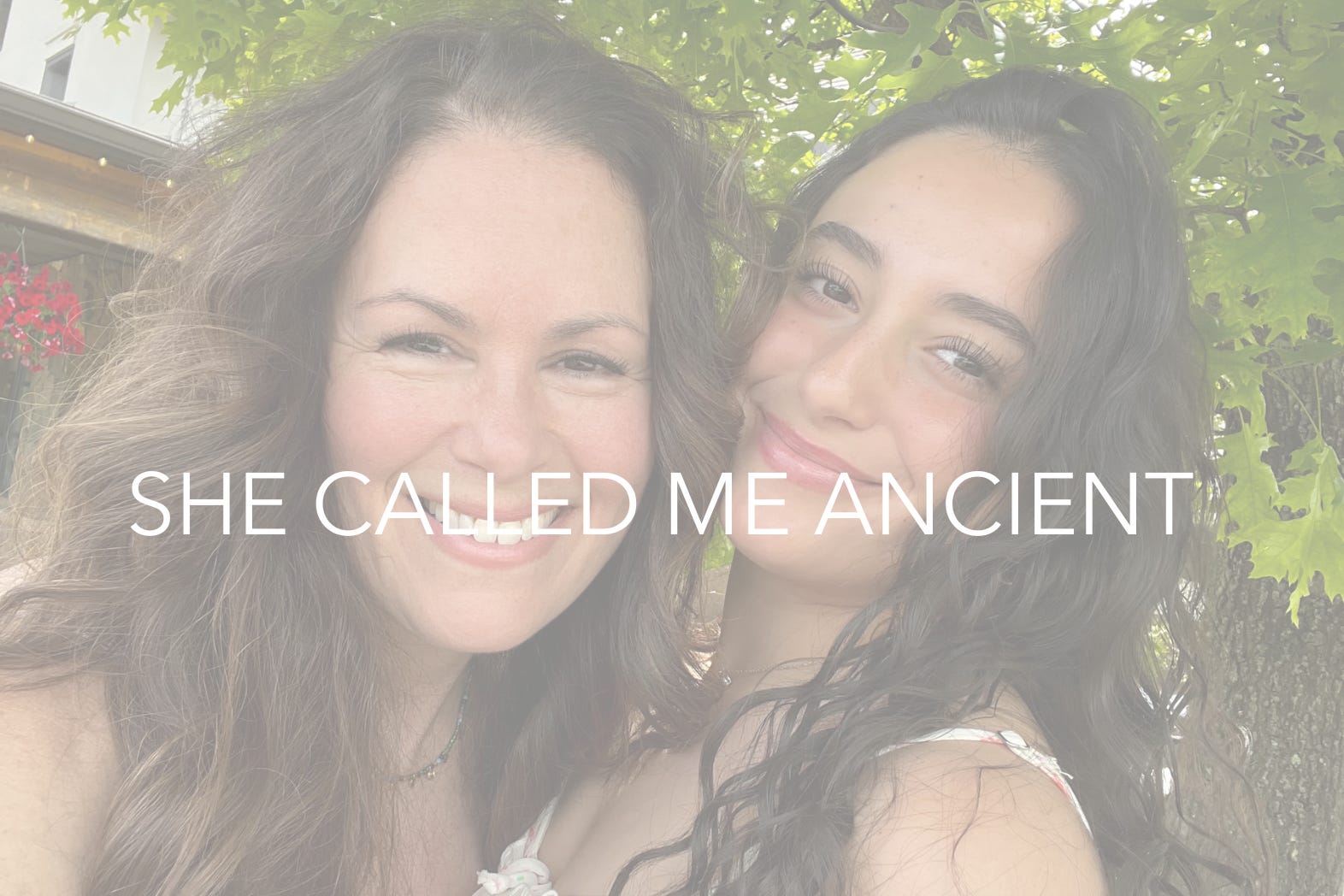
She made a comment about her body, and I did what mothers do. I tried to help her see what she couldn’t see.
Norah, you’re 18. You are in your metabolic prime. You can change whatever you want about your body. Trust me, this is not the issue you think it is.
To make my point, I showed her what I could pinch on my own body.
See? This is a couple of inches. You can barely pinch anything.
She looked at me and said, Well, Mom, you’re ancient.
Ouch.
Then, apparently wanting to soften the blow, she added, I mean, you look great. But you’re ancient.
So there it was. I am 56. And I might be ancient.
At first, I laughed. Because what else do you do when your 18-year-old casually hands you your mortality between the dining room mirror and the laundry basket by the stairs?
But I also kept thinking about it. Because “ancient” is not actually the word that bothered me. I know what she meant. To an 18-year-old, 56 probably does feel ancient. I’m sure at 18 I thought 56 was one elastic waistband away from the nursing home.
What stayed with me was something else.
This whole strange tension of being a woman in midlife who still wants to look good, feel attractive, care for her skin, wear the jeans, buy the serum — and also not make looking younger her entire aging story.
Because that is where things have gotten weird.
I enjoy feeling attractive. I like when someone tells me I look good. I am not above targeted skincare. I swear by my collagen powder. I am also not above standing in front of the mirror and noticing what is working and what is very much announcing that midlife has entered the chat.
And yes, I do get the “you look great for your age” comments.
I know people mean it kindly. And I mostly receive it that way. But there is something inside that compliment that never quite lands clean.
It has this feeling underneath, like it seems you’ve managed to outrun the visible evidence of your age, and that is why we’re still allowed to consider you attractive.
That is the part I am starting to push back on.
Because “you look great for your age” is not just a compliment. It’s a comparison. It means I have been measured against what 56 is supposed to look like, and apparently I am passing the test. For now.
I don’t want “looking younger than my age” to become the centerpiece of my aging story. I love feeling like I’m aging well. I love feeling strong and feminine and healthy and alive in my body.
But I am less interested in passing for younger than I am than actually belonging to the age I am.
Because most of what is called “aging well” still kind of means aging invisibly. As if the best version of a woman over 50 is one who can make everyone forget she is over 50.
I don’t want to pass. I want to be seen for exactly who I am right now.
I feel like women over 50 are being sold an interesting version of empowerment.
It says: do whatever makes you feel good. Take care of yourself. Be confident. Be radiant. Be your best self.
And I am all for that.
But it feels like there’s another message running in the background: don’t let them see what time has done to you. Don’t wrinkle too much. Don’t sag. Don’t look tired. Don’t look like you’ve lived through motherhood, heartbreak, sleepless nights, hormone shifts, caregiving, loss, reinvention, and everything else life has handed you.
The quest is not just to stay young. It’s also to stay culturally acceptable. You see this all the time in the comments. Midlife women must appear as though they still care about their looks. They must look like their still trying. Enough so that nobody has to confront what aging actually looks like on a real woman’s body.
Skincare, lasers, filler, peptides, face tape, neck tape, red light masks, lifts, peels, snatched jawlines, anti-aging everything. Some of it may be fun. Some may genuinely help a woman feel more like herself.
For a while I was fascinated by the facelift accounts on Instagram. The transformations are amazing! And I completely understand why, after watching those reels, a woman would want to shave 20 years off her face. It is seductive. Especially when it’s framed as: I just want to look on the outside how I feel on the inside.
I get that. I really do. I have thought about various things while watching those reels. Things like, would I ever do that if I could afford it? Is this empowering or is this insanity? How does this work when your body looks 70 but your face looks 40?
But I think we should be honest about what this is asking us to believe. If the outside has to look younger to match the inside, what does that say about the outside we actually have? The one that has carried us our entire lives?
And there is a longer-term question nobody seems to be asking. The woman doing everything “right” looks great at 55. Then she is 65. Then 75. At some point, time will get a say. And then what? If most of midlife has been organized around not looking your age, that is a very hard conversation to be having for the first time at 75.
Here is what I actually know, not just as a person living through this in real time, but as an integrative dietitian who has spent 25 years sitting across from women trying to navigate life in a body they don’t love. No matter what age they are.
The beauty trap and the health trap are the same trap.
I see it happen all the time. The same energy that goes into not looking your age goes into forcing your 50-something body to perform the way it did at 38. Different arena, same fight.
The restriction, the efforting, the constant managing, it’s all a version of the same thing: refusing to let your body be what it actually is right now. Refusing to listen to what it’s trying to tell you. And in both cases, whether you’re fighting your appearance or fighting your biology, you do pay a cost.
And that cost is not just emotional. It’s also physiological.
Becca Levy at Yale has spent decades studying self-perceptions of aging. Her longitudinal research found that people with more positive views of aging lived an average of 7.5 years longer than those with more negative ones. Seven and a half years! And it’s not about telling yourself a cheerful story. It’s about the measurable physiological cost of chronic negative self-perception — what it does to cortisol, to inflammation, to nervous system regulation, to every downstream outcome that follows.
How you talk to yourself about your changing body is a health variable. A real one.
What I see in my practice is women who are so busy managing how they look and pushing through how they feel that they have completely lost access to what their body is actually telling them. The signals are there. They are just being overridden.
Because our bodies in midlife are talking. All the time. Through energy, sleep quality, hunger, mood, body composition, stress tolerance, the feeling in your gut when you walk into certain rooms.
In midlife, the stuff “we knew for sure” changes. The food we ate our whole life we suddenly can’t tolerate. The workout we’ve relied on forever stops “working.” The glass of wine we use to wind down now has real consequences the next day. The job we’ve loved for a decade somehow starting to feel like a hostage situation.
These are not signs of a breakdown. These are signals.
Your body is asking for a new rhythm.
The invitation here is not to embrace decline. I want to be clear about that. I believe in using every intelligent tool available to help your body age with strength and resilience — food, movement, sleep, timing, light exposure, rest, nervous system support, and strategic supplementation.
But there is a real difference between supporting your biology and forcing an old rhythm onto a new body.
That is where so many women get stuck. They’re trying to live in a 50-something body with the schedule, stress load, food patterns, exercise habits, and self-talk that belonged to a younger version of themselves. And then they wonder why everything feels more resistant, inflamed, and generally unfamiliar.
What I see over and over is the shift that actually changes things is not another protocol. It’s a whole new orientation.
More rhythm and less chaos. More morning light and less midnight screen time. More protein, timed well, and less grazing through stress. More muscle and less obsession with being smaller. More actual rest and less pushing through. More nervous system repair and less peace keeping.
More listening. Less managing. Less efforting.
Because aging well is not just about how we look. It’s about how well we are actually living inside the body we have right now.
Especially in 2026. I might consider going back to 1988 for the music, the freedom, and the general lack of technology. But not for the insecurity. Not for the constant comparison. Not for the confusion about who I was or where I belonged.
At 18, I had tighter skin and curly hair I absolutely could not control.
At 56, I have better instincts. (The hair I still can’t control.)
I know which one I trust more.
And that is the part we do not talk about enough. We keep acting like youth is the prize, but many of us would never want the consciousness we had when we were younger. We may want the skin. We may want the metabolism. We may want the ability to sleep on a bad pillow and somehow not need physical therapy.
But do we want to go back to not knowing ourselves?
Do we want to go back to outsourcing our worth to whoever was looking at us?
Do we want to go back to thinking our body was the most interesting thing about us?
I don’t.
I have worked way too hard to know myself. I have earned too much discernment. I have mothered, loved, lost, learned, healed, questioned, changed, and become.
I do not want to erase that from my face.
I want to be recognizable to myself.
Maybe ancient is not the insult I thought it was.
Maybe ancient means I have lived long enough to stop asking my body to prove my worth.
Maybe ancient means I have stories. A better sense of what actually matters. A relationship with my own truth that took decades to build.
Maybe ancient means I am no longer interested in spending my energy fighting the evidence that I have lived.
Aging will ask you for a new definition of beauty. I think that is actually the invitation.
I want to belong to my life in the body I am in now. I want to belong to this age, this face, this wisdom, this chapter. And I still want good skin. Obviously. I still want to feel beautiful, strong, desirable, and alive.
I want a body I am in partnership with.
I want a rhythm that supports this chapter.
56 is not the new 36.
56 is 56.
And maybe the real work is not making 56 look younger.
Maybe the real work is learning how to live 56, in rhythm.
xo Danielle 💛
If you’re new here — I’m Danielle, a Registered Dietitian and Rhythm coach. I write about midlife metabolism, circadian biology, and what it actually looks like to age well in a body that’s asking for something different. Glad you’re here. 💛

If you’re looking for something different than another protocol, another plan, another program that treats your body like a problem to solve — Embodied Health is my four-month private mentorship where we start with the full picture and build a rhythm for the life and body you are actually in right now.
Not the one you had at 38. This one.
Twenty-five years of clinical experience. No generic plan. Just personalized support for the woman who is done managing symptoms and ready to understand what her body is actually asking for.
→ Schedule a Free Clarity Call
Thanks for reading In Rhythm with Danielle Omar! This post is public so feel free to share it.
Comments
Nothing yet. Say the first thing.
Sign in to join the conversation.