
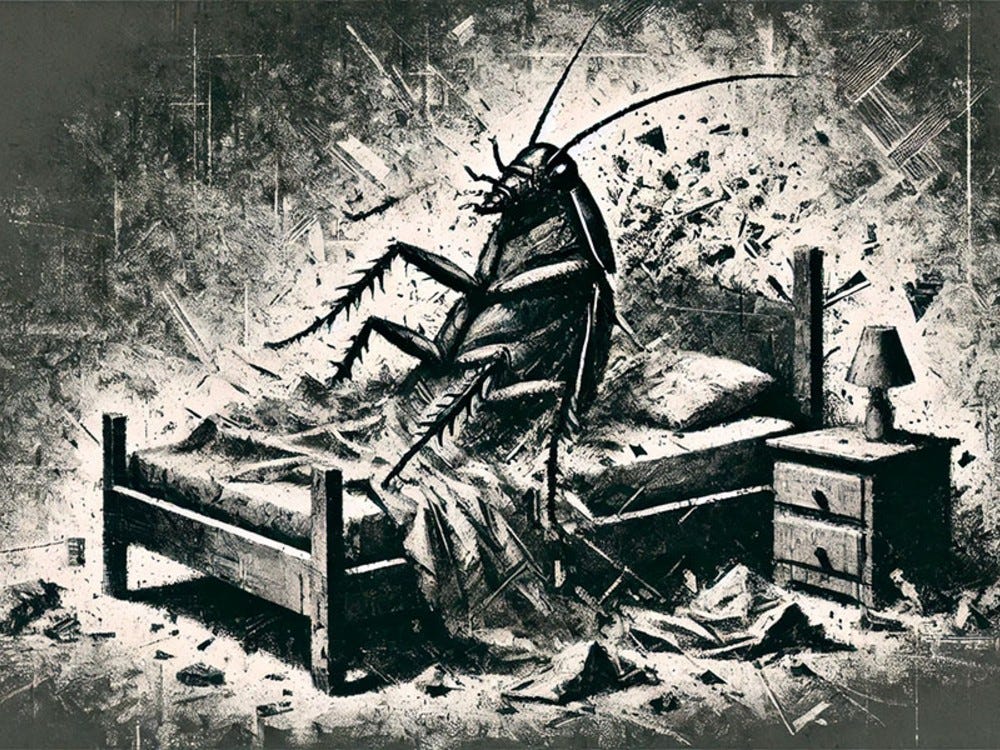
Banner image for ‘Metamorphosis Variations’ by John Biscello at 3:AM Magazine.
This post is the twelfth entry in a series on editing fiction for 3:AM Magazine. Click here to read my introduction to the series, with links to subsequent posts.
It must be clear, by this point, that if you’ll grant me the old (simplistic) distinction between form and content in literature, form is what wins my interest first. As I wrote earlier this year, in a slightly different context, “I don’t think that any [element of content] is, in and of itself, more interesting or deserving of attention than any other... unless and until, in literature, language makes it so.” So, to paraphrase Roger Ebert, I’m less intrigued by what a fiction is about than I am by how it is about it—and this means I’m a sucker for fictions that search for new forms, or that at least discard familiar forms in order to take on unusual shapes.
If you’ve read Michael Conley’s Flare and Falter or Gabriel Blackwell’s Babel, both of which I published through Splice, you’ll already have a sense of my fondness for formal play. You’ll have a sense of it, too, if you read my reviews of fiction collections by Helen McClory, Ruby Cowling, Linda Mannheim, Cathy Sweeney, Ben Pester, and others. Ultimately, then, when a formally playful piece of prose comes my way, by default I’m keen to publish it at 3:AM. I might end up turning it down—it might not quite hang together—but simply by virtue of its playfulness, it always starts off on the front foot.
Earlier this year, John Biscello’s ‘Metamorphosis Variations’ was an easy submission for me to snap up. It is exactly what it sounds like: a glorious little hybridisation of Kafka and Queneau, a half-dozen stylistic variations on the opening pages of ‘The Metamorphosis.’ Elliott Simpson’s ‘Thirteen Ways to Prepare an Egg’ is exactly what it sounds like, too, a numbered list of methods for serving eggs, although some methods are more fanciful than others and each one progressively reveals a larger situation behind the making of the list. Both Biscello and Simpson focus on a single conceptual gimmick (I don’t use the word “gimmick” pejoratively!) and then explore it through a series of fragments that are organised in a linear fashion. In this respect, both writers favour a relatively straightforward approach to formal play, sustaining a quirk of form without quirking it any further partway through their prose.
In contrast, Sabrina Lim Fang’s ‘It’s All Quite Straightforward, Really’ isn’t what it sounds like: it’s complicated. In essence, it’s a study of its narrator’s interpersonal relationships—past, present, future—but multiple warpings of its form muck around with its flow. Firstly, it’s divided into sections that lay things out like a bureaucratic management plan: ‘Introduction,’ ‘Purported rectifications,’ ‘Liabilities and obligations,’ and so on. Then the text within each section is broken down into numbered points and sub-points, à la Wittgenstein’s Tractatus, and finally the chronology of events is bent out of shape and tangled anew as narrative incidents are contorted into this schema. Unlike Biscello and Simpson, Fang requires her readers to reconstruct a situation from her own presentation of it: a situation shattered and reassembled in an unnatural way, a presentation that cleaves to a system of order so unfamiliar it seems chaotic. In doing so, she demands of us a more conscious, more participatory role in the construction of her work.
Two other writers at 3:AM lean towards Fang’s mode of formal play, but with a directness of situation more like Biscello’s and Simpson’s. In ‘Devil’s Ivy,’ Shannon Hardwick navigates a relationship between two people whose mutual friend has recently died, but she structures her exploration around three or four disparate incidents which are linked together as a “set” in the mathematical sense of the word. Consider passages such as this one: “To study the way humans interact, you must look at the standard party, the typical grouping. Can you place a numerical value on behavior? If Aaron’s good mood is X, and X’s coefficient is 5, what is his attitude at Y if Y is a broken dinner plate?” The result only indirectly acknowledges the emotional intensity of the narrative situation, by attempting to subordinate it to a colder, more rational, less charged system of meaning-making.
And then, in ‘Instructions for Shooting,’ J.P. Seabright offers a similarly short, sharp piece of prose about grief, but foregoes mathematical theory for strict depiction. If it’s a truism to say that grief is a shattering experience, best represented in a fragmented literature, Seabright embraces the truism to make an art of the breakages. Grief is, indeed, at the heart of the situation here, but Seabright depicts an experience of grief in the sense that the experience is literally reduced to pictures: each paragraph of ‘Instructions for Shooting’ describes an image whose significance depends on all the images around it. The prose scrambles chronology, confusing cause and effect, picking up the pieces of a life after a shattering experience, but it can’t reassemble them as they would’ve been. The effect, overall, is a sense of desolation paired with a sense of disorientation, as the emotional dimensions of the narrative situation are augmented, rather than suppressed, by Seabright’s formal playfulness.
No posts
Comments
Nothing yet. Say the first thing.
Sign in to join the conversation.