
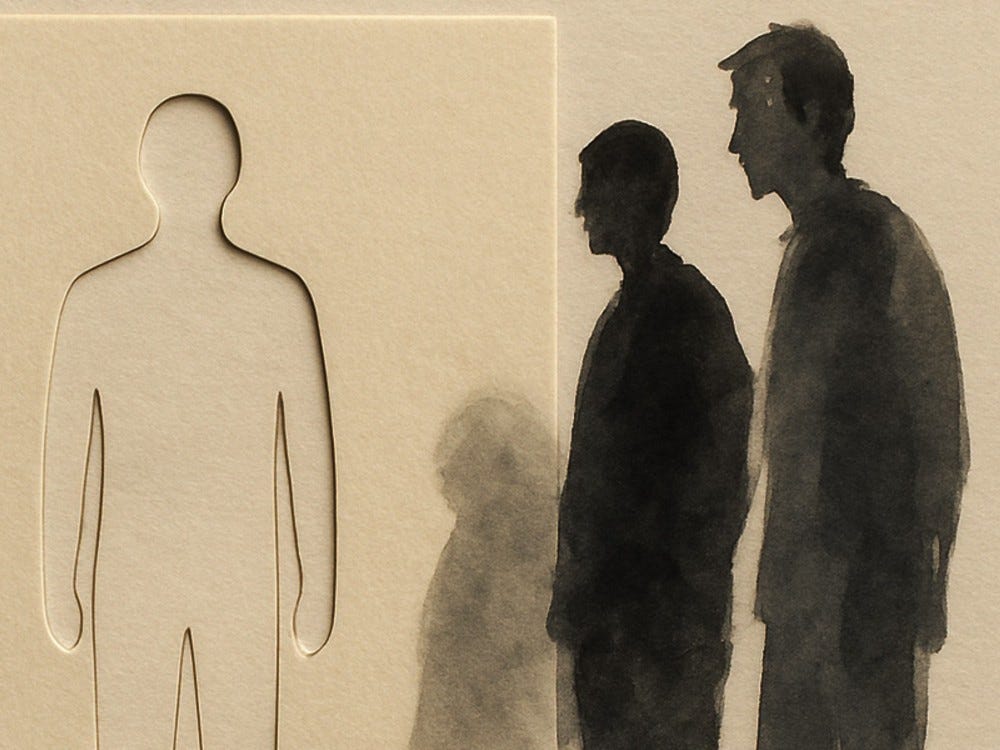
Banner image for ‘Someone Else’ by Miklós Vámos (trans. Ági Bori) at 3:AM Magazine.
This post is the thirteenth entry in a series on editing fiction for 3:AM Magazine. Click here to read my introduction to the series, with links to subsequent posts.
Broadly speaking, we might say that a formally playful fiction is one in which a linchpin of conventional narrative cohesion has been jettisoned in favour of another way of ordering events, rendering experiences, and making meaning. So, then, what do we say of fictions that jettison something—not necessarily a linchpin of cohesion, but certainly a conventional element of narrative—but don’t replace it with anything? Such fictions of rescission are marked by an empty space in which we recognise a refusal to have our expectations met.
Joshua Judd Porter’s ‘Detective Story Without a Detective’ is a sleek, confident specimen of the type of fiction I’m talking about. It has all the elements of a noir mystery, minus the one element that would bring all the others together. The effect, for readers, is mesmerising, in the way that a carrot on a stick is mesmerising for an ass, and as intentionally unsatisfying. Petra Meindl-Andrews’ ‘Lomseggen Ridge Stories’ is more jagged, less refined, unfolding over a longer timespan and tripping or leaping through its eras. What’s been removed here is the connectivity—continuity, if not causality—between events whose only point of kinship is the site of their occurrence.
Meanwhile, in Conor McLean’s ‘When Palm Trees Fall,’ the event in the title, the falling of the palm trees, is precisely what is omitted. The more appropriate but less mellifluous title would be ‘After Palm Trees Have Fallen’; McLean offers only oblique glances at the event by focusing on its aftermath. Robert Warf does something similar in ‘Casings,’ but at a sort of double remove: the reader is left to piece together not only the events preceding the situation the narrator speaks from, but also the events that preceded the narrator placing himself in that situation.
Finally, Emma Campbell and Miklós Vámos have both written fictions of rescission that foreground dialogue. In ‘Did You Hear About Laura?,’ Campbell takes a delicate approach to the rescission of imagery. She doesn’t entirely do away with visuals, but she does rob her central character of eyesight while focusing closely on what her two ancillary characters can see—and yet, while she gives those two characters the power of speech, she deprived them of the power to say anything with certainty. In ‘Someone Else,’ however, Vámos (trans. Ági Bori) goes all the way with the rescission of imagery: his prose is one hundred per cent dialogue, untagged. This way, he leaves his readers feeling surrounded by voices, as if by the maelstrom of hearsay and gossip that sweeps across his characters, and simulates for us what his characters experience: the difficulty of crediting the events the voices speak of.
In a certain sense, the principle at work in these fictions is not too far removed from the one the Oulipians operate on: namely, that by imposing a constraint on oneself—by denying oneself the use of a particular tool in the literary toolkit—a writer can strike a spark of inventiveness for themselves. Abiding by this principle in short fiction is no doubt less demanding than in an Oulipian project of greater length, but it’s enough to invigorate narrative situations whose interest would dissolve in more conventional prose.
No posts
Comments
Nothing yet. Say the first thing.
Sign in to join the conversation.