
FOREWORD:
Today, we are publishing Part IV of Kurdistanî Azad: The Long Dream of Kurdish Self-Rule (Introduction and Chapter 11). As the narrative approaches the present, the Kurdish story becomes one of extraordinary resilience, painful setbacks, and moments that transformed both Kurdistan and the wider Middle East. These chapters examine not only the struggle for self-rule, but also the political ideas, institutions, and choices that continue to shape the Kurdish future.
If you have not yet joined us, consider subscribing. We are publishing the complete book in five parts, giving subscribers access to a work that brings together history, political philosophy and firsthand experience to illuminate more than a century of the Kurdish question.
By subscribing as paid to The Kurdish Dream of Self-Rule on Guerre & Shalom, you will also gain access to a growing collection of books, essays, and long-form research exploring Kurdistan, the Middle East, and the ideas that shape our world.
If you would like to explore the project first, the Authors’ Prologue and additional introductory material are available free of charge, and Parts I, II and III can be found in our earlier Substack releases on this tab of our website (work from the bottom up).
We hope you will join us for the final stages of this journey. - Daniel CS (editor)
Safe haven, self-government, civil war, federalism, and the difficult art of corrigible rule
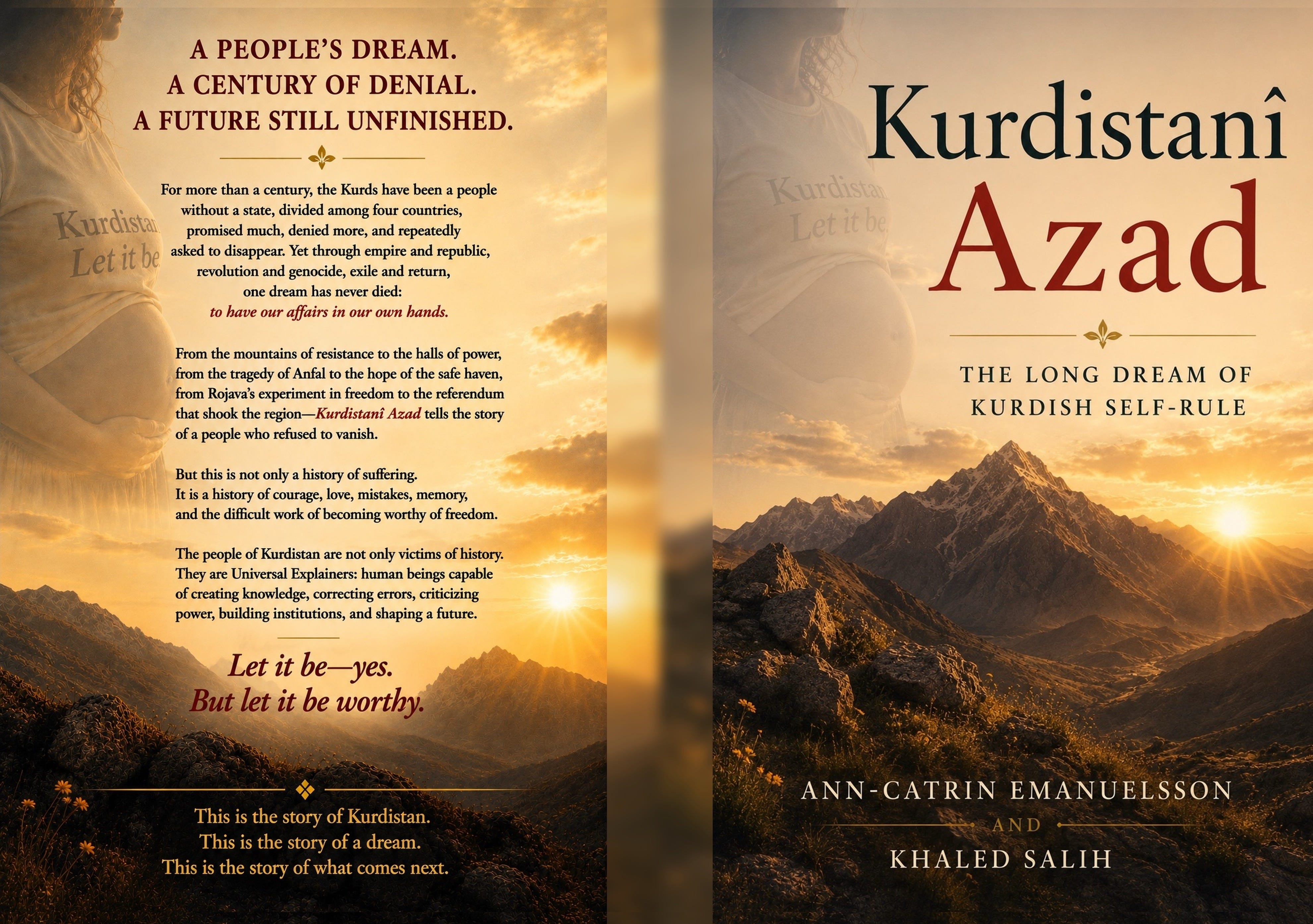
In the prologue, we described London in 1991: a Kurdish refugee catastrophe, a pregnancy, and a T-shirt saying Kurdistan — Let it be. Ann-Catrin wore that shirt while pregnant; Khaled photographed her and said that one day, if the Kurds survived, the image would make a book cover.
Only later did we fully understand why the image mattered.
The Kurdish dream was like unborn life. It was real before it was secure. It was loved before it had protection. It was carried through fear, memory, and expectation. It belonged to the future, but the future gave no guarantees.
The safe haven after 1991 was therefore not the end of the dream.
It was the birth.
And birth is not completion.
A child who survives delivery must still be raised. The transition from hidden protection into exposed life is dangerous. Breath must begin. The body must adjust. Others must care for the life that has arrived. The child is no longer only an image of hope. It is a responsibility.
So it was with Kurdish self-government.
This introduction argues a limited claim: the birth of Kurdish self-government after 1991 was a historic correction to exposure and genocide, but birth did not complete the dream. It created a new test: whether Kurdish power could become public, accountable, institutional, and corrigible rather than party-owned, militarized, or protected from criticism.
This is where government-fungibility becomes the danger. A people denied authority must acquire authority; but once authority becomes Kurdish, the moral problem changes. The citizen must not become party property. The ministry must not replace the public. The Pêşmerge must not replace law. The budget must not become private inheritance. The court must not become an instrument of faction. The flag must not silence the journalist, the woman, the minority, the young person, the civil servant, or the opposition voice. Government exists to make Kurdish persons more protected, not more replaceable by Kurdish power.
After Anfal and Helebje, after the uprising and the mountain flight, after Operation Provide Comfort and the no-fly zone, the Kurds of Iraq gained something unprecedented in modern Kurdish history: protected space. It was not independence. It was not full sovereignty. It was not a final legal settlement. But it was space — and for a people repeatedly denied political existence, space was the beginning of everything.
It was also wounded space: full of graves, refugees, destroyed villages, armed parties, trauma, poverty, external pressure, and memories of betrayal.
The safe haven was therefore both protection and inheritance: it protected Kurds from Baghdad’s immediate violence, while forcing them to govern the wounds that violence had left behind.
Wounded space must not become possessed space. The graves, refugees, destroyed villages, armed parties, trauma, poverty, and memories of betrayal explain why Kurdish government was born under abnormal pressure. But they do not make the space the private property of those who suffered, fought, administered, or inherited authority first. Protected space becomes a home only when the wounded can speak, the displaced can return, the citizen can criticize, and the institutions built from survival remain answerable to those they govern.
After genocide, even imperfect space can become the first condition of political life.
The Pêşmerge could defend a people from death. But someone now had to organize life.
Defense could prevent disappearance; it could not by itself pay teachers, settle disputes, run hospitals, protect journalists, restrain mismanagement, or make courts independent.
Someone had to build schools, courts, budgets, ministries, roads, hospitals, newspapers, police forces, and procedures. Someone had to transform sacrifice into administration. Yet administration alone was not enough. The deeper task was to transform sacrifice into correction: institutions through which citizens could name failure, restrain power, expose mismanagement, protect minorities, and revise policy without returning to war. Armed parties had to learn that the homeland was not their private inheritance. Someone had to turn survival into government.
Comments
Nothing yet. Say the first thing.
Sign in to join the conversation.