

We had a free day in Dublin, and I spent most of it in one room.
On the plane over, I started David Benner’s Surrender to Love and was still chewing on it when I walked into the National Gallery of Ireland. As I’ve mentioned, there’s nothing better than being alone in a museum and going at your own pace. So, I wandered, no plan, until I turned a corner and stopped. Six paintings, telling one story. My favorite. The prodigal son.
I’d never heard of the painter Bartolomé Esteban Murillo, a Spanish master I somehow managed to miss until now.1 He’s the only Spanish artist ever to paint the whole parable as a narrative cycle, from beginning to end, and it’s the only complete cycle of his that survives. I stood there a long time, looking at each in turn.
I love Rembrandt’s rendering of the story too. Most people do. It’s iconic. But Rembrandt freezes at the embrace, the son’s shaved head buried in his father’s chest, the whole parable pressed into one held moment. Murillo won’t let you do that. He makes you walk all six. And you don’t feel the father’s arms until you’ve stood in the pigpen.
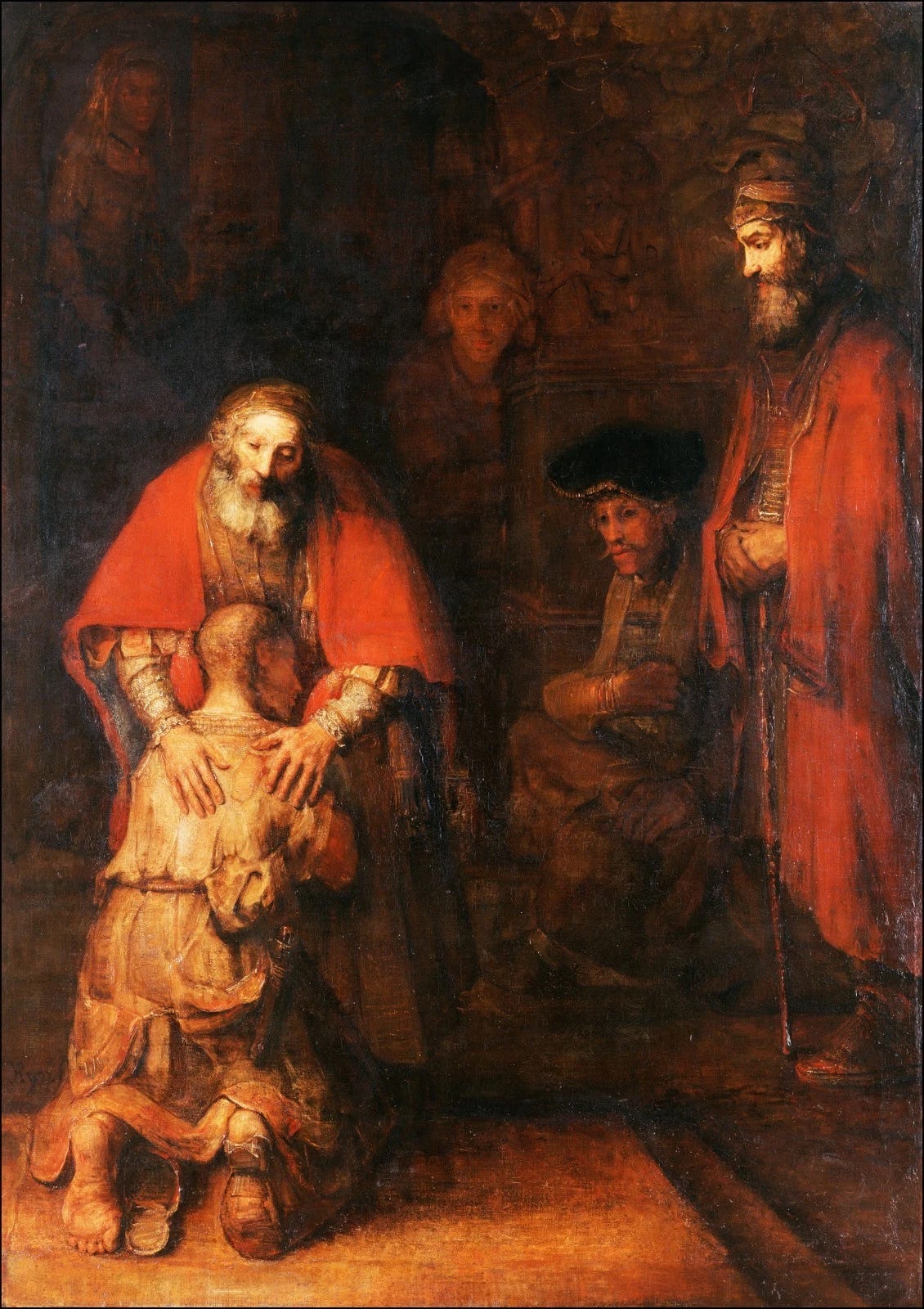
Six panels, in order.
The son collects his inheritance, the coins counted out while the household looks on. He leaves home, and you can read the grief on his parents’ faces, already worried for him. He throws the feast, all friends and wine and money burning a hole in his purse. The same friends drive him out once the money’s gone. He kneels in the pigpen, looking up. And then again, this time in his father’s arms.


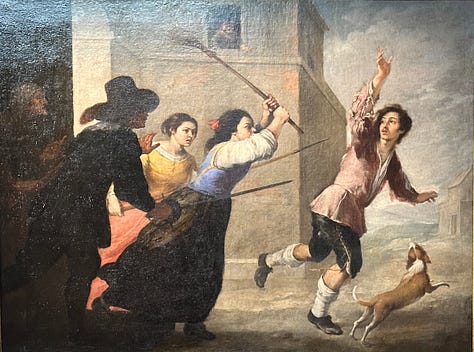
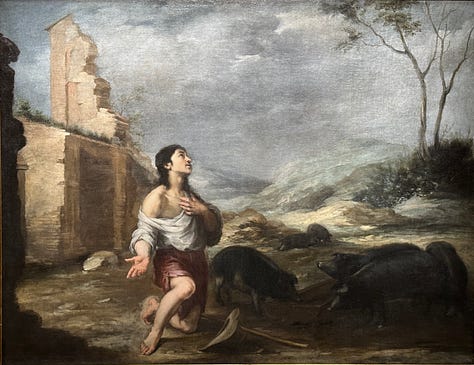
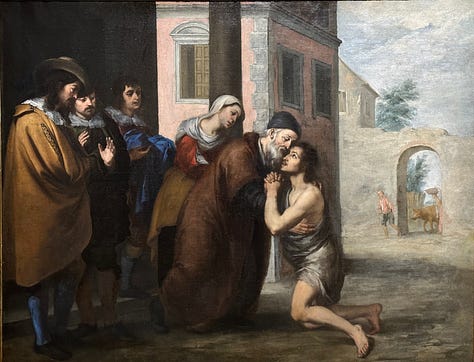
You can take in a Rembrandt in a breath. Murillo makes you wait. There is no shortcut to the sixth panel. You have to walk the descent to receive the embrace, and I think that’s the point. Over the past couple of posts, I’ve been circling the same idea from different angles: most of what reading the signs asks of us is simply to slow down long enough to look and listen. Six frames on a wall captured my attention, and I let it. I walked all six beats of the story, then walked them again. And because of that, I noticed something.
There is almost no blue in these paintings. That isn’t a choice of taste. The blue has faded. Murillo painted his skies with smalt, a cheap pigment ground from blue glass that breaks down over the centuries, and what were once bright Spanish skies have drained to gray.
But in the last panel, one blue pops. A servant comes running with a robe for the returning son, and the robe is a deep, living blue the rest of the paintings have lost. Murillo painted it in ultramarine, ground from lapis lazuli hauled halfway across the world and, ounce for ounce, worth more than gold. For three centuries, painters had reserved that blue for the holiest figures: the mantle of the Virgin, the Christ child, the wings of angels.2 It was the color of heaven, and Murillo drapes it over a boy who came home smelling of pigs.
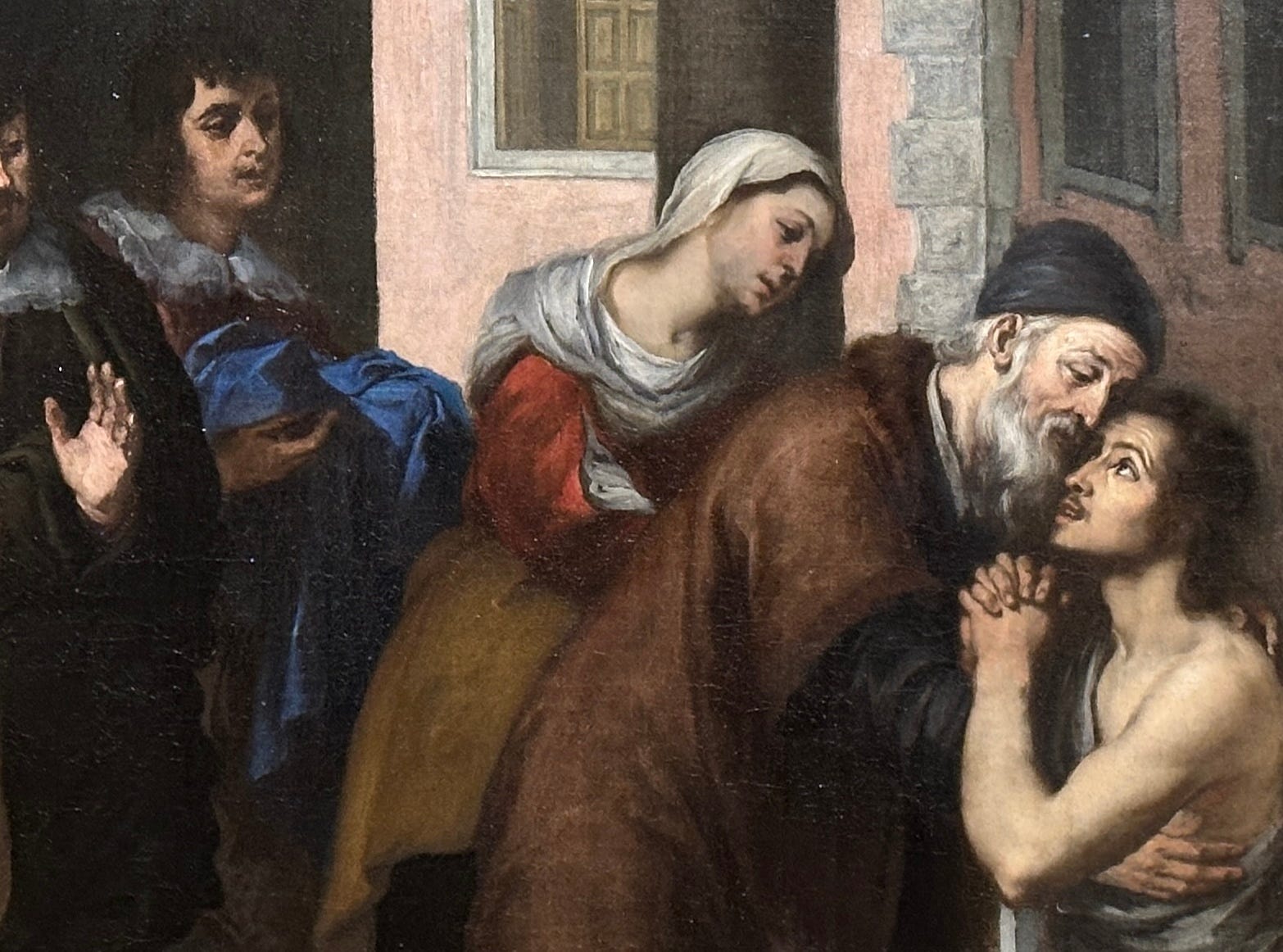
That’s not a painter’s flourish. That’s the gospel. “Bring the best robe,” the father says (Luke 15:22), and Murillo takes best literally. The most sacred color on a painter’s palette, the one kept for heaven, goes on the least deserving figure in the story. The father doesn’t restore his son cautiously, on a payment plan. He spends his costliest color on a robe for a boy who comes home in rags.
That is what Benner has been pressing on me this whole trip. We keep trying to buy our way back in as hired servants. The father keeps refusing the transaction and handing us a robe instead.3
We call it the parable of the prodigal son, and we read it as his story. One son, one sin, one homecoming. But Jesus doesn’t tell it that way. He tells it to a room of religious insiders who are grumbling that he eats with the wrong people, and so he hands them two brothers, not one.4
Read the words closely and ask which one has the true relationship.
The younger son, out in the far country, rehearses his speech to the pigs. “I will set out and go back to my father and say to him: Father, I have sinned against heaven and against you. I am no longer worthy to be called your son” (vv. 18–19, 21). He’ll give up the name son. He won’t give up the word Father. He walks all the way back carrying both, because he still has a sense of home.
The older brother never reaches for a single relational word. Not father. Not brother. Not once. Even the servant recognizes the relationships (v. 27). But when the father comes out, the elder son leads with a grievance: “All these years I’ve been slaving for you” (v. 29). The word underneath is douleuō, the verb for a slave’s labor, not a son’s.5And then, pointing at his own brother: “this son of yours” (v. 30). Not my brother. This son of yours. He won’t even claim him.
The father won’t let it stand. The older brother says “this son of yours” (v. 30); the father answers with “this brother of yours” (v. 32). The son distances with the pronoun; the father restores the relationship with the very same word.
There’s the turn. One boy was far from home and still called him Father. The other never left and called himself a slave. I sometimes wonder if the “outsiders” are quicker to get it than the “insiders” are because proximity isn’t the same as knowing who you belong to. You can live inside the house your whole life and still be standing outside it in your heart.
I know which brother I am.
The older I get, the more I catch myself in the elder son. I’ve spent years in the house. I teach in it. I’ve kept the rules, mostly. And I still call myself a servant in a home where I have always been a son.
Henri Nouwen said the real journey of this parable runs through all three figures. First you come home like the younger son. Then you have to be converted out of the older son’s resentment. And finally, if grace has its way with you, you become the father, the one who runs out to meet them both.6 I’m somewhere in the middle of that.
Here’s where I actually live these days. I’m the older brother to my own younger-brother impulses. When they surface, I don’t run to them with a robe. I fold my arms and start running the numbers. And I’m the older brother most of all toward the religious, the “insiders.” Timothy Keller names the reflex precisely:
“If you’re pharisaical towards Pharisees, you’re still a Pharisee.”
Judging the judgmental is still the older brother, just in a nicer robe.
Benner’s book and those six panels keep saying the same thing. The father runs to both sons. He welcomes the one who wasted everything and the one who never left, and he ranks neither. Only as I receive that same welcome, the belovedness that isn’t earned by staying home or demanded by leaving, do I grow into the kind of father God is inviting me to be: the one who welcomes the lost and the religious alike, reconciling people to God and to each other in one motion. The horizontal restored along with the vertical. That’s not a footnote to the gospel. That is the gospel.
The color that didn’t fade is the one thing you can count on. Skies go gray. Feasts end. Friends scatter the moment the money does. What holds is the father’s costliest love, the blue he saved for the worst day of his son’s life.
Murillo painted six panels and stopped at the embrace. He left one scene out.
The parable doesn’t actually end with the hug. It ends with the older brother out in the dark, refusing to go in, and the father standing in the cold, pleading with him. “His father came out and begged him” (v. 28). And then Jesus simply stops. We never find out whether the older son goes inside. The story has no final panel.
That isn’t an oversight. Jesus left it open because he was telling it to the Pharisees, the elder brothers in the room, and the last panel was theirs to paint. It still is.
So the whole wall leaves you with the question I keep answering myself. Which one are you? The son who wandered off and is afraid he’s used up his welcome? Or the son who stayed and forgot he was ever loved for free?
Either way, the father is already outside, already coming toward you. To the one who wasted it all, he runs with the best robe in the house. To the one at the edge of the party with his arms crossed, he leaves the celebration to say, gently, everything I have is yours; come inside. The most expensive color on the wall was never for the deserving.
The Father spent his best for our worst, and that’s the color that will never fade.
Thanks for reading Truth and Wonder! If this helped you, the best way to say thanks is to send it forward.
I’d never heard of the painter Bartolomé Esteban Murillo, a Spanish master I somehow managed to miss until now. He’s the only Spanish artist ever to paint the whole parable as a narrative cycle, from beginning to end, and it’s the only complete cycle of his that survives. I stood there a long time, looking at each in turn.
Ultramarine came from lapis lazuli mined almost entirely from one remote source, the Sar-e-Sang deposits in present-day Afghanistan; the name is Latin, ultra marinus, “beyond the sea,” for the journey the stone made to European workshops. Purifying it was brutal: a kilogram of rock yielded only about thirty grams of pigment, so patrons often paid for it as its own line on the commission rather than leave the cost to the painter. And unlike the cheap smalt Murillo used for the skies, natural ultramarine is chemically stable and doesn’t discolor, which is the plain reason the robe still glows while the skies have gone gray.
David G. Benner, Surrender to Love: Discovering the Heart of Christian Spirituality (InterVarsity Press, 2003). Benner’s argument, in brief: transformation comes not by trying harder but by surrendering to a love we cannot earn, which is precisely the surrender the elder son refuses to make.
Jesus tells all three of Luke 15’s parables (the lost sheep, the lost coin, the lost sons) to Pharisees and scribes who were muttering that he “welcomes sinners and eats with them” (Luke 15:1–2). The older brother is a portrait of the audience.
douleuō, “to serve as a slave.” The older son describes his years in his father’s house in the language of slavery rather than sonship (Luke 15:29). He has been home the whole time and never felt like a son.
Henri J. M. Nouwen, The Return of the Prodigal Son: A Story of Homecoming (Doubleday, 1992). Nouwen wrote it after sitting for hours before Rembrandt’s painting in the Hermitage, and traces the movement from younger son to elder son to father.
No posts
Comments
Nothing yet. Say the first thing.
Sign in to join the conversation.