
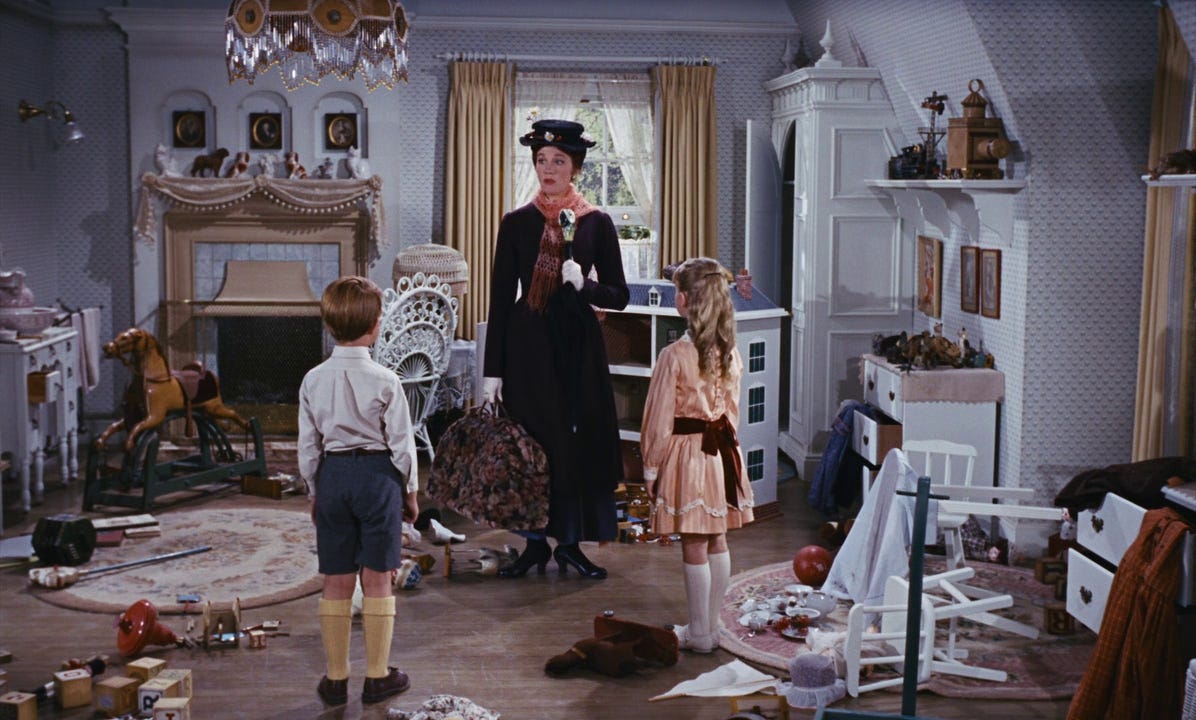
I’ve stood on the steps of St. Paul’s Cathedral in London. And last year, on a grey afternoon with the rain running down the windows of the flat we’d rented, Maria and I watched Mary Poppins. Again. I’ve seen it at least 20 times, and every time it shows me something new.
We all remember the same things: the magic nanny, the spoonful of sugar, the penguins, the tea party on the ceiling. We file it under children’s movies and move on.
But watch it again and ask the question this series is encouraging you to ask. Not just what happens, but who it happens to. Who’s actually broken? And why?
Because it isn’t the children.
Jane and Michael are fine. They’re not cruel, not lost, not in trouble a nanny could fix. They’re just lonely for a father who’s somewhere else even when he’s home. The one who’s broken, the one the whole story is trying to save, is the grown man in the bowler hat. Mary Poppins doesn’t come to fix the kids.
She comes to get their father back.
George Banks runs his home like a branch office. He tells us so himself, in a song: the household on schedule, the children tidy, tradition, discipline, and precision.
“A British bank is run with precision,” he sings. “A British home requires nothing less.”
Everything measured. Everything on time.
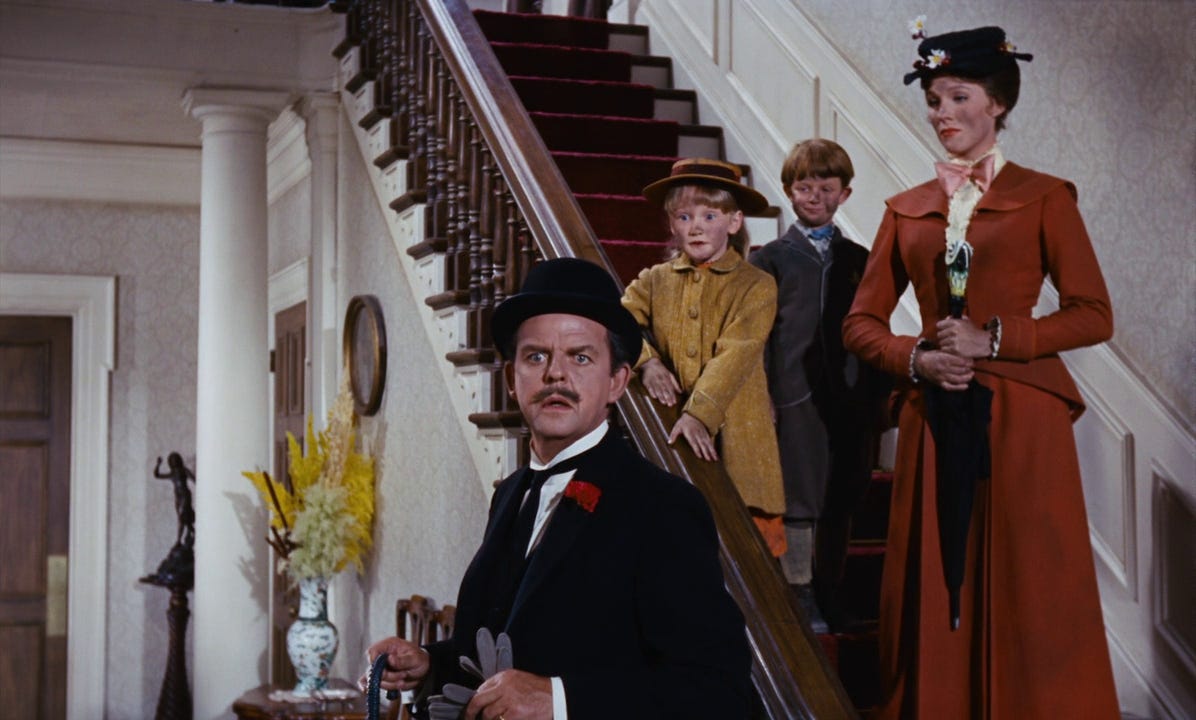
That the family is named Banks is the film’s quietest joke and its sharpest: the father’s very name is the institution, and the whole story is about prying the two apart.
And underneath the comedy is a quieter claim, the one he’s built his life on: a man is worth what he produces, what he earns, what he keeps in good order.
If that sounds familiar, it should. On Tuesday we watched a stranded astronaut try to science his way home, one solved problem at a time, on the theory that if you’re competent enough you can earn your way back.
George Banks believes the same gospel. He’s just wearing a different costume. Where Watney has equations, Banks has tuppence. Same religion of worth-by-effort. The ledger kept in a suit and tie instead of a spacesuit.
And like every priest of that religion, the one thing he can’t spare is his children, the very people he claims to be doing it all for.
He can barely spare two pennies for them. Hold onto those two pennies. The whole film turns on them.
Watch how help arrives.
The children don’t want a stricter nanny. They want a kind one, so they write their own advertisement, in a child’s hand, for someone cheerful who’ll take them on outings and won’t smell of barley water. Their father reads it, scoffs, tears it to pieces, and throws the scraps in the fireplace.
And the scraps go up the chimney.
Then the wind changes. The row of stern nannies gets blown clean down the street, and Mary Poppins comes down from the sky under an umbrella, carrying, of all things, the children’s torn-up advertisement, taped back together. The prayer the father shreds shows up at the door, answered, over his head, without his permission.
She doesn’t apply for the job. She “pops in” uninvited and unannounced. She interviews them and hires herself.
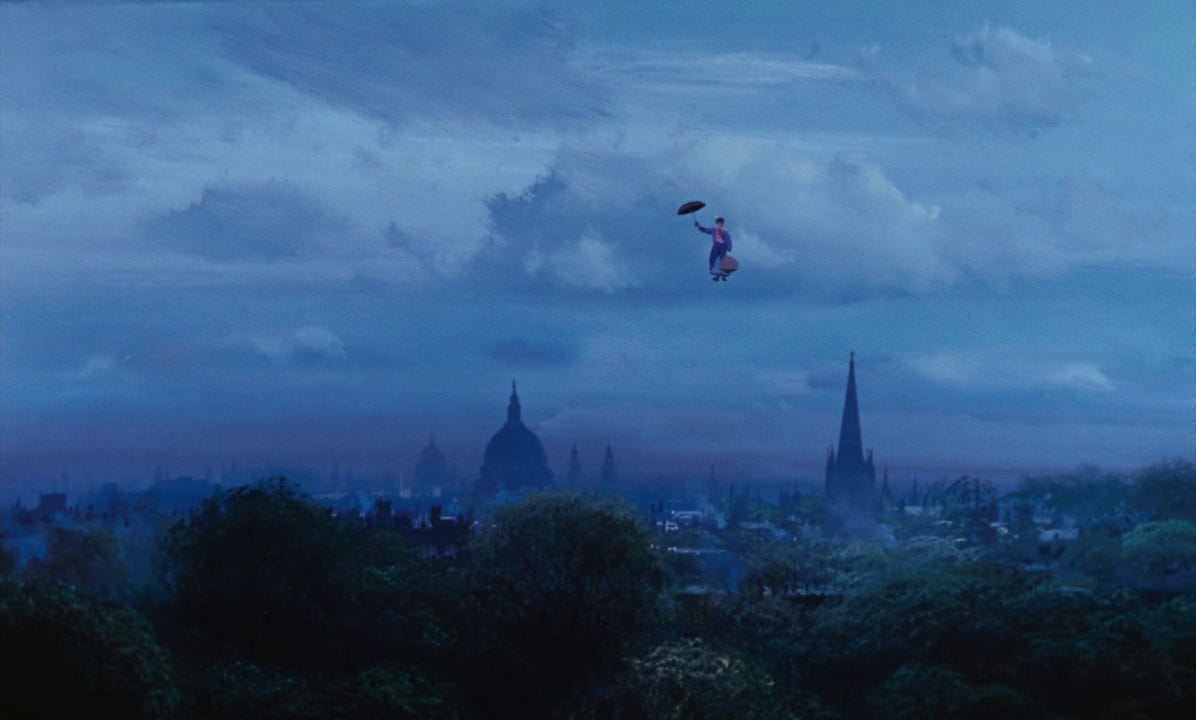
Grace doesn’t wait to be earned, or even asked.
And that’s the shape of the entire thing. We don’t summon grace with the right credentials. It comes anyway, on a wind we could never muster.
Now the two pennies.
The song at the center of this film is quiet and a little haunting. And almost everyone forgets it, but Walt Disney never did.
He’d call the Sherman brothers up to his office on Friday afternoons and say, “Play it,” and they knew exactly which one he meant. They’d sing “Feed the Birds,” and Walt would look out the window and say, “That’s what it’s all about.”1
Of the whole dazzling songbook, that’s the one he loved. I think it’s worth asking why.
The song is about an old woman who sits on the steps of St. Paul’s Cathedral selling crumbs to feed the pigeons. Tuppence a bag. That’s the whole business.
“All around the cathedral the saints and apostles look down as she sells her wares.”2
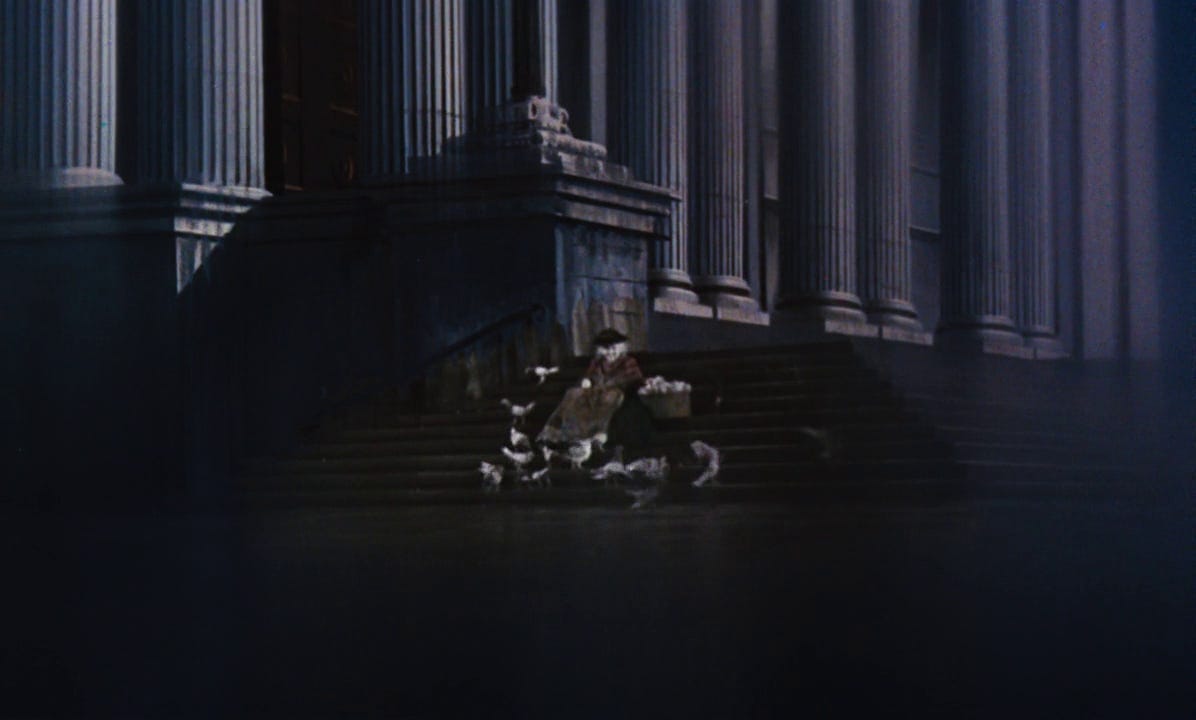
Mary Poppins sings it to the children as a kind of lullaby, and it plants a question that ignites the very next scene.
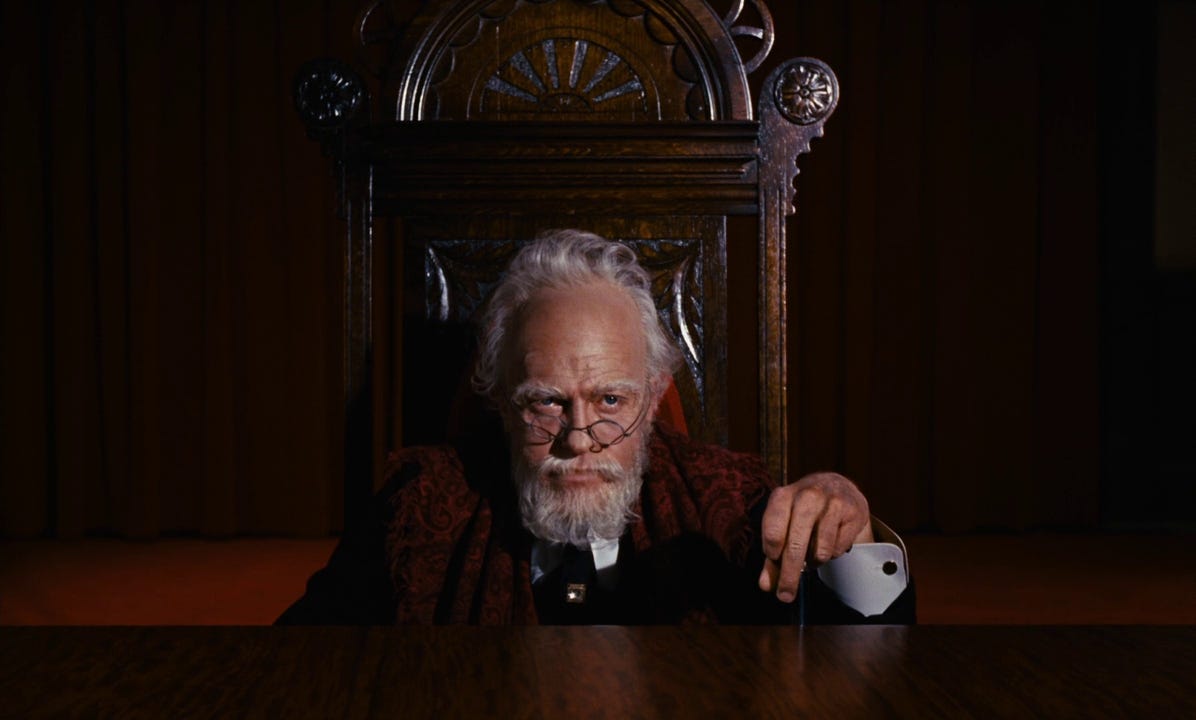
The next day George Banks takes his son to the bank, and the bank wants the boy’s tuppence. Not to hold it. To grow it. Old Mr. Dawes leans down and sings the boy an entire liturgy to compound interest, tuppence “safely invested in the, to be specific, in the Dawes, Tomes, Mousley, Grubbs Fidelity Fiduciary Bank,” and from there to railways and dams and plantations and the whole imperial enterprise, all of it blooming out of one child’s two coins wisely kept.3
But the boy doesn’t want to grow it. He wants to feed the birds.
That’s the entire theology of the film in one scene.
Two pennies, and two things you can do with them. You can invest them, which is to say keep them, feed them back into the machine that measures a man by what he piles up.
Or you can give them away on the cathedral steps for nothing. No return, no interest, just an old woman, some hungry birds, and a mercy that shows up wherever we’ll let it.
The bank on one side.
The cathedral steps on the other.
It’s an old argument. A widow once dropped two small coins into the temple treasury, all she had, and the one person watching said she’d out-given every wealthy man in the place.4
Two coins, given away, worth more than a fortune kept. The bird woman is that widow, on the steps two thousand years later.
There’s an easy move here, and it’s the wrong one.
The easy move is to cast Mary Poppins as a savior figure. You can see the pull. She literally descends from the heavens. She’s “practically perfect in every way,” in her own words. She arrives when the need is greatest and does what no one else can. When the work is finished, she rises back into the clouds and is gone. Descent, perfection, mission, ascension. It’s right there.
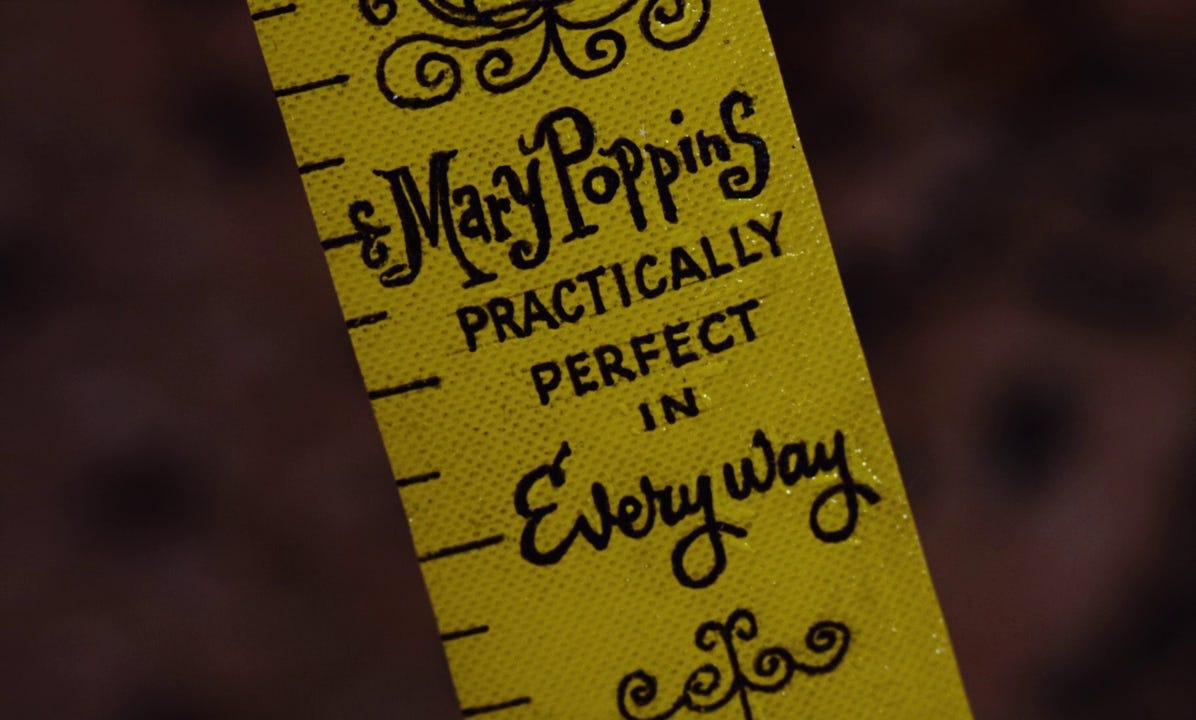
It’s so right there that the woman who wrote the books hated what the movie did with her. P. L. Travers wept through the premiere, bitter tears, furious that Disney had taken her sharp, prickly Mary and made her lovely and sweet and perfect.5 She felt they’d glamorized her. I think she was onto something, though not in the way she meant it.
Because the film doesn’t hide God in the glamorous one who floats down from the sky.
Read the signs, and you’ll find him on those cathedral steps, in the one character the film doesn’t even bother to name. Not the dazzling nanny descending in a shaft of light. The poor woman crouched in the cold, ignored by everyone hurrying past, holding out mercy for the price of two pennies. That’s the shape of the real thing, and Scripture told us it would be.
He had “no beauty or majesty to attract us to him, nothing in his appearance that we should desire him.”6
We keep expecting God to arrive like Mary Poppins: from above, immaculate, impressive, magical, obviously worth watching. So much of what we prize in the world and even in the church.
But he comes like the bird woman. Low, unglamorous, easy to walk straight past, calling out to anyone who will stop.
That’s what reading the signs is. An ordinary thing, a coin, a kite, or a woman on some cold steps, turns out to be carrying far more than anyone thinks. The movie puts both figures on screen and quietly dares you to notice which one actually is Christ. Most of us watch it our whole lives and only ever see the nanny.
So how does George Banks get rescued? Not by improving. Watch.
The boy won’t hand over his tuppence. He wants it back for the birds, reaches for it, and shouts. The customers hear a child crying, “give me back my money,” and take it as a warning. There’s a run on the bank, the first since 1773.
George is summoned back that night to answer for it. And they don’t simply fire him. They perform it. They punch the crown out of his bowler hat, turn his umbrella inside out, and tear the flower from his lapel.7 Every emblem of the ordered, precise, respectable life, undone, one shameful beat at a time.
His whole religion collapses in a single scene.
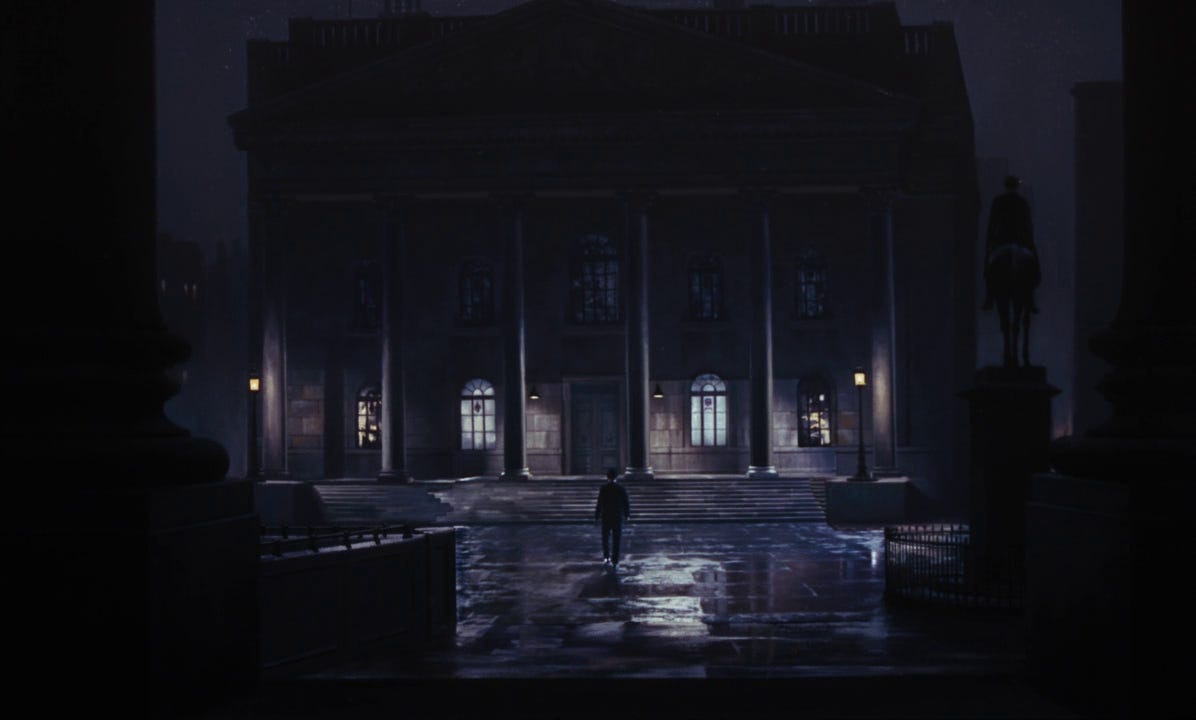
And then something breaks open. Asked if he has anything to say for himself, this rigid man reaches for a word, the ridiculous one his children keep singing, and he says it: “Supercalifragilisticexpialidocious.” And he laughs. He tells a joke, and he laughs. Then he sets the smashed hat on his head and walks out into the London night, a ruined man. But a free one.
The firing is his rescue.
Because the thing that had him was never the bank. It was what the bank stood for, the whole ledger by which he measured whether he amounted to anything. And you don’t reason your way to zero on that ledger.
Usually it has to be taken from you.
The collapse of the system he’d built his worth on is the exact thing that finally lets him go home. That’s a hard, strange grace, but it’s the one Jesus kept describing: whoever tries to save his life will lose it, and whoever loses his life will find it.8 George Banks loses everything he thought made him a man, and walks out having found it.
He goes home, and he mends the kite.
It’s a small thing, and that’s the point. Earlier in the film, the children’s kite is torn. Now their father, the man who can’t spare two minutes, sits on the nursery floor with paste and string, fixing it. And then they all go to the park, and the man who had no time spends an entire afternoon running under an open sky with his children beside him.
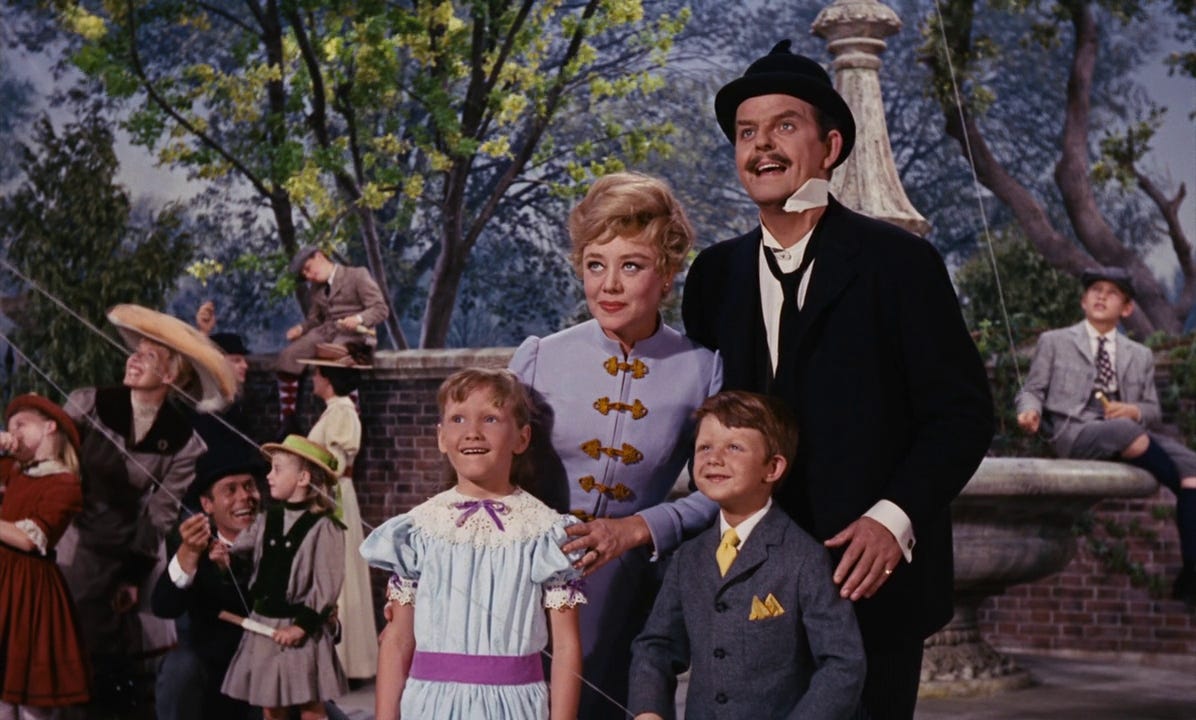
That’s what the film was aching for the whole time. Not the magic. Not the penguins. A father who comes home. Everything else, the tea parties on the ceiling, the rooftops full of chimney sweeps9 and the woman falling from the sky, all of it in service of this: a grown man on the grass, undignified, delighted, present at last to the people who actually belong to him.
And here’s the turn I love. He isn’t restored to being a better banker. He’s restored to being a child. The gospel keeps insisting the door swings that direction, that unless you turn and become like a child you’ll never see the kingdom.10
The children don’t grow up into his sober world. He climbs down and rejoins theirs. The God of this story, it turns out, is not the one behind the desk keeping the score. He’s the one out flying the kite.11
And Mary Poppins, seeing the family whole, packs her carpetbag and goes.
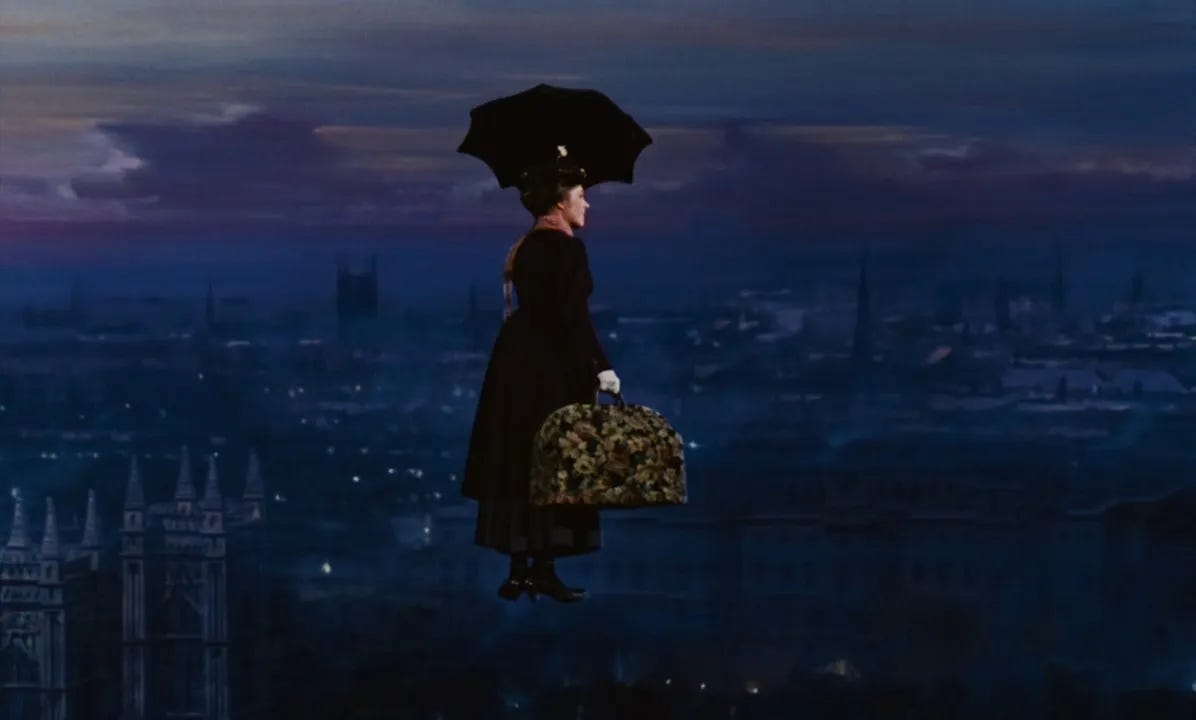
The wind’s changed. Her work is done, so she leaves, and the parrot handle on her umbrella scolds her for it. They didn’t even thank you, it says. They didn’t say goodbye. After everything you did, they think more of their father than they do of you. And she quiets it because that’s exactly as it should be.
She doesn’t come to be loved. She comes to do the work and point beyond herself. To hand a family back to each other and step out of the frame.
Grace at its best doesn’t cling or collect.
It restores the relationship and then gets out of the way, content to be forgotten as long as the thing it came to heal is healed.
She rises back into the clouds unthanked, which may be the most honest thing the movie says about how grace usually works on us. We remember the healing, but sometimes, we forget the hand.
Maybe you’re the children in the story, and you just want someone to come home to you. That’s a lot of us.
But some of us are George Banks.
Some of us have quietly organized a whole life around being worth something. We keep the ledger. We run the household with precision. We measure the day by what gets produced and the self by what gets earned.
And we are so busy at the bank that we have nothing left over, not two pennies, not two minutes, for the few people the whole enterprise is supposedly for.
If that’s you, here’s the hard and hopeful thing this film may be saying to you. Your rescue may not look like a win. It may look like the collapse of the very thing you’ve been trusting to make you matter.
And on the far side of that ruin is a freedom you can’t get any other way. The freedom to stop earning your way home and simply go home. You were never going to compound-interest your way into being worth it.
You were worth rescuing before you produced a single thing.
Feed the birds. Fly the kite. Give the tuppence away.
“Feed the Birds (Tuppence a Bag),” music and lyrics by Richard M. and Robert B. Sherman, in Mary Poppins, dir. Robert Stevenson (Walt Disney Productions, 1964). It was the first song the Shermans wrote for the film, and by Richard’s account its key: on finding the Bird Woman in Travers’s book, he recalled, “we said to each other, ‘That’s the metaphor for the whole film.’” (Seastrom, “Feed the Birds,” The Walt Disney Family Museum.)
“Fidelity Fiduciary Bank,” Sherman and Sherman, Mary Poppins (1964). The Shermans wrote the bankers’ number as a mock Gilbert-and-Sullivan patter song, pitched by grown men to a five-year-old.
Mark 12:41–44 (also Luke 21:1–4). The King James calls the widow’s two coins “two mites,” about as close to “tuppence” as translation gets. Watching the treasury, Jesus reverses the math: she “hath cast more in, than all they which have cast into the treasury,” because she gave everything and the rich gave only surplus.
Travers’s weeping at the 1964 premiere and her “so distorted” remark are documented in Valerie Lawson, Mary Poppins, She Wrote: The Life of P. L. Travers (New York: Simon & Schuster, 2013). Her standing objection was that Disney had made the character too lovely.
Isaiah 53:2 (NIV), on the Servant with “no beauty or majesty” to draw us to him. The scandal of the incarnation is that God arrived in a form the world was built to overlook, the very pattern a film stumbles onto when it hides its mercy-figure in an unnamed pauper while every eye follows the dazzling one from the sky.
The old term for the scene is that Banks is “cashiered,” ceremonially stripped of office: the ruin of hat, umbrella, and boutonnière staged as a formal un-making rather than an ordinary firing.
Matthew 16:25, with parallels in Mark 8:35 and Luke 9:24: “Whoever wants to save their life will lose it, but whoever loses their life for me will find it.”
The rooftop sweeps get the film’s most joyful number, “Step in Time,” and it’s no accident the exuberance is handed to the lowest, soot-covered laborers on the street. The film keeps putting delight and dignity at the bottom of the ladder, not the top: the sweeps, the bird woman, the children. The people the bank would never notice are the ones having all the fun.
Matthew 18:3: “Unless you change and become like little children, you will never enter the kingdom of heaven.”
G. K. Chesterton got there first. In Orthodoxy he pictures a God with “the eternal appetite of infancy,” one who says “Do it again” to the sun each morning the way a child would, and then the line itself: “we have sinned and grown old, and our Father is younger than we.” The man on the grass with the kite has grown young again, and the God of the story was never the tired one. G. K. Chesterton, Orthodoxy (1908), chap. 4, “The Ethics of Elfland.”
No posts
Comments
Nothing yet. Say the first thing.
Sign in to join the conversation.