
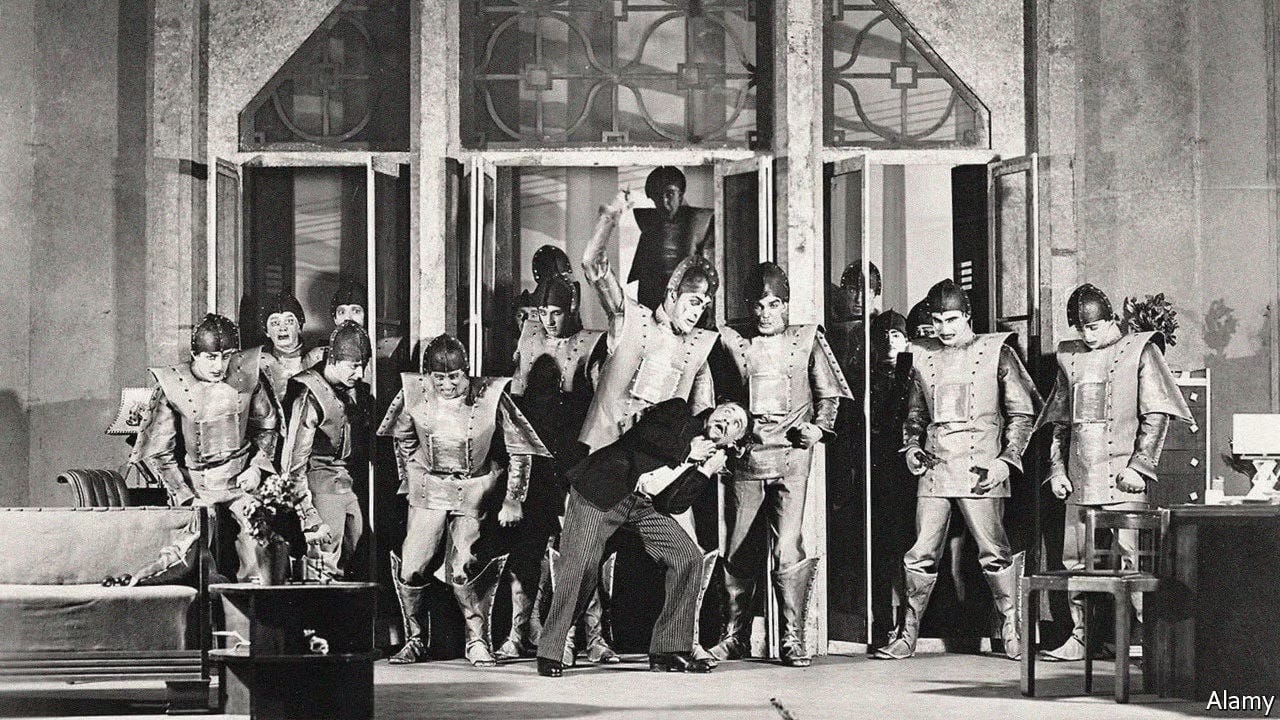
As a writer/editor/reviewer, I tend to stick to the written word, but recently I was inspired to make a rare foray into long-form video. The current discourse about AI has been nagging me for some time to relate it back to one of my long-held obsessions -- Rossum’s Universal Robots.
That’s the 1920 play, better known as R.U.R., that introduced the word “robot” to the world. But it’s about so much more than just robots. It’s about artificial intelligence, and specifically about a society where almost all work across every industry has been handed over to AI-powered robots.
In the minds of the executives at the Rossum’s Universal Robots company (named for the scientist who created the first robots), this is a good thing because it means the cost of producing most goods can drop to nearzero, freeing humanity from the drudgery of labor.
Of course, in the play, things don’t work out that way. The robots (who are more like Blade Runner’s replicants than a metal machine) finally decide they’ve been getting the short end of the stick. Spoiler alert for play written in 1920, but an apocalyptic revolt follows.
I’ve been low-key obsessed with R.U.R. for years, and its origin story is as fascinating as the play itself. It was written by Czech playwright Karel Čapek, with the word “robot” (actually suggested by his brother Josef) coming from the Czech word “robota,” meaning forced labor. Čapek was an anti-fascist and anti-communist, but he’s best remembered as a science fiction pioneer, both for introducing the term “robot” and a handful of SF novels like “War with the Newts.”
I wrote extensively about R.U.R. back in 2018 when I was researching a potential book on the cultural history of robots. But the rise of AI and its infiltration into almost every area of employment made me go back to that material and look at it in the context of AI, rather than just the physical form of the robot.
It’s the play’s central concept—that once made widely available, inexpensive, always-on AI-powered robots would reshape the global economy almost overnight—that makes it feel even more relevant today. Especially of interest, the play debates the value of labor, and what to do with billions of humans if AI can do almost any job.
“Of course, terrible things may happen at first, but that simply can’t be avoided.”
The chief executive of the robot factory says: “In ten years, Rossum’s Universal Robots will produce so much corn, so much cloth, so much everything, that things will be practically without price. There will be no poverty. All work will be done by living machines. Everybody will be free from worry and liberated from the degradation of labor. Everybody will live only to perfect himself.”
A beat later, he adds, “Of course, terrible things may happen at first, but that simply can’t be avoided.”
Watch my full video on how R.U.R. predicted much of our current AI era here.
The clear best-use case for AI is coding, and you see it everywhere from major corporations, where there’s nary a single line of human-written code being created, to small teams and individuals building the tools and apps they want on demand.
I’ve played around with creating a couple of AI-assisted apps, including 3DBookmark.app, which takes any image and converts it into a multi-color 3D printer file in the shape of a bookmark (so you can create custom bookmarks for your books just by snapping a photo of the cover).
My latest app is similarly simple. It’s a minimalist bookshelf that lets you show off what books you’re currently reading (or want to read, but might never get around to). I used Claude Code to develop it over the course of a single weekend.
The Shelf Yourself app (thanks to Libe for the name suggestion) doesn’t ask you to sign up for anything or to become a member. It’s made for maximal minimalism.
You just look up the books you’re currently reading in a search box, and the app inserts them on a virtual bookshelf. Hover over each spine to see the cover. While I intended this as a way to show off your current reads, it also works if you want to curate a collection of books about a particular subject or by a particular author.
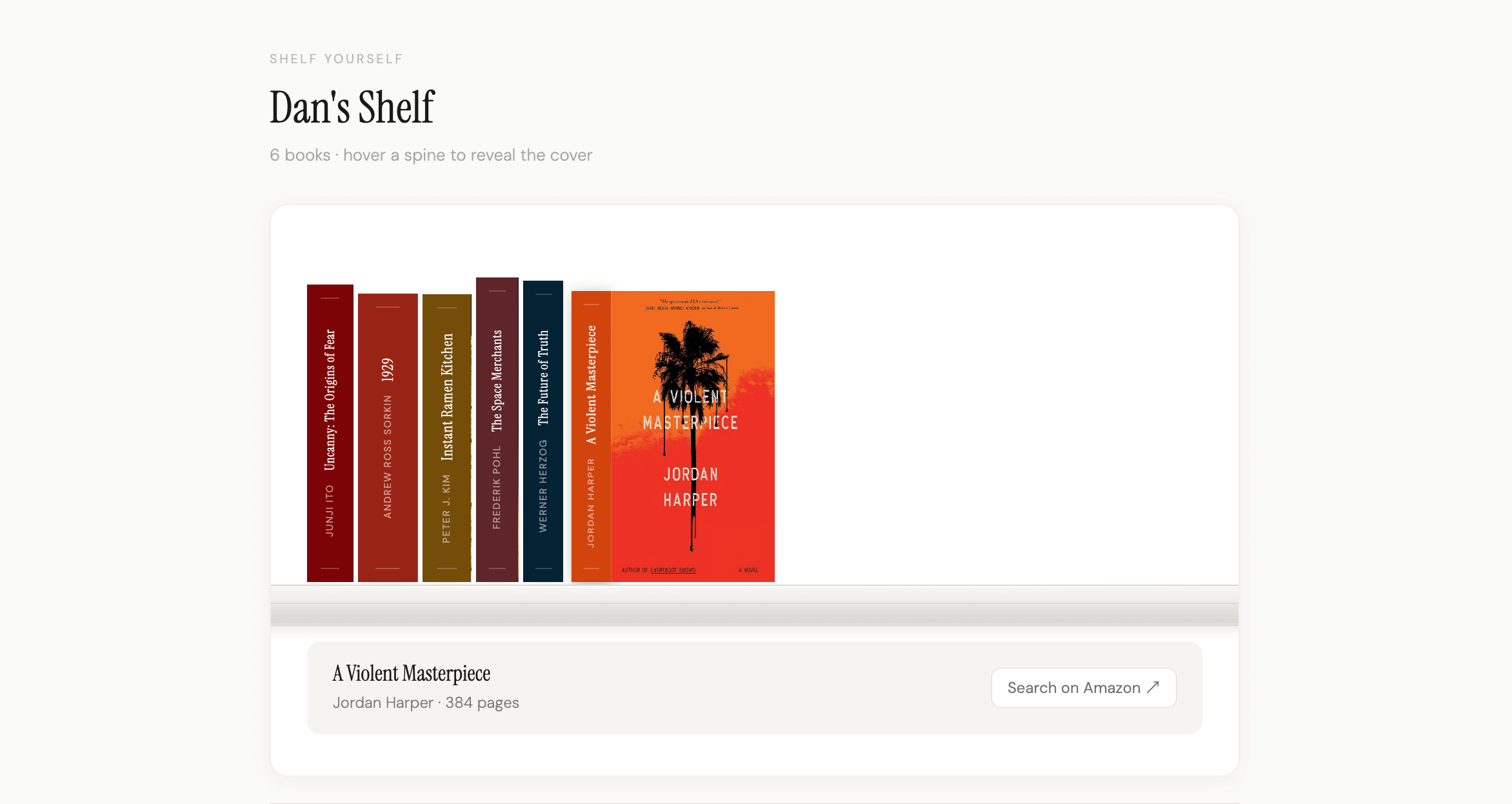
Once you create a shelf, the app gives you a custom URL to share your shelf and a second (secret) URL to go back and edit it later. Save those if you want to share or edit your shelf.
Check it out at ShelfYourself.app and here’s my current reading list: https://www.shelfyourself.app/s/-UmqAACS
Have you made any micro apps? Would love to hear how your experiments are going. Drop me a line / email/ social media message.
I made these Chez Ma Tante pancakes, literally fried in clarified butter, for Mother’s Day, and they were a big hit.
The excellent Widow’s Bay on Apple TV feels like the only show that’s become appointment-based viewing lately, with people talking about episode drops on social media.
A New York Times mention got me to read A Violent Masterpiece by Jordan Harper. It’s a modern LA noir story that’s impossible to put down.
Call of the Elder Gods feels a bit like a cozy mystery with Lovecraftian vibes and puzzles that are just logical enough that I can actually figure them out. It’s on Game Pass, so worth a spin if you’re a subscriber.
Read my NYT-reviewed gaming history book: The Tetris Effect
Play my tabletop game, Techlandia!
Threads: threads.net/@danack
Bsky: danackerman.Bsky.social
LinkedIn: linkedin.com/in/danackerman
TikTok: tiktok.com/@danacknyc
YouTube: youtube.com/danackerman
MC News: microcenter.news
New app! 3Dbookmark.app
New app! ShelfYourself.app
Comments
Nothing yet. Say the first thing.
Sign in to join the conversation.