
When people talk about job search automation, they almost always conflate volume with slop. The assumption is that high-output application tools are, by definition, spray-and-pray machines, scrapers blasting a generic resume at 400 job postings while you sleep. That's a fair critique of bad tooling. But it's the wrong critique of volume itself. The real problem was never applying to many jobs, it was applying to many jobs without intention, without quality, and without observability.
If you can apply to fifty roles, each with a genuinely tailored resume and a cover letter that reflects why you fit that role, you're not spamming. That's what I built JobOps to do. And the moment you solve the quality-at-volume problem, a new and entirely predictable problem emerges: your inbox becomes a warzone. Not because you did something wrong, but because you did everything right.
The post-application stage is messy by default. Recruiter replies don’t arrive in a clean format. Interview invites blend into newsletter noise. Rejections come as soft language, delayed threads, or vague follow-ups. Important messages get buried, and status tracking turns into a mix of memory, sticky notes, and “I’ll update the spreadsheet later.” Most tools still treat this phase like an afterthought.
I built Post-Application Tracking because once JobOps was doing its job on the apply side, the inbox became the bottleneck. You can't fix one end of the pipe and ignore the other.
JobOps connects to Gmail with scoped read-only access and watches for recruitment-related messages. When a matching email arrives, the Smart Router runs it through a multi-point analysis: sender domain, subject line, body content, and thread history are all factored against your existing job records. The output is a confidence score, and that score determines what happens next.
The routing has three tiers. At 95-100% confidence, the system links the email to the correct job and updates your timeline automatically. A direct reply from a hiring manager you've already corresponded with, on a thread that traces back to a specific application, will clear that bar easily. At 50-94% confidence, the email surfaces in your review queue with a suggested match attached. You see the email snippet, the proposed job record, and you confirm or correct with a single action. Below 50%, the system still catches the email if it looks recruitment-relevant, but treats it as an orphan: it sits in the inbox flagged for review rather than being silently dropped or incorrectly linked.
That tiered model exists because job search communication has a specific failure mode that full-autonomy AI handles badly. Consider the common cases: a third-party recruiter contacts you through an agency alias with no obvious connection to the role title you applied for six weeks ago. A company you applied to twice, for different positions, sends a reply that could belong to either thread. A "Quick chat?" subject line arrives from someone whose name doesn't appear in your original application. These are not rare corner cases. They are the normal texture of a recruiter inbox. A system that tries to resolve these deterministically will corrupt your pipeline state regularly, and you won't always catch it when it does.
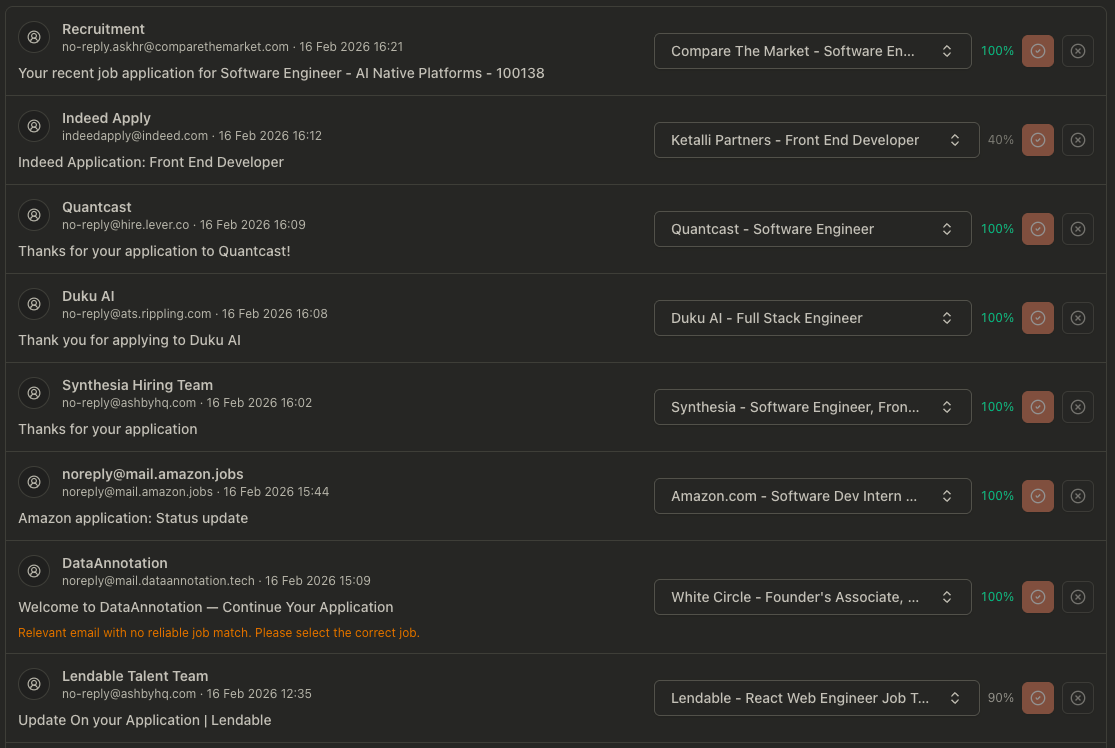
The review queue is the design response to that problem. Rather than letting the system guess and silently write bad state, ambiguous cases get surfaced with enough context for you to make a fast, informed decision. The goal is not to eliminate human judgment from the process. It is to eliminate the drudgework of hunting for context so that when you do make a call, it takes seconds rather than minutes of re-reading old threads.
In practice, this produces something worth naming precisely: a reliable timeline. Not an approximation, not a spreadsheet you half-remember to update, but an actual record of what happened, when it happened, and what is still pending. When your post-application state is accurate, your next action becomes obvious. You can see at a glance which roles are in active conversation, which are stalled without a follow-up, and which interview windows are approaching. That clarity compounds across a 50 or 60-application pipeline in ways that are hard to get back once you've lost track.
On the infrastructure side: JobOps is self-hosted, and the Gmail integration requests only gmail.readonly scope. The system sends minimal metadata for matching purposes. Email content is not stored on a third-party server, and the integration is not designed to expand into a general-purpose inbox agent. If you want to audit exactly what the system touches, that is possible because the instance is yours. For a tool that deals with professional correspondence, that boundary felt like a correctness requirement, not an optional privacy feature.
The short version is this: applying is only half the problem. If your post-application flow is still manual and inconsistent, your pipeline is broken exactly where outcomes are decided.
JobOps is open source and self-hosted. If you want to see how the router is implemented or try it against your own inbox
Docs: jobops.dakheera47.com/docs
GitHub: github.com/DaKheera47/job-ops
And if you find the idea useful, star the repo.
Comments
Nothing yet. Say the first thing.
Sign in to join the conversation.