

The author at graduation, too tired to think about his career
This feels like a strangely shameful thing to admit for someone who’s made his career in workforce development, but when I was growing up and thinking about going to college, I don’t believe I thought much at all about how it would help me find a job or a career.
As we’ll see below, from the perspective of student motivations today, this seems odd, maybe even irresponsible: my family wasn’t wealthy, the school I went to was very expensive, and I wound up taking out very substantial loans.1 But to the extent that I thought about my undergrad experience as career preparation, it was that for most of my senior year, I planned to go to grad school to pursue a doctorate in history and eventually become a college professor.2
More than thirty years after graduating, I realize that college absolutely helped shape my ultimate career path, in two ways. Majoring in history and political science, with their heavy doses of required reading and analytical writing and class discussion, all helped me build and refine the skills that I’ve mostly used ever since. Even more important, the closest friendships I made there helped set the course of my career after coming out of grad school: one of my close friends flagged the think tank job opening that was my first role in policy (I’d previously helped connect him to a job working with me at NBC Sports).3
But again, that wasn’t why I went, and that’s not what I mostly value from it. I was thinking about this earlier this week, while reading a piece at Inside Higher Ed finding that most college graduates feel good about their choice to go:
Seventy-one percent of all surveyed alumni—and 83 percent of those who graduated before 1996—said their education was worth the price they paid for it. Asked if they would do it again, 93 percent said yes.
More than three-quarters of bachelor’s degree holders and 52 percent of associate degree holders said their degree was “critical” or “important” to reaching their financial goals. Eighty percent of bachelor’s degree holders and 55 percent of associate degree holders said the same regarding their career goals.
It’s not a newsflash to note that top-line survey results can obscure as much as they reveal. Are the respondents also satisfied with their careers? How does this break down by demographics (other than before/after graduating in 1996)? Did choice of major matter? What were the motivations or intentions of those respondents when they went to college?
The Gallup/Lumina Foundation report from which IHE pulled these stats doesn’t get into any of that, but we do have a high level sense of student motivations for going to college, and how they’ve changed over time. The gist is that between 1967 and 2018, far more students cited being financially “very well off” as a reason for going to college (42% to 82%) and far fewer identified “develop[ing] a meaningful philosophy of life” (86% to 46%).
My research assistant helpfully adds that this isn’t just about rising materialism; as everyone knows and complains about, college itself became vastly more expensive over those decades. Why this was the case is beyond my immediate interest here, but it seems noteworthy that based on that same Gallup/Lumina report, “satisfaction” wasn’t inversely proportional to cost: if anything, the opposite seems to be true.
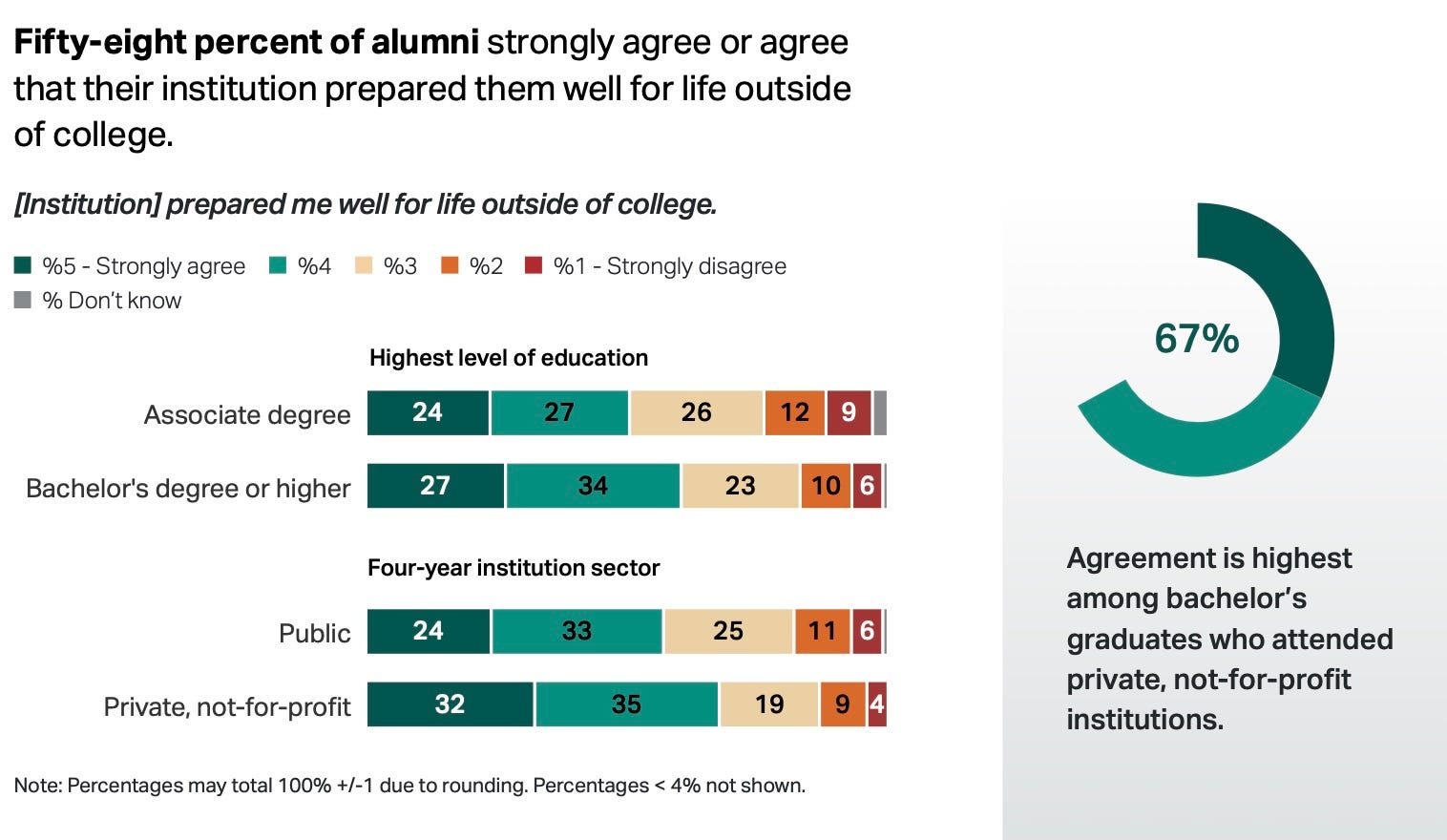
Again, it would be helpful here to understand why they were satisfied—and for that matter, whether the satisfaction level further rose at the most “elite” schools, and if I’m really being research-greedy,4 whether the “well-off” group or the “meaningful philosophy” group were, on balance, more satisfied. But we’re stuck at the level of (pun unavoidable) educated guesses.
On balance, “satisfaction” with college, while still high, has declined over time. Here’s the share of respondents agreeing that “their education was worth the cost,” broken out by year of graduation. Strong agreement is in dark green.
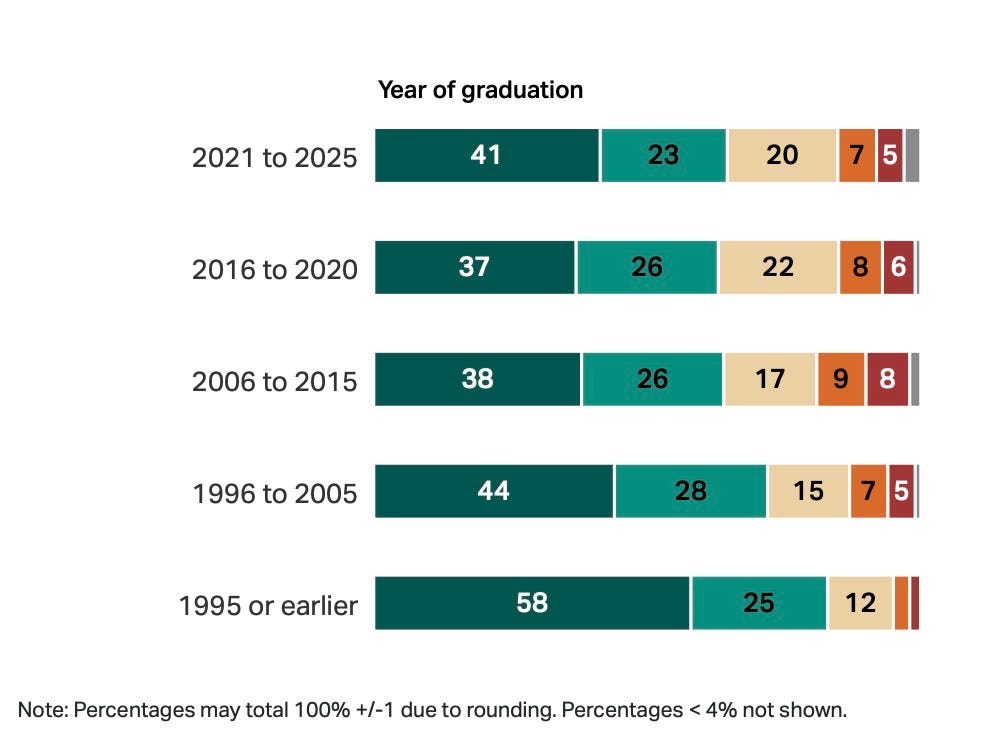
It doesn’t feel like a huge stretch to guess that some relationship exists between the decline in satisfaction and the shift in student motivation from desiring a “meaningful philosophy of life” to prioritizing career success and economic security. But there are a couple other things to keep in mind as well.
The first is that today’s students look a lot different than those from the late 20th century—and that there are a lot more of them.5 Undergraduate enrollment in the United States has more than doubled since 1970, and the bulk of the increase has been among students who are:
Age 25 and above (by 2010, this group accounted for more than a third of undergraduates)
Non-white (45% of all postsecondary enrollment in 2022, up from 15% in 1976)
Lower income (51% of low-income high school graduates were in college by 2014, up from 31% in 1975)
So we have different students, whose backgrounds help explain the shift in motivation: if you’re worse off financially, and/or already of working age, of course you’re more likely to care about making enough money to feed your family. And there’s nothing at all wrong with that.
The second thing is the experiential gap between the people who run colleges—administrators and faculty—and their students. Claude had nothing for me on how many faculty followed the “traditional” path from high school straight into undergrad and then on to doctoral programs. But it did find that college faculty “are up to 25 times more likely to have a parent with a PhD.”6 The people running colleges and universities clearly thrived within the classical higher education model, and it’s understandable that they would be reluctant to change it.
But eventually I think they either will have to do so, or face closure. Let’s posit that the implicit value proposition of college is twofold: you’ll have a holistic experience that will “prepare you well” for the rest of your life, and you’ll accumulate assets—not just a diploma, but also skills and a network—that will significantly bolster your employability and earning power.
Colleges seem to have delivered on this promise, more or less, through the second half of the 20th century. The GI Bill and other factors drove significant expansion even before A Nation at Risk turbocharged enrollment, and the huge increase in graduates made their presence felt in a labor market characterized by deindustrialization and the shift toward a knowledge economy. We know that college graduates are healthier, happier, and more connected to their communities, in addition to an earnings premium that still sits around 80 percent above what a high school graduate makes.
Between falling graduation rates and declining user satisfaction,7 though, the model is showing serious cracks. It’s to the point that I’m starting to wonder whether it’s time to split that value proposition into its two component parts.
A few years ago I worked on a project looking at non-college postsecondary options for young adults in New York City. At one of the most highly regarded programs I talked to, the executive director described how his organization was building a one-year version of the college experience without the usual trappings: no dorms, no quad, no sports, no degree as such, just pure education to prepare learners for a great career. I had two reactions: one, that this made sense and was more cost-efficient, given their great outcomes, than anything else I knew of; and two, that without all those things, I didn’t think you could call it “college.”
But there’s no reason why “college” has to serve both aims.8 If your goal is economic mobility, there should be an affordable solution. If your goal is holistic development, let’s solve for that. And of course it shouldn’t be, and wouldn’t be, all one or the other: a curriculum of reading instruction manuals, versus one solely comprised of Joyce and Wittgenstein.9
The counterargument will be that this reinforces class distinctions, will stigmatize students pursuing the more purely vocational options, et cetera. It’s a valid point. But the status quo, with more than a third of bachelor’s degree students failing to complete their degree (and significantly lower rates for older students, Black and Hispanic students, and part-time students) within six years, and nearly two-thirds of associate degree students not finishing within three, isn’t doing much to inaugurate the classless society either.
We could (and should, and to an extent are trying to) shift the college model to boost retention and completion, which largely would involve making changes to better support those non-traditional learners. That will always entail overcoming resistance from everyone with an emotional or financial investment in the status quo.
Or we could just figure out a better model. It could be an embrace of European-style apprenticeship, or something like the “Big Blur” concept that Jobs for the Future unveiled a few years back—essentially to combine the last two years of high school with the first two of college, overlaying explicit skills training and work experience.
Creating something new might minimize the stigma risk… though it also could be that as AI restructures entry-level employment and further underlines our need for workforce talent in blue-collar and care sectors, societal views around what work is most valued and prestigious might change anyway.
If “Career College” became a thing, that wouldn’t eliminate the value of the other function, which I think we could shorthand as “individuals maturing within a community.” To go back to my own case, I can’t really imagine that I would have made a successful transition into full-time employment at 18: I was arguably able, but I surely wasn’t ready. Over the four years in between, I started to figure out who I was and how I could function in the world, at the same time I was reading hundreds of pages a week and writing papers and all that.
Are there other structures and means by which we could help young adults “find themselves”? Of course. Maybe it’s service corps, or faith or community groups. The search for those entities is likely to hit the big obstacle of our collective/unconscious/sadistic (choose one or more) choice to have people make their way on their own. But as the cost of that path becomes clearer, I’m holding out hope that collective action can gain ground.
Fully paying off those loans, for both undergrad and grad school, shortly before my 40th birthday remains high on the list of my proudest Adulting accomplishments.
That didn’t happen, because of that first job in sports I’ve written about elsewhere, a few months into which I had to admit to myself that I wouldn’t be able to leave it—living in New York City, going to Super Bowls and such—for six to eight years of sitting in a quiet college library somewhere in the Midwest, trying not to fall asleep on a beanbag sofa.
Off the top of my head I can think of at least five or six work connections that have come out of that friend group. None of us were rich growing up—we ranged from lower to upper middle class—and I doubt that this is exactly what Joe Biden meant when he once declared that a “river of power… flows from the Ivy League.” But if I were to attempt to quantify the value of my “social capital” derived from going to college where I did and making the friends I made, it would be substantial.
The very best kind of greedy, and I’ll fight anyone who claims otherwise.
It’s fair to wonder if that will continue, though. I’ve written before about our falling birthrate, which has even more immediate and drastic implications for education than it does for the workforce. Enrollment actually has increased over the last few years, and I can imagine that continuing if colleges evolve to better serve “non-traditional” learners. But the default pool has drained quite a bit, and will continue to do so for many years to come.
This rate nearly doubles at the very top schools, and has been stable for 50 years.
And I think the main reason it tries is brand recognition. Trump’s occasional grunts and hoots about Harvard supporting vocational education kind of gets at this, and if he understands anything at all, it’s the power of branding. Nick Beadle gets at this in a typically thoughtful post from just this week.
I think maybe, lifetime, I’ve read one Joyce novel, in high school, and probably 1-3 instruction manuals. No Wittgenstein. Fun name, though.
No posts
Comments
Nothing yet. Say the first thing.
Sign in to join the conversation.