

Noted career-changer Roland “Mr. Prezbo” Pryzbylewski
I’m not sure where the following ideas fall on the spectrum running from “duh” to “wow.” Maybe they don’t plot neatly along that axis at all.
These ideas seem obvious to me, grounded in common sense and logic as well as evidence and a simple ability to look at the world as it is now and seems on track to become. They also would represent a comprehensive break with the main thrust of federal workforce policy for coming up on 50 years—a period during which, as we’ve established, the field’s funding and relevance consistently declined even as the world changed in ways that really should have spotlighted the value of job training and employment services.1
Just as a super-quick refresher, the status quo workforce system as governed and funded by the federal Workforce Innovation and Opportunity Act (WIOA):
Prioritizes short-term job placement (“rapid attachment”);
Does not emphasize job quality;
Does not incentivize building long-term or comprehensive relationships with businesses (and views them only as “employers”—a function, not a full description); and
By virtue of being underfunded, offers little to displaced professionals or high-skilled blue collar workers who need retraining, or the businesses that might wish to hire them.
Worse, WIOA as practiced in recent years looks less and less viable going forward, as a number of the most common training and placement options are projected to dry up as AI implementation continues. If the law is reauthorized along the lines of the most recent proposal, A Stronger Workforce for America Act of 2026, the most likely outcome is a continued slow bleed of funding, stretching local areas as they try to pivot toward evolving demand.2 ASWA Redux perpetuates all these problems, and if passed would add the opportunity cost of meaning another five years at least3 until we got another bite at the apple.
So let’s maybe try this instead.
Support career success, not just job placement.
Deliver “employment-plus” services that enable workers to thrive on the job.
Build relationships with businesses, not transactions with “employers.”
Shift the culture of workforce development from compliance to excellence.
Embrace the intersectionality of workforce as a field.
It’s worth looking at these five ideas all at once, because as we’ll see, they turn out to be pretty interdependent. But let’s take them one by one as well.4
Support career success, not just job placement. Rapid attachment—the basic premise that the first and most important task of publicly funded workforce services is to help connect someone to a job, any job, and what happens after that is mostly up to them—has been the core concept of the system since 1982. If that approach ever made sense, it doesn’t anymore: the path from the mailroom to the corner office has long since been sealed off. A new emphasis would maintain job placement as one objective, but understand it as only the beginning of the story. Through deeper engagement with the organizations that employ workers, workforce providers could better understand the challenges to retention and advancement, and deliver services that improve those outcomes. This approach benefits both the worker and the business, which saves money on turnover costs and sees its employee become more productive over time.
What it might look like: Supporting a worker over the entirety of their career arc could take several different forms. Most obviously, it could include a more active sustained engagement with jobseekers following placement: not only tracking their retention per current WIOA metrics, but providing intentional follow-up services including career advice, peer supports (to help workers build networks), financial empowerment, and support services. It also could come through deep engagement with businesses to help them determine and address common causes of turnover, reducing related costs, and defining internal advancement pathways. Another aspect could be to incentivize higher-paying job placements, either immediately or over time: with stronger data tools, providers that place and support jobseekers who eventually reach a self-sufficiency income can be recognized and rewarded.
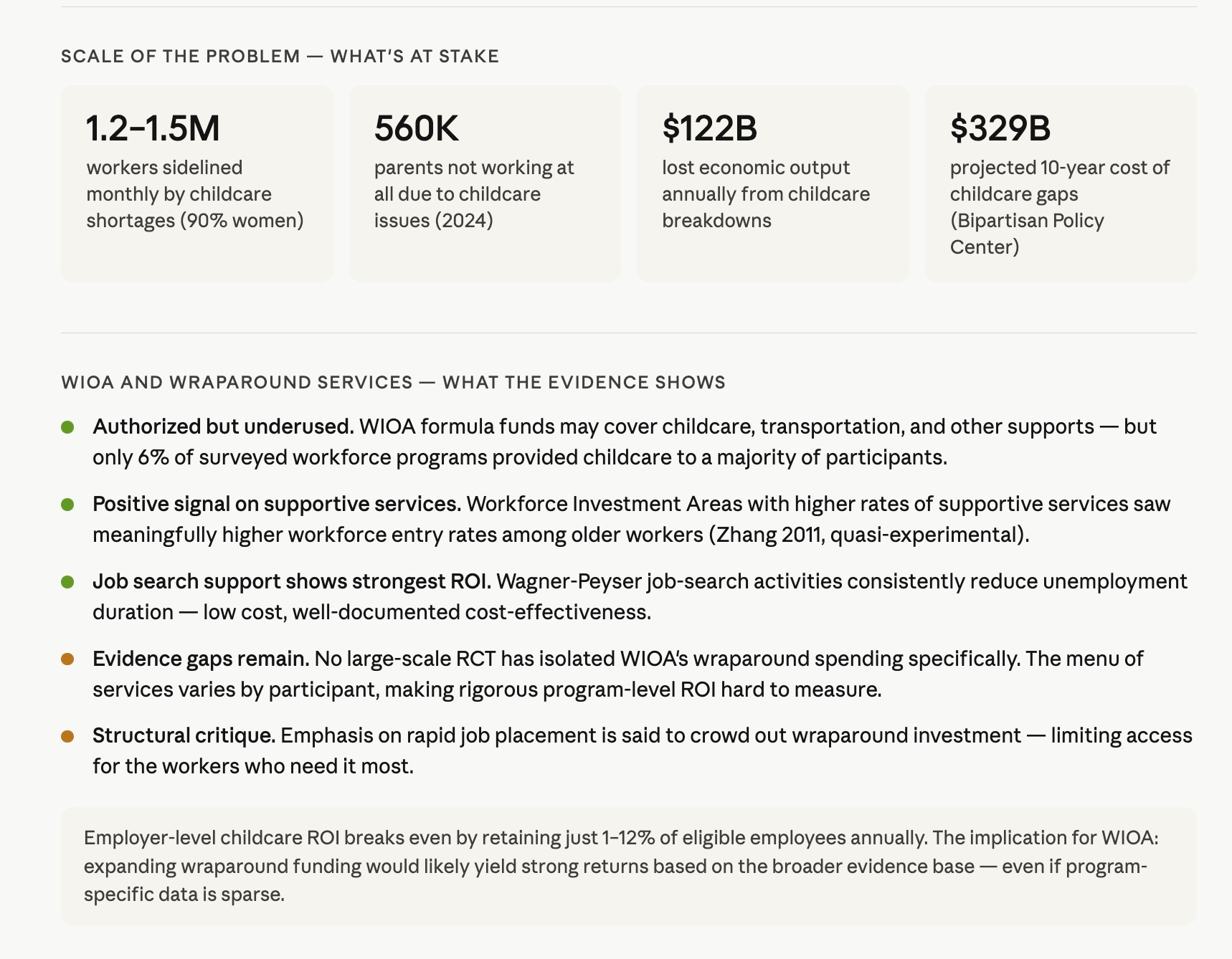
Deliver “employment-plus” services that enable workers to thrive on the job. Perhaps the biggest factor driving high turnover rates in many job titles is uncertainty in an employee’s life outside the workplace. A worker who has recurring concerns about the reliability of their childcare or being able to get to their place of work is far more likely to miss shifts or otherwise struggle on the job, and risk getting fired as a result. Just as the workforce field is realizing that wraparound services are vital for jobseekers in training programs, the next step is to ensure that they remain available beyond the point of placement. The childcare shortfall alone is an enormous drag on the labor force, which WIOA does somewhat north of nothing to address:
What it might look like: Closely aligned to Premise #1, the idea here is to create the enabling conditions for workers to stay on the job and advance over time. Ultimately, this means a stronger safety net that leans into an ethos of care and strengthens the nonprofit/social services sector. Operationally, this could include grants that attach to newly placed workers—vouchers for childcare or other supports—and/or working with providers, employers, or outside actors who can negotiate a higher volume of support services at a lower price point.
Build relationships with businesses, not transactions with “employers.” All too often, workforce providers approach businesses with the same transparent intentionality of Beavis and Butthead talking to girls. It’s purely transactional: they ask about current job openings, or present a menu of services, without considering the organization’s deeper circumstances. These interactions should instead be grounded in efforts to understand the potential business partner’s objectives and pain points holistically—viewing their talent strategies and processes in the same context that businesses themselves see them. This mindset shift is necessary if we are to evolve beyond placement and toward embracing worker career success and shared prosperity as system priorities. It also might lead to fewer figurative slaps in the face.
What it might look like: This change is the simplest in theory and perhaps the hardest in practice, because it involves culture, norms, and motivations. At least since JTPA, the incentives of federal workforce policy have been such that providers conduct “employer engagement” with an eye toward the outcome, most often sourcing candidates for job openings on the adult side or securing commitments to host interns or seasonal workers on the youth side.
But it’s one thing to assert that the field should consider businesses in the entirety of their operations rather than through the lens of their function as “employers,” and another to actually do that, unless and until the incentives change. This is why new policy that creates incentives for that shift, in the form of both a wider range of worker outcomes (retention, advancement over a longer timespan) and new metrics (say, bonuses for sustained engagement with high-road employers) is absolutely necessary.
Shift the culture of workforce development from compliance to excellence. After decades of dwindling resources and circumscribed goals, public administrators and providers in the workforce ecosystem have adopted a scarcity mindset and a deficit focus. Particularly in the face of federal threats to already-scarce dollars, looking to avoid further harm is a rational response. Yet, this mindset contributes to the vicious cycle of diminishing value and growing irrelevance. The field must embrace bravery and creativity—and policymakers must make it safe for practitioners to be bold on behalf of workers, jobseekers, and businesses.
What it might look like: In current workforce policy, “compliance” functions like one of the greatest lines from The Wire: “No one wins. One side just loses more slowly.”5 As the system continues to feed low-wage workers into low-wage, high-turnover jobs, providers meet their numbers, low-road employers enjoy outsourced HR, workers continue to churn at the bottom of the labor market, and Congress progressively starves the program of funding—but “more slowly.”
A different approach would look much more like what Rachel Lipson called for, in one of the best pieces written about workforce last year: “treating human capital like research and development.” In R&D, “failure” doesn’t mean you lose funding, much less that your narrow-margin provider ceases to exist; it’s part of the process, from which you learn and move on. Understanding workforce as an investment in shared economic prosperity rather than the policy equivalent of an OTC painkiller for structural poverty, our whole perspective would shift in ways that, as Rachel puts it, might “enhance national competitiveness, [and] expand opportunity for Americans historically left out of the innovation economy.”
Embrace the intersectionality of workforce. Work is a nearly universal human experience, in that almost everyone is, has been, or will be employed. Workforce development sits at the junction of economic development and education, and touches issues ranging from housing and social services to criminal justice and healthcare. This vast reach offers enormous potential to form coalitions and pursue creative solutions. Recognizing this intersectionality as a strength to leverage, rather than an obstacle to navigate around, can build momentum and supercharge advocacy.
What it might look like: If, as Nick Beadle has it, “Everything is workforce,” that suggests both a challenge and an opportunity. Policy issues without an obvious institutional home or population focus tend to get orphaned: everybody’s problem is nobody’s priority. Add in that “workforce development” is not as immediately comprehensible in terms of what it is and what it does as “education” or even “social services.”6 But the opportunity is that there’s almost nothing that doesn’t have workforce implications. A unifying story—around, say, maximizing dignity, security, and mobility in every job—can suddenly cohere a vast coalition of active and passive supporters.
Now, as we’ve covered previously, how much money is available for workforce programming probably matters much, much more than the particulars of legislation. The smarter WIOA defenders I talk to likely would point out that there’s little if anything in the above that the current law straight up wouldn’t allow.
Which, fair enough. But I also think that what’s in the legislation—who it’s understood to serve, and to what ends—has a lot to do with congressional appetite to fund these programs. A couple other relevant points are that, one, it doesn’t seem like many (most?) WIOA administrators are fully aware of the flexibility they have, and two, given their limited dollars and accountability obligations, even those who are aware of their options might not be in a position to pursue them.
I haven’t really asked for comments to any of these posts—not that I wouldn’t always love and cherish them—but if anyone has feedback on these five ideas, I’d love to hear them. This post, and pretty much everything I do here, should be understood as an effort to articulate my thinking. That’s always and rightly an iterative process, and life has proven me wrong about things with sufficient frequency and intensity that I’ve gotten relatively comfortable with changing my mind.
Including but not limited to: the decline of unionization rates, the gutting of the manufacturing sector, financialization, several tech-driven transformations, the College for All movement, the emergence of the green economy, long-term birth rate decline, and most recently the onset of automation and AI as well as a clampdown on immigration.
Realistically, more like 12-15 at least. The Job Training Partnership Act and Workforce Investment Act each stayed in place for 16 years.
And no, I didn’t arrange it this way because I can’t figure out how to format this essay on Substack the way I might in other formats. Why do you ask?
Prez got this line, which is why his image graces this post.
Neither is “economic development”—but there’s more obviously money to be made in that area of policy, so those people tend to do ok.
No posts
Comments
Nothing yet. Say the first thing.
Sign in to join the conversation.