

A principal who’d probably agree with this principle
Hey folks! This is Part 1 of a two-part series on federal workforce policy. It presents my current thinking on why this system is the way it is. It does not do what I’d previously planned, which is really dig into down the whats and whys and wherefores of present (much less past) policy. I couldn’t get past the reality that there are many, many people who do this on the regular better than I could, including but not limited to The Century Foundation’s outstanding analysis of the Workforce Innovation and Opportunity Act from last summer, and ongoing coverage by the National Skills Coalition, and Nick Beadle’s Jobs That Work newsletter. There’s a high-level summary toward the end here, but I encourage you to dig in deeply at those sites.
Part 2, coming early next week, will present five principles for rebuilding the system. This is a conversation I’m excited to follow and hoping to find ways engage in over the next year-plus, as initiatives like NSC’s A New Promise of Work raise the salience of these issues, platform new thinking, and inject some needed energy and urgency.
Once in awhile I’ll be working on a document, making comments to something a colleague shared, and out will pop an idea I subsequently realize must have been rattling around in my head for a long time but hadn’t quite found its way into words.
I had one of those earlier today, in the context of a possible project focusing on career readiness for young adults:
We could talk here about the mostly unexamined/unconscious premise at the root of this: that while society has some interest in public education, subsequent labor market outcomes are left to the individual, who is obligated to navigate systems and make meaning [from their experiences] on their own. Based on our policy choices, one could reasonably conclude that we value this principle so much that it justifies otherwise-needless wasted economic potential and human misery.
One way that I understand the history of social policy in the U.S. is as an ongoing argument between individual versus collective responsibilities. Individualism got off to an enormous head start, both because the Western world until the Enlightenment had very little sense of community outside of religious groups, and not much more for a long time after that, and because there was just so much space in North America.1
Since then, collective responsibility gradually has caught up—in part on values grounds, and in part owing to economic efficiencies. For example, three hundred years ago, there was very little public education to speak of; if you weren’t born into a wealthy household, you might or might not be literate,2 but you almost certainly weren’t “educated” as the word would have been understood then.
But as the labor market began to evolve beyond the simple categories of “farmer, soldier, or artisan,” the value of literacy to society rose, and communities began to make provision for education. It was simply more efficient for a community to employ teachers who could work with groups of children, and to figure out how they would pay for this, than for everyone to do so on their own. By the early 20th century, public education through high school was nearly universally available in the United States.3
As K-12 schooling came to be understood as the government’s responsibility both in terms of providing it and ensuring quality,4 education took its place along with old age insurance, unemployment support, regulation of markets in the public interest, and much more as markers of a civilized society. The through-line of these innovations and interventions was that a small-d democratic government had real stakes in making sure that a universal foundation of opportunity, and a safety net for those who struggled, were both in place.
Once they reached adulthood and had to work, however, most people were still on their own. While the norm was no longer sturdy yeoman farmers taming the vast wilderness, the expectation remained that Americans would find their way through the labor market.
There were exceptions, particularly during the Great Depression, as I wrote about last week: government employed millions through the Civilian Conservation Corps, and then substantially took over the economy to fight World War II. Direct public sector employment diminished after that, but early federal workforce policy, at least through the Comprehensive Employment and Training Act (CETA), seems to have carried forward the New Deal concept that government had some role to play as an employer.
All that began to break down in the late 1970s, as public skepticism of government spending and programming—really, of that idea that we had collective responsibilities—came to dominate American politics, culminating in the 1980 election of Ronald Reagan. I don’t think job training and employment services were a top target of the Reagan Revolution… but it wasn’t an enormous conceptual leap from Reagan’s (deeply misleading) demonization of so-called welfare queens to the conclusion that job training was a dodge for parasites.5
At the least, we took pretty severe collateral damage from the idea that “government is the problem.” Back by popular demand, it’s the table showing actual workforce spending from 1979 to 2024 vs. what we would have spent if funding had kept place with overall federal spending growth!
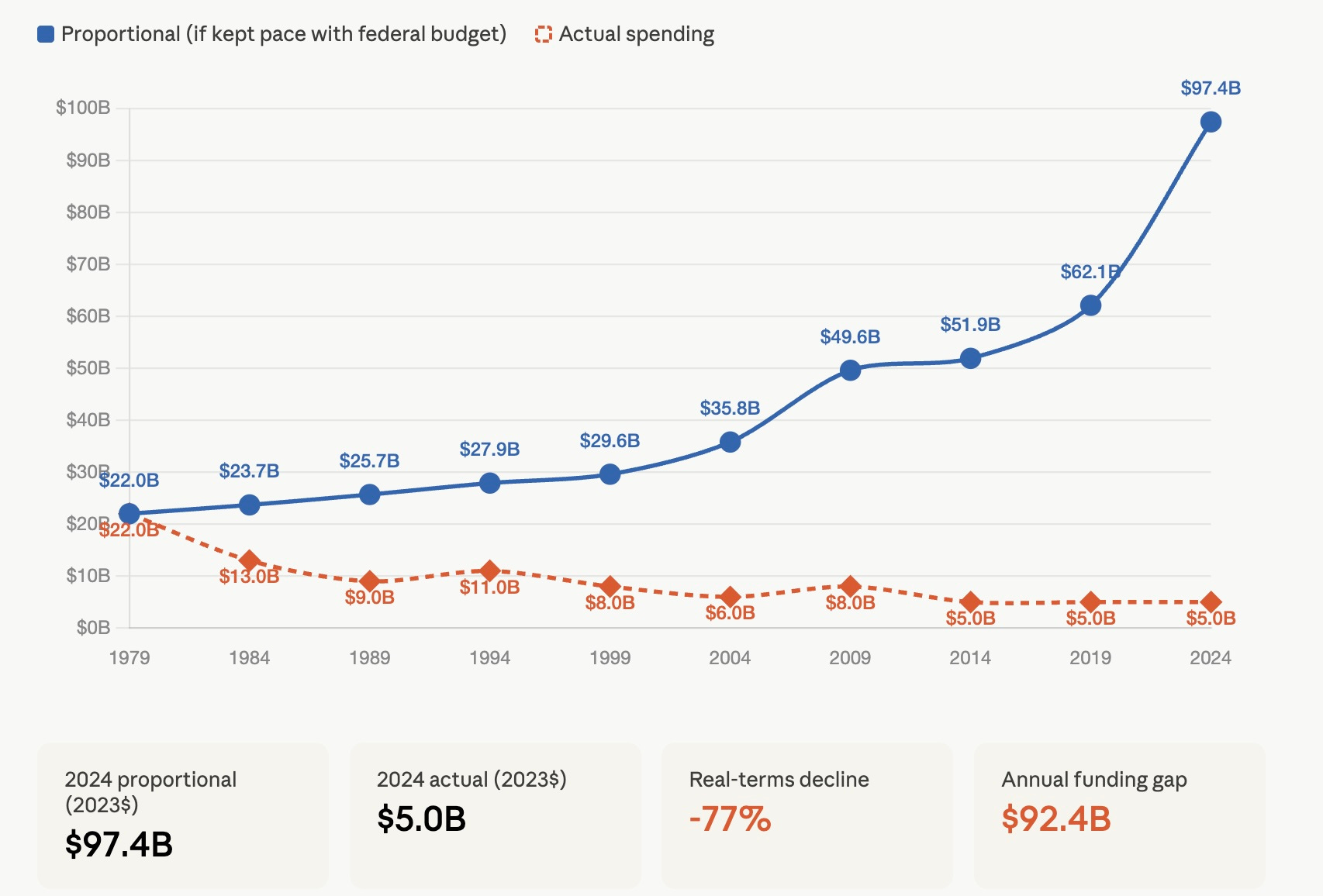
I used to argue that one goal of the workforce system was to give jobseekers and workers the tools they needed to navigate the labor market on their own. I don’t repudiate this, exactly, but I now consider it incomplete. As the labor market gets more challenging and inhospitable—not only for workers, but for employers as well—stronger and bolder interventions seem called for. This is because the premises used to justify the decline, including that workers once employed could make their way toward career advancement and higher wages through union support or employer investment in skills training, are no longer valid.
And yet those premises continue to guide the Workforce Innovation and Opportunity Act (WIOA), as they did its two predecessor laws: the Job Training Partnership Act (JTPA), and the Workforce Investment Act (WIA). Having covered this before, I won’t go through it all again, but to summarize, I think it’s fair to say that WIOA:
Prioritizes short-term job placement (“rapid attachment”)
Does not emphasize job quality
Does not incentivize building long-term or comprehensive relationships with employers
By virtue of being underfunded, has little to offer displaced professionals or high-skilled blue collar workers who need retraining6—which also means that the law holds limited value for businesses seeking talent in those categories
These realities are the result of choices, active and passive, that have accumulated since Congress tossed CETA aside in favor of JTPA’s “you’re on your own” approach in the early 1980s. I don’t think it’s a coincidence that funding has trended down since then—or that evaluations of JTPA and WIA in particular found that the programs mostly didn’t work all that well, which of course further sapped Congressional interest in funding it.7 Federal workforce became, to quote an ugly cliché, “a poor program for poor people.”
With the spending counterfactual in mind, today I asked Claude a different question: if we had funded workforce programs to keep pace with overall spending growth since 1979, what might that have meant for American workers?
Claude kind of hedged in response, pointing out that such a modeling exercise requires a bunch of entirely hypothetical assumptions about service delivery mechanisms, effectiveness rates, and exogenous factors like unionization decline that were happening at the same time.8 But in the end, drawing upon research literature that probably would have taken me a solid month to get through, we got some data:
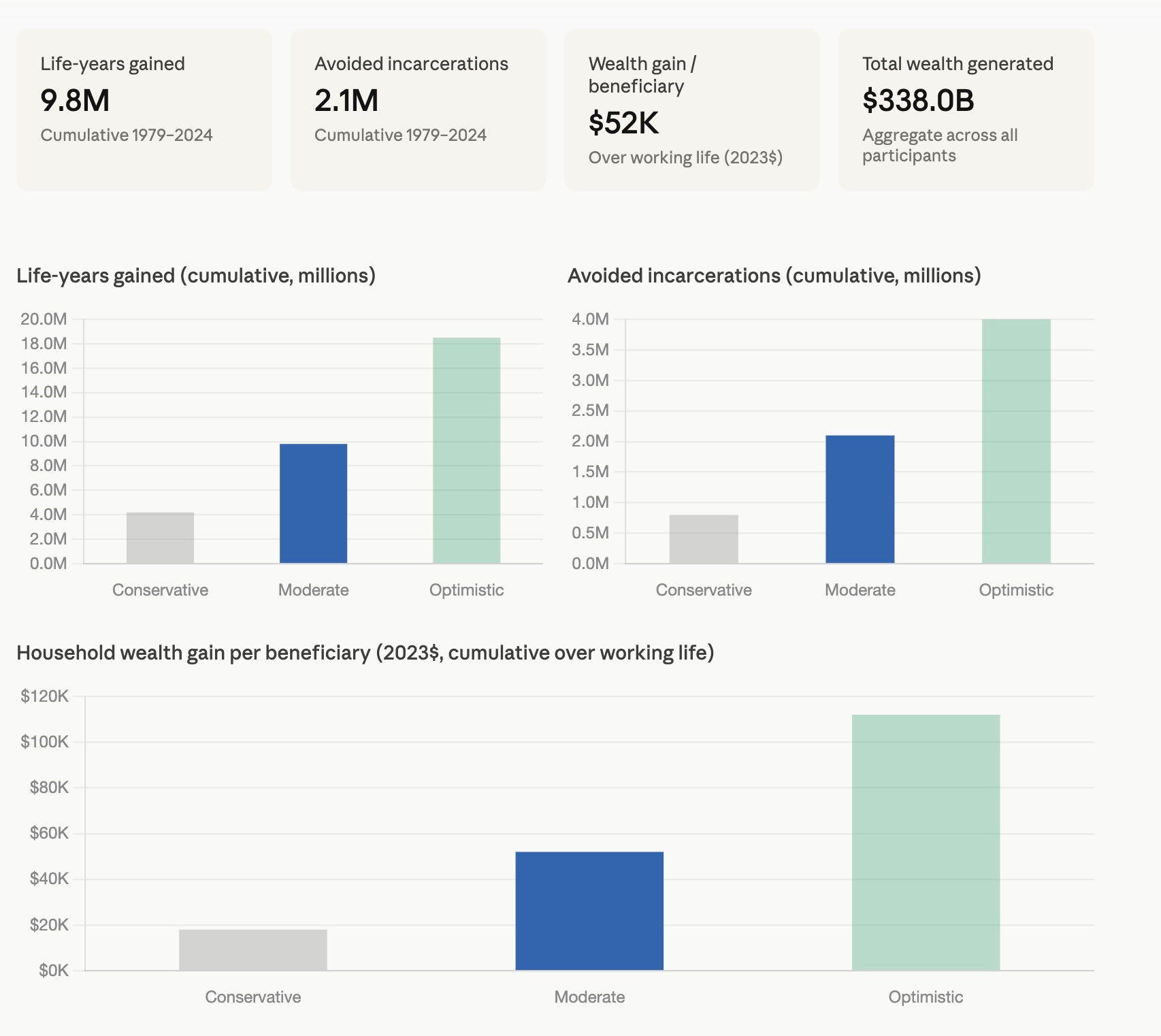
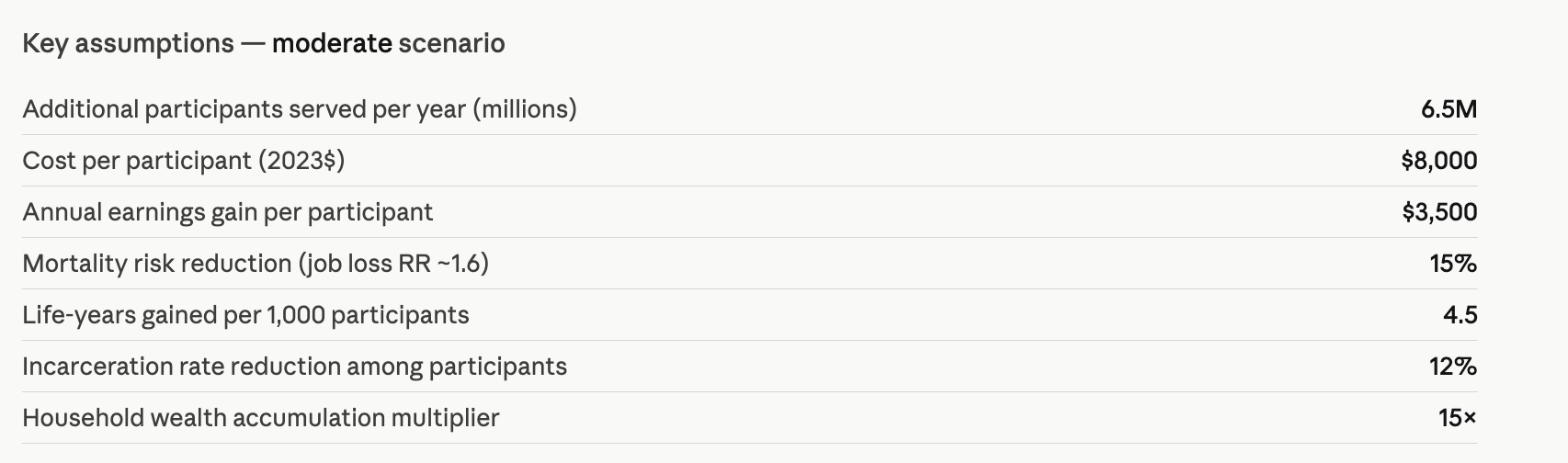
Statistics aren’t people. But the idea of Americans getting a cumulative additional 9.8 million years of life (based on research finding that losing a job roughly doubles short-term mortality risk and keeps it higher for years to follow), and 2.1 million of us who were actually incarcerated avoiding that fate… the mind slides off of those numbers.
The wealth gains are, of course, quite significant as well—even before we consider how greater economic security might have factored into democratic participation, social connectedness, housing and food security, educational attainment… pretty much any input you can imagine into a life worth living.
“Fine,” says the hard-headed government actuary. “People would have had more home-cooked meals and holidays with their families and other Kodak Moments. What would it have meant for the public fisc?”
Well, I asked that too:
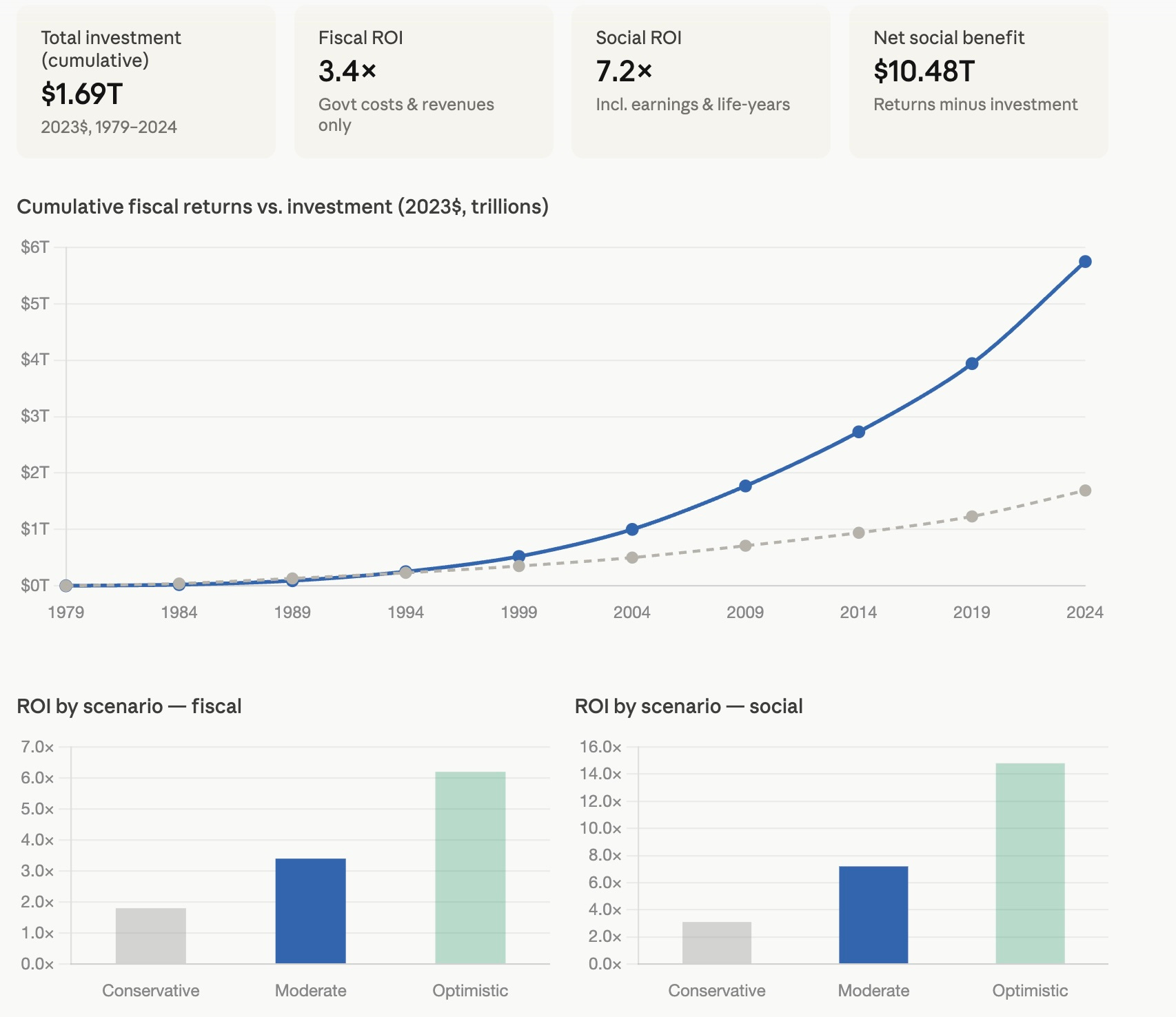
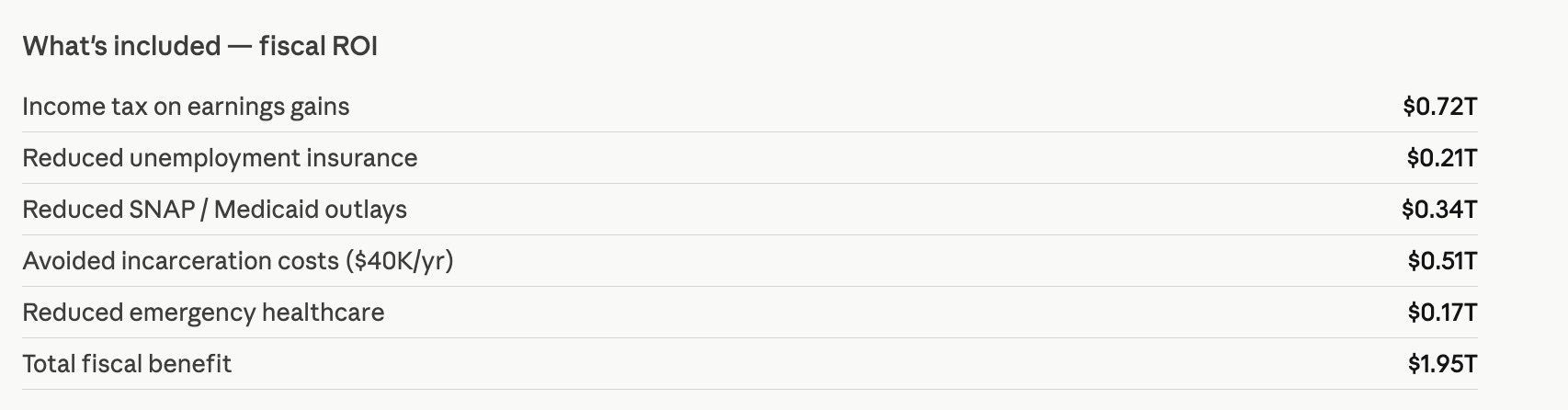
Claude doesn’t just run these numbers, but includes commentary as well—in this case, the observation that even the most conservative fiscal ROI scenario suggests that every unspent workforce dollar would have yielded a return of $1.80, “making the funding gap look less like a savings and more like a compounding loss.”
The question now is whether we’re going to continue digging the hole deeper, or start to climb out. The first principle that undergirds the decision to disinvest in workforce development—that when it comes to jobs and careers, everyone is on their own—has imposed a staggering cost. I presume that few if any people understand this cost. Maybe that’s for the best, as I can’t imagine how anyone could argue with a straight face that it’s been worth it.
Especially after the indigenous population was killed or displaced.
Though graduation doesn’t seem to be have been an expectation until a bit later on, accompanied by the ugly sentiment that those who didn’t graduate were somehow lesser-than, and worthy of scorn.
With the enormous caveat of “separate but equal” schools in the decades prior to the Supreme Court’s Brown decision in 1954.
It’s possible to utilize WIOA funds, particularly Individual Training Account vouchers, to partially defray the costs of more advanced/expensive training, as discussed in this post. But WIOA alone usually can’t cover tuition for most high-quality training programs, and to cobble together the funds from multiple sources requires time and effort that displaced workers in crisis might not have.
If you want to follow the full chat, feel free to do so here. Note my learning at the outset that, just like the Terminator whenever it’s sent back in time, Claude has no memory of previous interactions. This feels both useful, in that it creates some psychological distance, and a little sad.
No posts
Comments
Nothing yet. Say the first thing.
Sign in to join the conversation.