
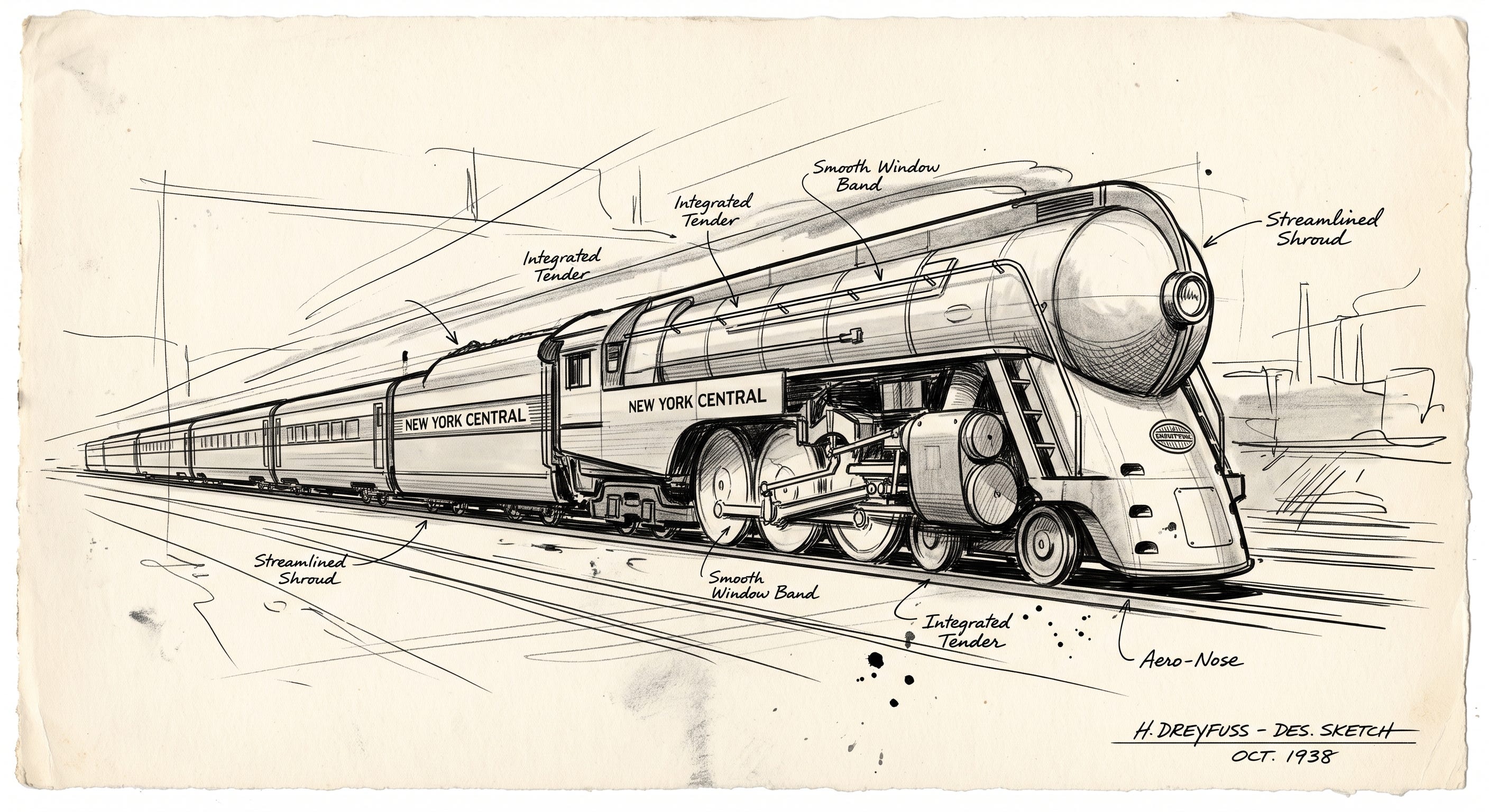
In 1925, RKO sent a twenty one year old Henry Dreyfuss to Sioux City to figure out why their new theatre sat empty while a run down competitor down the street sold out every night. They had already tried cheaper tickets and free snacks. He spent three days watching people out front and listening to what they said to each other, and what he found was that the theatre was too nice. The farmers and labourers were intimidated by the lobby, and specifically by an expensive red carpet they were afraid to ruin with muddy boots. He had it pulled out and replaced with rubber matting, and the crowds came.
Nobody in that town could have told him about the carpet if he had asked them, because they did not know that was why they were not going. That instinct, of going and finding what people cannot tell you, is most of what made Dreyfuss the person he became. His principles ended up permeating most of American industrial design, to the point where a lot of what we now just call good product sense is really his argument passed down enough times that nobody attributes it anymore. Despite that, I think if you go back and look at the core of what he was actually arguing, modern AI product design has deviated pretty heavily from what he would have called good design.
Dreyfuss wrote Designing for People in 1955, after about twenty five years of designing telephones, tractors, vacuum cleaners, and locomotives. He had a lot of core obsessions, but the one everyone remembers is the Point of Contact, the moment where the object actually meets the person. He wrote that when “the point of contact between the product and people becomes a point of friction,” the designer has failed. The part of him that I think gets lost, though, is what the Point of Contact was in service of. When he was designing, the default was engineers building the machine expecting people to adapt to it. His whole inversion was fitting the machine to the person instead. His work in The Measure of Man, which came a few years later, was him spending the time collecting measurements of the human body to lay the foundation of what that inversion actually required. The work was laid so the object could absorb the variation, instead of every person having to accommodate the object.
Which brings me to where I think we have drifted. Most AI products today exist on the concept of prompting, and to me this is the clearest sign of the drift. It is a skill and a paradigm we are getting better at, but the existence of having such a skill is not necessarily a good sign. It is an admission that the burden of translation is sitting on the wrong side, which is the exact thing Dreyfuss spent a career trying to move.
With an agent, the person only touches the system twice. Once when they hand off the work, and once when they decide whether to trust what came back. The handoff is the translation moment. It is where somebody has to convert what they want into something the system can act on, and most of that conversion is happening in the person’s head before they type anything. A blank text box is a very friendly looking way of demanding that somebody already knows how to say what they mean.
The way out of that is not just better prompt UI. It is in utilizing every piece of context that the system can go and get for itself, any angle which reduces the burden of information that someone has to supply, whether that comes from what is already in the workspace, what happened on the last run, or how the team has always done the thing. In Dreyfuss’s time this looked like going out and measuring thousands of bodies to fit one object to a distribution of people. Software does not have that constraint, so the interface itself can be fitted to the individual rather than the average, and the thing somebody does most often can be the thing in front of them.
It changes the paradigm of modern product design, because I see it as no longer designing a screen but rather the range of screens the system is allowed to produce. The onus is on you to bound that range, so that even with this level of auto customization there is still some signature element that makes it distinctly your product, and the worst version it can generate is still one your team would be proud of. That is only possible if you have gone and understood your users first, since you cannot set the bounds of something you have not seen. Dreyfuss rode the trains, he sat in the tractor seats, he spent three days outside a theatre in Iowa. Great product design has always hinged on understanding your users.
The difference now is that you have to understand them well enough to design a version of the product you may never see.
Check out this Podcast Episode!
You can also listen on Spotify, Apple Music, and Google Podcasts
In this episode of Building Blocks, we sit down with Emre Ertan, co-founder and co-CEO of Cenoa, a borderless super wallet revolutionizing how people in emerging markets access digital dollars.
Previously the CPO/CTO at Getir where he scaled the engineering team from 80 to 400 people, Emre shares his journey from a small town in Turkey to Silicon Valley, and how that experience shaped his vision for democratizing financial access globally.
He discusses Cenoa’s explosive growth in Nigeria (50K+ signups in first month), their innovative approach to simplifying blockchain technology for everyday users, and his perspectives on building compliant fintech products across 40+ markets.
Thanks for reading,
Daivik Goel
Comments
Nothing yet. Say the first thing.
Sign in to join the conversation.