
One night, 136,000 people rushed into emergency rooms across the country, all in the middle of a heart attack. When doctors pulled the charts, they found something that should unsettle anyone who has ever felt reassured by a clean cholesterol panel: 75% of those patients had perfectly normal total cholesterol.
Not high. Not borderline. Normal.
That single statistic is a good place to start questioning almost everything we’ve been told about longevity, because it turns out the standard rulebook — restrict fat, watch your LDL number, trust the average — misses the actual danger more often than it catches it. The real story, once you dig into the clinical data and molecular biology, runs through your cell membranes, your bloodstream, your nervous system, your morning plate, and even your ligaments. And almost none of it looks like the advice you’ve heard before.
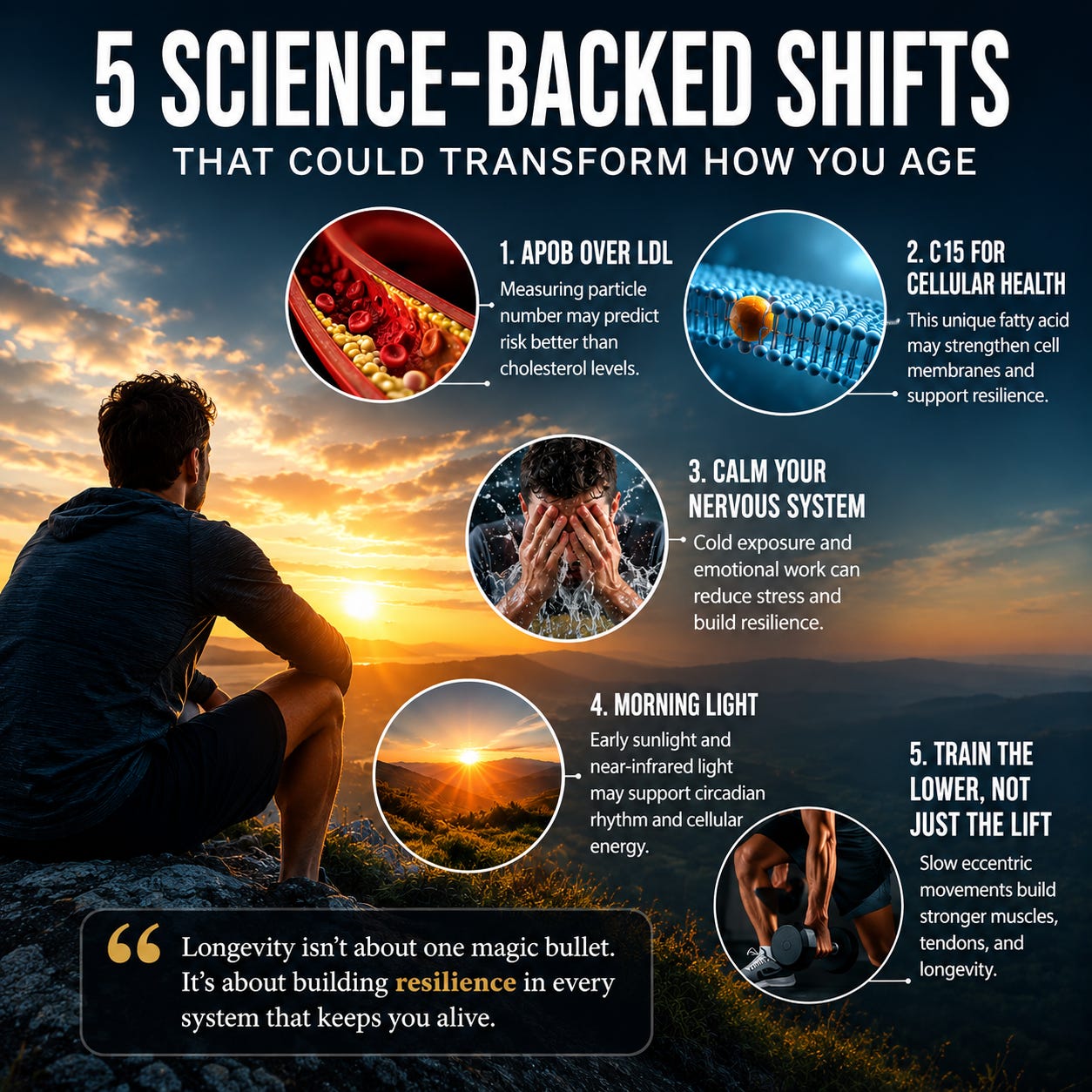
Start with the fat we spent fifty years vilifying. For half a century, saturated fat has been treated as the dietary villain. But one specific odd-chain saturated fat, pentadecanoic acid — known as C15 — doesn’t behave like the rest. Most saturated fats linked to inflammation, like C16, contain double bonds, which are essentially weak spots where oxygen can steal an electron and cause the fat to oxidize. C15 has no double bonds. It doesn’t go rancid inside the cell. Instead, it acts as a kind of molecular armor for the cell membrane, while also activating AMPK — your cellular fuel gauge, which triggers cleanup and repair — and inhibiting mTOR, the pathway that drives unchecked cell growth and accelerated aging. It’s rust-proofing, and unstable fats are the equivalent of driving on salted roads without a clear coat: you don’t see the corrosion until the chassis gives out.
The numbers behind it are almost absurd. A rise of just 0.1% in blood C15 correlates with a 32% reduced risk of developing type 2 diabetes. People in Sardinia — one of the world’s genuine blue zones, where living past 100 in good health is unremarkable — carry C15 levels two to three times the global average.
And the discovery didn’t even start in humans. Veterinary epidemiologist Dr. Stephanie Venn-Watson noticed that aging Navy bottlenose dolphins were developing fatty liver disease and insulin resistance eerily similar to human metabolic syndrome — except the dolphins eating diets naturally rich in C15 were spared entirely. Current guidance points to roughly 100–200 milligrams of C15 daily, available through full-fat, grass-fed dairy or as a standalone supplement.
Then there’s the bloodstream itself. A standard LDL test only measures the total weight of cholesterol in your blood — it tells you nothing about the size, structure, or number of particles carrying it. Picture the bloodstream as a highway: ten tons of vehicles could mean five slow-moving semi-trucks, or a thousand small, erratic sports cars weaving through traffic. Insulin resistance — driven by excess starch and sugar — forces the liver to manufacture the sports cars: small, dense particles that are far more likely to crash into arterial walls, oxidize, and seed plaque. This is why measuring ApoB, which counts particles rather than weighing cargo, matters so much more than LDL alone. Pair it with fasting insulin, high-sensitivity CRP, and lipoprotein(a) — a genetic variant that acts like biological Velcro, making particles stick to artery walls even faster — and you get an honest picture. Dr. Mark Hyman calls the alternative the “skinny fat illusion”: people who look lean and have flawless lipid panels but are quietly insulin resistant underneath, a hidden dysfunction affecting an estimated 93% of Americans.
“The body cannot heal while it believes it is under attack.”
The fix for a lot of this starts at breakfast. Skipping the morning meal and running on coffee forces the liver to dump stored sugar via cortisol and adrenaline — metabolically, it’s like heating your house by burning your own furniture. A protein-forward breakfast of 30 to 50 grams flips the script: leucine switches on muscle protein synthesis, while tryptophan feeds serotonin and dopamine production, stabilizing mood and appetite for hours. Protein researcher Dr. Heather Leidy ran a six-month trial with 150 chronically breakfast-skipping teenagers — arguably the hardest population to get to comply with anything — and found that once they were given 24 to 30 grams of animal protein each morning, compliance hit 90%, and cognitive performance improved measurably into the afternoon.
When stress spikes anyway, biology has a manual override. The mammalian dive reflex — submerging your face in ice water for 30 seconds while holding your breath — tricks the nervous system into thinking you’re underwater, forcefully dropping heart rate and redirecting blood to your core organs. Clinical psychologist Dr. Jenny Taitz built it into the TIPP protocol for emotional regulation. It’s not a distraction technique; it’s a physiological override. And the belief you hold about stress matters almost as much as the stress itself — a study tracking 28,000 people found that high stress paired with the belief that stress is destroying your health was the combination most associated with premature death.
That’s where shadow work comes in: identifying suppressed emotional loops from childhood and consciously letting the “shadow self” voice its rawest fears, then stepping in as the adult to offer reassurance. Coach Katie Clark described years of paralyzing imposter syndrome traced to a single sentence she’d buried since childhood — “you’re just a stupid girl” — and how naming it finally closed the loop.
Even light plays a role you probably haven’t considered. Watching the sunrise with bare eyes and skin — no glasses, no window glass — exposes you to near-infrared wavelengths that restructure water inside your cells into a charged, energy-storing state, and prompt cells to produce most of their daily melatonin during daylight hours as an antioxidant, not a sedative. Energy-efficient windows filter out nearly all of it, leaving only the stimulating blue light behind — the light equivalent, as one guest put it, of eating pure refined sugar.
Finally, the scaffolding. Muscle adapts in days; tendons and ligaments, with poor blood supply, take 50 to 100 days to rebuild a single batch of collagen. High-rep, low-weight training wears down that connective tissue without ever giving it a strong enough signal to rebuild. The fix is heavy, slow eccentrics — a three-to-five-second controlled lowering phase on compound lifts — which fires mechanoreceptors that instruct fibroblasts to lay down organized, load-bearing collagen. Dr. Stephanie Estima documented this with a 47-year-old patient, Sandra, whose hormone replacement therapy had accelerated collagen turnover faster than her light exercise routine could organize it, leaving her joints loose and unstable. Ten weeks of heavy eccentric training resolved it completely.
Taken together, the thread running through all of it is uncomfortably simple: modern comfort — climate-controlled glass, skipped meals, light exercise, suppressed emotion, blind trust in averages — is quietly working against our biology. The fix isn’t a new supplement or a stricter diet. It’s the deliberate reintroduction of discomfort: cold water, heavy weight, honest emotion, unfiltered light, and a fat we spent decades avoiding for no good reason.
Key Takeaways
Ask your doctor for an ApoB test, not just standard LDL — and check fasting insulin, hsCRP, and Lp(a) alongside it.
Aim for 100–200mg of C15 daily through grass-fed dairy or supplementation.
Eat 30–50 grams of protein within an hour of waking.
Keep a bowl of ice water on hand for acute stress spikes — 30 seconds, face submerged, breath held.
Watch the sunrise outdoors, without glasses or a window between you and the sky.
Trade a few sets of high-rep training for heavy, slow eccentrics — a 3-to-5-second controlled descent on your main lifts.
Acknowledgements:

Sources:
Jun-30, Ian Mitchell, #451: Reimagining Aging: C60’s Role in Muscle Function, Neuroprotection, and Extending Vitality With Ian Mitchell, on, LONGEVITY with Nathalie Niddam
Jun-30, Dr. Don Layman, Is the Protein RDA Too Low for You? What 40 Years of Studies Show - Dr. Don Layman & Dr. Heather Leidy | GLS #214, on, The Dr. Gabrielle Lyon Show
Jun-30, Karen Martel, 643. Mastering GLP-1s in Peri and Menopause: What 95% of Women Are Doing Wrong, on, The Thyroid Fixer
Jun-30, Anna Cabeca, Oxytocin: How To Naturally Induce Your MIRACLE Hormone | Anna Cabeca : 1493, on, The Human Upgrade
Jun-30, Dr. Michael Breus, 759: Tired, Wired & Inflamed? The Sleep Fix Most Women Are Missing with Dr. Michael Breus, on, Energized with Dr. Mariza
Jun-29, Layla Taylor, Layla Taylor EXCLUSIVE: The Truth She’s Finally Ready To Share, on, On Purpose with Jay Shetty
Jun-29, Healthy Eating Set On Easy Mode, on, Well Beyond 40
Jun-29, Stephanie Venn-Watson, The Longevity Discovery Hidden in Dolphins, on, Longevity.Technology UNLOCKED
Jun-29, Cynthia Thurlow, The Truth About Menopause, Belly Fat & Insulin Resistance with Cynthia Thurlow, on, Optimal Protein Podcast with Vanessa Spina
Jun-29, HRT Can’t Fix Your Ligaments: The Diabolical Role of Estrogen on Connective Tissue, on, BETTER! Muscle, Mobility, Metabolism & (Peri)Menopause with Dr. Stephanie
Jun-29, Katie Clarke, The Hidden Part of You That’s Blocking Everything You Want | Katie Clarke, on, The School of Greatness
Jun-29, Encore: Why Normal Cholesterol Doesn’t Always Mean Low Heart Disease Risk, on, The Dr. Hyman Show
Jun-29, Ido Portal, Movement Practice to Strengthen Your Mind-Body Connection | Ido Portal, on, Huberman Lab
Jun-29, The Beekeepers Garden - A Sleep Story Read by Matt Walker, on, The Matt Walker Podcast
Jun-29, Dr. Jenny Taitz, Use These Stress Resets and Stop Letting Stress Control You - With Dr. Jenny Taitz, on, The Model Health Show
Jun-29, #398 ‒ AMA #86: GLP-1 RAs and muscle loss: new data, better questions, and how to preserve muscle during weight loss, on, The Peter Attia Drive
Jun-29, How to Keep Your Brain Sharp, Strong, and Growing at Any Age, on, Kwik Brain
Jun-29, Simon Hill, What Happened To The Vegan Movement? Rich & Simon Hill On The Rise & Fall Of Plant-Based Eating, on, The Rich Roll Podcast
Jun-29, Visceral Fat - The Hidden Fat That Drives Insulin Resistance, on, The Metabolic Classroom with Dr. Ben Bikman
Jun-29, Claude M. Steele, That Background Hum of Worry in Every Important Conversation — Here’s What It Is and How to Quiet It | Claude M. Steele, on, 10% Happier with Dan Harris
Jun-29, Stacy Sims, BONUS: Protein, Creatine and Training for Menopause and Beyond with Dr. Stacy Sims, on, Everyday Wellness: Midlife Hormones, Menopause, and Science for Women 35+
Jun-28, BONUS: The Anti-Aging Molecule Backed by Nobel Prize Research : 1492, on, The Human Upgrade
Comments
Nothing yet. Say the first thing.
Sign in to join the conversation.