
A 35-year-old woman starts a GLP-1 weight loss medication. Within months, she drops 28 pounds. Her doctor is thrilled — on paper, it’s the outcome every clinic hopes for. Privately, she’s devastated. Her sex drive has vanished, and she’s lost the ability to orgasm entirely.
Her doctor looked at a single metric: the number on the scale. What actually happened underneath it — a structural and hormonal collapse — never showed up in that number at all. It’s a useful place to start, because it captures the blind spot running through most of what we’re told about health: we equate getting smaller with getting healthier, while largely ignoring how the biological machine actually functions.
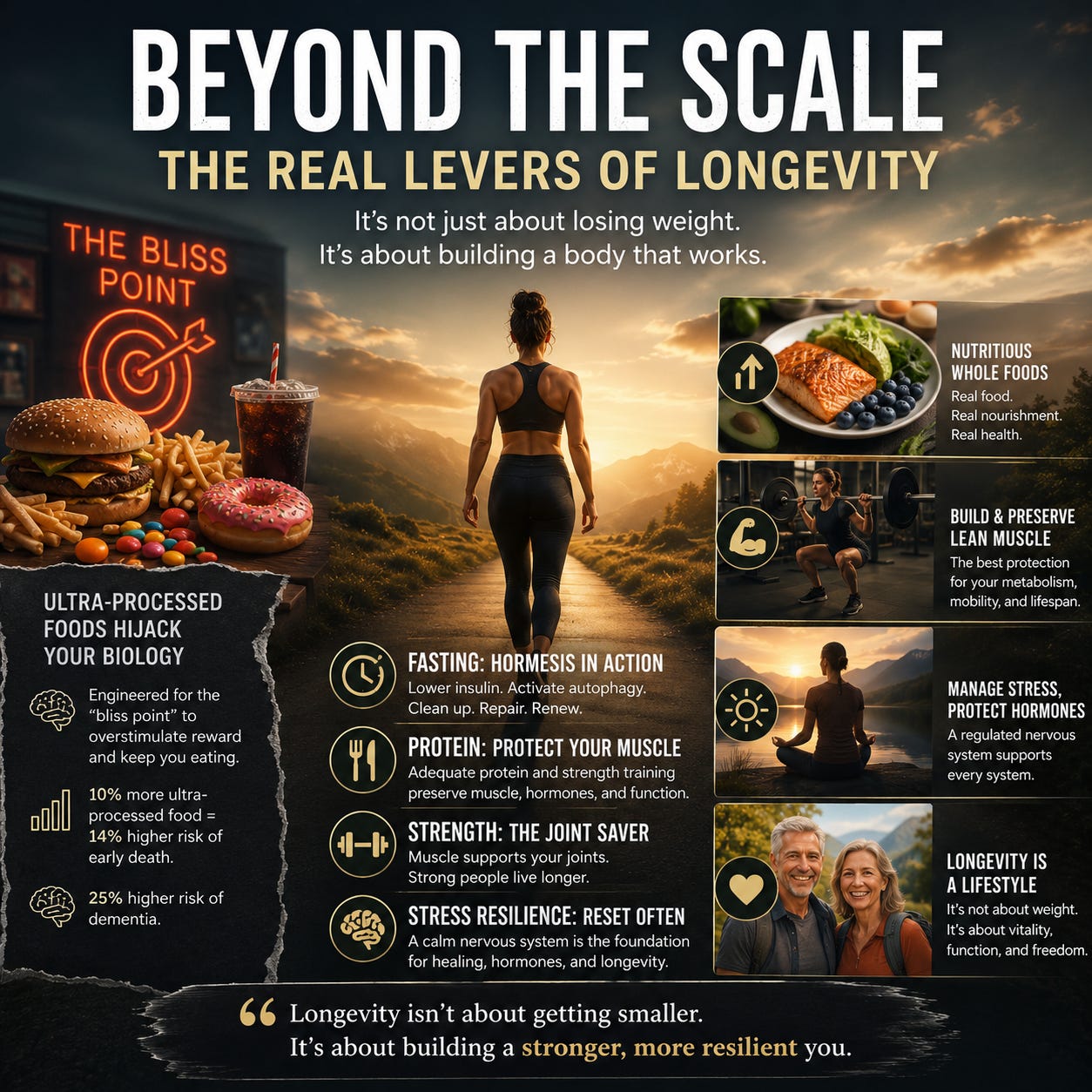
Start with the fuel. Every source agrees on step one: eliminate ultra-processed food. But the reason goes well beyond “calories in, calories out.” Journalist Max Lugavere describes how these foods are engineered — quite literally, by food scientists — around what the industry calls the “bliss point”: a mathematical ratio of fat, sugar, and salt calibrated to overstimulate the brain’s reward centers. To make that formula shelf-stable and profitable, manufacturers strip out water and fiber, the two things your stomach’s stretch receptors actually need to register fullness. Without them, and without enough protein to suppress ghrelin, your hunger hormone, you can eat thousands of calories and your brain will still insist you’re starving. It isn’t a willpower problem. It’s a rigged carnival game where the rings are built too small for the bottles.
The numbers behind this are stark. In an NIH metabolic ward study, researcher Kevin Hall let subjects eat ultra-processed food until full and watched them run a 500-calorie daily surplus — with the exact same instructions, on whole foods, they ran a 300-calorie deficit. An 800-calorie daily swing, with zero conscious portion control. Longer term, the epidemiological data is blunt: a 10% increase in dietary ultra-processed food correlates with a 14% higher risk of early mortality and a 25% higher risk of dementia.
Once the bliss point stops hijacking your appetite, timing becomes the next lever. Dr. David Sinclair’s research frames periods of hunger as hormesis — a manageable stress that makes the organism stronger. The mechanism runs through insulin and IGF-1, a growth signal that stays elevated if you’re grazing all day, effectively keeping your cellular construction crew on the clock around the clock, never given a shift to sweep the floors. Introduce a real fasting window and IGF-1 drops, flipping on ancient maintenance circuits — AMPK among them — that trigger autophagy: cells hunting down misfolded proteins, repairing damaged DNA, and clearing out senescent “zombie” cells. In the CALERIE trial, subjects who cut caloric intake by just 12% slowed their biological pace of aging by 2–3%, translating to a 10–15% reduction in early mortality risk. Sinclair himself pushed this to the extreme with a three-week water fast on exogenous ketones, reporting sharper cognition, more strength, and unusually deep sleep — fascinating, and almost entirely impractical, since prolonged fasting like that risks burning through muscle tissue for amino acids.
“The chemistry is mathematically designed to bypass your off switch.”
That tension — deep cellular cleanup without sacrificing muscle — is exactly what the Protein-Sparing Modified Fast, championed by Dr. David Jockers, is built to solve. You cap daily intake around 800–1,000 calories, dedicate 150 grams of it to protein, and keep fat and net carbs each under 30 grams. With insulin flat, the body mobilizes stored fat for ketones, while the flood of leucine from all that protein switches on mTOR just enough to tell the nervous system: don’t touch the muscle, we have building materials coming in. Vanessa Spina used this exact protocol to lose 13 pounds of pure fat while keeping every pound of lean muscle intact.
Which raises the real question: why does the muscle matter so much? Physiotherapist Will Harlow tracks grip strength and walking speed as primary predictors of lifespan — numbers that sound almost arbitrary until you follow the mechanics. Most of what we chalk up to “aging joints” is actually muscular atrophy: when the quadriceps and hamstrings weaken, they stop absorbing the shock of walking, and that force transfers straight into cartilage. The joint isn’t failing from age; it’s failing because its scaffolding collapsed. In a decade-long study of men in their 70s, 86% of the fastest walkers were still alive ten years later — versus just 18% of the slowest. When Harlow puts patients with “incurable” joint pain through a targeted strength protocol instead, 80% see their pain drastically improve or disappear.
Which brings us back to the woman who lost 28 pounds and her libido along with it. Dr. Gabrielle Lyon’s protocol for anyone on GLP-1 medication is non-negotiable: one gram of protein per pound of target body weight, and heavy resistance training three times a week. Here’s why. Rapid, unmanaged weight loss reads to the liver as starvation, and in response the liver overproduces SHBG — sex hormone binding globulin — which acts like a sponge, soaking up free testosterone from the bloodstream. Meanwhile, the medication is doing exactly what it’s designed to do: dampening dopamine reward signaling to kill overeating urges. Combine a muted reward center with a hormone-sponging liver and a body that’s shedding structural muscle — and losing the vascular blood flow that muscle supports — and you get a patient who is lighter on the scale and, in every way that matters, endocrinologically bankrupt.
Fuel and muscle can be perfectly dialed in, and the system will still break down if the nervous system is fried. Somatic experiencing, the work of Sasha Ayana, treats trauma as a physical charge trapped in the body rather than a memory stored in the mind — an interrupted fight-or-flight cycle that never got to finish. Ayana’s own case is illustrative: entering a genuinely safe, loving marriage, she found herself gripped by inexplicable panic and the urge to flee, her limbic system projecting old abandonments onto a present that held none of them. Logic didn’t touch it — trying to reason with a limbic response is like trying to talk yourself out of being cold instead of putting on a sweater. A year of therapy, including light physical pressure that let stored energy discharge through shaking, crying, and heat, is what finally let her nervous system register safety.
That same principle underlies the Apollo wearable, developed by Dr. Dave Rabin, which delivers sub-200Hz vibrations that feel like a deep hug, stimulating touch receptors that signal directly to the vagus nerve — the body’s brake pedal — pulling the nervous system out of fight-or-flight. In a three-year Oura Ring study spanning 440,000 nights of sleep, users gained an average of 46 extra minutes of sleep, with measurable gains in deep and REM sleep. Rabin used the same protocol on himself for seven years and quadrupled his heart rate variability, from 30 milliseconds to 120.
For moments with no device on hand, researcher Dr. Ethan Kross and ultra-endurance athlete Robin Arzon rely on psychological distancing — simply swapping “I can’t do this” for “you can do this.” That single pronoun shift creates real distance between conscious identity and the amygdala’s panic response, letting the analytical brain take over from the spiraling one. Arzon used it verbatim during brutal back-to-back ultra-marathon training runs, talking herself through exhaustion the way she’d coach a friend.
Put the three pieces together — fuel, muscle, nervous system — and a bigger idea emerges. If trauma is a stress cycle that never completed, and if lifting heavy weights is one of the few voluntary ways we put our bodies through real physical stress and let it resolve, then the next hard set at the gym might be doing more than building muscle. It might be one of the most primal forms of therapy available to us.
Key Takeaways
Read ingredient labels for engineered “bliss point” ratios, and prioritize whole foods with intact fiber and water.
Consider a real fasting window before reaching for extreme protocols — even 12–16 hours can flip on autophagy.
Track your grip strength and walking speed as seriously as you track your weight.
If you’re on a GLP-1 medication, pair it with 1g of protein per pound of target body weight and resistance train at least three times a week.
Try shifting your inner monologue from “I” to “you” the next time you’re in acute physical or emotional distress.
Acknowledgements:

Sources:
Jun-27, Jimmy St. Louis, Could ONE Score Reveal How Fast You’re Aging? The Longevity Quotient & How a Former NFL Player Is Redefining The Standards of Longevity Medicine, With Jimmy St. Louis, on, Boundless Life
Jun-27, Emily Sadri, Ep. 612 Why Perimenopause Affects More Than Your Cycle with Emily Sadri, NP | Menopause, Perimenopause, Estrogen, on, Everyday Wellness: Midlife Hormones, Menopause, and Science for Women 35+
Jun-27, Part 3 The Midlife Stress Crash: What Your Midlife Breakdown Is Actually Trying to Tell You, on, The Hormone Solution with Karen Martel
Jun-26, Will Harlow, Mobility Secrets for Stronger Aging, on, Well Beyond 40
Jun-26, Elisa Port, Elisa Port: Discuss THE BREAST ADVICE Book, on, Ground Truths
Jun-26, Fish Oil Doesn’t Work? Anti-Aging Butterflies, the Ancient Brain Focus Switch, and the Best Brain Diet : 1491, on, The Human Upgrade
Jun-26, Sheleana Aiyana, Break the Cycle of Toxic Love for Good | Sheleana Aiyana, on, The School of Greatness
Jun-26, Dr. Steve Scottsdale, 642. This Changed My Skin More Than My Facelift + The Hair Treatment That Actually Works, on, The Thyroid Fixer
Jun-26, Dr. David Jockers, PSMF SERIES: PSMF Explained—Burn Fat, Stay Full & Preserve Lean Mass with Dr. David Jockers, on, Optimal Protein Podcast with Vanessa Spina
Jun-26, If You Can’t Stop Thinking About Your Ex, Do This (The Path To Real Closure), on, On Purpose with Jay Shetty
Jun-26, Robin Arzón, For the Burned Out, Overcommitted, and Perpetually Drained | Robin Arzón, on, 10% Happier with Dan Harris
Jun-26, Nicole Bell, #450: Lyme, Bartonella & Babesia EXPOSED: Hidden Vectors, Lost Lives, and the Battle for Early Detection With Nicole Bell, on, LONGEVITY with Nathalie Niddam
Jun-25, Dr. Dave Rabin, 758: Why Your Body Can’t Heal Until It Feels Safe: The Nervous System Shift That Changes Everything with Dr. Dave Rabin, on, Energized with Dr. Mariza
Jun-25, Dr. Layne Norton, Essentials: The Science of Eating for Health, Fat Loss & Lean Muscle | Dr. Layne Norton, on, Huberman Lab
Jun-25, Dr. Andrew Weil, #871: The “Divine Leaf” with 8,000+ Years of Use — Exploring the Many Benefits of Coca with Dr. Andrew Weil and Wade Davis, on, Tim Ferriss Show
Jun-25, Jeff Boyd, The ‘Secret Sauce’ To A 10/10 Morning Routine : 1490, on, The Human Upgrade
Jun-25, Max Lugavere, BITESIZE | 3 Foods to Avoid for Better Brain Health (& How to Reduce Them In Your Diet) | Max Lugavere #669, on, Feel Better, Live More with Dr Rangan Chatterjee
Jun-25, Oliver Amdrup-Chamby, The Protein Mistakes Costing You Muscle in Midlife | Puori, on, The Dr. Tyna Show
Jun-25, Nobody Tells You What GLP-1s Do to Your Sex Drive | GLS #213, on, The Dr. Gabrielle Lyon Show
Jun-25, Ep. 611 “What the Pill & Depo Do to Your Bones” | Menopause, Perimenopause, Bone Health, on, Everyday Wellness: Midlife Hormones, Menopause, and Science for Women 35+
Jun-25, Fasting as a Path to Longevity: The Facts | Lifespan with Dr. David Sinclair - Season 2, Episode 2, on, Lifespan with Dr. David Sinclair
Jun-25, Brett Hurt, What Will The Coming “Age Of Abundance” Look Like? (AI, Solar Power, Computer-Brain Interfaces, Robots & More!) With Brett Hurt., on, Boundless Life
Comments
Nothing yet. Say the first thing.
Sign in to join the conversation.