
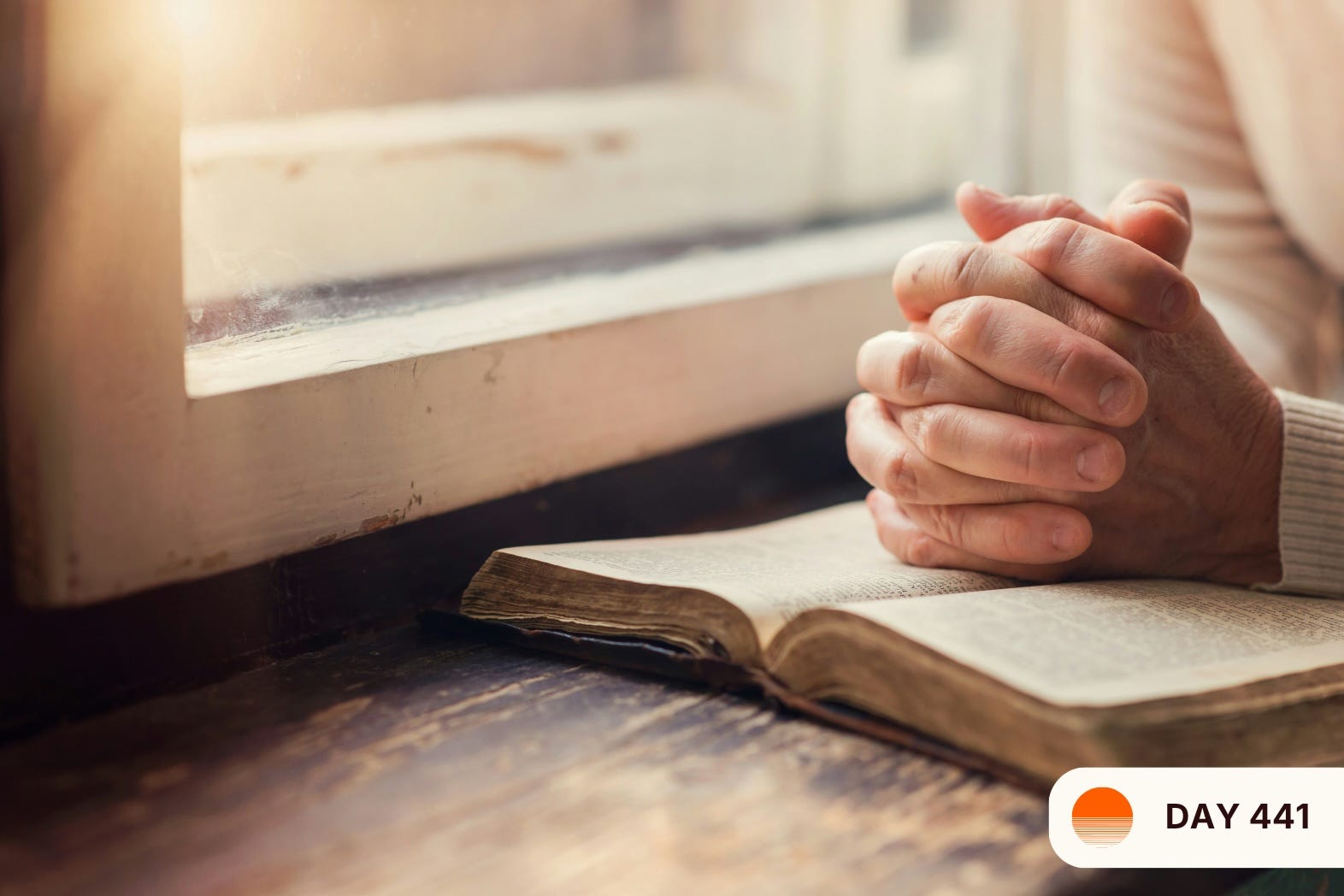
Getty Image from Unsplash (Thank you!)
With so many new members of our hopeful community, I’m getting more answers to my question of “What gives you hope?” Many of those answers surround your faith. For those of you who are new to us, I wanted to send you a “mash up” of two different posts that I did on faith. One was fairly recently on July 31, 2026 and the other was on June 1, 2026. For those of you who have been readers for a while, these may appear to be repetitious. Yet, I find that the similar yet different lens on Faith and Hope actually provide all of us with a new perspective. I hope you enjoy them.
(For this occasion, I’ve created a new graphic which I found on “unsplash,” a public domain site of different artwork to which I now subscribe.)
July 31, 2026
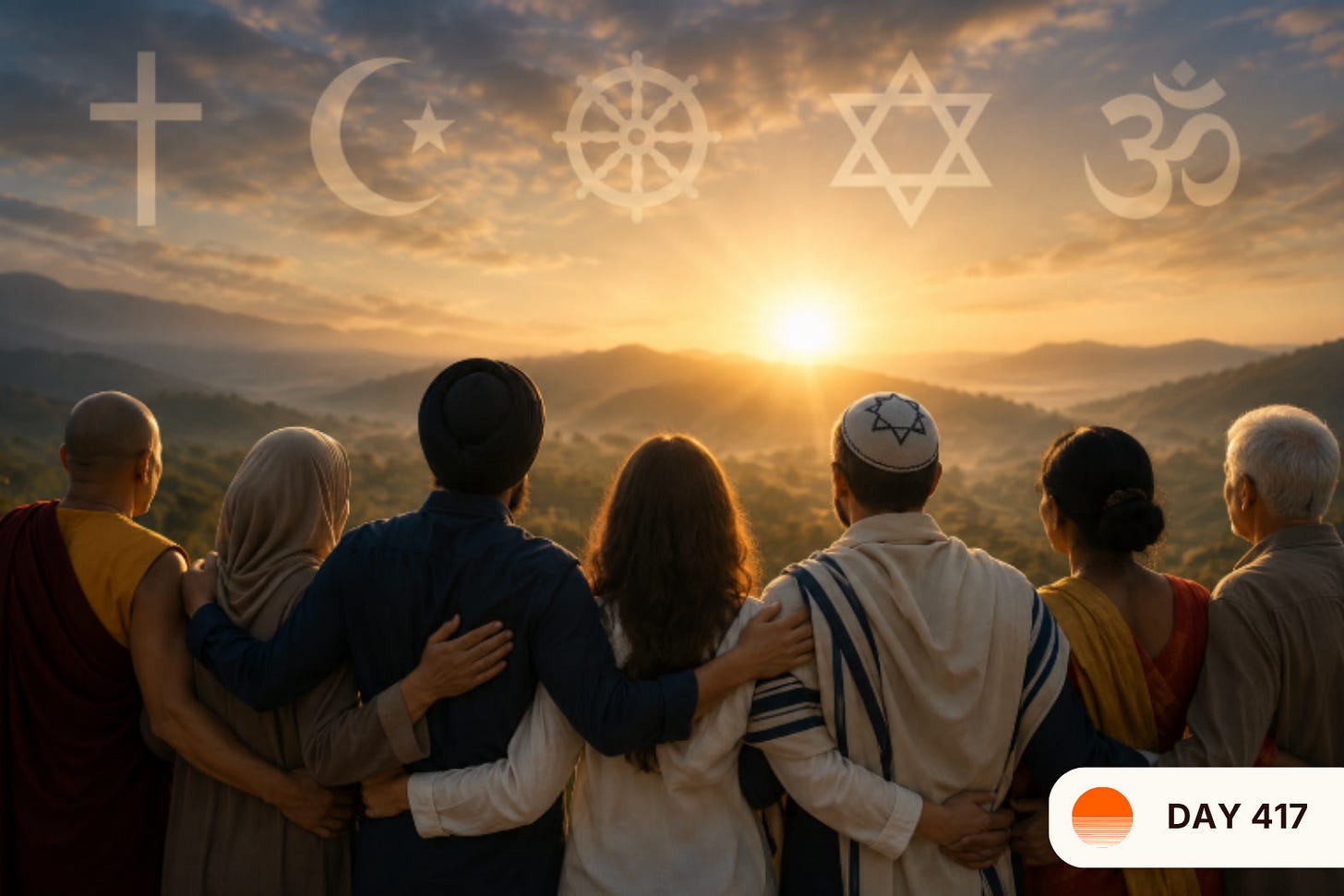
I was reading through your comments sent directly to me about what gives you hope. I couldn’t stop noticing something: so many of you said your hope comes from faith. Not the same faith, either. Christianity, Islam, Buddhism, Judaism, Hinduism, and more. Different books, different gods, different rules for how to live a good life. And yet here you all are, saying the exact same thing: hope.
So I went looking. What do these religions actually have in common that keeps producing the same feeling in people who’ve never met and never will?
Turns out psychologists asked almost this exact question, and the answer surprised me. Back in the early 2000s, two researchers, Christopher Peterson and Martin Seligman (a Professor at my alma mater), tried to map “good character” across nearly every major tradition on record — Confucius, Aristotle, the Torah, the Quran, Buddhist texts, Norse mythology—all of it. They weren’t hunting for hope specifically. They were just looking for overlap. And hope kept showing up on its own, in traditions with zero contact with each other.
Nobody copied anybody. They just kept arriving at the same idea, independently, like they were all trying to solve for the same missing piece.
I’ll go one step further than the researchers did, because this is my newsletter and I’m allowed an opinion — I think that’s also why switching religions rarely wrecks someone’s hope, but losing the community around one often does.
So this isn’t really a post about any one religion. It’s about the thing sitting underneath all of them: hope.
What’s a moment, from your faith or your family or anywhere else, where you actually felt that your religion provided you with hope? Tell me in the comments.
Jun 01, 2026
Eight years ago, I flatlined.
My heart stopped. The monitors went silent. And somewhere in that space, that impossible, unmeasurable space between here and gone, something happened that I am still, to this day, trying to find the right words for. I came back. And the first coherent thought I had wasn’t fear, or relief, or even gratitude. It was quieter than all of that. It was this:
There’s a reason.
I didn’t know what the reason was. I still don’t know the full shape of it. But I have never — not for a single day in the eight years since — stopped believing it exists. And I’ve come to understand that that belief, that stubborn, unverifiable, unshakeable certainty that my surviving meant something, is the purest definition of faith I have ever encountered.
I’ve been sitting with this question ever since a member of our community sent me a message that stopped me mid-scroll. She wrote: “I don’t go to church. I don’t pray. But every morning I wake up believing today will be different. Is that faith?”
It is. And with 96 countries now in this community when I write the word faith, it lands differently in each of you. For some, it is God. For others, it is science. For some, it’s the stubborn, irrational belief that the phone will ring with good news. For others, it’s a grandmother’s voice saying you’re going to be okay, baby. All of it counts.
So let’s talk about what faith actually is because I think most of us have been handed a definition too small for what we actually experience.
is trust in something larger than yourself — a divine presence, a sacred text, a spiritual lineage that stretches back further than your own life. For billions of people, faith is relational. It is a conversation with God, Allah, the Universe, the ancestors. It is the practice of surrender: I don’t fully understand, but I trust the design. This kind of faith doesn’t require certainty. In fact, most theologians across traditions will tell you faith lives precisely in the absence of certainty. Doubt isn’t the opposite of faith. Doubt is often where faith begins.
I know this firsthand. Lying in a hospital bed after my heart attack, I wasn’t certain of anything, not theologically, not medically, not personally. But I was certain of one thing: I was still here, and that meant something. That certainty had no proof behind it. It was pure faith.
is quieter, but no less real. It’s the scientist who doesn’t know if the experiment will work but runs it anyway. It’s the mother who keeps showing up for a child who has pushed her away. It’s the entrepreneur who pitches again after the third rejection. The philosopher William James called this the “will to believe”: the active choice to act as if something is possible before you have proof. That choice, James argued, is itself a creative force. It changes what becomes possible. When I started building this community in the years after my heart stopped, I had no proof it would matter. I had a will to believe it might. That’s secular faith. That’s also how this community reached 96 countries.
and this one I think we under-celebrate: is faith in people. The belief that humans, despite all evidence to the contrary, are fundamentally trying. I saw it in the faces of the medical team working on me. People who had never met me, pouring themselves into keeping me here. Relational faith is what holds communities together. It’s what makes you trust a new friend, love a new city, believe in a new beginning. It’s what makes a stranger’s hands feel like the hands of someone who was always supposed to find you.
perhaps the most overlooked and it lives in the body, not the mind. My body kept fighting before my mind had any say in it. My heart, when it came back, didn’t ask for my permission. It just resumed. There is something in us (call it biology, call it spirit, call it grace) that orients toward survival before we’ve consciously chosen it. This is faith as muscle memory. As instinct. As the part of you that keeps breathing even when your mind has given up the argument. I didn’t think my way back. Something deeper than thought made the decision.
Here’s the surprising thing research keeps confirming, and it still startles me: people with a strong sense of faith (religious or secular) recover from trauma measurably faster. A landmark study published in the Journal of Health Psychology found that what predicted resilience wasn’t the specific content of someone’s belief system. It was the coherence of it. The sense that life has meaning, that suffering isn’t random, that there is a story you’re inside of and that orientation, whatever its source, appears to be neurologically protective. Faith isn’t just comfort. It is a cognitive architecture that makes hope structurally possible.
I lived this. The belief that I survived for a reason didn’t just make me feel better. It made me move differently. It gave the days after my heart attack a direction. I didn’t need to know the reason’s full shape to let it guide me. The faith in its existence was enough.
Which brings me to the relationship between faith and hope — because they are not the same thing, even though they live in the same house.
Hope is “things will get better.” Faith is the belief that getting there is possible even when you can’t see the path; even when the monitors have gone flat; even when the room has gone very, very quiet. Faith is what you carry when hope goes silent. When I flatlined, I wasn’t capable of hope — I was unconscious. But something in me, or around me, or both, had faith on my behalf. And I came back into a world that still had reasons in it.
Here’s the stance I want to take today, one that might surprise you:
I don’t think surviving is random, and I don’t think you need a medical explanation to know that. Every person who has walked through something they shouldn’t have survived (a diagnosis, a crash, a night that felt unsurvivable) and come out the other side carrying the question why am I still here? is already living inside faith. The question itself is an act of faith. You’re asking it because you believe the answer exists.
I believe it does. For you. For all of us still here, still asking.
Soft, aching, and full of the kind of hope that doesn’t shout — it whispers. The lyric “I saw a friend of mine the other day / and he told me that my eyes were gleaming” captures something faith does that we rarely talk about: it shows in you before you even realize it’s there. It’s what people saw in me after my heart attack, long before I felt it myself. Play this on a morning when you need to remember you still have it — because you do.
If you’ve ever walked through something you weren’t sure you’d survive — an illness, a loss, a moment where the ground disappeared — what did you hold onto? Not what should you have held onto. What did you actually reach for in that moment?
And if today’s dose was useful, share it with someone who could use some hope.
Most people wait for life to feel lighter before they feel hopeful again.
This was built for the days when it doesn’t.
For $5/month, upgrade to receive the full daily essays.
Comments
Nothing yet. Say the first thing.
Sign in to join the conversation.