

My patients hear me say this constantly. Tell me your total cholesterol and you’ve told me about as much as you’d tell me by saying you’re five foot four. It’s a data point. It isn’t a story. Or a diagnosis.
That lands hard for people who have carried that number around like a diagnosis. Someone told them 214 was bad, put them on a statin, they went home scared, and nobody explained what cholesterol does or why the body makes it on purpose.
About 75 to 80 percent of the cholesterol in your blood was built by your own liver, on purpose, every day.
It builds your hormones. Estrogen, progesterone, testosterone, cortisol, DHEA. Every one of them is made from cholesterol. That’s not a theory, it’s the assembly line. Cholesterol is the raw material and your body has no substitute for it.
So a woman with a total cholesterol of 145 who feels flat and tired and can’t sleep is not a mystery to me. You cannot build good hormones without good cholesterol. Same for men and testosterone. If you’re in perimenopause and exhausted and your number is scraping the floor, those two things belong in the same conversation.
It’s in every cell you have, keeping your membranes stable.
Your vitamin D starts as cholesterol sitting in your skin, waiting for sunlight.
You can’t digest fat without it. No bile, no absorption of fat or vitamins A, D, E and K.
Your brain is loaded with it. Two percent of your body weight, about a quarter of your body’s cholesterol. I want that raw material in good supply for the decades you’ll need it.
Cholesterol is a fat and your blood is mostly water, so your body packs it into carriers and ships it. LDL is a delivery truck heading out to your tissues. HDL is the return truck. Neither one is good or bad.
So “LDL cholesterol 138” isn’t measuring bad cholesterol. It’s estimating the cargo, and it says nothing about how many trucks are on the road. Two people with the same LDL can have very different particle counts and very different risk. Their reports look identical. An elevated LDL does not mean you have bad cholesterol and need to go on a statin it means you need more testing.
That gap is why advanced testing exists.
Triglycerides climb with sugar, refined carbs, alcohol and ultra-processed food. They’re an early sign of insulin resistance and they move before glucose does, long before your A1c gets flagged. When I see 190, I’m thinking about your pantry and your fasting insulin, not your fat intake.
Check your thyroid too. An underactive thyroid raises triglycerides and cholesterol and it gets missed constantly.
Then do the math nobody does for you. Divide triglycerides by HDL. Under 2, ideally under 1. Free, because you already paid for both numbers.
Normal ranges come from a bell curve of a population that is tired, inflamed and metabolically sick. Normal is common. Optimal is healthy.
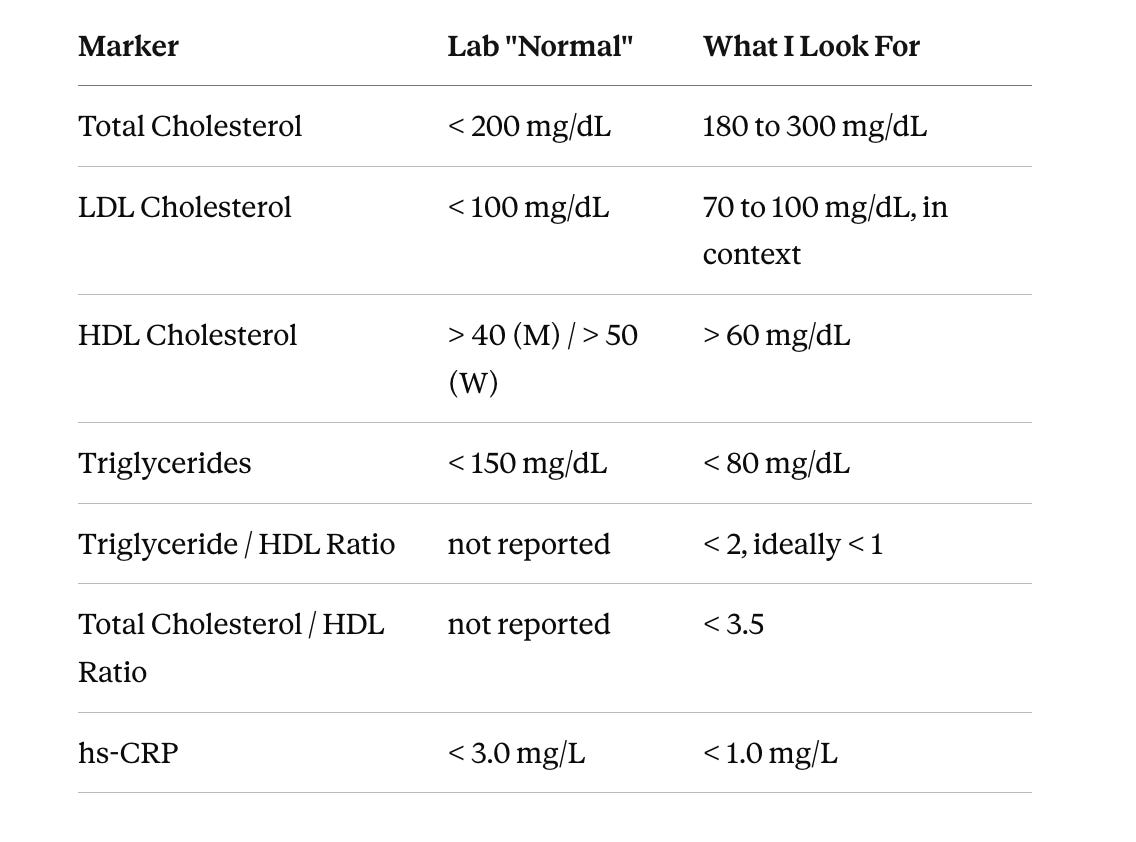
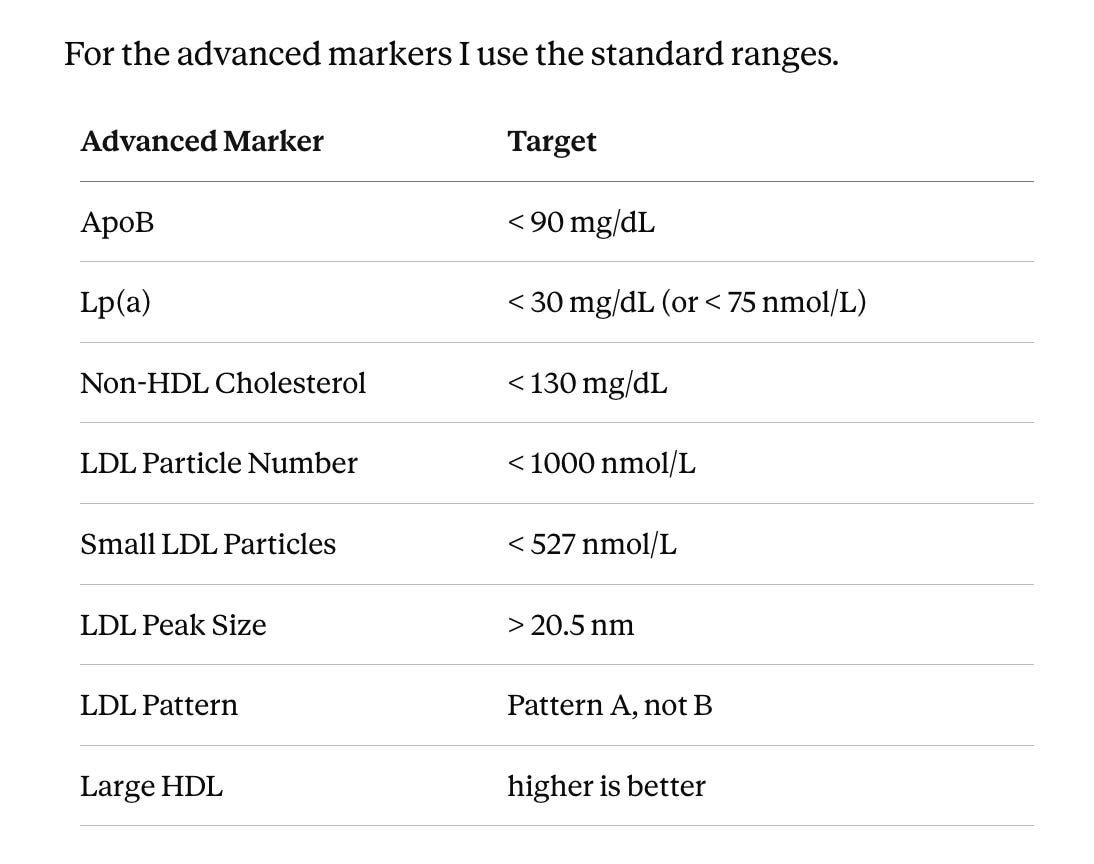
Labs use different methods for the particle counts, so track your trend at one lab rather than comparing across them.
I worry more about a total cholesterol of 140 than one of 240.
A study in Scientific Reports followed 12.8 million Korean adults and recorded 694,423 deaths. The relationship between total cholesterol and death from any cause was a U-curve. Lowest death rate at 210 to 249 mg/dL for most groups, and the risk of being low was steeper than the risk of being high. Read that again. This is my experience in my practice too.
I like to see total cholesterol between 180 and 300, read alongside everything else. Your hormones, your brain and your cells are built out of it, and a number in the 140s usually means something upstream needs attention.
The honest limitation, and I’d rather say it than have someone say it for me. This is observational, and low cholesterol can be a result of illness rather than a cause of death. Cancer, liver disease, eating disorders, malnutrition, leaky gut and frailty all pull it down. That’s fair criticism. It’s also not a reason to assume lower is always winning. I want to know why a cholesterol of 140 is 140 before anyone celebrates it.
The rules changed in March 2026. Your doctor runs a calculator called PREVENT that estimates your odds of a heart attack or stroke over ten years. Over 5 percent, a statin should be considered.
PREVENT replaced an older calculator, and the chair of the guideline committee said plainly that the old one overestimated risk by 40 to 50 percent. Then the threshold to prescribe dropped from 7.5 percent to 5.
Better calculator, lower bar, and now over 60 percent of American adults aged 30 to 79 qualify for a statin. Six in ten.
Notice the direction. Every revision since 1988 has widened the net.
Some facts, and I’ll let you do what you want with them. Eight of the nine authors of the 2004 cholesterol guidelines had financial ties to statin makers. The BMJ reported a majority of the 2013 panel had current or recent industry ties. Multiple authors of the 2026 guideline declared industry affiliations. And the money isn’t where people assume. Statins are generic and cost a few dollars. The 2026 guideline lowered LDL targets and brought in five newly approved drugs, and generic statins often can’t reach those goals on their own.
Credit where it’s due. The guideline now says check Lp(a) once in every adult, use apoB, and use calcium scoring. Those are the tests I’ve been telling people to ask for.
Japan ran a study called J-LIT. They put 52,421 patients on simvastatin and followed them for six years, then looked at where people’s cholesterol landed on the drug and who died.
It was a J-curve. The lowest cholesterol group had higher total mortality, and the leading cause of death was cancer. The researchers running it wrote that patients need close monitoring when cholesterol falls sharply on a statin, and they suggested aiming for a total cholesterol under 240 instead of chasing it down.
That’s their conclusion, not mine, from their own trial.A 30 percent reduction sounds enormous. Here’s what it can mean. Your risk was 4 out of 100 and now it’s under 3 out of 100. Both of those are the same sentence. One of them makes you feel rescued. It also makes your doctor feel like they helped and followed the rules.
Three groups.
People whose screening lipid panel came back abnormal. People being told to start a statin. And people carrying other cardiovascular risk, meaning a family history of early heart disease, diabetes or insulin resistance, high blood pressure, or a history of smoking.
If your screening panel was clean and none of that is you, skip all of it.
For everyone else, get the full picture before anyone makes a decision. Function Health runs the whole set in one draw: ApoB, Lp(a), LDL particle number, LDL small, LDL medium, LDL peak size, LDL pattern, HDL large, non-HDL cholesterol, total cholesterol to HDL ratio, and hs-CRP. ($25 off with my link: Function Health)
Two matter most. ApoB puts one molecule on every plaque-forming particle, so it counts the trucks instead of guessing at cargo. In a UK Biobank analysis of 502,413 people, when apoB and LDL disagreed, apoB tracked the real risk. Lp(a) is genetic, unmoved by diet, and now carries the guideline’s strongest recommendation to check once in every adult. Most people never have.
Then imaging. A coronary artery calcium score looks at your actual arteries, runs $100 to $200, often cash pay. Zero isn’t immunity, since in the MESA study a quarter to a third of cardiac events happened in people scoring zero, because soft plaque hasn’t calcified yet. A CCTA sees what a calcium score misses. I should add that I would not do a calcium score on a patient over 55 years old.
Most people tolerate statins without much trouble. A lifelong medication still deserves a real accounting.
Diabetes risk goes up. A meta-analysis of 13 trials and 91,140 people found statins raised the odds of developing diabetes over four years, with higher doses carrying more risk. A drug meant to lower heart risk nudging you toward the condition that drives heart risk.
Muscle symptoms, and here’s the messy truth. Observational studies report aches in 10 to 29 percent of people. Blinded trials report 1 to 5 percent, and a meta-analysis of 83,880 people found no difference between statin and placebo. Serious muscle injury runs about 1 in 10,000 a year. On the epigenetic testing I do I can see if you have a vulneratiblity to not tolerating a statin.
Liver enzymes can rise, which is why they’re monitored.
None of this is a reason to stop a statin you need. If you’ve had a heart attack, this list doesn’t change my answer. It’s a reason to be sure before you sign up for thirty years.
Almost nobody gets real lifestyle intervention. They get told to eat healthy, and then they leave.
That phrase means nothing anymore. Ask ten Americans what healthy eating is and you’ll get ten answers, most of them shaped by a food label or a decade-old guideline. Low fat. Whole grain cereal. Margarine instead of butter. Some of what people were told was heart-healthy is a direct cause of the triglycerides on the panel now.
Here’s what I do instead. Sleep. Fasting insulin. What they eat and when. Whether they move. Alcohol. Stress they’ve stopped noticing.
It works on the exact markers we’ve been talking about. In a randomized trial of a Mediterranean diet plus exercise in people with metabolic syndrome, small dense LDL went down and large LDL particles went up. The dangerous pattern shifted toward the safe one. In PREDIMED-Plus, a year of diet and exercise improved triglycerides, HDL, fasting glucose, waist circumference, HbA1c and insulin resistance at once.
No prescription does that. A statin lowers your LDL and leaves everything else exactly where it was.
This takes months and it cannot be delivered in eleven minutes by someone with a full waiting room. Lifestyle doesn’t replace medication for everyone but I would like to argue it can for most and those that are motivated. Almost nobody gets a fair shot at it first, and then we call the statin necessary.
Familial hypercholesterolemia. A genetic condition in about 1 in 250 people causing lifelong extreme LDL and early heart disease. These patients need treatment, often aggressive and often young. If numbers in the 300s run in your family alongside heart attacks in people’s forties, that’s a cardiology conversation.
If you’ve already had an event. After a heart attack, stent or stroke, the statin evidence is strong. I’m not the person telling you to stop.
What I push back on is the wide middle. In a meta-analysis of eight primary prevention trials covering 65,383 adults aged 50 to 75, only one of the eight showed reduced all-cause mortality, and it took about 2.5 years of treating 100 people to prevent one cardiac event. Cochrane’s review did find a mortality benefit, so the literature isn’t unanimous.
Nobody handed you those numbers along with the prescription.
Can we run an apoB instead of relying on my calculated LDL.
Have I ever had an Lp(a) drawn, and if not, can we do it once.
What is my triglyceride to HDL ratio.
Would a coronary calcium score change what we decide here.
What’s my absolute risk reduction over five years, not the relative reduction.
None of this is anti-medication. It’s anti-guessing. Plenty of people who ask these questions end up on a statin with a much clearer sense of why, and that’s a good outcome.
But this decision deserves more than fifteen minutes. It’s a drug you may take for thirty years, chosen off a screening number and a calculator, usually without anyone checking the tests that would tell you whether you need it or trying the thing that might mean you don’t.
Thursday, for paid subscribers: a tool you can drop your full lipid panel and risk factors into, that reads it the way I read it and tells you what to look at next. Plus what real cardiovascular intervention looks like, how a woman’s risk shifts through menopause, and why HRT is not my first tool for protecting a woman’s heart.
Yi SW, Yi JJ, Ohrr H. Total cholesterol and all-cause mortality by sex and age: a prospective cohort study among 12.8 million adults. Scientific Reports. 2019;9:1596.
Yadlowsky S, et al. Clinical implications of revised pooled cohort equations for estimating atherosclerotic cardiovascular disease risk. Annals of Internal Medicine. 2018;169(1):20-29.
Rana JS, et al. Accuracy of the atherosclerotic cardiovascular risk equation in a large contemporary, multiethnic population. JACC. 2016;67(18):2118-2130.
Sniderman AD, et al. Discordance among apoB, non-high-density lipoprotein cholesterol, and triglycerides. European Heart Journal. 2024;45(27):2410.
Yourman LC, et al. Evaluation of time to benefit of statins for the primary prevention of cardiovascular events in adults aged 50 to 75 years: a meta-analysis. JAMA Internal Medicine. 2021;181(2):179-185.
Taylor F, et al. Statins for the primary prevention of cardiovascular disease. Cochrane Database of Systematic Reviews.
Landray MJ, et al. Effects of extended-release niacin with laropiprant in high-risk patients. New England Journal of Medicine. 2014;371(3):203-212.
Sattar N, et al. Statins and risk of incident diabetes: a collaborative meta-analysis of randomised statin trials. The Lancet. 2010;375(9716):735-742.
Cheeley MK, et al. Assessment and management of statin-associated muscle symptoms (SAMS). Journal of Clinical Lipidology. 2022;16(4):361-375.
Salas-Salvadó J, et al. Effect of a lifestyle intervention program with energy-restricted Mediterranean diet and exercise on weight loss and cardiovascular risk factors: one-year results of PREDIMED-Plus. Diabetes Care. 2019;42(5):777-788.
Blumenthal RS, Morris PB, et al. 2026 ACC/AHA/Multisociety Guideline on the Management of Dyslipidemia. Circulation / JACC. March 2026.
Blaha MJ, et al. Zero coronary artery calcium score: desirable, but enough? Circulation. 2020;142(10):917-919.
2015-2020 Dietary Guidelines for Americans, 8th edition. USDA and HHS.
This post is for educational purposes only and does not constitute medical advice. Please work with your own healthcare provider for personalized care. Never stop or change a prescribed medication without talking to the clinician who prescribed it.
The most radical act in a sick society is to heal yourself — and then gently help others heal too. — Dagmara
No posts
Comments
Nothing yet. Say the first thing.
Sign in to join the conversation.