
Pedro Oliveira are the guest editors of Diseña #30, themed around Minor Gestures. The deadline is very soon! Full call for papers here.
I responded to 20 questions for the podcast Unique Ways, which felt strange when there wasn’t an exchange on other end. In any case, listen on Spotify or on Apple Podcasts.
My article “Moments of Palestine” was published in Disegno #40: Freedom. Buy a copy. I’ve also scanned the article so you can read it :)
Books:
Design Otherwise: Transforming Design Education in the Arab Region is available for purchase online, or order it at your favourite bookstore.
Designerly Ways of Knowing is available with a new cover (big up Pali!), and is now on its third print! Order here.
Back in February, I received a strange unsolicited email from someone who claims to help “authors whose books address underserved, important conversations but aren’t yet reaching the readers who need them most.” She writes: “Five months after publication, your work has no reviews, and I think that gap between the book’s substance and its visibility is something worth closing.”
I am not sure who this person is or what their actual expertise is, and a quick search produces nothing, which leads me to think it’s a bot masquerading around as someone claiming to help authors. I do not disagree with what she’s saying, and the email made me think about academic service and publishing.
My first book is more successful because it’s not an academic monograph and the publishers have been doing a great job promoting it via book fairs. It’s now in its third print-run1, it has been the subject of a module at a Canadian university, someone designed a workshop around it, another curated an exhibition based on it, friends text me when they see it on someone’s bookshelf, and so in the impact category, it is successful. It has two reviews on Amazon which miss the point of the book entirely (they are very funny though).
I did not bother replying to the email from the person who helps authors because her approach of berating me assumed a familiarity from someone I do not know, but also because my book also came out three months after I gave birth to a child, and the academic machine is EXHAUSTING.
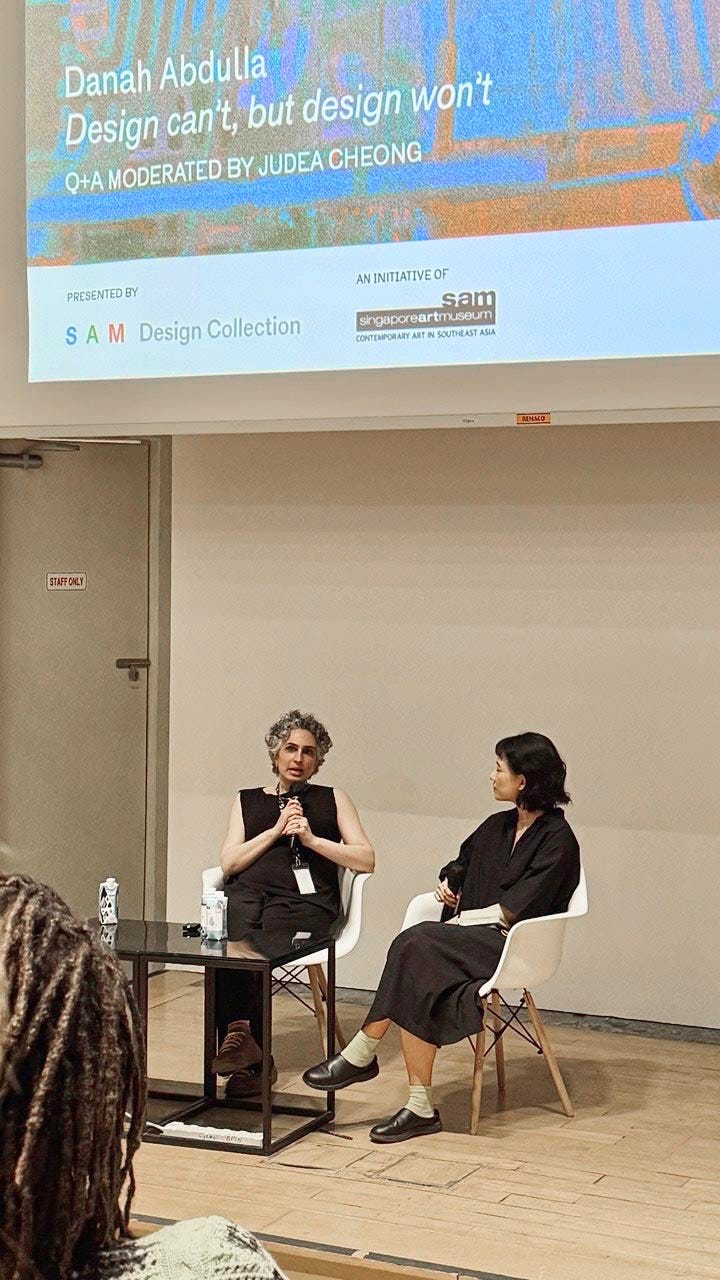
Despite the former, I did have a brief book tour which included a book launch with food and a DJ in London, and several stops across the UK, US, Canada, EU – all of which had a full house and sold books. According to my publisher, the book has demonstrated amazing reach geographically, which is not common for such a niche title. So I would conclude, mission semi accomplished.
In my last newsletter of 2025, I discussed the slop that has taken over the world. The slop is accompanied by an expectation of free work in this gig/precarious/whatever you want to call it economy. I am now entering my eleventh year in academia on a permanent basis, and I am getting fed-up with the demands in the name of “academic service”. I am referring to the free labour ecosystem that exists around academia – from serving on the editorial boards of journals, to reviewing, to tenure reviews, to applications, to recommendation letters, to committees, to student expectations, to working groups, to travel and right to work admin, to learning new systems that do not work. The list is endless, and it gets longer with demands of “picking my brain” regarding something I have written about extensively (I no longer reply to these requests – if I’ve written about it more than once, the information you’re looking for is there).
I have tried to centre the circulation of ideas and scholarship by attracting different audiences. After all, we conduct research on behalf of society, not for the five publishing houses that force us to produce quantity over quality research. Interestingly, I am writing this newsletter and I receive an email from my publisher asking me if I want to opt-in for generative AI licensing of my book…
Two years in a more research-oriented role, focused on churning out grant applications (new normal of UK unis), I’ve come to the realisation that pretty much every awarding body wants you to solve really big problems. In my work, I am interested in taking what appears to be insurmountable and impossible problems, and thinking of them differently by breaking them down into controllable possibilities that redefines the scale. When you propose something that is hyper-localised that addresses part of the system while acknowledging the interdependencies, the grant awarding bodies reject it, claiming it lacks ambition (!!!). My theory is, these awarding bodies don’t want you to actually solve problems; they want you to write about how you will solve big problems like climate change through interventions that don’t actually change anything. They’re interested in big grandiose projects that claim to make change but only maintain the status quo, and the projects they fund stay really theoretical or in a “mapping” stage. It’s disheartening, especially for someone whose work – quoting the person who berated me on email “proposes something actionable.”
However, I have decided to place constraints on how many of these academic service demands I commit to in a year. And by constraints I mean numerical: I am quantifying what they’ve quantified; strict numbers on how many times I will perform each “service” I in a year.
The exploitation system was not always in place and fails to acknowledge the current realities of academic work. The last two decades has seen a profound shift into type of work academics are expected to perform, and this is accepted it without hesitation (academics are trained in knowledge of the status quo2). Academia is vocational, people rarely switch careers, after all, it is a privilege to work in a university, to have a flexible (or inflexible depending on the time of year) schedule, to work with young people on their journey to shaping their research and practice, and to dedicate my time in the life of the mind (allegedly). I am even more grateful for working in an art and design uni, which allows room for experimentation that is not possible in more traditional disciplines.
The UK educational system has changed substantially over the last 15 years, which is well documented in books and articles (see here and here), and I won’t bore you with more about this. The solutions to the problem however are even less imaginative than how it has been marketised: beyond abolishing tuition fees and awarding grants like the ‘good old days’, most people just shrug “what are we gonna do?”, and unions are too busy focusing on the needs of hourly paid lecturers to actually bring forth feasible alternatives. It’s time for real academic service where we put our heads together and imagine an alternative to the tuition-fee and research-intensive systems that exist. If there was a need for another working group, maybe that’s one I’ll join.
In conclusion, buy my book. If you did, give it a review.






Watch: Saw the Wes Anderson exhibit at the Design Museum. I was expecting more on process than just props and costumes but that’s what sells exhibition tickets (£23!). Anderson’s work was innovative at one point, but has since become formulaic and repetitive. BUT, visiting the exhibition did make me rewatch Rushmore, truly one of his best.
Listen: March mixtape
Be well.
Danah (The Pessoptimist)
design books are seldom bestsellers.
See Andrews, K. (2018) ‘The Challenge for Black Studies in the Neoliberal University’, in G.K. Bhambra, D. Gebrial, and K. Nişancıoğlu (eds) Decolonising the University. 1st edn. Pluto Press, pp. 129–144. Available at: https://doi.org/10.2307/j.ctv4ncntg.
Comments
Nothing yet. Say the first thing.
Sign in to join the conversation.