In this weekly feature for Andelman Unleashed, we continue to explore how media of other nations view America and the rest of the world, bringing to bear 60 years of reporting from 90+ countries. We cover lots of ground—diving each week through 30+ newspapers & 100+ websites on every continent. You may not want to read it all, but it’s all here for you!
We can all learn from what others say about us, around the globe.
To accomplish this mission for you, I pay for a host of global media—newspapers, magazines, websites, television—so you all can become better informed about the world…A (lightly) paid, even Founder subscription would help if you are able…and allow you to participate to the fullest in our adventures.
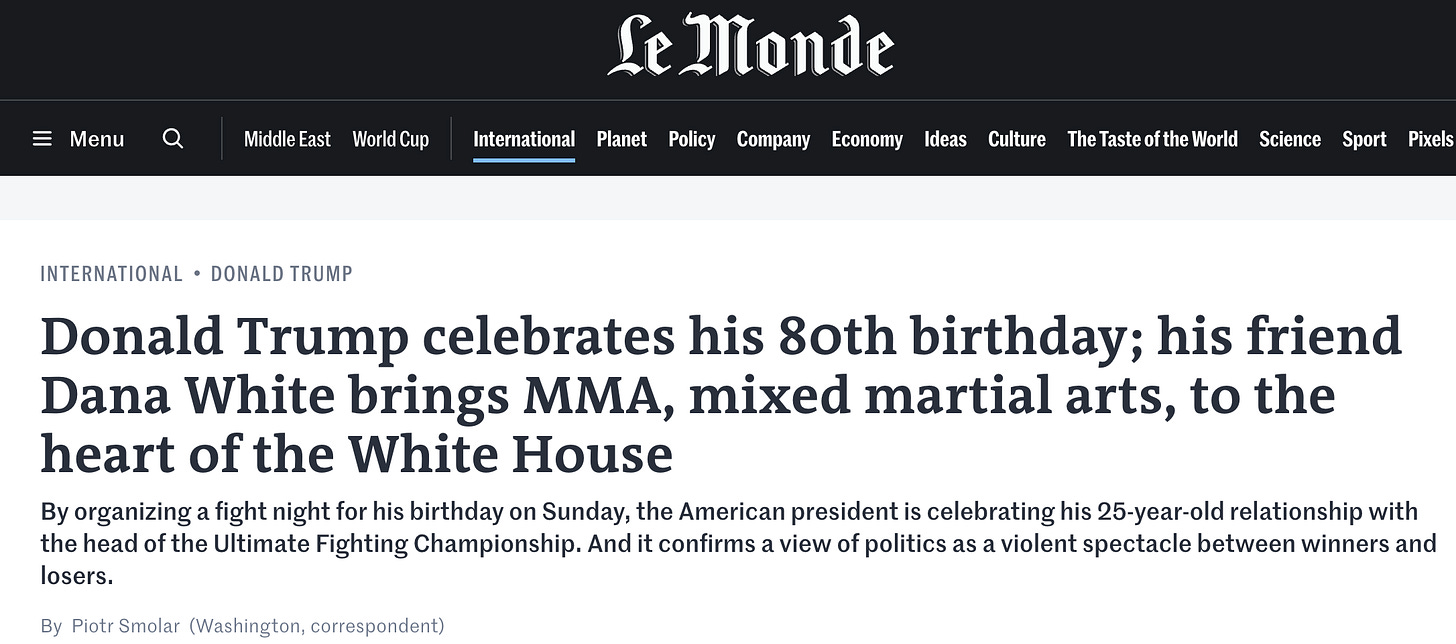
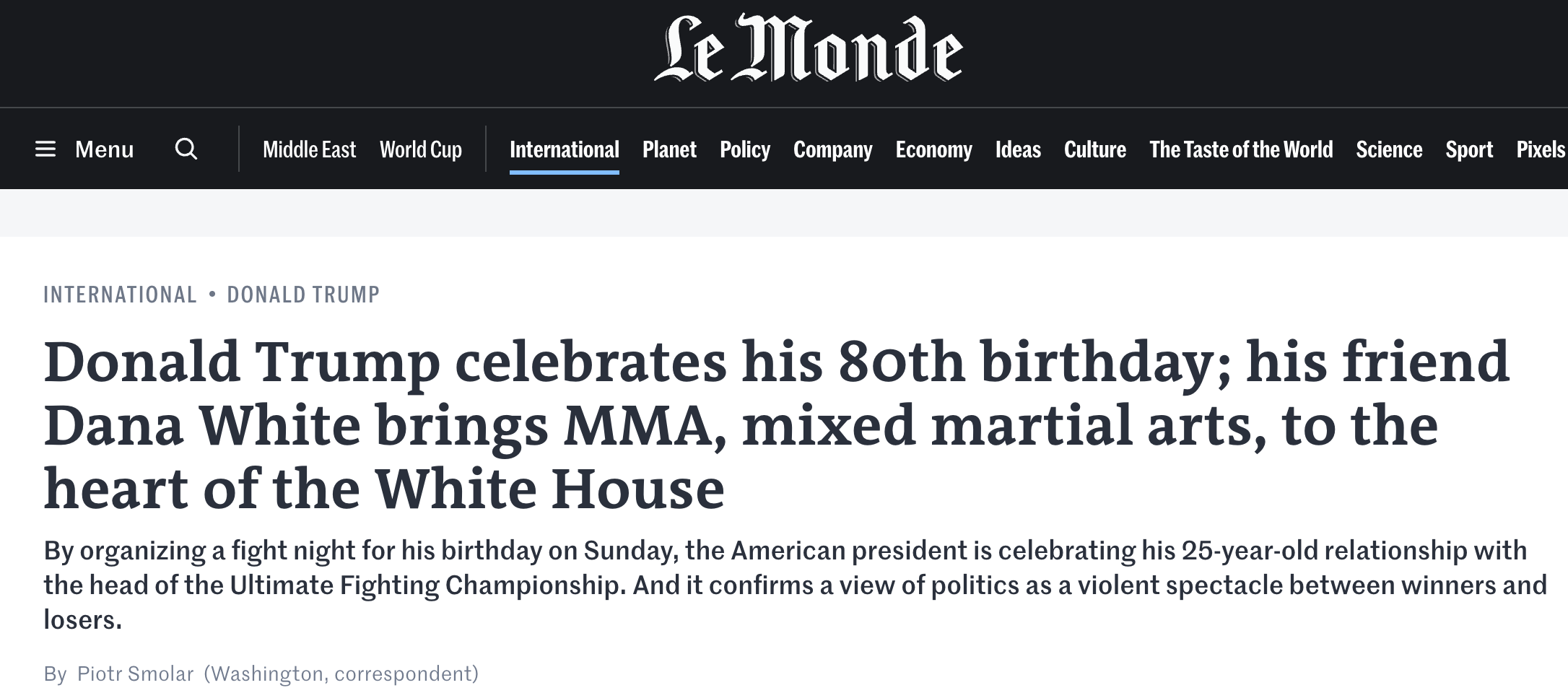
Who’s playing? Just about everyone involved it would seem. First priority, the Cage Match and an 80th birthday … or as Le Monde’s Piotr Smolar puts it:
In the time of the Roman Empire, circus games were not mere entertainment. They served as a tool for social cohesion, demonstrating power and bolstering the emperor’s popularity. This Sunday, 4,000 privileged spectators will take their seats in the stands erected on the White House lawn around a caged octagon, beneath a massive steel structure decorated with the colors of the American flag. It is there that the most sensational and highly anticipated evening in the history of mixed martial arts (MMA) will take place, under the auspices of the Ultimate Fighting Championship (UFC). Giant screens will allow a much larger crowd to enjoy the spectacle near the White House grounds.
The idea was launched in early July 2025 by Donald Trump himself in Des Moines, Iowa. He included it in the plans for the 250th anniversary celebrations of the Declaration of Independence, which began that June. But this event also coincided with the American president’s 80th birthday.
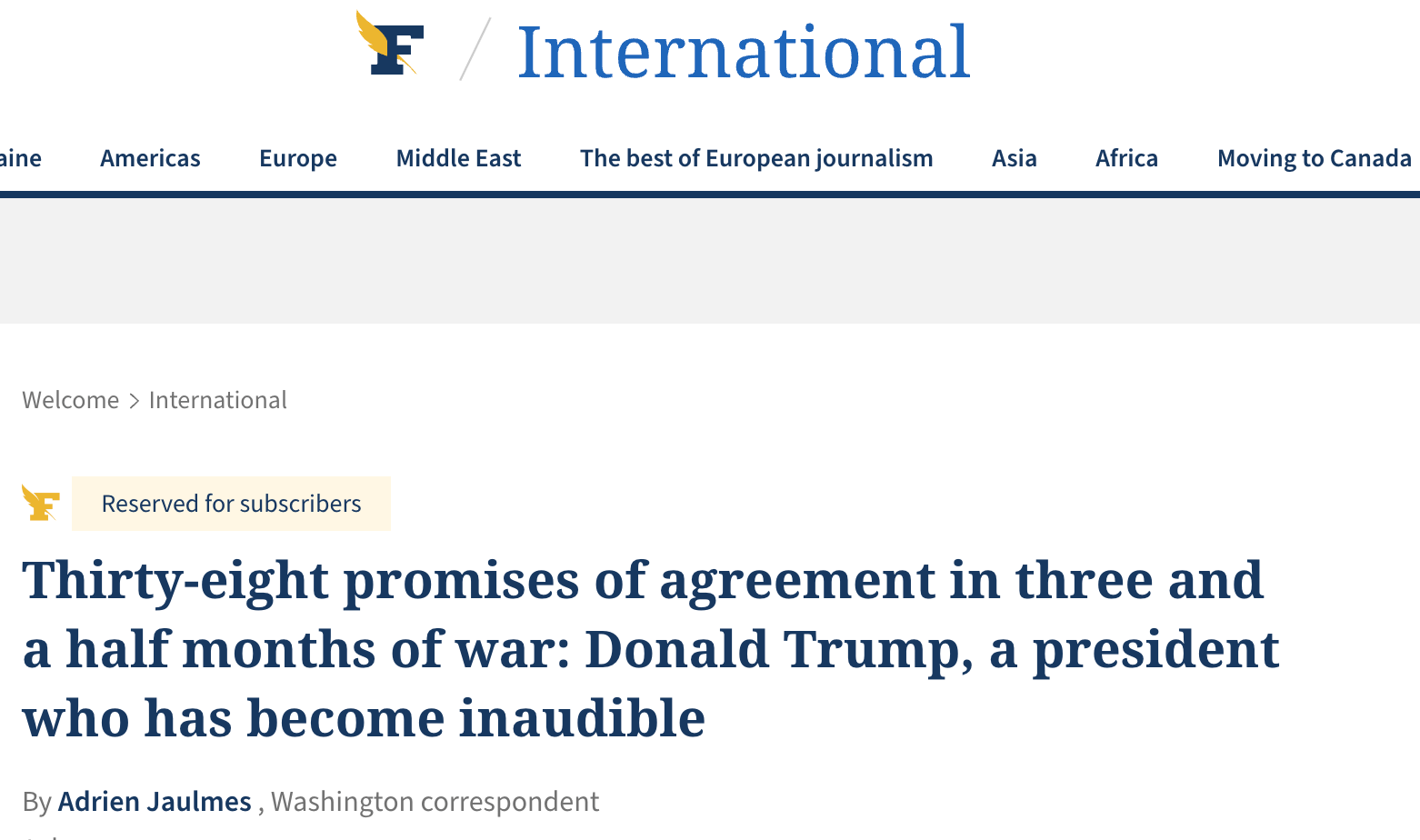
Left in the lurch, of course, were billions around the globe—victims of the war in Iran and the closing of the Strait of Hormuz—who still beg for a solution amid growing ripples of despair. Even Trump’s one-time supporters in Europe’s moderate right appear to be throwing in the towel as Le Figaro writes from Washington:
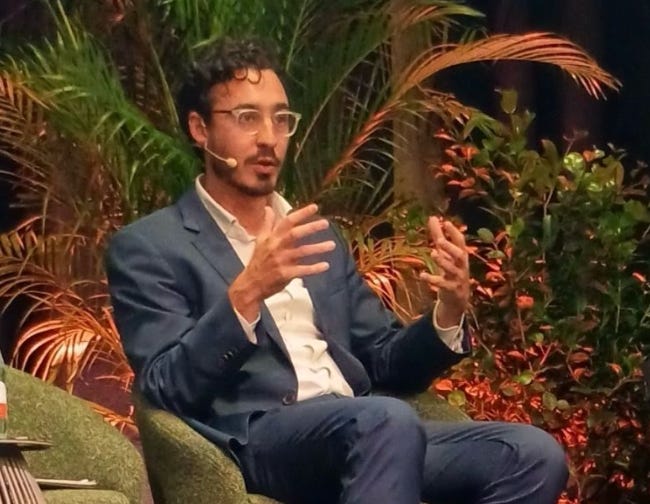
The real and largely unrecognized victims—with very little recourse—are the world’s small states, as a scholar of small nations, University of St. Gallen’s lecturer Wesley van Drongelen told our Unleashed Conversation on Friday, reflecting on America’s largely unremitting attitudes, live from Zurich….
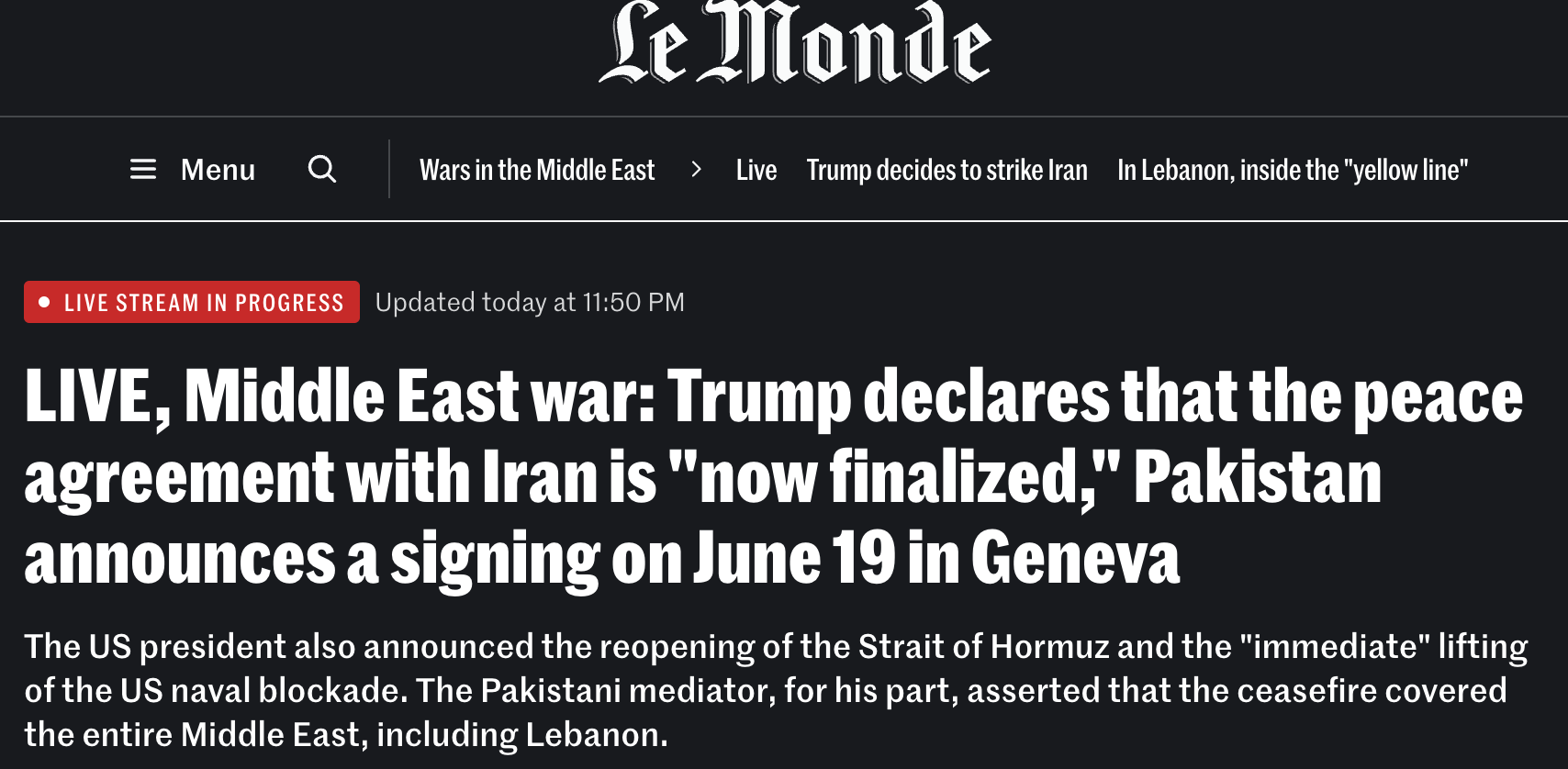
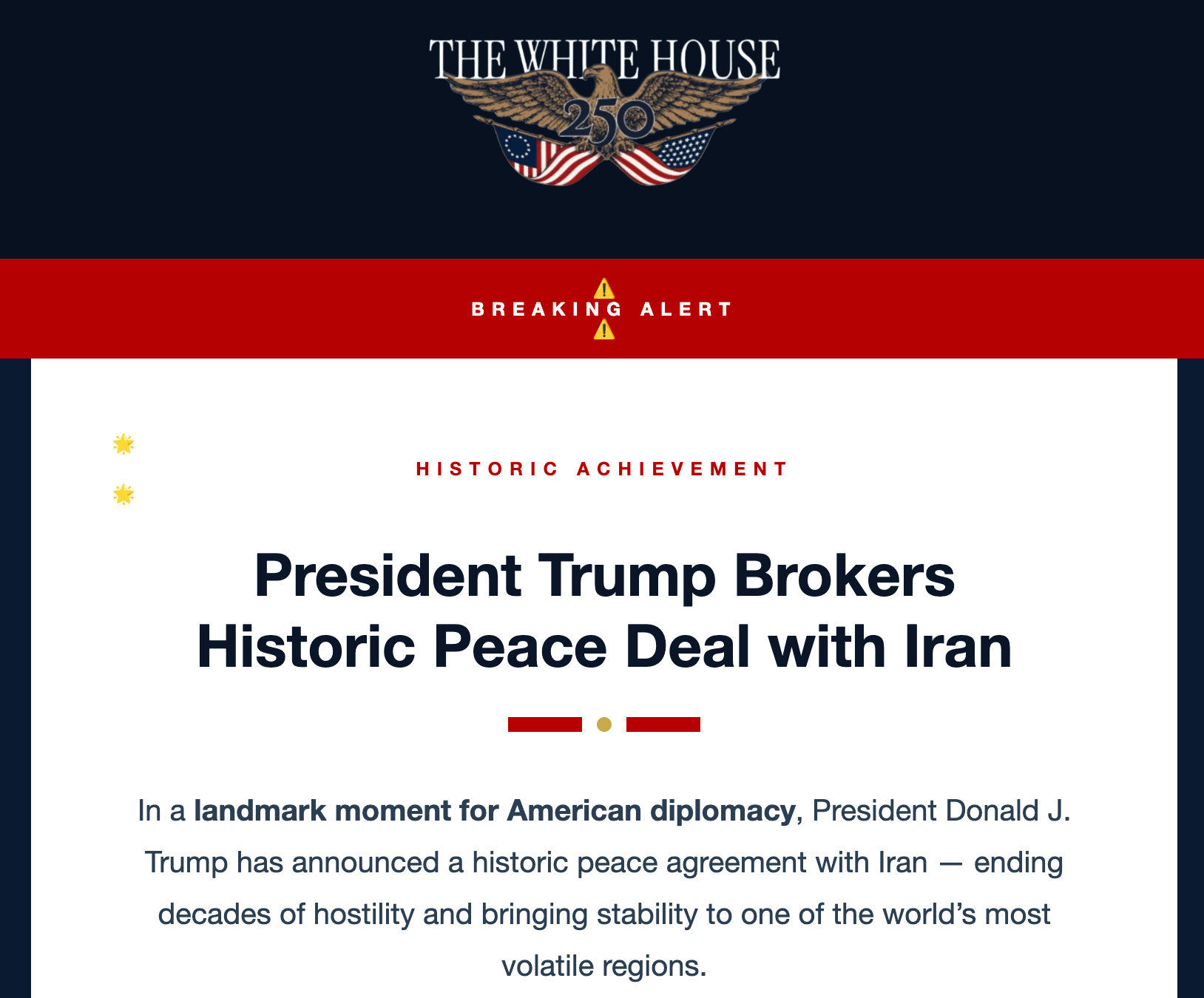
Trump had hoped to sign at least some form of Memorandum of Understanding with Iran that would open the Strait of Hormuz before he meets a pretty united front of skepticism among the G7 nations gathering in Evian (yes the water) under the leadership, this year, of France’s decidedly lame duck president Emmanuel Macron.
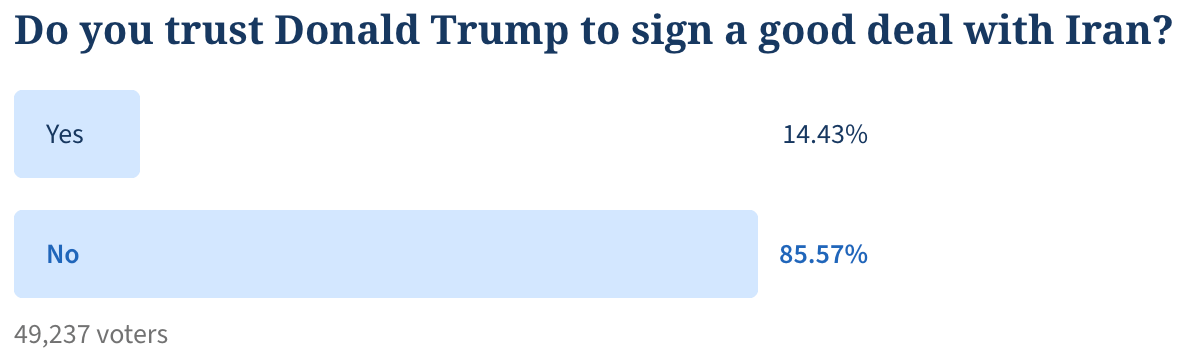
The center-right daily Le Figaro suggested just where its readers were coming down on the cataclysm that is threatening Trump (and the world)…..
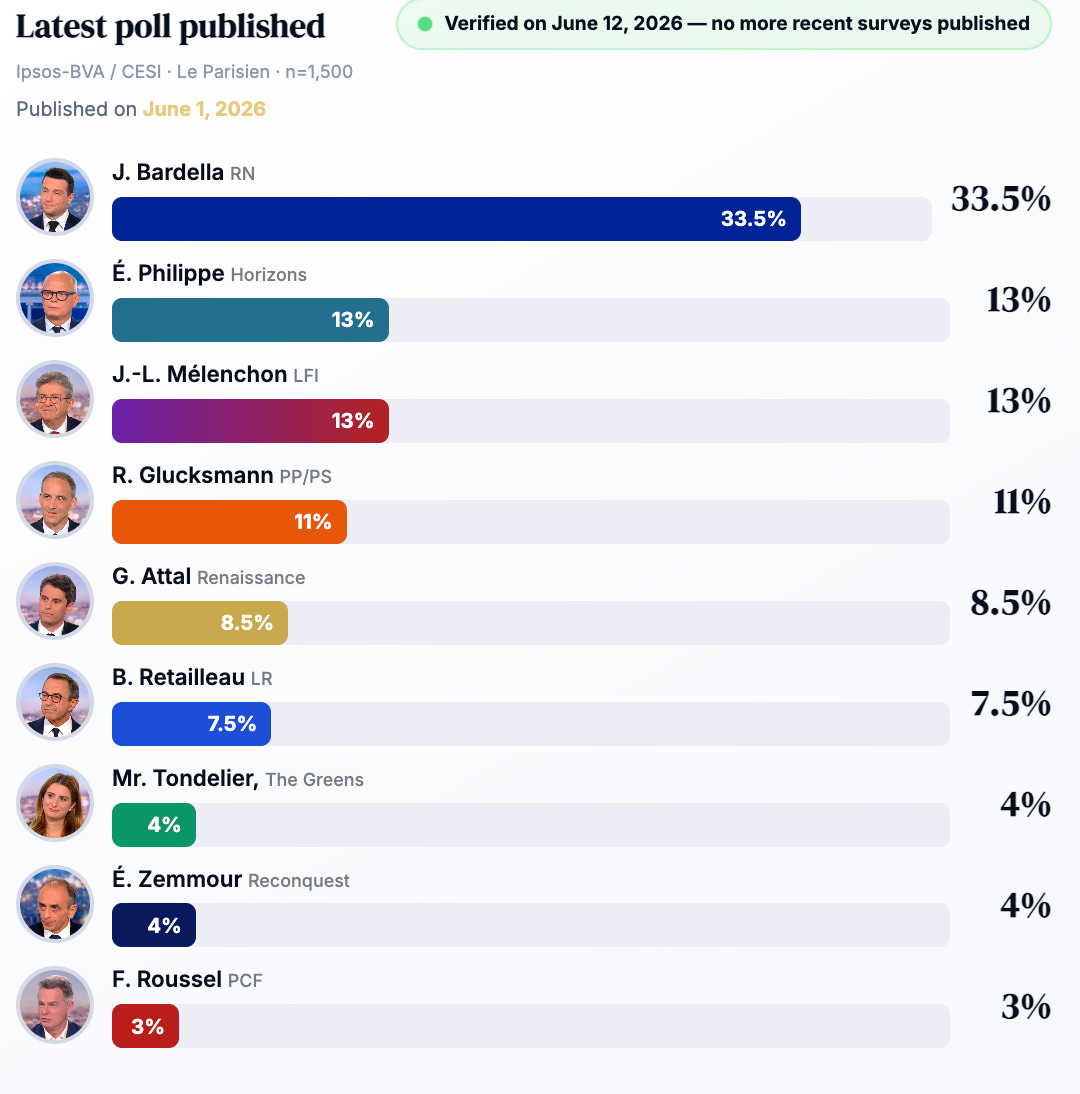
Incidentally, the ‘Yes’ vote is less than half the latest number polled by Jordan Bardella, the far right RN party leader in France’s 2027 presidential contest:
Even Bardella, and by extension his mentor Marine Le Pen, appear to be pulling back from their once full-throated admiration for Trump, as Bardella told Politico France’s Marion Solletty:
Trump’s behavior is “not only erratic but also extremely unsteady and constantly shifting,” said Bardella in the interview. Asked how he views the American president, he said: “It depends on the day. There’s a Monday attitude, a Tuesday attitude, a Wednesday attitude.”
Bardella also rejected a potential endorsement from Trump, who has attempted to influence elections in Hungary, Poland and Argentina by backing leaders who align with his politics. “The support we’re seeking with Marine Le Pen is that of the French people, the support of French voters,” he said. “We don’t need to accept or open the door to any form of interference.”
In March 2024, ahead of Trump’s reelection, Bardella told POLITICO Europe that his “heart leans toward Trump.” In December 2025, when he was asked on French television what he wanted to ask the U.S. president, he replied with a soft laugh: “Where does he get all this energy?”
Young, telegenic and popular on TikTok, the National Rally leader has helped transform a party once regarded as a political outcast into France’s most powerful opposition force. Polls suggest he could enter the Élysée Palace in 2027 if Le Pen’s conviction for embezzlement prevents her from running.
But, pardon the diversion, back to Iran, the Straits and the nuclear weapons overhang which got us into all this in the first place. As Maziar Motamedi reported for Al Jazeera from Tehran:
The two sides on Sunday appeared close to signing the first stage of a deal—but there was also fierce last-minute pushback from hardliners inside Iran, as well as seemingly from Israel. Qatari mediators arrived in the Iranian capital on Sunday to advance the talks. Yet hardliners are also sensing a deal may be near—and are pushing the Iranian side to make as few concessions as possible. The Fars news website, affiliated with the Islamic Revolutionary Guard Corps (IRGC), said Iranian officials were unlikely to sign on Sunday since it was Trump's birthday.
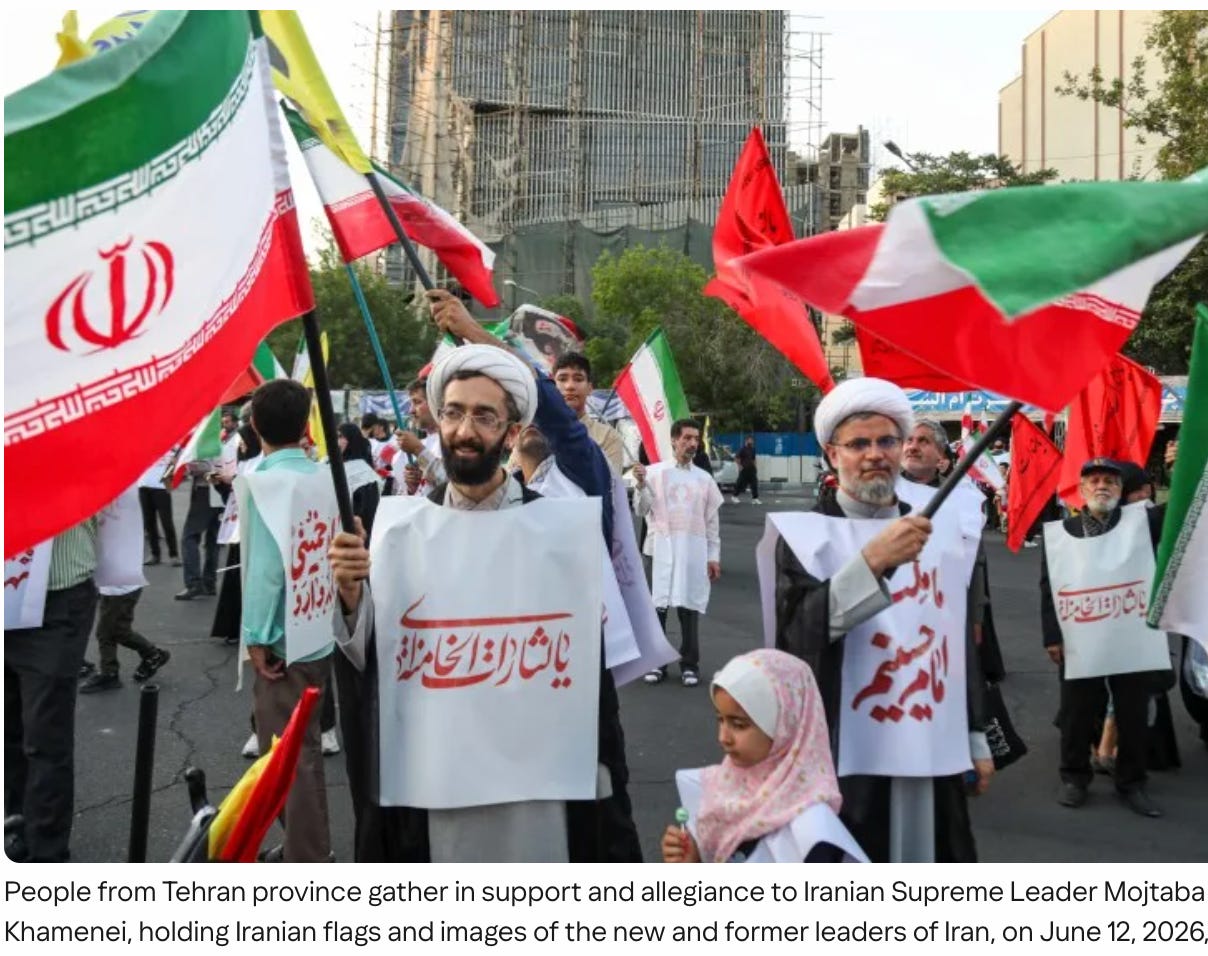
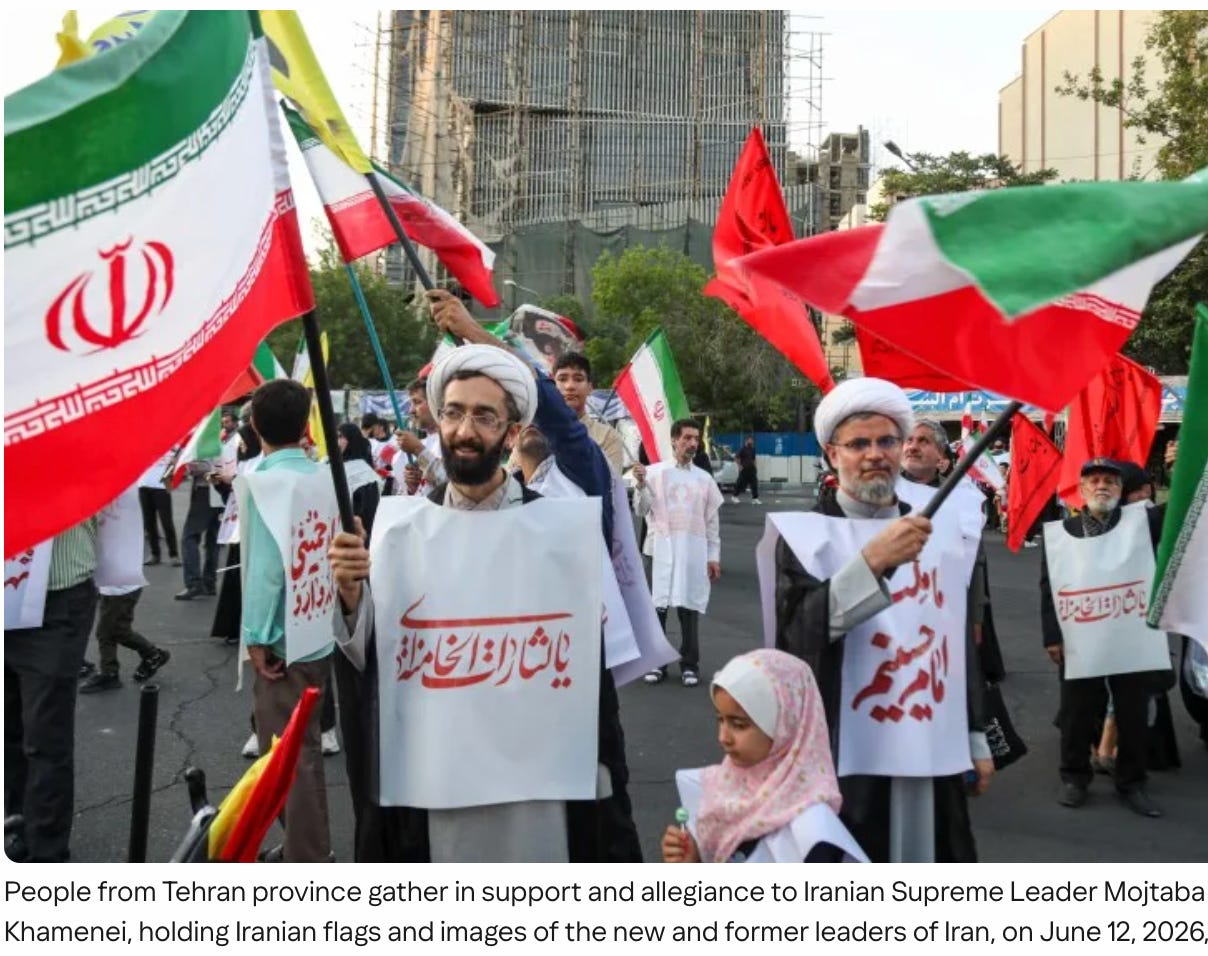
“It is the birthday of the murderer of our supreme leader; have some honour,” Mohammad Mannan Raisi, an anti-deal member of parliament from Qom, told officials while speaking to supporters of the establishment gathered in the streets of the holy Shia city Saturday night. Ayatollah Ali Khamenei, Iran’s former supreme leader, was killed on the first day of the joint US-Israeli air attacks on February 28.
[ Of course, as we publish this, it is now no longer Sunday in Tehran, it is the day after Trump’s birthday.]
In Tehran, Qom and Mashhad, a number of pro-establishment voices expressed their opposition to the deal through speeches, banners and slogans. Some of the chanting directly targeted Mohammad Bagher Ghalibaf, parliament speaker who has been appointed to lead the talks, as well as Foreign Minister Abbas Araghchi.
Mahmoud Nabavian, an ultra-hardline scholar and lawmaker from Tehran, remains the most vocal opponent to an agreement, as with previous deals involving the US and Western powers. Appearing on state television, he carried what he said was a text of the latest draft of the interim understanding, which he believes must not be signed since it throws away perceived political and military achievements gained after months of war with the US and Israel.
Opposition against the deal has also reignited a debate over the power structure in Iran, where decisions require approval from the supreme leader, now Mojtaba Khamenei, and the Supreme National Security Council, comprised of military commanders and government officials. In nightly gatherings and online posts, a number of hardline supporters of the Islamic republic went as far as saying they would oppose the current emerging agreement even if Khamenei greenlights it.
The Elysée presidential palace observed that there will be a lot of eager observers present at Evian—as Macron’s guests:
The Summit will bring together the leaders of the G7 member countries, representatives of the European Union, the partner countries associated with this presidency (Brazil, South Korea, Egypt, India and Kenya), as well as several international organizations and invited countries, including Ukraine and several Gulf States.
On the Memorandum of Understanding between the US and Iran, the Institute for the Study of War parsed it in some detail:
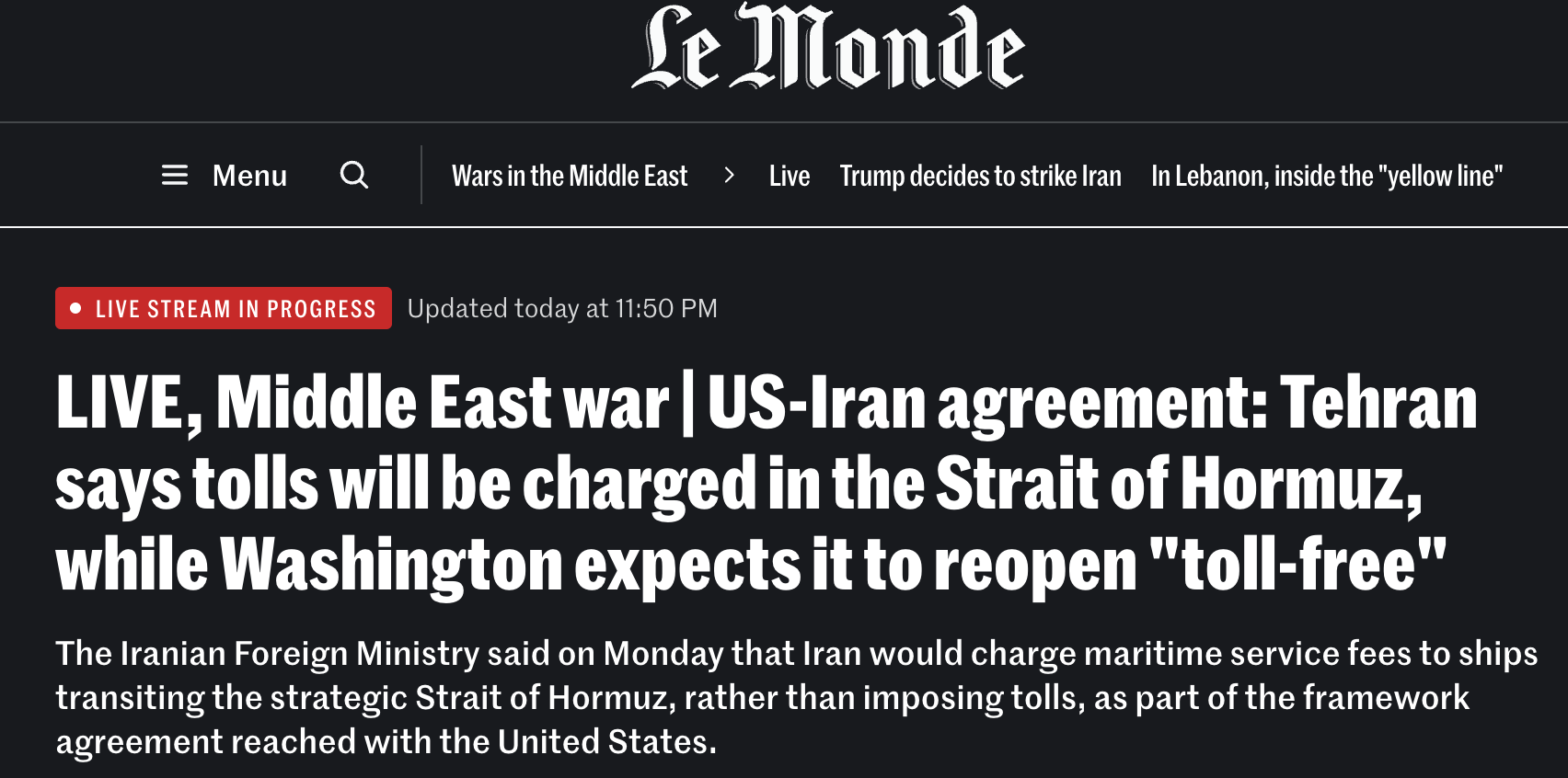
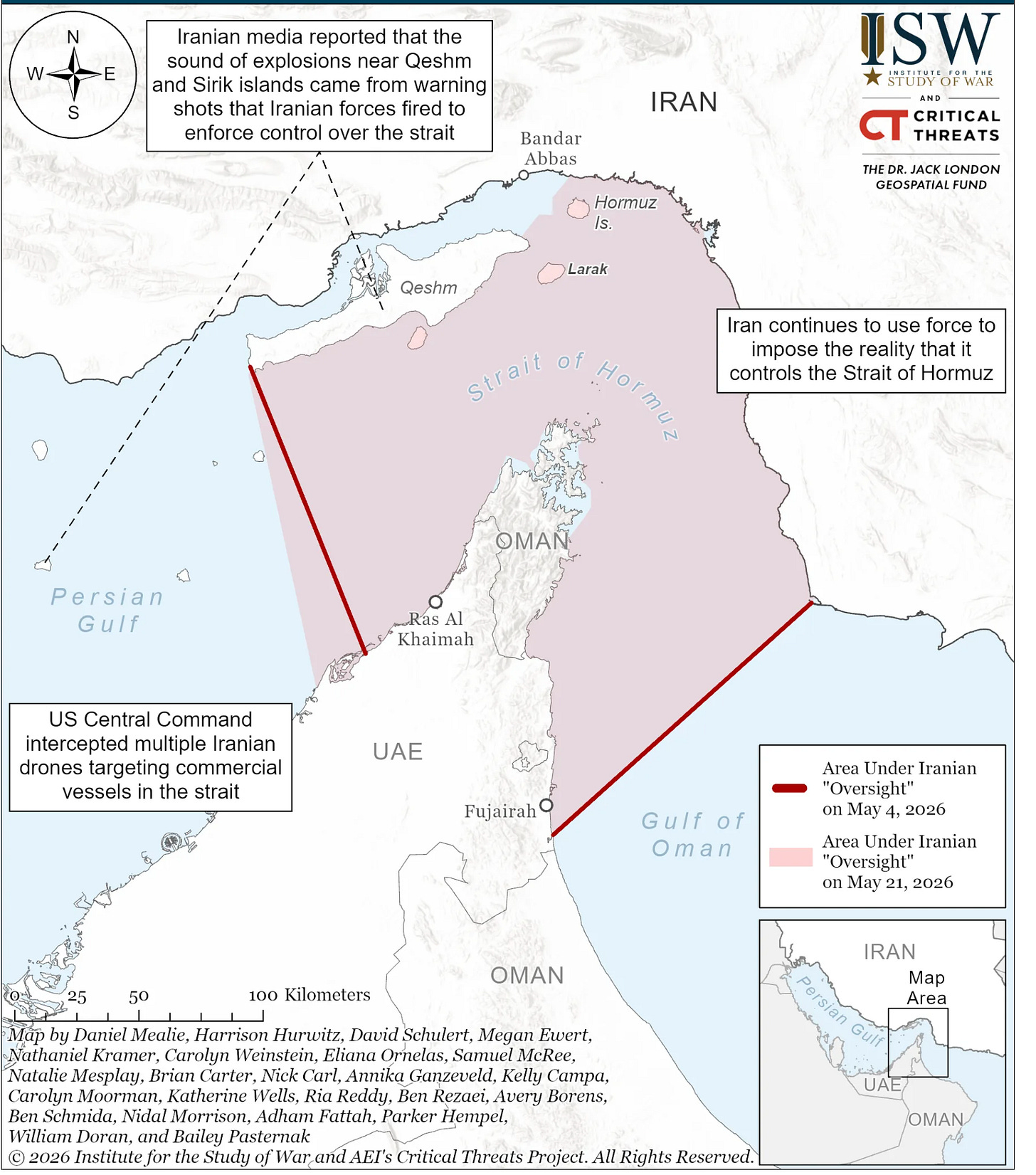
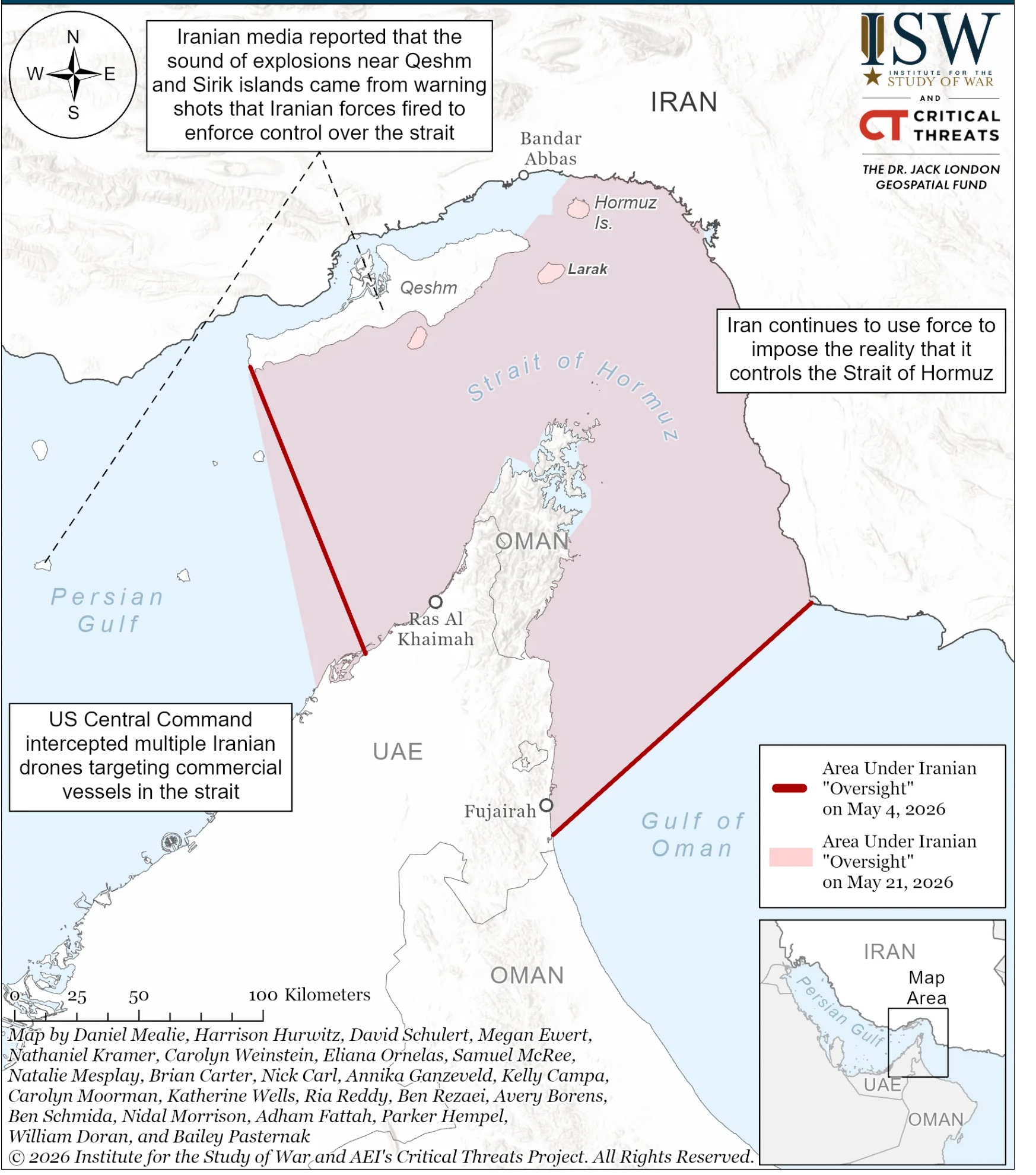
Iranian statements regarding the contents of the US-Iran memorandum of understanding (MoU) indicate that some terms of the agreement are at odds with stated US positions on the Strait of Hormuz in recent months….The system of management is at odds with both US policy and long-established maritime legal precedence….An “open” strait under Iranian management is not a return to the pre-war status quo and would mean that Iran has accomplished a key war aim….Trump separately stated that “no money will exchange hands,” which conflicts with Iranian demands for the release of its frozen assets.
Iranian media appears to be portraying a possible MoU as a tactical pause in the war rather than a final settlement. Khorasan argued the emerging agreement only aims to end the current war and does not resolve underlying issues between Iran and the United States….which may indicate a growing consensus among Iranian regime leaders on Iran’s red lines for negotiations.
The background, all but lost two days earlier, also from ISW:
The Iranian regime is attempting to use force and the threat of force to establish a strategic reality in which any Israeli or US attack on an Iranian proxy or partner would result in a large-scale conflict that would seek to impose significant economic and political costs on Israel and the United States.
Meanwhile, the Trump administration is circling the world seeking to build its position—as a statement from Secretary of State Maro Rubio highlighted:
Rubio spoke with Indian External Affairs Minister Subrahmanyam Jaishankar. The two officials discussed recent events in the Strait of Hormuz. The Secretary stressed that all commercial vessels should immediately comply with orders from US forces as they seek to uphold peace and security in the Strait. He underscored violations of the US blockade and illicit transport of Iranian oil will not be tolerated.
Twenty-four Indians were aboard the Settebello tanker vessel when the United States struck it with a missile off Oman’s coast today, and according to the external affairs ministry three of them are missing. Unlike with the American attack on the MT Marivex that also carried Indian crew, the ministry today summoned the US’s deputy chief of mission in New Delhi, Jason Meeks, to protest the attack on the Settebello (ambassador Sergio Gor is in Kazakhstan) and publicly condemned it, though it again did not name the US in its statement. “The continuing incidents of attacks on shipping in the region are deeply worrisome and a direct result of the ongoing conflict in the region,” India said, calling for a halt to such attacks and for de-escalation (What caused these tensions too did not find mention, as has been the case since February 28).
The US military acknowledged attacking the Marivex saying the vessel was trying to evade its blockade of Iranian ports.
Meanwhile, do remember Gaza. Another Trump project, quickly proposed, apparently just as quickly forgotten, has Zurich’s Neue Zürcher Zeitungpleading:
Unleashed won’t hazard an update to this constantly-changing kaleidoscope of cheers and tears … but the Trump administration’s decisions on who might be able to root on their favorites to victory left some happy, if at a distances as the BBC noted:
Argentine World Cup fans who had US visas rejected given free TVs
Argentine football fans who had their US visas rejected, and were unable to travel to watch the Fifa World Cup 2026, have received free televisions to watch the games. The company behind the campaign said the first 100 people who could prove they had their US visa rejected would receive a television to watch the matches from home.
Indeed, a lot were left on the outside, as Le Monde noted, though Iran’s still playing:
The Iranian national team under close surveillance
While the war in the Middle East remains unresolved, Iran will indeed be participating in the World Cup, putting an end to the numerous speculations and contradictory statements from both the American and Iranian sides. “Team Melli,” scheduled to play its three group stage matches in the United States—in Los Angeles against New Zealand on June 16, then against Belgium on June 21, before traveling to Seattle on June 27 to face Egypt—will nevertheless train in Mexico, as its base camp has been moved from Tucson to Tijuana.
While the players and the “necessary support staff” obtained their authorizations to enter the United States, several members of the delegation, including the president of the [Iranian] federation, Mehdi Taj, former commander of the Revolutionary Guards, did not receive visas.
Far from his promise made in May 2025 to welcome “fans from all over the world” for the World Cup, US President Donald Trump has since taken a series of measures that prevent many supporters from traveling to the United States to attend the tournament. Nationals of Haiti and Iran are thus subject to near-total entry bans to the United States.
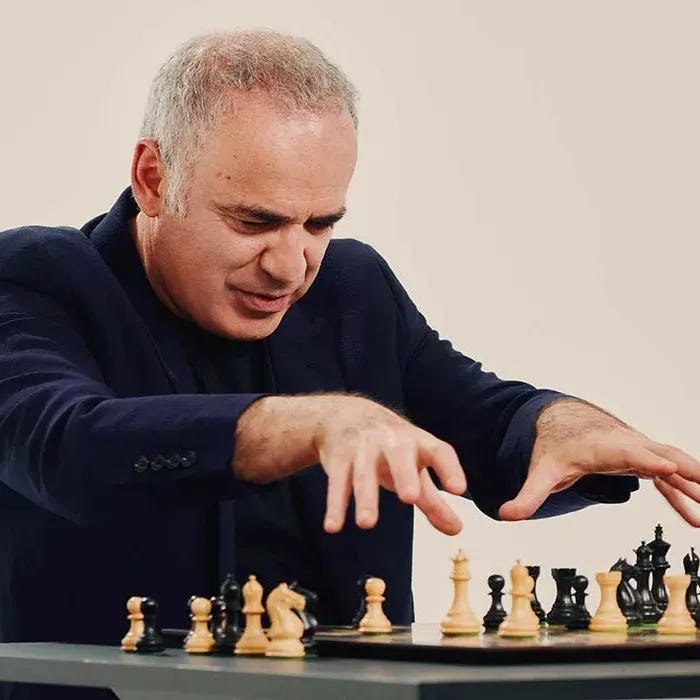
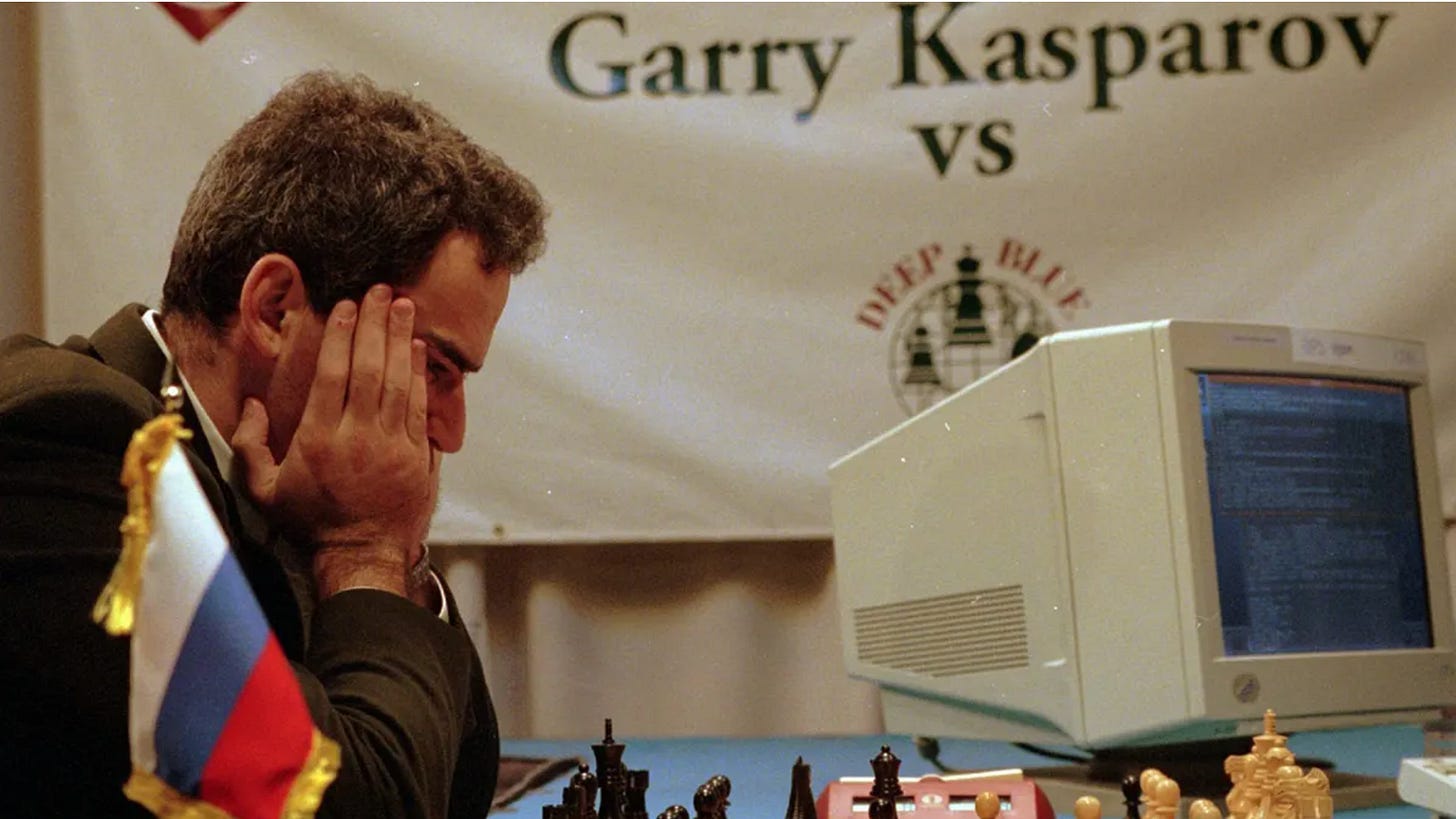
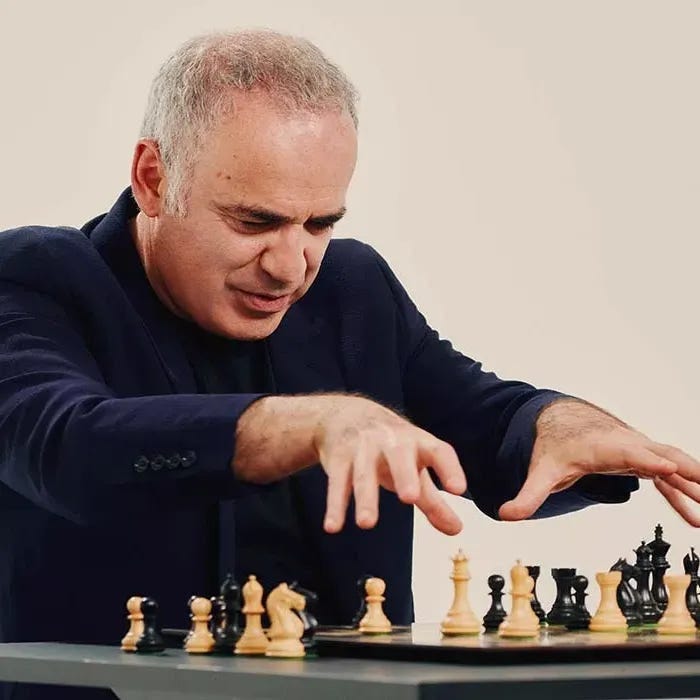
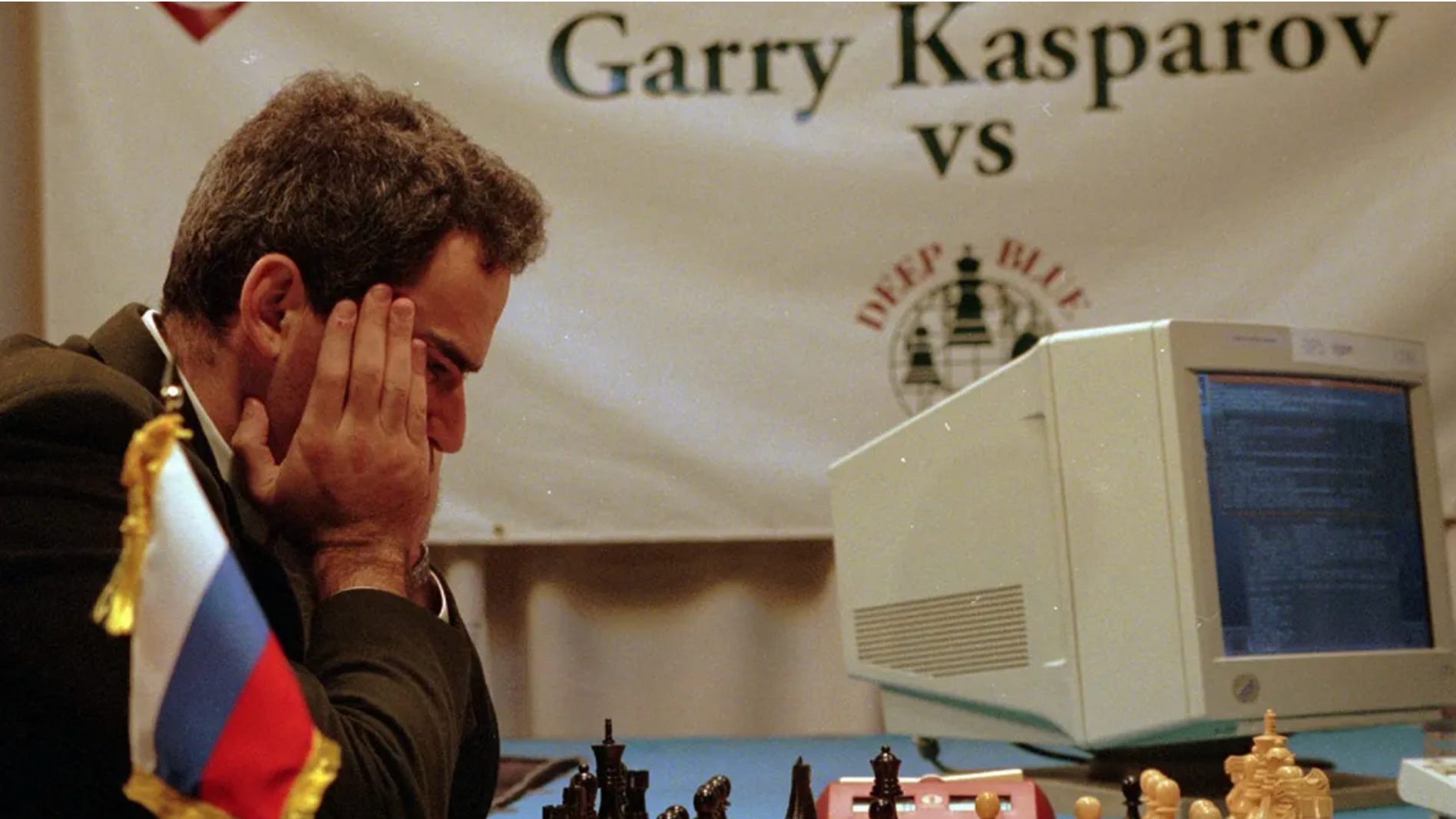
Chess champion, renowned Putin critic, and potential presidential challenger, Garry Kasparov in his Substack had his own historical spin on FIFA with no love lost for the institution that welcomed this autocracy as a World Cup host at the very moment Putin was licking his chops over Ukraine:
The 2018 World Cup gave the Kremlin an opportunity to project normalcy to the world while it waged a campaign of military aggression against neighboring Ukraine. The dead and disappeared in the Donbas and Crimea were buried under sleek modern stadiums. It evoked the 1980 Moscow Olympics, held in the shadow of the USSR’s brutal war in Afghanistan. At least back then, there was a well-organized boycott of the games.
For Vladimir Putin, the World Cup was the apex of his international position, truly having his medovik [cake] and eating it too. Twelve years ago, when Moscow seized Crimea and invaded eastern Ukraine, I called out FIFA for not revoking the Russian regime’s bid to host the 2018 World Cup. “Would anything cancel it?!” I asked incredulously. “It’s war!”
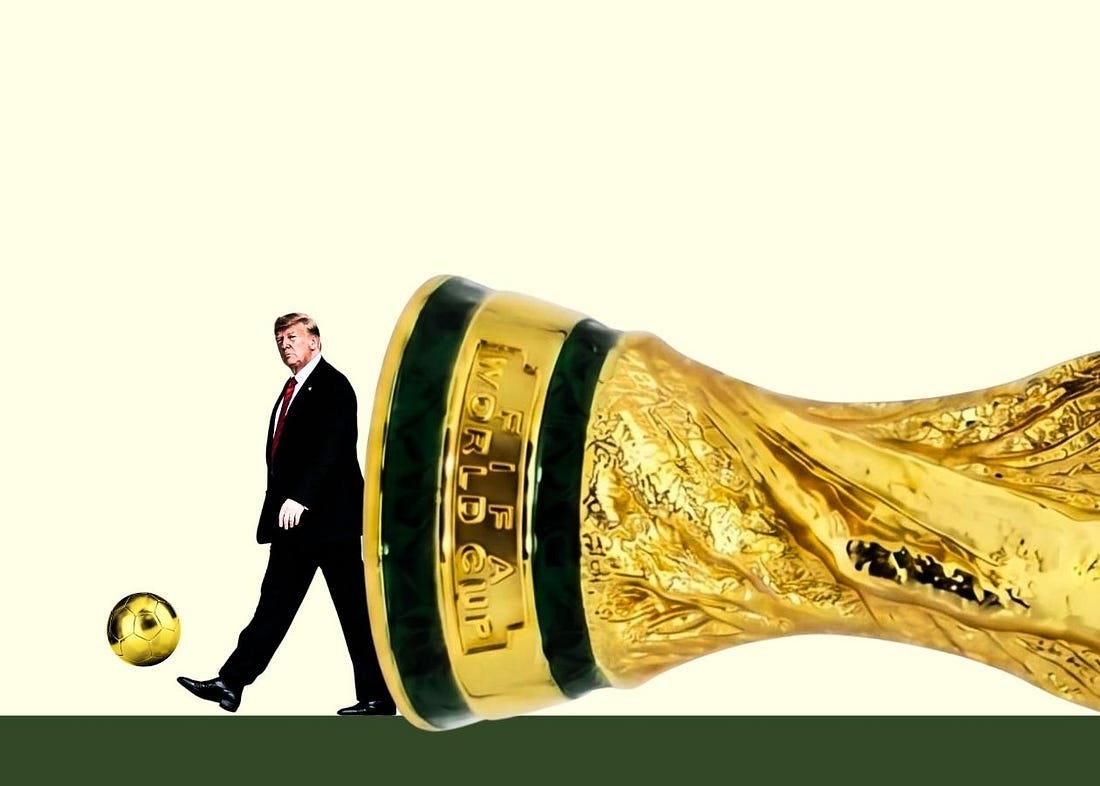
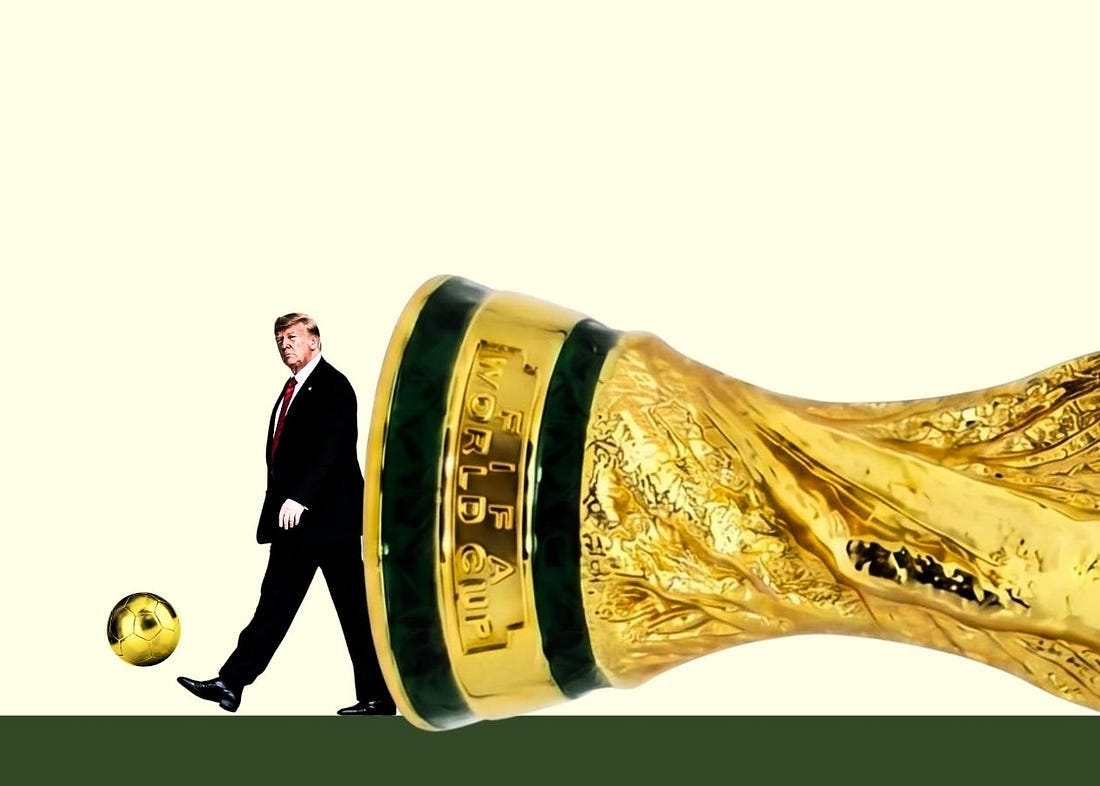
America today is not Russia, but the train is moving rapidly in the wrong direction. The massive soccer competition will edge out stories of marauding ICE agents and blatant corruption. President Donald Trump is expected to present the World Cup trophy in July. He will be sure to put his distinctive personal stamp on the whole affair, like Napoleon taking the crown from Pope Pius VII.
Twelve years ago, when Moscow seized Crimea and invaded eastern Ukraine, I called out FIFA for not revoking the Russian regime’s bid to host the then-upcoming 2018 World Cup. “Would anything cancel it?!” I asked incredulously. “It’s war!” The 2018 World Cup gave the Kremlin an opportunity to project normalcy to the world while it waged a campaign of military aggression against neighboring Ukraine. The dead and disappeared in the Donbas and Crimea were buried under sleek modern stadiums. It evoked the 1980 Moscow Olympics, held in the shadow of the USSR’s brutal war in Afghanistan. At least back then, there was a well-organized boycott of the games.
FIFA has been a willing accomplice in all of this. It is a famously amoral institution. The news was not that FIFA was effectively bribing a world leader (corruption is standard fare among most international sporting committees)—the shock was that the leader being bribed was the president of the United States.
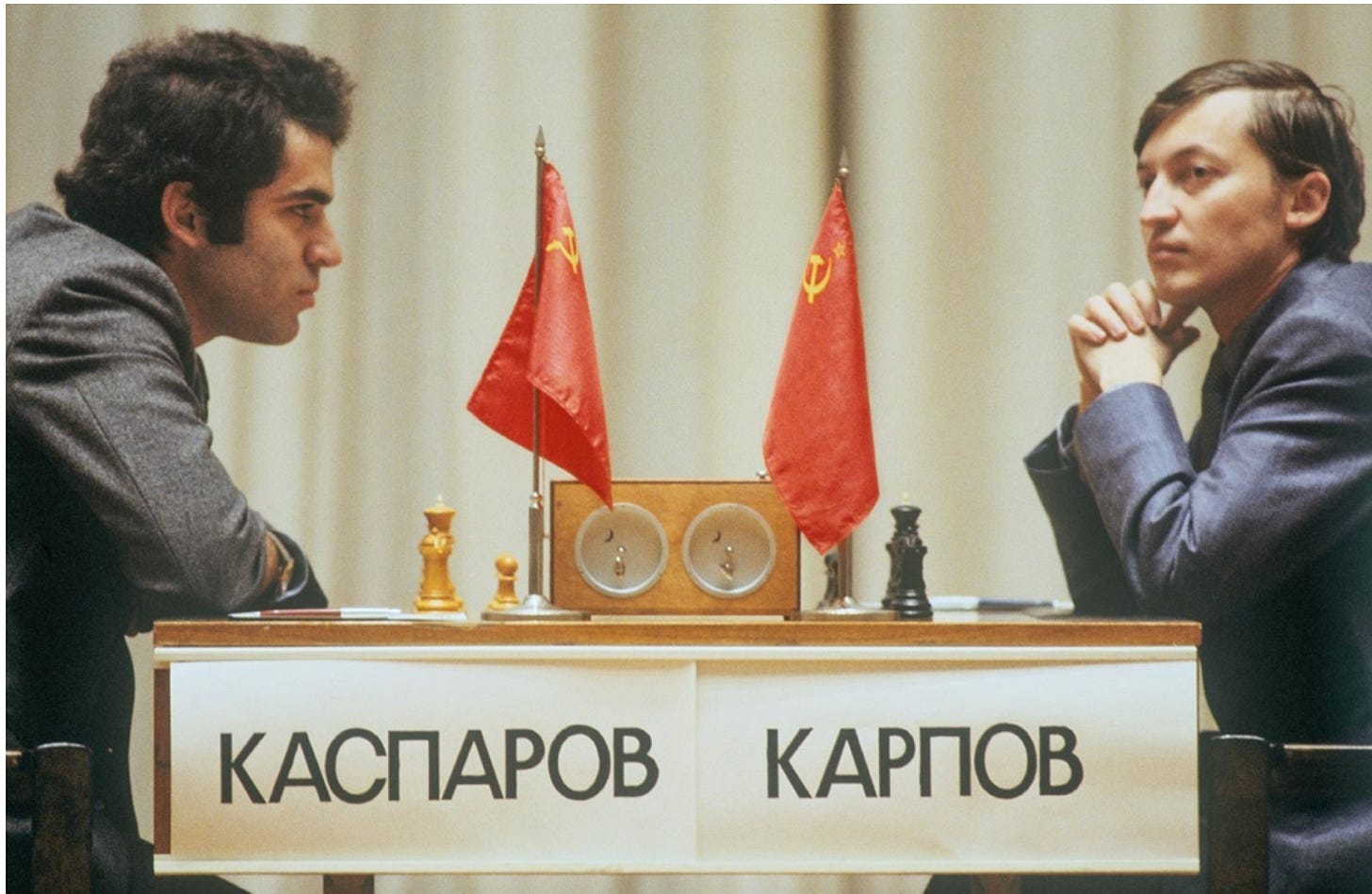
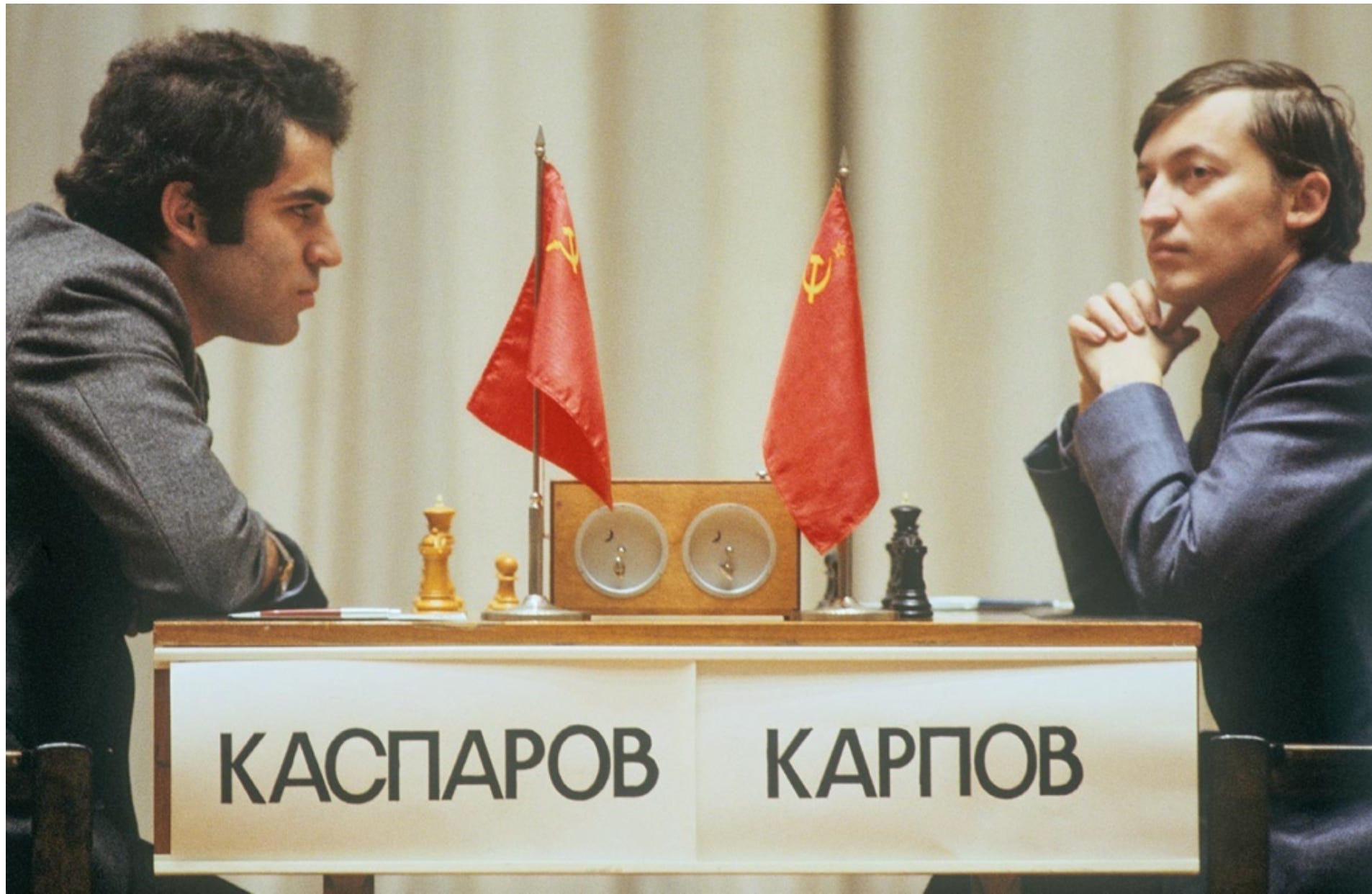
In the first half of my chess career, I competed internationally under the Soviet flag.
While I was hardly the Communist Party favorite, my victories—like those of other Soviet athletes—were nevertheless leveraged as proof of the socialist system’s superiority. Such propaganda was a farce then. It remains so now. Talented athletes often succeed in spite of authoritarian regimes, not because of them. That’s why I eventually abandoned not only the Soviet flag, but the Russian tricolor too. I played under white-blue-red flag for 15 years, but I decided that I was not going to give Putin any more free legitimacy.
While fans enjoy the “beautiful game” over the coming weeks, they should remember that hosting a World Cup or winning a chess match proves nothing about the health of a country’s politics. To host a World Cup, a nation need only be as democratic as the Argentine junta (1978), as transparent as Qatar (2022), and as peaceful as Russia (2018). Donald Trump might be fine with such a low bar for this nation. The American people should aspire to something better.
New threats, new challenges, their antecedents…Plus, an inscribed copy of my book, A Red Line in the Sand. Along with a weekly portfolio of cartoons…and Friday our weekly live conversation.…with a new Celebrity Guest to decode the universe….On Friday:
Damien had a fifteen-year career in international affairs in France, Russia and the Asia-Pacific before founding Geopolitical Strategy.
Most recently, he was Head of Global Engagement and principal advisor to the Secretary-General at the International Chamber of Commerce where he also served as Deputy Director of Trade and Investment. In those roles, he led the ICC’s engagement with the United Nations system, the World Trade Organisation and governments in over 170 countries.
Earlier, he worked as a diplomat in Moscow, trade negotiator and legal counsel. Damien holds degrees in law and liberal arts, and speaks French, Russian and Italian. Damien is based in Paris.
THE NEXT FRIDAY:
An investor, scholar and journalist, Dr. Christopher Smart spent six years in the Obama Administration as a senior policymaker for international economic affairs: Special Assistant to the President at the National Economic Council and the National Security CounciL. From 2009-13, he was Deputy Assistant Secretary of Treasury, where he led the response to the European financial crisis and designed U.S. engagement on financial policy across Europe, Russia and Central Asia. Now at the Kennedy School at Harvard!
It’s still ongoing with suffering on all sides. Still, democracy [if a trifle distracted by the necessities of oil and economics] abroad, appears very much holding its own, as ISW observes with growing skepticism in the enemy camp:
A Russian State Duma Deputy from the Communist Party criticized the Kremlin and the broader Russian war-waging strategy, contradicting the Kremlin's narrative. State Duma Deputy Vyacheslav Markhaev published a post on both his personal Telegram and VKontakte channels accusing the Kremlin of using events such as the Russian Victory Day to demonstrate a false sense of prosperity and "personal enrichment of the elite" amid ongoing bans, restrictions, and a growing financial burden on regular Russians while not taking measures to help Russians with these issues. Markhaev acknowledged Ukrainian forces are expanding the geographical extent of ther long-range strikes against Russia and accused the Russian political elite of losing touch with needs of the Russian people.
In the end, though, it may all come down to weaponry, as ISW continued:
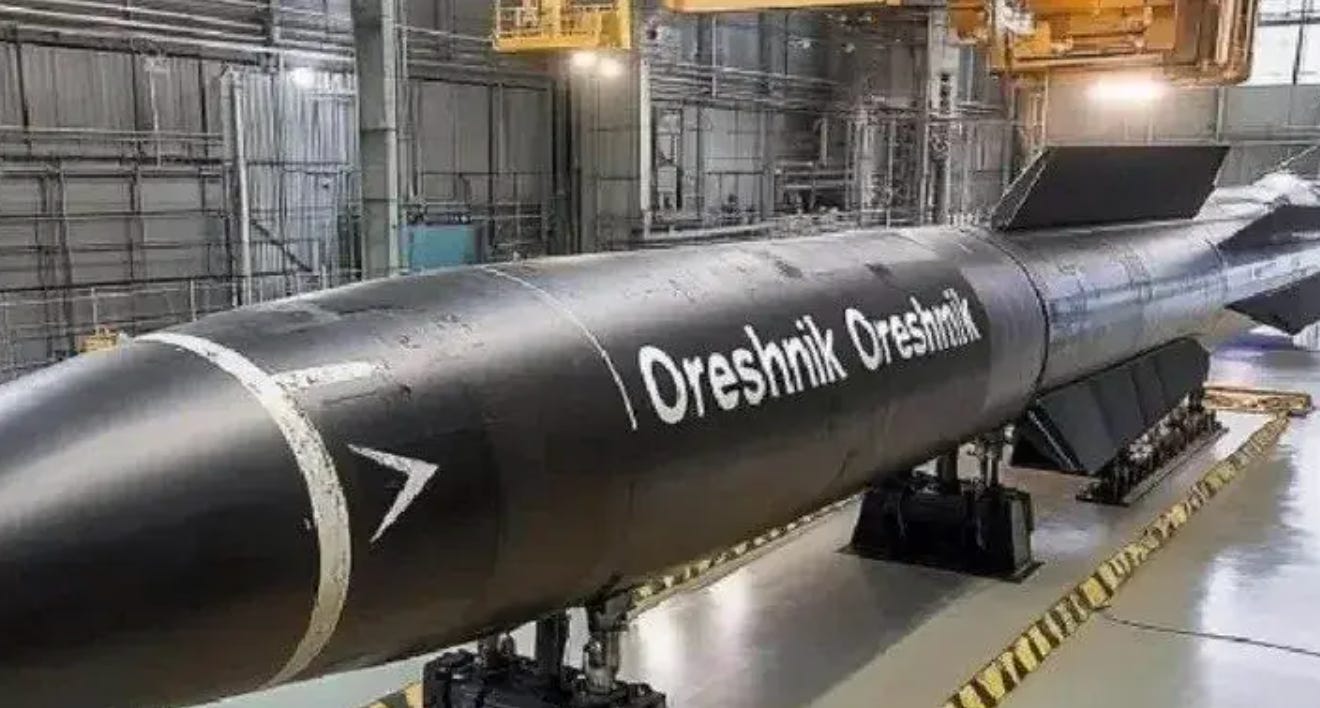
Russian forces may launch [another] Oreshnik intermediate-range ballistic missile (IRBM) at Ukraine. The Ukrainian Air Force warned there is a "high probability" that Russian forces will launch an IRBM from the Kapustin Yar missile launch site in Astrakhan. Ukrainian outlet RBK Ukraine reported, citing an informed source in the Ukrainian government, that the United States warned Ukraine about the threat of a Russian Oreshnik IRBM strike.
The Kremlin has launched Oreshniks at Ukraine at least three times, at least two of which were in 2026. The Kremlin has particularly escalated its long-range strike campaign against Ukraine since Ukraine's own long-range strike campaign exposed Russian President Vladimir Putin's inability to reliably defend his capital, St. Petersburg, and other Russian cities from Ukrainian strikes.
[It’s worth noting the Oreshnik is capable of carrying a nuclear warhead.]
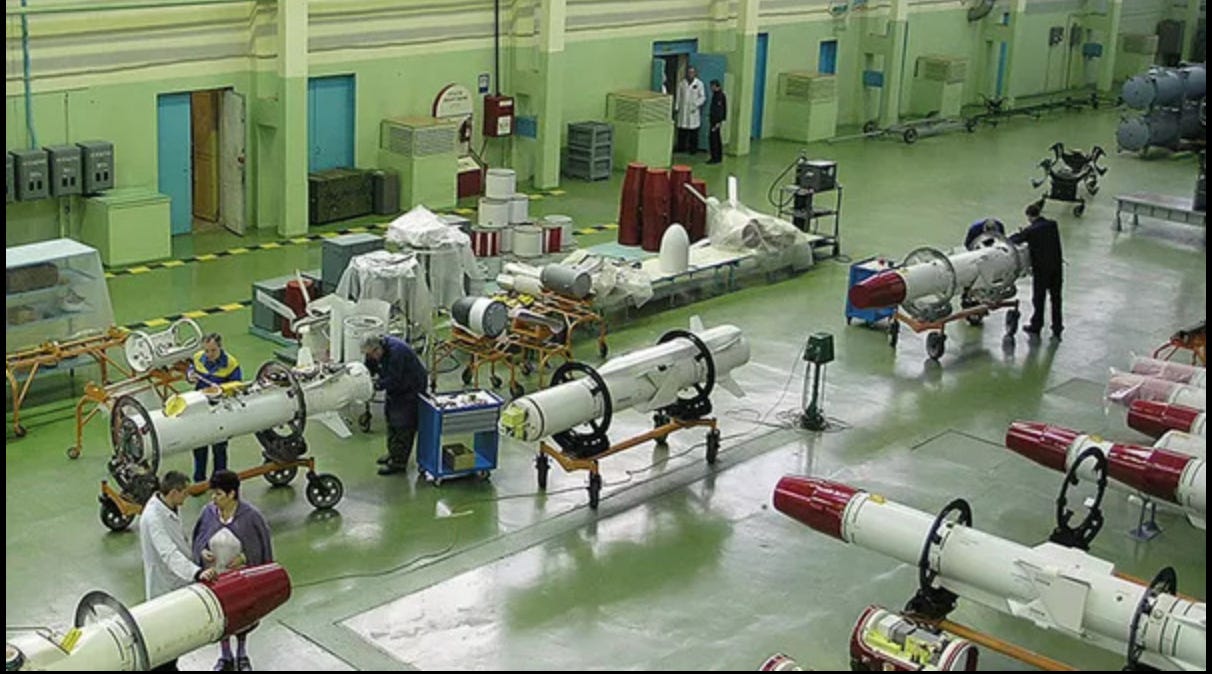
Russian forces are increasing the production rate and modernization of their ballistic missiles and drones. Available information suggests Russia’s monthly missile production surpasses the US’s monthly Patriot air defense interceptor missile production. Chief Researcher of the Ukrainian State Research Institute for Armament Testing and Certification Colonel Oleksandr Zaruba reported Russian forces are producing between 40 and 50 Kh-101 cruise missiles, between 60 and 70 Iskander-M ballistic missiles, and around 10 Iskander-K cruise missiles monthly.
Zaruba noted Russian forces are integrating technical solutions from the North Korean KN-23 ballistic missile into the Iskander-M ballistic missile to increase production. The United States currently produces around 600 PAC-3 Patriot interceptor missiles per year, or about 50 missiles per month according to the US Department of Defense.
[And most of those seem to be destined for the Middle East and anti-Iran deployment.]
US-made Patriot air defense systems that can effectively counter Russian ballistic missiles remain critical for Ukrainian air defenses. Ukraine has also been trying to secure production licenses for Patriot interceptor missiles from the United States to allow for production in Ukraine. Ukraine has also recently tested its first anti-missile interceptor as an alternative to the PAC-3 interceptors and is working with its European partners on a joint anti-ballistic system.
Russia is reportedly increasing military spending even as Russian revenues decrease. German Institute for International and Security Affairs economist Janis Kluge assessed, citing data from the Russian Finance Ministry, that Russian military spending reached 5.9 trillion rubles (about $81.4 billion) or 46% of total budget spending in the first quarter of 2026, 30% higher than military spending a year ago.
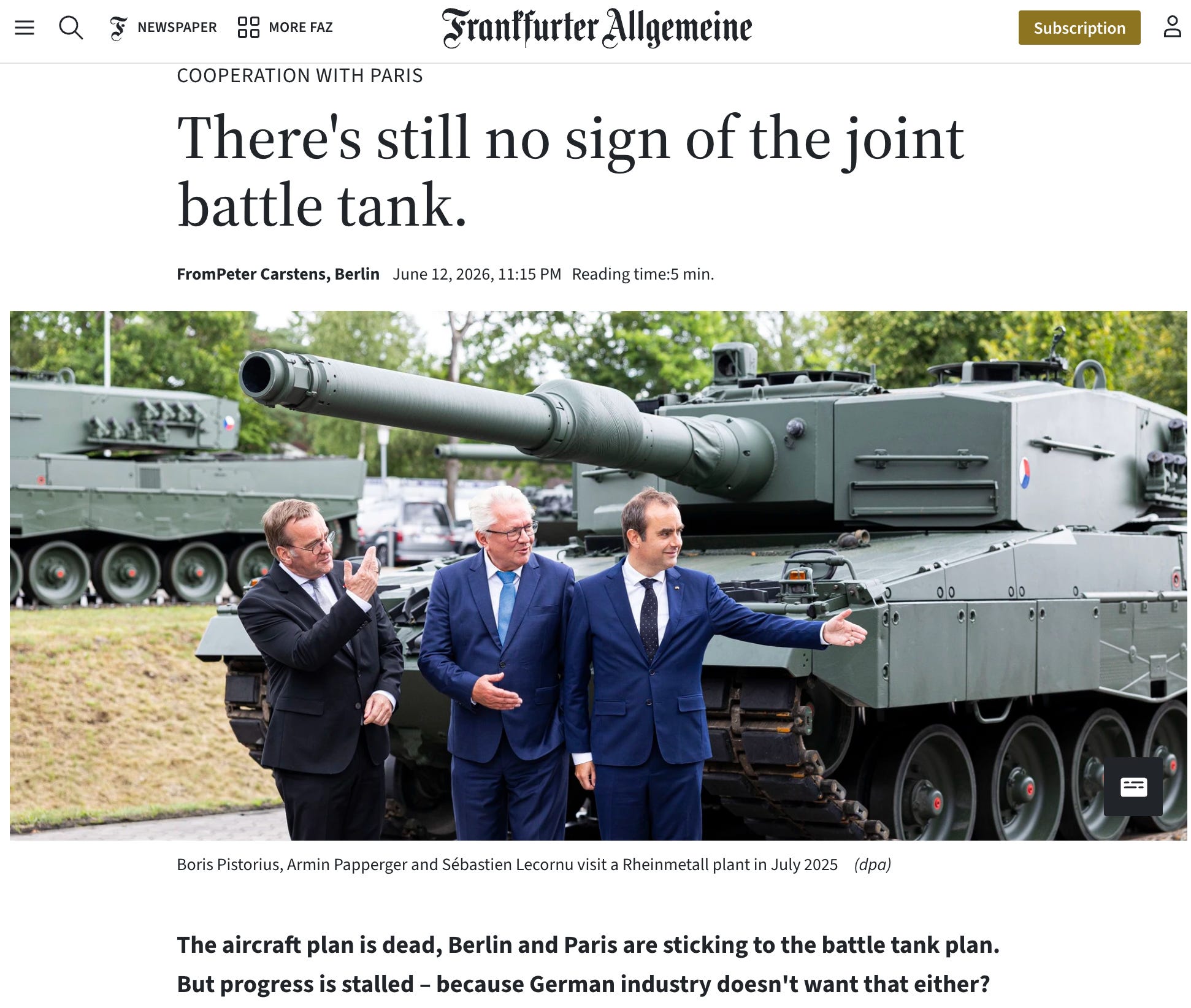
As Frankfurter Allgemeine reported, Germany and France still can’t come to some critical terms:
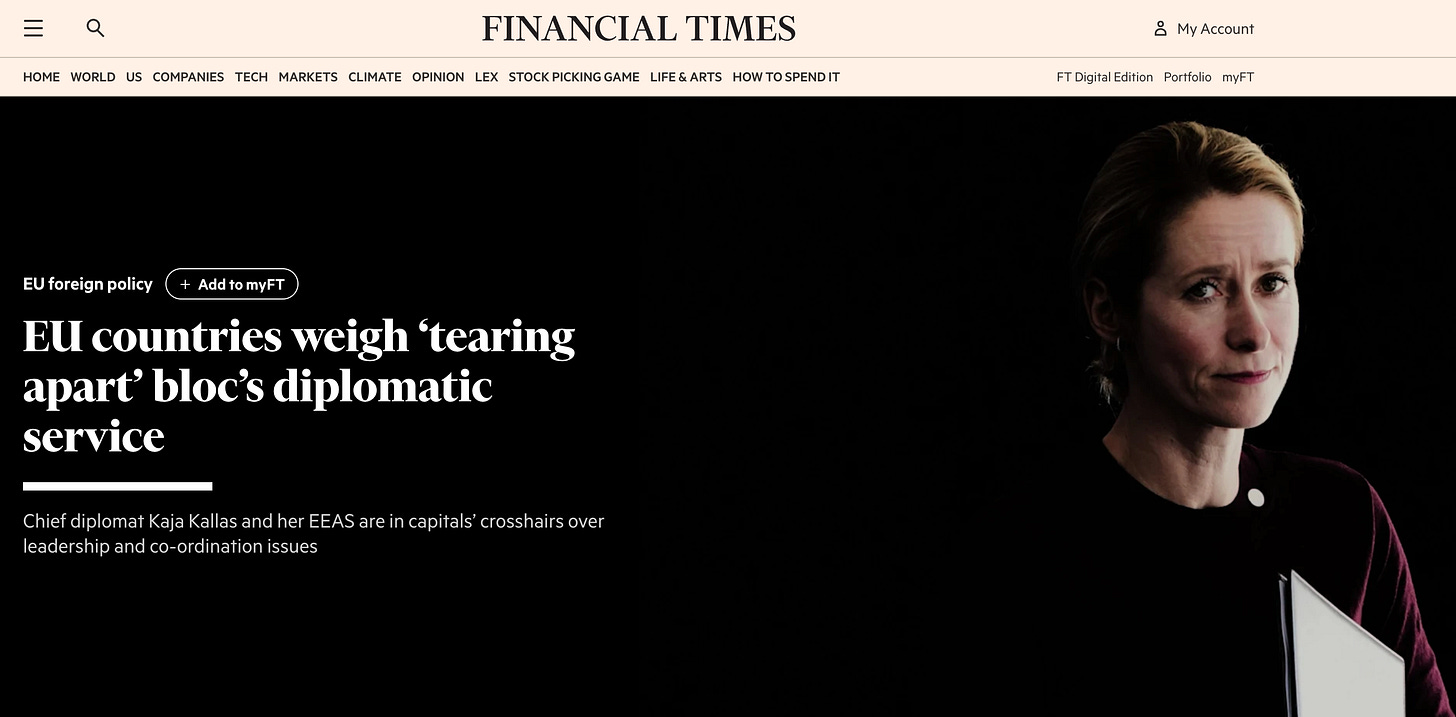
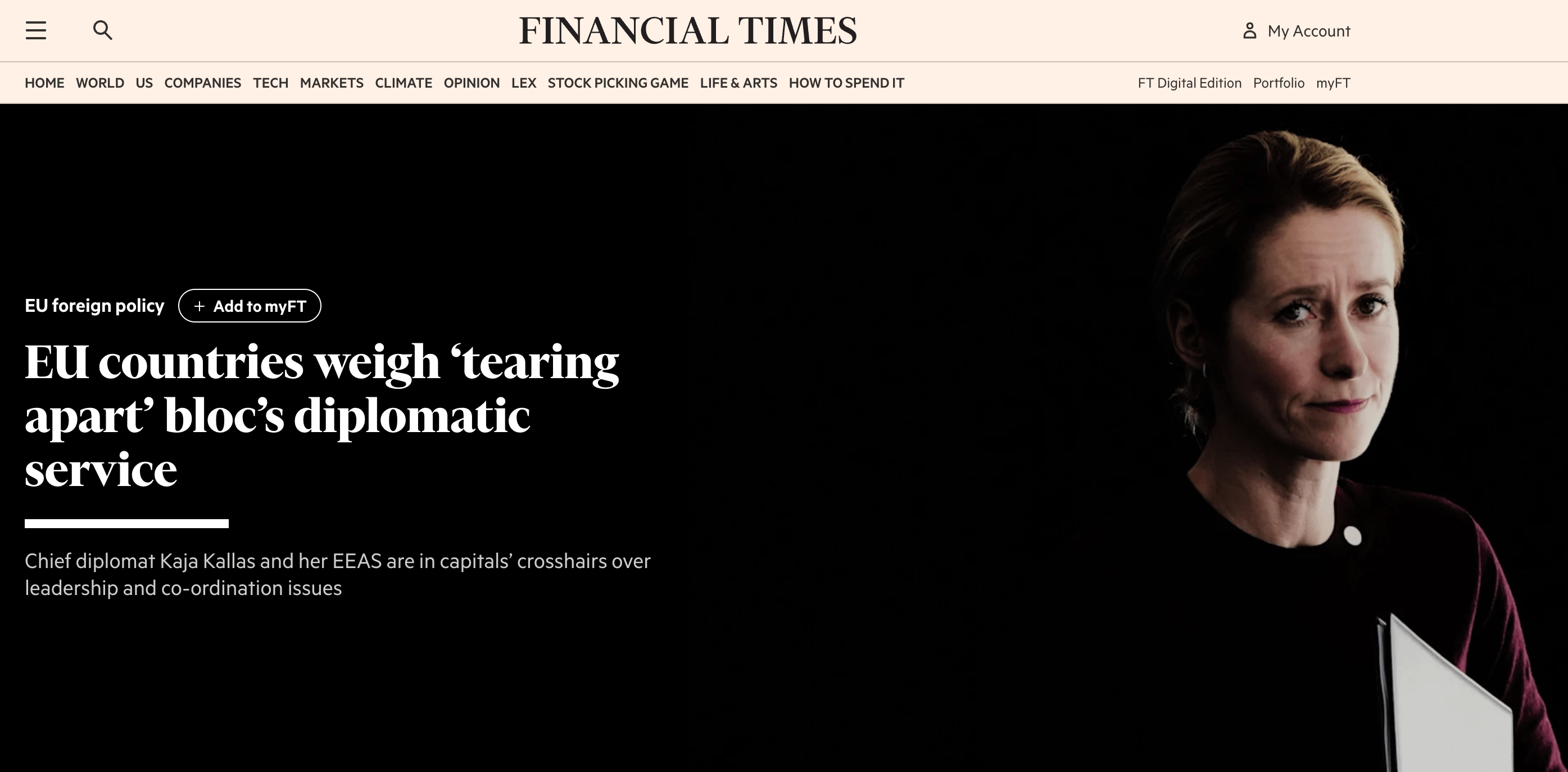
Let alone the EU, where as the Financial Times reported:
France and Germany are discussing proposals for a radical overhaul of the EU’s 15-year-old diplomatic service in an attempt to improve the bloc’s response to geopolitical crises. Paris, Berlin and other capitals are weighing options that include stripping powers from the bloc’s chief diplomat Kaja Kallas and her €1bn-a-year External Action Service (EEAS), returning them to the European Commission and member states, according to five senior officials briefed on the discussions.
“It is clear that [the EEAS] doesn’t work the way it should in today’s world. It is dysfunctional,” said one of the officials. “The problem is structural and so the structure needs to be rebuilt.” In recent years, the EU has been roiled by the wars in Ukraine and Iran, the whims of US President Donald Trump and the rising use of tariffs, economic coercion and energy supplies as foreign policy tools, with many questioning whether the EEAS is up to the task of coordinating effective responses. The proposal, which would reverse the aims of a 16-year-old decision to create the EEAS as an autonomous service.
Finally, there’s the question of whither Ukraine….Nicholas Vinocur of Politico Europe examining the chances for Ukraine joining the EU:
Kyiv and Brussels have publicly hailed the likely start of formal negotiations on June 15 as a breakthrough. But Ukraine is concerned its bid could be “parked” due to political issues, including France’s presidential election [in 2027]. That could push enlargement off the EU agenda. Brussels, meanwhile, is worried about the pace of reforms in Kyiv.
Membership lite: Discussion papers floated by Paris and Berlin, touting “associate membership” for Kyiv and other interim solutions for candidate states, are jangling nerves. “In practice, Ukraine is being offered everything except membership itself,” Ukraine’s Ambassador to the EU Vsevolod Chentsov told Playbook Brussels.
Nobody puts Kyiv in a corner: The risk for Ukraine is being parked in a side room—with some of the benefits of EU integration but no clear path to full membership. Kyiv isn’t rejecting the Franco-German ideas, but wants stronger guarantees on where it will end up, according to officials informed on the talks.
Like a Cheshire cat—while the rest of the world is tearing itself apart, Xi Jinping is quietly remaking everything….but especially his still flourishing economy as the world suffers. CNBC Asia reported:
China’s trade growth held up better than expected in May, as surging AI-related exports helped buffer the economy against disruption from the Iran war. Overall exports rose 19.4% from a year earlier, customs data showed, accelerating from the 14.1% gain in April. “The war is boosting demand for green exports, such as electric vehicles, batteries, solar products, and AI-related technology goods,” said Sheana Yue, senior economist at Oxford Economics, expecting the outperformance in high-tech product export growth to persist.
Chinese exporters have so far weathered the fallout from the Middle East conflict, with overseas buyers rushing to lock in supplies before energy costs climb further. While demand remains weak, rising commodity costs from disruption to energy flows through the Strait of Hormuz have helped to alleviate deflationary pressures that have plagued Chinese economy for years.
Economists expect the country’s producer inflation to accelerate to 3.8% in May, the strongest in nearly four years, as manufacturers absorb the higher input costs,
Just to clarify matters, we don’t use AI for our ideas—as one weaned in newsrooms where typewriters ruled, who went into the wars, revolutions or diplomacy with an Olivetti Lettera-32 at his fingertips. [Once, the Olivetti storefront museum in Venice tried to talk us into donating our vintage Lettera. No cigar.]
Still, if we have on occasion succumbed, purely for research, it’s to Claude we have turned.
For our highly valued, but lightly paid, members….if you wondered how Canadians and Americans were getting along in the age of Trump (and apart from FIFA!)—a look at a Canadian-American library straddling the frontier, breaking a pledge from Kristi Noem…Plus as also pledged, the full hour of Unleashed Conversation with Wesley van Drongelen. And our weekly portfolio from the world’s greatest Cartoonists.

Comments
Nothing yet. Say the first thing.
Sign in to join the conversation.