
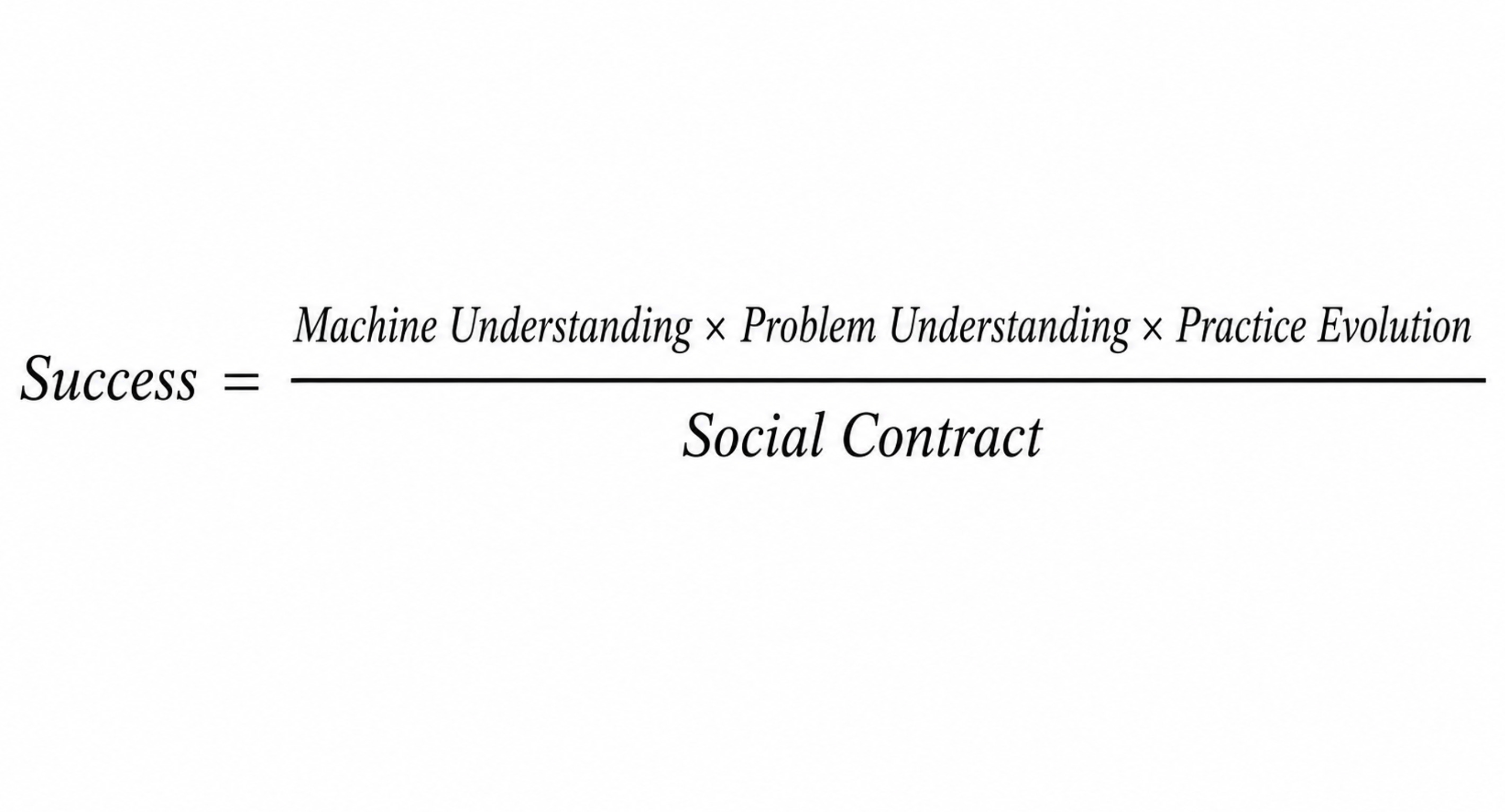
Here’s a simple model for thinking about AI success in organizations.
\(\text{Success} = \frac{\text{Machine Understanding} \times \text{Problem Understanding} \times \text{Practice Evolution}}{\text{Social Contract}}\)
How AI actually works. The inputs and outputs. The failure modes. You don’t need an expert-level sense of the math, but you need a viable mental model of how the technology and what it is doing. Understanding the costs (based on a very incomplete current sense of the costs). Said another way, you have to get past the “magic” of AI.
Context, domain experience, skill, customer knowledge, constraints, history, politics. Everything that makes your problem a real-world problem and not a generic problem. If you are at risk of falling into the Build Trap, you’ll just do it faster with AI.
How the work actually gets done. Experimentation, feedback loops, workflow adaptation, team learning. The connective tissue between knowing and doing. Accepting that there are no “best practices” yet. Things change every week.
The organizational commitment that improvement gains will be used in line with a shared agreement, not against the people who generated them. And that the work remains compatible with who people are and who they are becoming.
Resistance to AI mandates is a perfectly rational behavior. Kaizen only works when there’s a credible social contract that the gains from improvement will not be captured against the improvers. Without that contract, you don’t get resistance out of ignorance. You get resistance out of rational self-preservation.
But it is not just defense. This is not just people “afraid for their jobs.”
The jury is genuinely still out. The data is not there (especially over any reasonable period of time). The resistance is not merely emotional or self-interested. In many cases it reflects an accurate reading of the evidence. People are being asked to cooperate with a premise that has not been proven, and that might be used against them if it ever is.
The formula is multiplicative. Any term at zero in the numerator kills the product:
Machine × Problem × No Practice Evolution
You know what AI can do but never update how you use it. You assume the practices have been figured out.Machine × No Problem Understanding × Practice
Fast iteration in the wrong direction. No ability to evaluate the results.No Machine Understanding × Problem × Practice
Deep expertise, no sense of what the machine is doing underneath. When the technology changes you are unaware. Can slip into “it is magic” thinking.Machine × No Problem Understanding × No Practice Evolution
Demos and pilots disconnected from real work. No practical way to put it in motion. No real applicability.No Machine Understanding × Problem × No Practice Evolution
You know it isn’t working, but have no idea why. And no way to refine your practices.No Machine Understanding × No Problem Understanding
New workflows for their own sake.
And when the denominator is broken—when people don’t trust where the gains will go, or feel the work threatens their identity—the formula collapses regardless of how strong the numerator is. You get rational resistance, not incompetence.
Most AI mandates fail because they try to force one term in the numerator high while ignoring the other two. “Everyone must use AI” is a Practice Evolution mandate that assumes Machine Understanding and Problem Understanding will take care of themselves. They won’t.
And even if the numerator is strong (even if people understand the machine, know the problem, and are ready to experiment) without a credible social contract, honest effort never arrives.
The denominator is not optional. It is the precondition for everything above the line.
No posts
Comments
Nothing yet. Say the first thing.
Sign in to join the conversation.