
The current conceptual model of internet browsing is “tab-directed”: we operate on the browser system with the actions of opening, closing, navigating and branching out to new tabs. Phrased another way, the tab is our primary interface to the browser as a system, and the internet more broadly whose access it mediates.
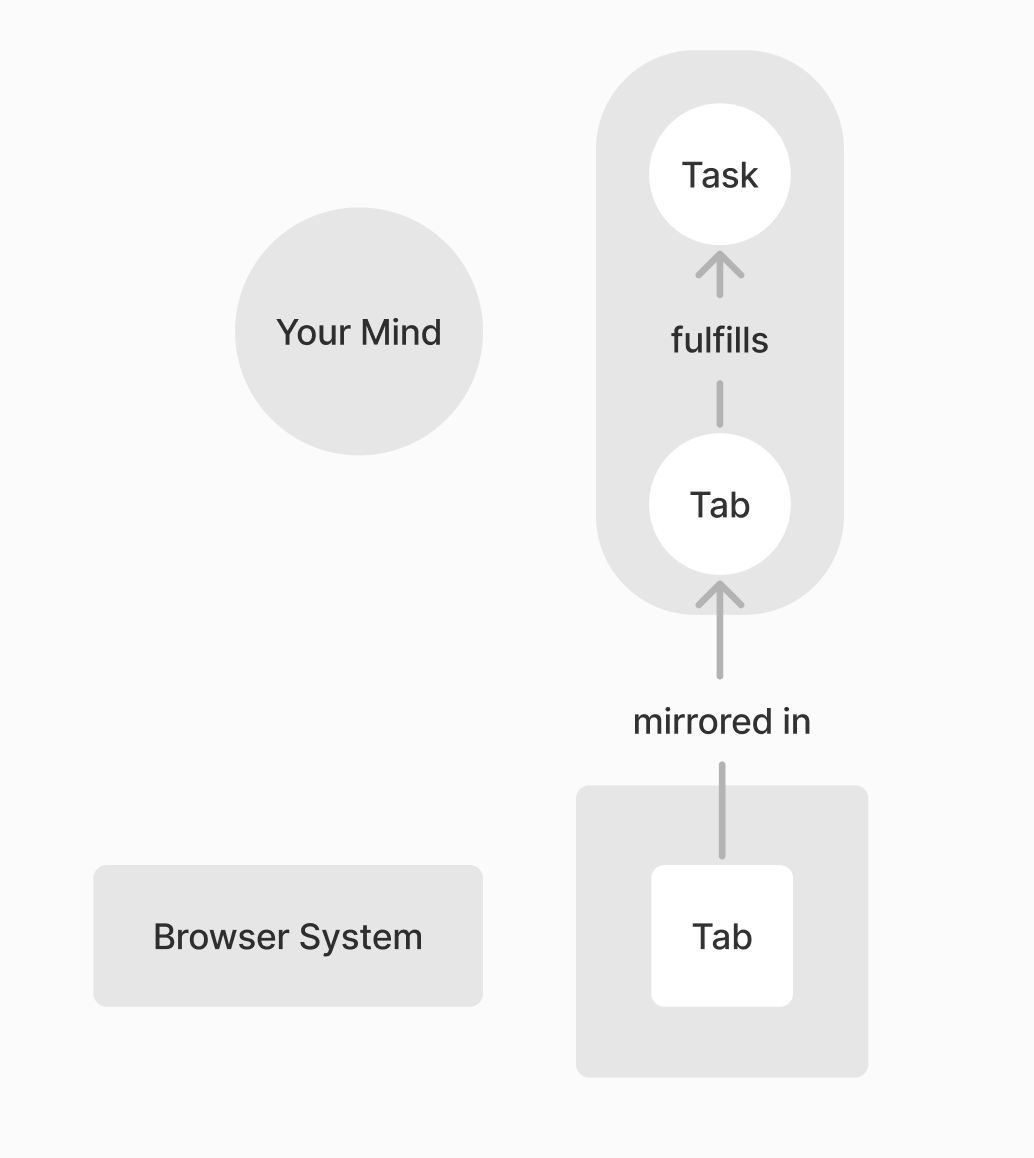
When we want to accomplish a task that exists in our minds, we open a new tab and use the site on the tab to execute the task. For example, to find and read a recipe for an eggplant omelette (task), we search Google (tab), and then read a blog post (tab) linked in its results.
The key thing to note is that there is a relationship between tasks and tabs, and a distinction between where each of these are stored:
Tabs fulfill Tasks. But while Tabs live in the browser, Tasks live in our heads.
The tab is where we are, while a task is why we are here. Tabs live in the browser, but we construct a parallel model of it in our minds. Tasks live in our minds, alone, and are not shared with the browser.
This distinction is not important when the tabs and tasks number in the few to handful, in what we call the “humane-scale” regime. But the distinction becomes key to reasoning about “tab overload” in the reach-exceeds-grasp regime.
hIn the human-scale regime, there are only a few tabs. The browser is a humane interface, because its easy to remember what we intend to do on each tab. As the number of tabs increases, however, it enters,
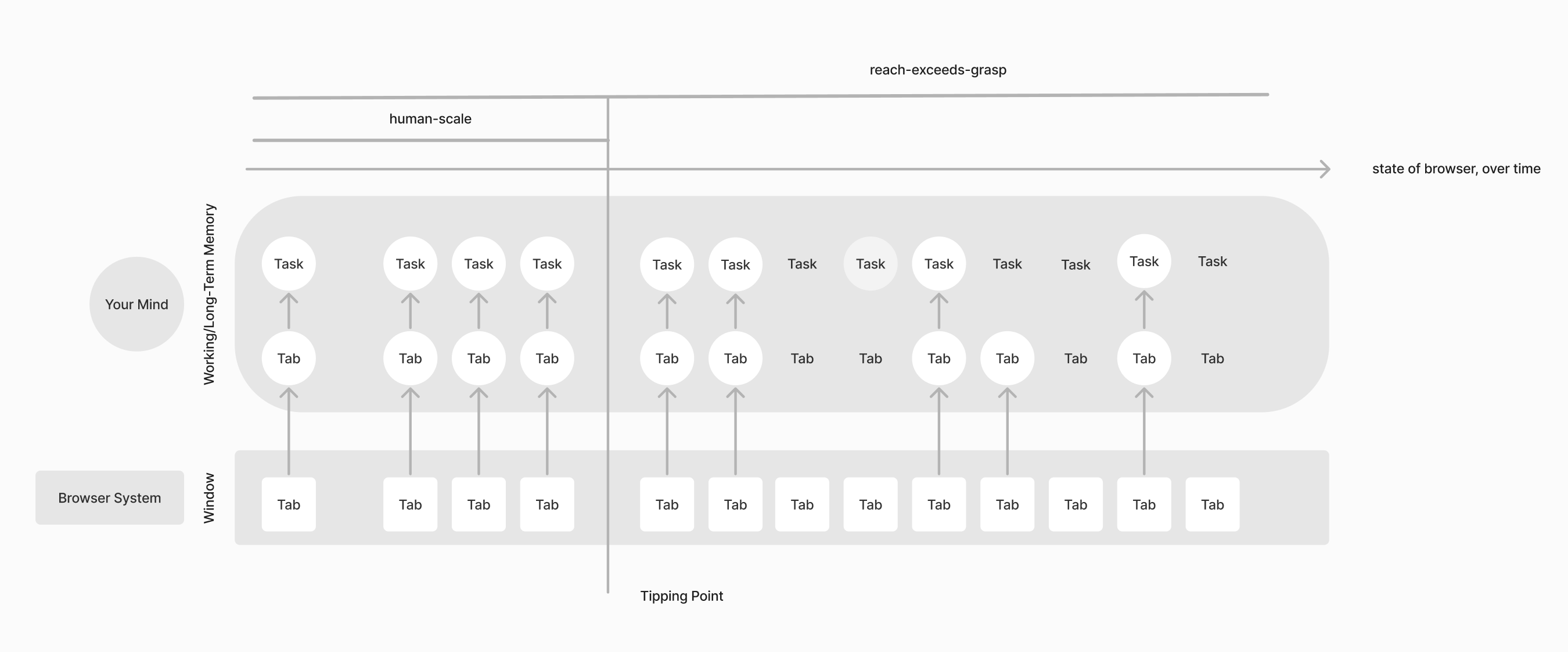
At some point, the browser enters the “reach-exceeds-grasp” regime, where the number of tabs begins to exceed our working memories’ capacity to remember them and their connections to tasks. There is, simply, too much to keep track of and organize.
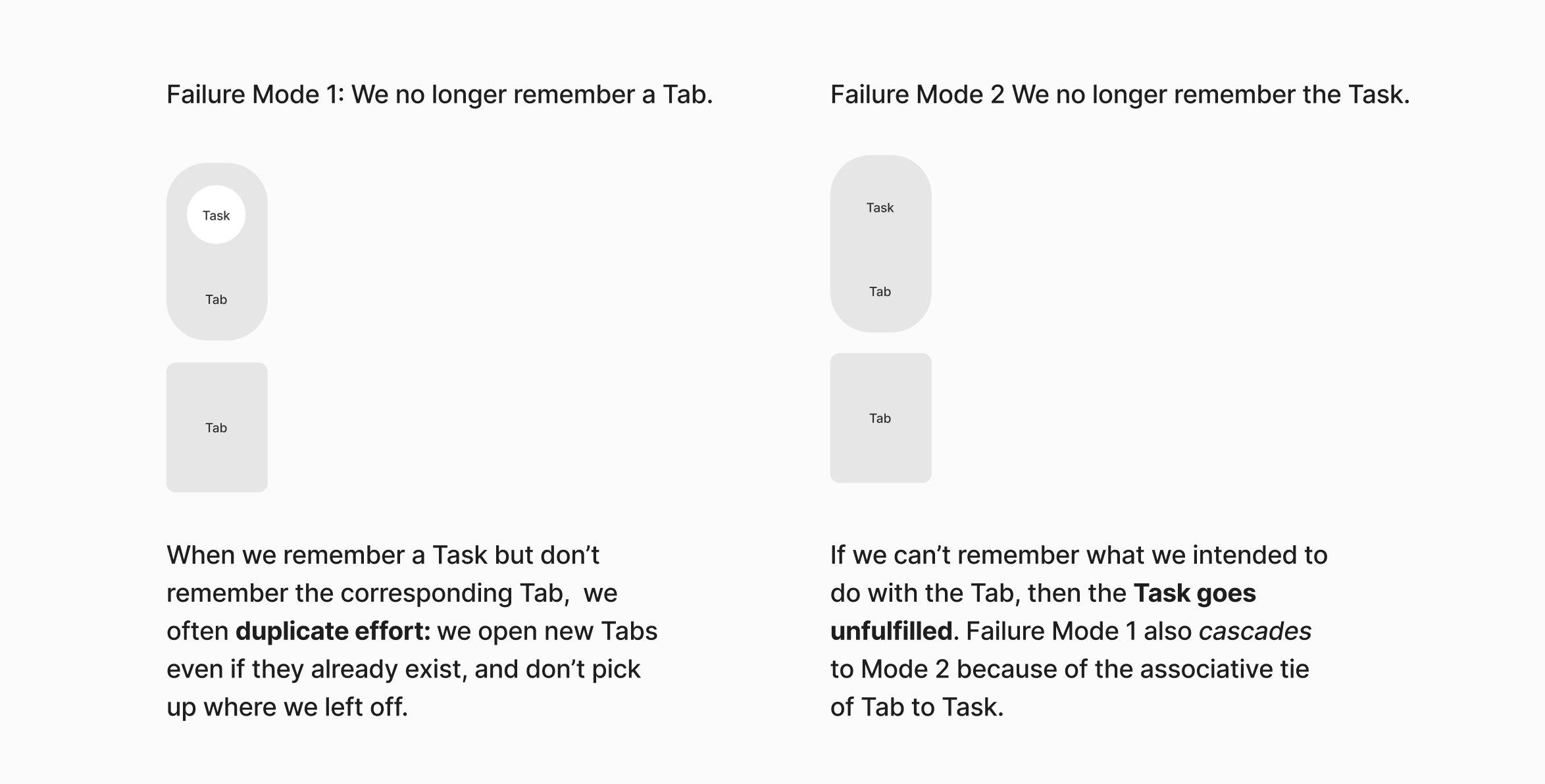
In this regime, we begin to struggle with regulating our desired behaviors (accomplishing tasks) and enter spirals (task switching, doomscrolling), both arising from the experience one of two failure modes.
It is not that tab-directed browsing is an inherently inhumane interface experience. Instead, it is to say that the scale with which we use browsers has exceeded the scale it was designed for, and this has made them inhumane.
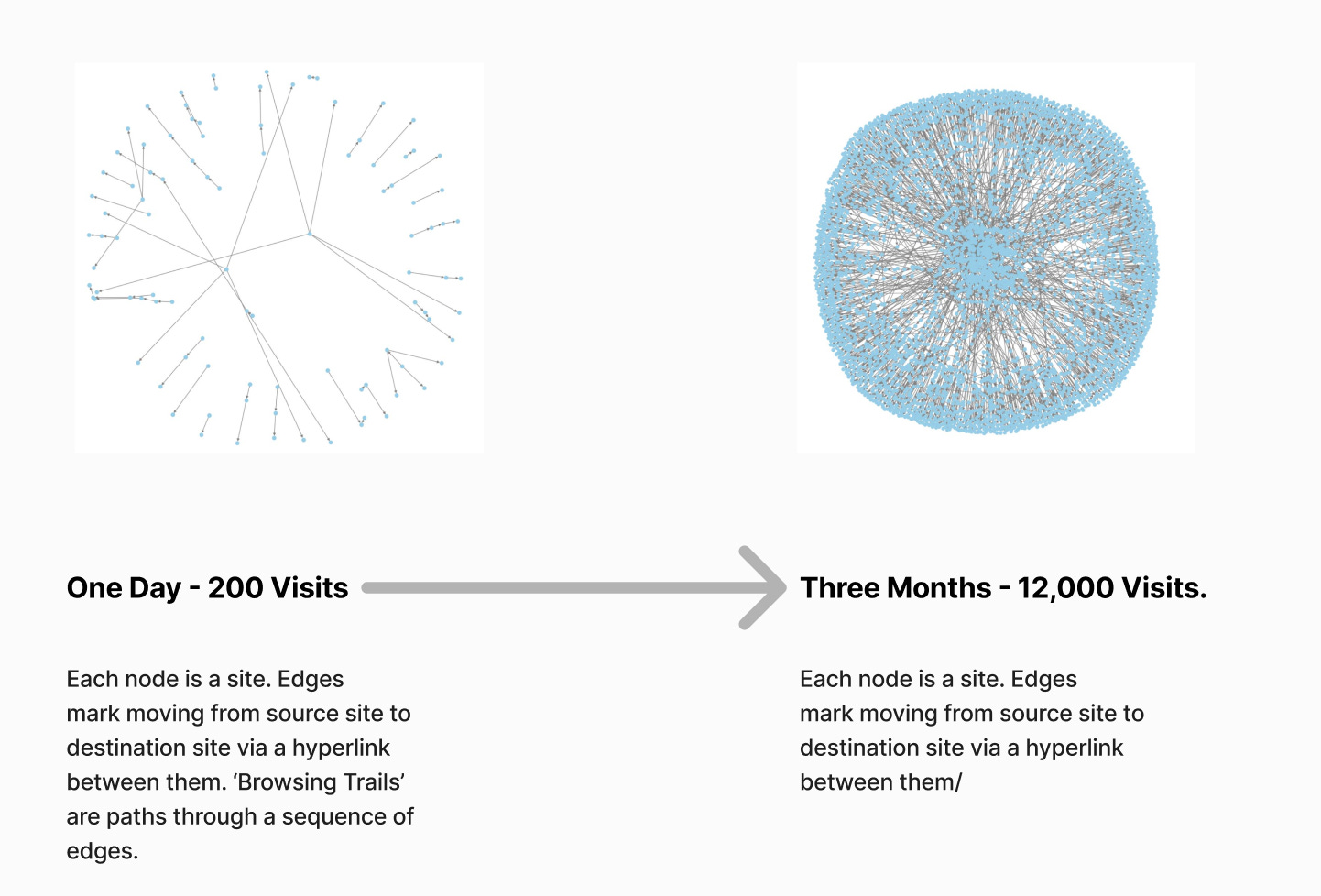
In my personal browsing history over three months, I made an average of 200 page visits a day and 12,000 total visits. If each site visit lasted 2 minutes on the lower bound, I’d have spent 400 of hours of my waking existence within the browser.
Safe to say, if I spend this much time in it, I don’t use the browser to accomplish isolated tasks anymore. I live in it, and and to live in it means experiencing the reach-exceeds-grasp regime more often than not.
I use my browser to live out my personal, social and professional lives. Each of these lives requires not just the execution of individual tasks, but the execution of plans (chains of dependent tasks, over time), to the deeper and more personal still, the accomplishment of long-term goals (chains of dependent Plans, over time), none of which are modeled by the browser system.
To ask a human to maintain not just a mental model of tabs and tasks, but tabs and tasks and plans and goals, however, would plunge us deeper into the reach-exceeds-grasp regime.
To answer this question, we’re utilizing the conceptual framework above to imagine “Intent-Directed Browsing”. The core thesis is this: instead of you carefully creating and maintaining a mental model of both your task and tabs, you share the creation and maintenance of this model with the browser at three time scales of intent: the task, the plan and the goal. By modeling intent at different time scales this way , we can do things like “pick up where you left off”, and automate the execution of Tasks, given that there’s an explicit conception of these within the System.
No posts
Comments
Nothing yet. Say the first thing.
Sign in to join the conversation.