
“Operator” and “Tool” are the terms Jeff Raskin uses in The Humane Interface to describe the roles and relationship between Humans and Computers in their interaction. This metaphor is at the base of Cognetics, his ergonomics of the mind, a theory outlined in the same book that gave a generation of interface designers the theory and language to invent the interfaces we use today.
“We are oppressed by our electronic servants. This book is dedicated to our liberation”, page 1, The Humane Interface (2000)
But for a book giving us the theory to reason about the interfaces that we deserve, those that ‘liberate’ us, the metaphors of “Operator” and “Tool” have started to feel stale.
Today, interfaces are not just tools that we operate. If we bend the metaphor, we might say that we live through our tools, or that we exist within these tools. But this language is clumsy. Digital systems and their interfaces mediate our professional, social and personal lives, determining the forms by which we might and might not interact, determining how we might think of ourselves, and how we might think of others.
The question of how to live and how to exist was and was and is not the concern of a Tool. A humanist would argue that question is ours alone to ask and to answer. And the question of how to live is a question of how to distribute our attention minute to hour, hour to day, day to week, week to month across the interfaces we live by (hinting at a need to define Attention within Cognetics).
Attention and its associated concepts - attention span & attention capture, hooked engagement and distraction - and the web of how they interact are not accounted for in Cognetics.
Raskin coins a definition for the Locus of Attention, but stops there, and for this reason, stops short; perhaps, in the gilded optimism of early computing, he could not predict that this locus could be captured across its many spans by interfaces, nor that this would be made a deliberate design goal by its designers.
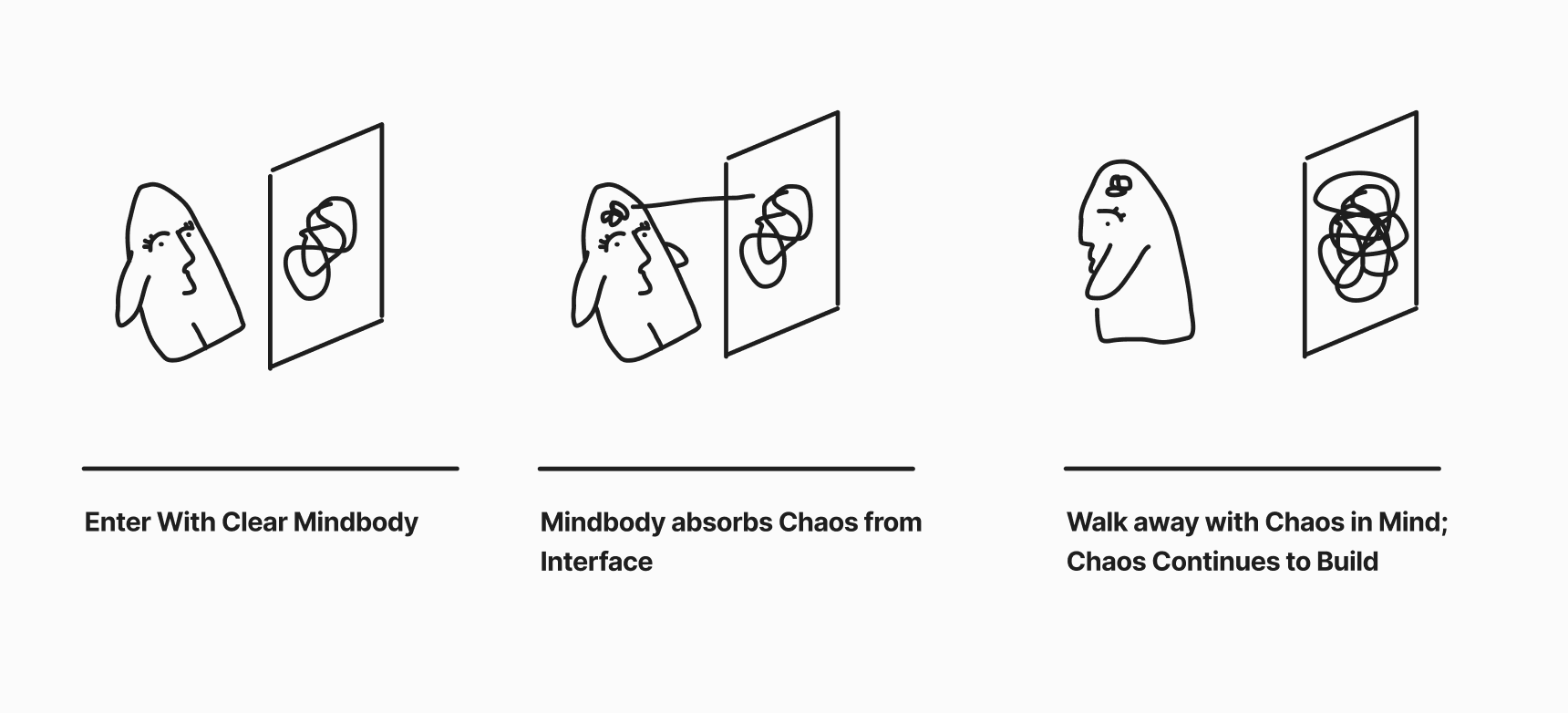
This research project, “Interfaces We Live By”, is an attempt to extend Cognetics with a broader, deeper theory of Attention, such that interface designers can incorporate Attention as a design concern in the interfaces we’re about to make.
The holy grail for curl.projects are those interfaces that are contemplative; interfaces that support conscious experiences, where our attention is sustained, and we retain agency over the systems we live alongside. Realizing this dream depends on a firm understanding on what it means to be conscious and attentive on an interface, in the first place.
We aim to draw on evidence from cognitive psychology and theories of consciousness, whether they descend from neuroscience research labs or ancient eastern philosophy, or a wonderful center in Berkeley hosting both [2]. As a parting remark,
References
[1] Jef Raskin. 2000. The humane interface: new directions for designing interactive systems. ACM Press/Addison-Wesley Publishing Co., USA.
[2] The Berkeley Alembic. https://berkeleyalembic.org/.
No posts
Comments
Nothing yet. Say the first thing.
Sign in to join the conversation.