

A team rolls out a new Terraform change to production. They accidentally referenced the wrong security group ID, resulting in critical services going offline. Downtime could have been avoided with a simple test.
Just like any application code, your Terraform configurations need testing. It helps catch errors early and improve the stability of your code.
Some frequent errors include:
Using the wrong resource types or values.
Breaking changes in modules.
Security misconfigurations.
Missing dependencies between resources.
📚Do you want to read all lessons in a single pdf? Check out my Terraform Quickstart ebook.
In this chapter, you’ll learn:
Types of tests used in Terraform projects.
Common mistakes tests can catch.
Tools you can use to test Terraform code.
Tests help you validate changes before deployment, especially in CI/CD pipelines. Refer to this testing pyramid:
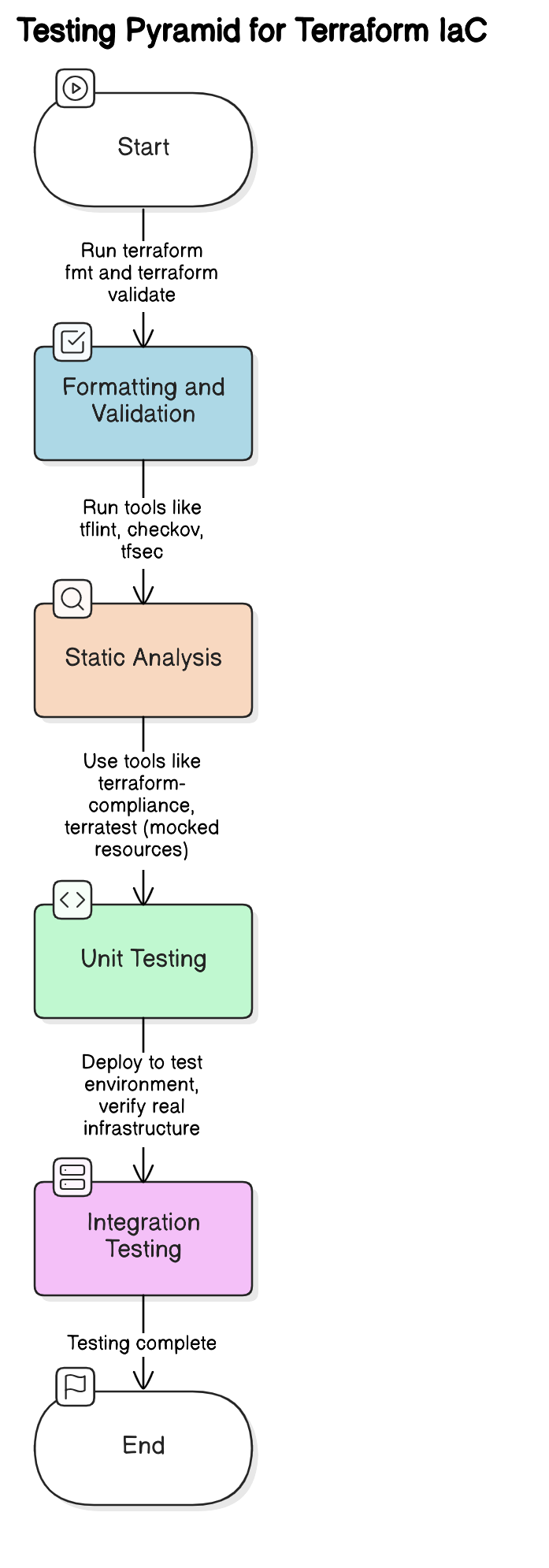
Let’s explore the stages one by one:
It checks if your config is syntactically correct and all required variables are defined.
$ terraform validateUse this before every plan.
This ensures your files follow consistent formatting.
$ terraform fmt -checkIt also avoids noisy diffs in version control.
For example, tfsec is a 3rd party tool that detects issues like open security groups, public S3 buckets, missing encryption.
$ tfsec .Checkov is another security scanner:
$ checkov -d .It supports many cloud providers and has extensive policies.
Terratest is a Go framework for testing Terraform code. You can write tests like:
terraformOptions := &terraform.Options{
    TerraformDir: "../modules/my-vpc",
}
terraform.InitAndApply(t, terraformOptions)
This approach:
Deploys real infrastructure
Verifies with assertions (e.g. "Is the VPC created?")
Destroys after test run
It's powerful but requires Go and more setup.
Comments
Nothing yet. Say the first thing.
Sign in to join the conversation.