
A few days ago I was in a working session with some younger professionals. Someone had prepared a brief using an agentic AI tool, and the output was clean, confident and well-structured. Nobody questioned it, so the brief moved forward.
I’ve seen this more than once recently. It feels like a trained reflex: the output looks authoritative and good, so it probably is. And I get it: In fast-moving environments, stopping to interrogate something feels like introducing friction nobody wants.
But it stayed with me. Because what I was watching was accepting a document that was way too perfect for a junior (no offence) and critical thinking being quietly skipped.
There’s a generational shift happening that goes deeper than convenience. A few years ago, the concern was that people were googling everything instead of thinking. But googling still required something from you. You got ten or more results, you had to choose between them, evaluate sources, form your own view from competing information. The process was imperfect, but it was still a process.

Now asking ChatGPT or Gemini is different. You get one answer, delivered with confidence, in fluent prose, yes, now with visible sources to interrogate (but who does?) and no signal of uncertainty, because the answer feels complete. And increasingly, for a generation growing up with these tools, that’s just how you find things out. Not just at work, for everything. (Some, including me, are pushing back for other reasons entirely: quitgpt.org has gathered more than four million people pledging to cancel their subscriptions, though mostly over OpenAI’s and Sam Altman’s political entanglements rather than what the tool does to how we think.)
Last April, Ann Kowal Smith wrote a piece for Forbes identifying four human skills she argues we can’t afford to lose as AI becomes more embedded in how we work: curiosity, critical thinking, empathy and collaboration. I agree with the list, but what interests me more is the question underneath it: why are these particular skills under pressure right now, and what does that actually look like in practice?
Critical thinking is the most visible casualty, and the OECD’s 2024 Survey of Adult Skills confirms what many of us sense: literacy proficiency has declined or stagnated across most European countries over the past decade. The foundation on which critical thinking depends is weakening at the same time the tools that require it are getting better and faster.
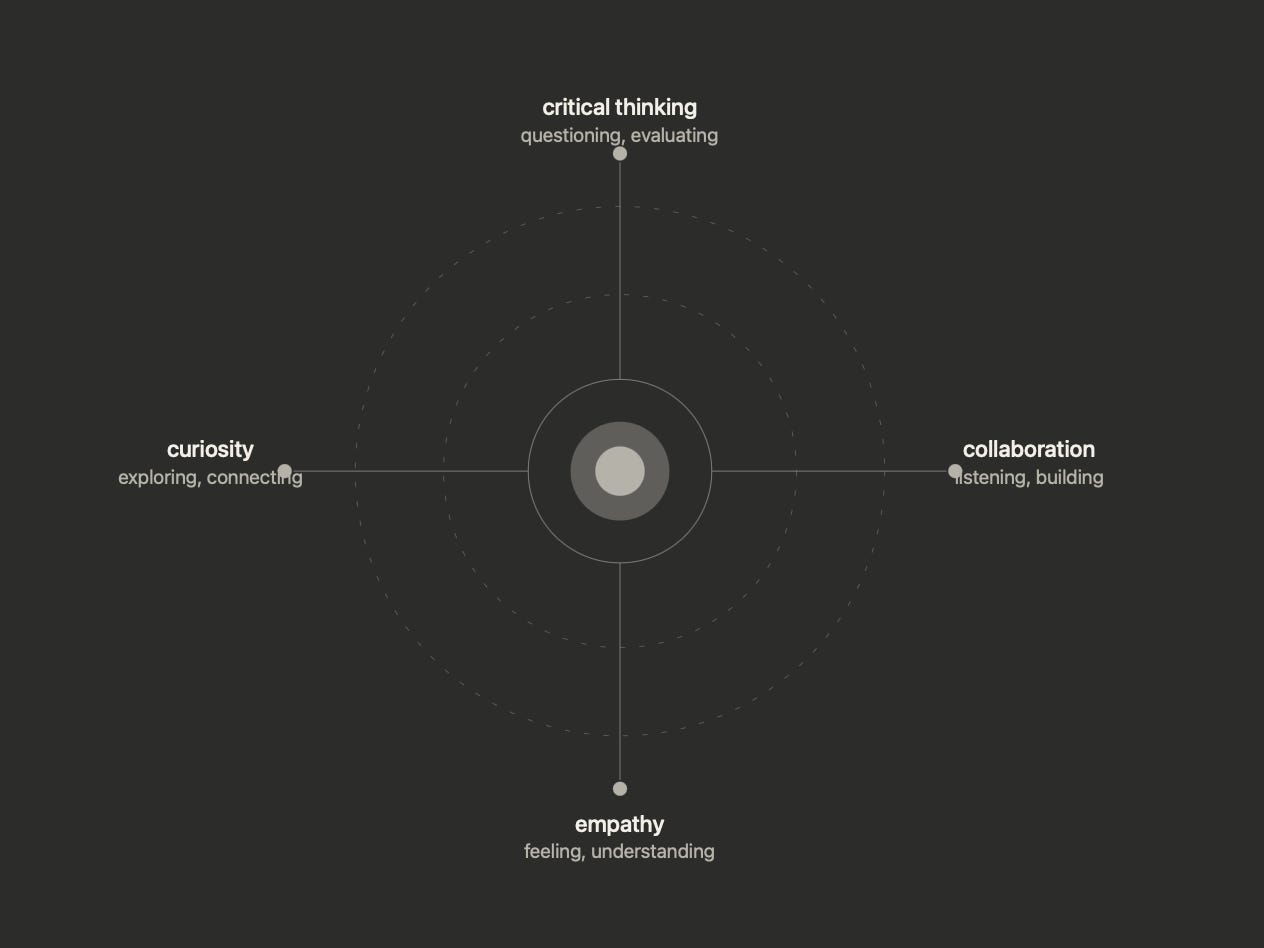
Curiosity is harder to defend because it looks like inefficiency. It’s the person who follows a thread that wasn’t in the brief, reads something that wasn’t assigned, takes the long route through a topic because something felt interesting and asks questions, like children do constantly. When a tool can generate ten directions in thirty seconds, that instinct starts to feel like a waste of time. But connective thinking, the kind that finds the unexpected link or spots the question nobody else thought to ask, still depends on a mind that was allowed to be genuinely unsure for a while.
Empathy has its own substitution problem. Customer feedback becomes a sentiment score. A difficult conversation becomes a carefully worded message, often drafted with assistance. These substitutions are efficient, but efficiency in the domain of human understanding tends to reduce what it measures. You can track sentiment without understanding what someone actually feels. You can track everything without knowing what the numbers actually mean.
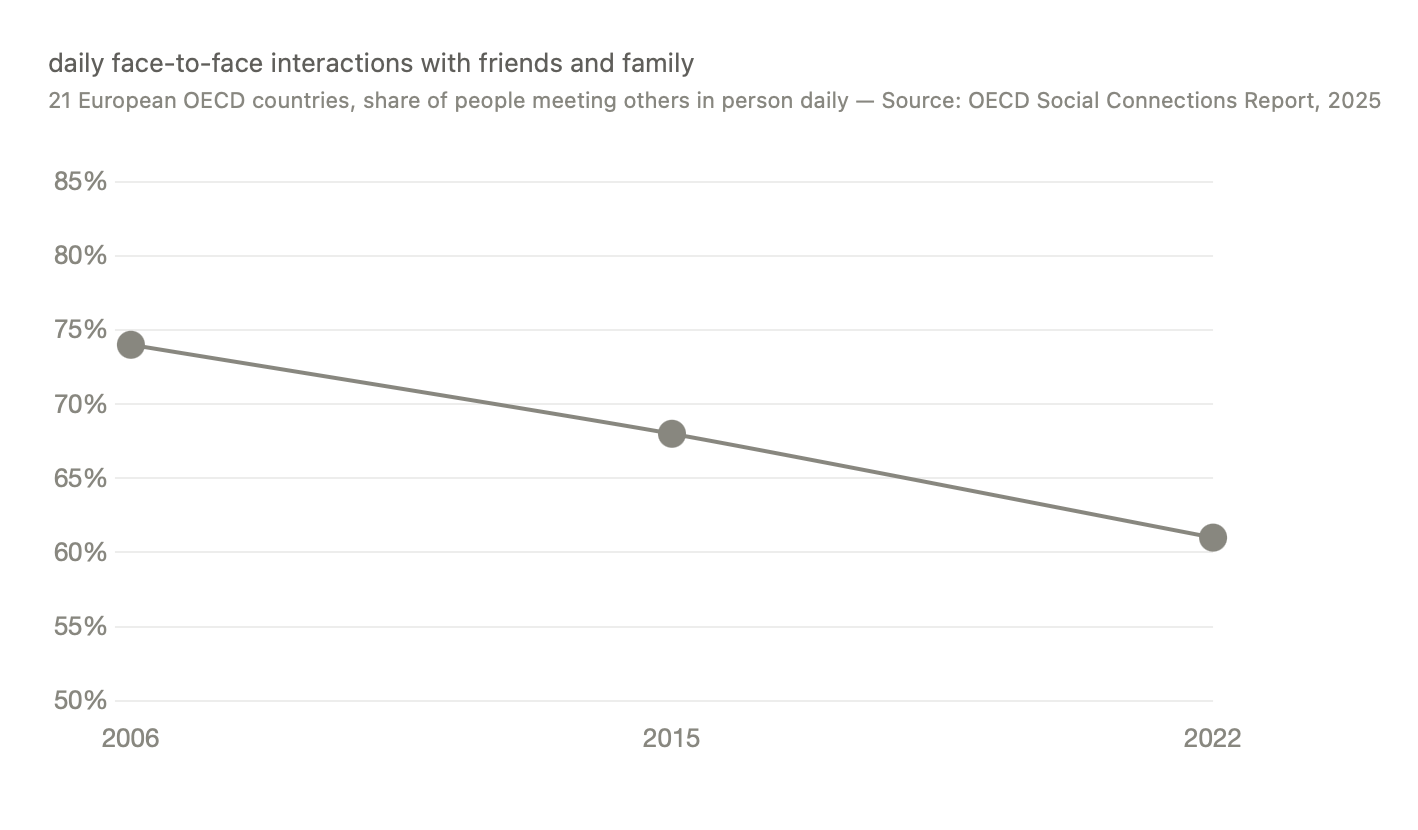
And then there’s how we actually meet. In 21 European OECD countries, daily face-to-face interactions with friends and family declined consistently between 2006, 2015 and 2022, with men and young people seeing the largest deteriorations. Collaboration still happens, but increasingly at a remove, asynchronous and screen-mediated, optimised for coordination rather than genuine exchange. The ability to read a room, to feel when something isn’t being said, to hold a disagreement long enough for something useful to emerge: these don’t develop in message threads.
Taken together, these four shifts point at something cultural, not just professional. A generation is forming its relationship to knowledge, to other people, to uncertainty, inside systems that reward speed and confidence over inquiry and doubt.
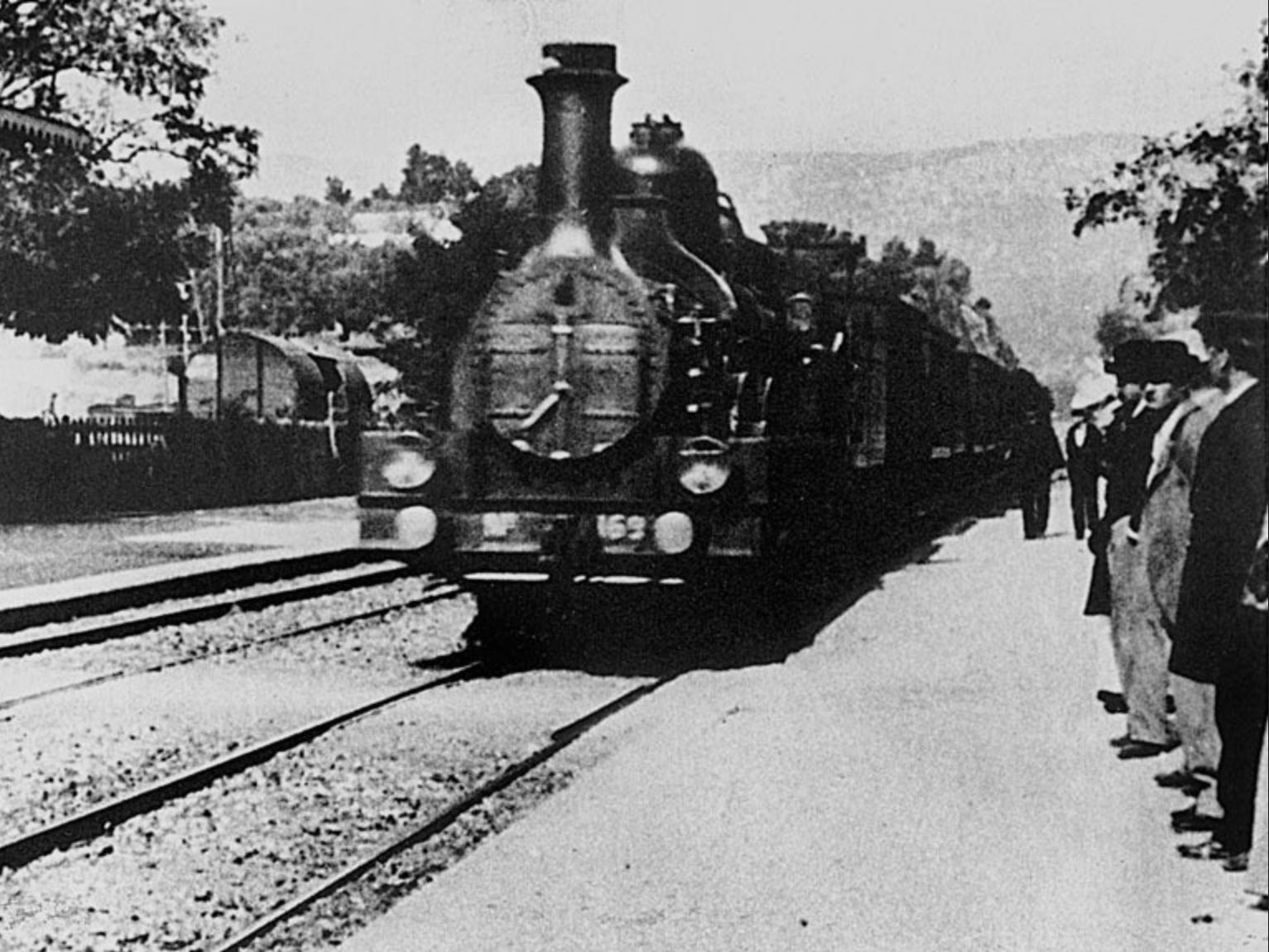
We’ve been here before, in a way. Every major communication shift, let. it be print, film, television, the internet, was followed by concern about what it was doing to how we think and relate. Most of those concerns were overblown. But the question underneath them was always the same: what are we practising, and what are we letting go? That’s what I keep coming back to, and what I want to explore through the conversations I’m building this year. What they’ll look like in ten years. Or maybe only five. Most likely.
What about practising them deliberately? Reading something you didn’t search for. Having the conversation instead of sending the message. Sitting with a problem before asking a tool. If you have others, send them my way.
*Moritz
No posts
Comments
Nothing yet. Say the first thing.
Sign in to join the conversation.