
For the uninitiated, here’s a bit of a catchup on the AI news of the day (or week I guess — I’m a little late to the game with these). High level here’s what happened:
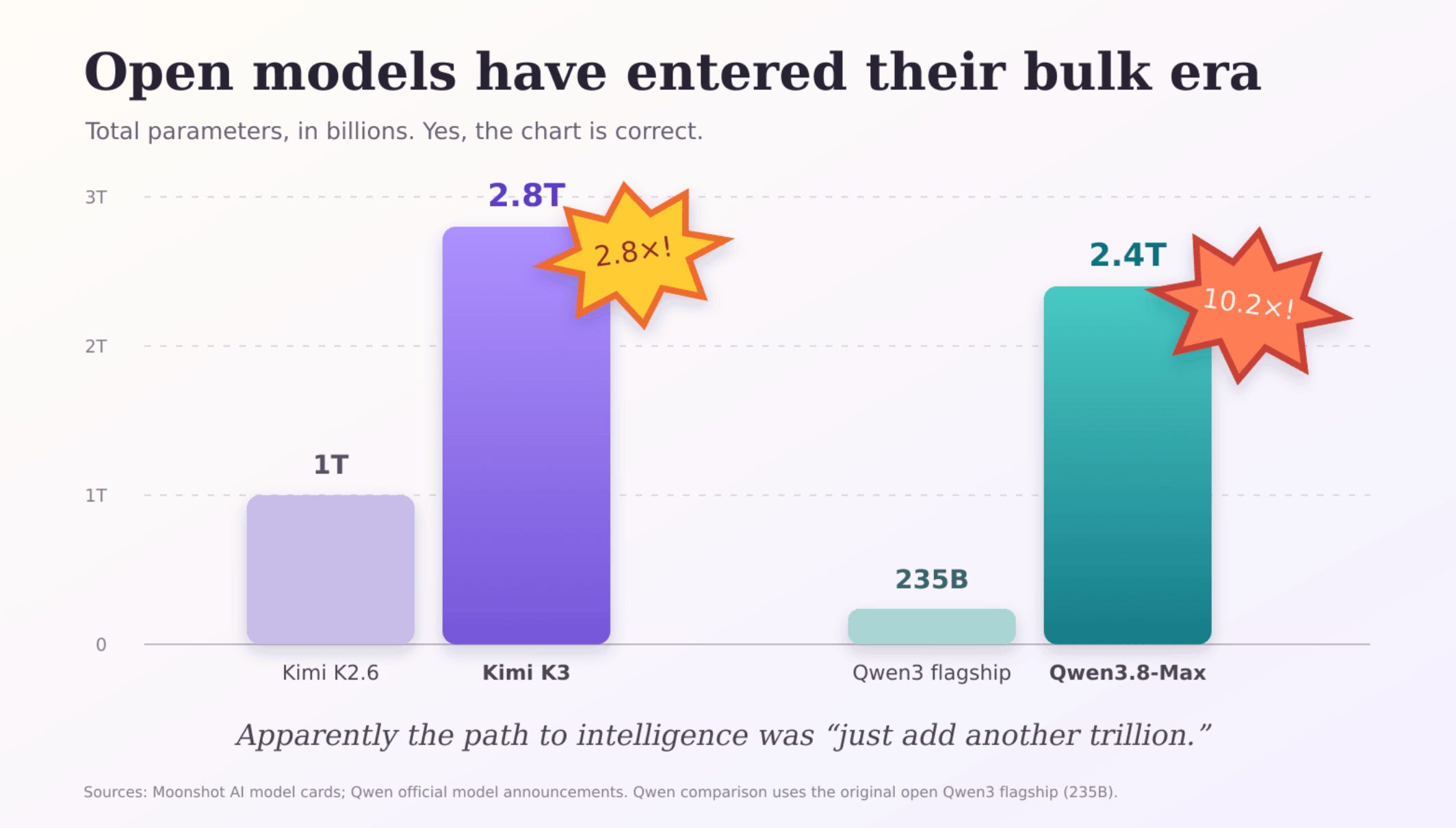
Moonshot AI released Kimi K3: A massive 2.8 trillion parameter open model that now sits alongside some of the best closed models out there.
Alibaba released Qwen3.8-Max: Another monster with 2.4 trillion parameters and some pretty insane results across coding, reasoning, and agentic tasks.
Then DeepSeek released V4-Flash-0731: It has 284 billion total parameters, with only 13 billion active at a time, but somehow gets surprisingly close to these much larger models on several major benchmarks.
Let’s start with the biggies (no pun intended hehe). K3 and Qwen3.8-Max are uber massive.
Kimi jumped from 1 trillion parameters in K2.6 to 2.8 trillion in K3, nearly tripling in size in a single generation.
The jump for Qwen is even crazier. The original open Qwen3 flagship had 235 billion parameters. Qwen3.8-Max has 2.4 trillion. That’s more than a 10x increase in a little over a year.
If you chart out these parameter jumps, you’d probably jump to the conclusion that the future of intelligence is going to be predicated massive model size increases.
And if this trend continued, you could make the argument that Dario Amodei’s almost erotic fascination with model size was correct.
But the fascinating thing that happened in tandem was DeepSeek.
While Kimi and Qwen were busy stuffing another trillion parameters into their models, Wenfeng basically said, “Hold my beer.”
DeepSeek went in the exact opposite direction.
And somehow, the smaller model absolutely rips. V4-Flash-0731 has 284 billion total parameters, with only 13 billion active at a time. Kimi K3 activates 104 billion and Qwen3.8-Max activates 95 billion. Despite that enormous difference, DeepSeek scored a 50 on Artificial Analysis’s Intelligence Index, compared with Kimi K3’s 57. DeepSeek is activating about one-eighth as many parameters as Kimi while getting surprisingly close to it in overall intelligence.
It also scored six points higher than DeepSeek’s own V4-Pro Preview. V4-Pro has 1.6 trillion total parameters and activates 49 billion, while V4-Flash-0731 has 284 billion total parameters and activates just 13 billion.
That makes Flash roughly 82% smaller overall, with 73% fewer parameters active at a time. DeepSeek didn’t just get closer to the frontier with a smaller model. It somehow made its smaller model better than its larger one.
The memory footprint makes this even crazier. Kimi K3’s released weights take up around 1.56 terabytes, while Qwen3.8-Max would require roughly 1.2 terabytes at 4-bit precision. DeepSeek V4-Flash-0731’s official checkpoint is around 167GB. That makes DeepSeek’s weight footprint roughly nine times smaller than Kimi’s and seven times smaller than Qwen’s.
To be clear, the 13 billion active parameters only tell us how much of the model is working on each token. The full model still needs to sit somewhere in memory (although you can offload some or even all of it to solid-state storage if you’re cool with waiting longer). But 167GB is something you can fit inside a very large workstation. Kimi and Qwen are firmly in “please show me your data center” territory.
Now I don’t want to stop here because, quite frankly, this is where everyone stops. They think it’s super cute that a smaller model is pumping at the Opus 4.8 levels before going back and fornicating over K3 and Qwen 3.8 Max.
And to be clear — I’m not making the argument that those releases aren’t groundbreaking in their own right. I mean, after all, they are basically competing with the frontier from Anthropic and OpenAI within weeks of their corresponding frontier releases.
But this flash model is probably more groundbreaking in ways that people don’t actually realize. I’ll lay out my case for this. But to jump the gun a bit — I actually think this release changes the way models are going to be trained and deployed. And uber foreshadowing — I think this could be a real thorn in the butt for OpenAI and Anthropic.
Ok so I made bold claims —> so let me try and and make the case through two main perspectives
There’s a very good reason these companies keep building enormous models. More parameters give a model more room to absorb information from an absolutely disgusting amount of training data.
A model takes trillions of messy, contradictory and often terribly written tokens and compresses the patterns inside them into its weights. It learns which ideas are related, which words tend to appear together and how concepts fit inside a shared mathematical space. The result is not a searchable copy of the internet, although larger models do memorize more of their training data. It’s closer to a very lossy compression of the world described by that data. The model takes all this disgusting raw information and gives it form.
But more storage capacity does not automatically translate into proportionally more intelligence. Model size is only one part of the equation. The amount and, more importantly, the quality of the data going into the model matter just as much.
The original scaling laws showed that performance depends on the relationship between parameters, training data and compute. You can’t keep stuffing more parameters into a model and expect them to magically become useful if the model is learning from the same repetitive internet sludge. Eventually, you run into bottlenecks. The supply of genuinely new, high-quality human data gets thinner, benchmarks begin to saturate and each additional chunk of compute produces a smaller improvement than the one before it.
We may already be seeing this at the frontier. On Artificial Analysis, GPT-5.6 Sol at medium reasoning scored 54, only one point above GPT-5.5 at high reasoning. Anthropic’s Claude Opus 5 scored 61, compared with 56 for Opus 4.8. These are still improvements, but they are not the giant leaps we used to associate with a new generation of frontier models.
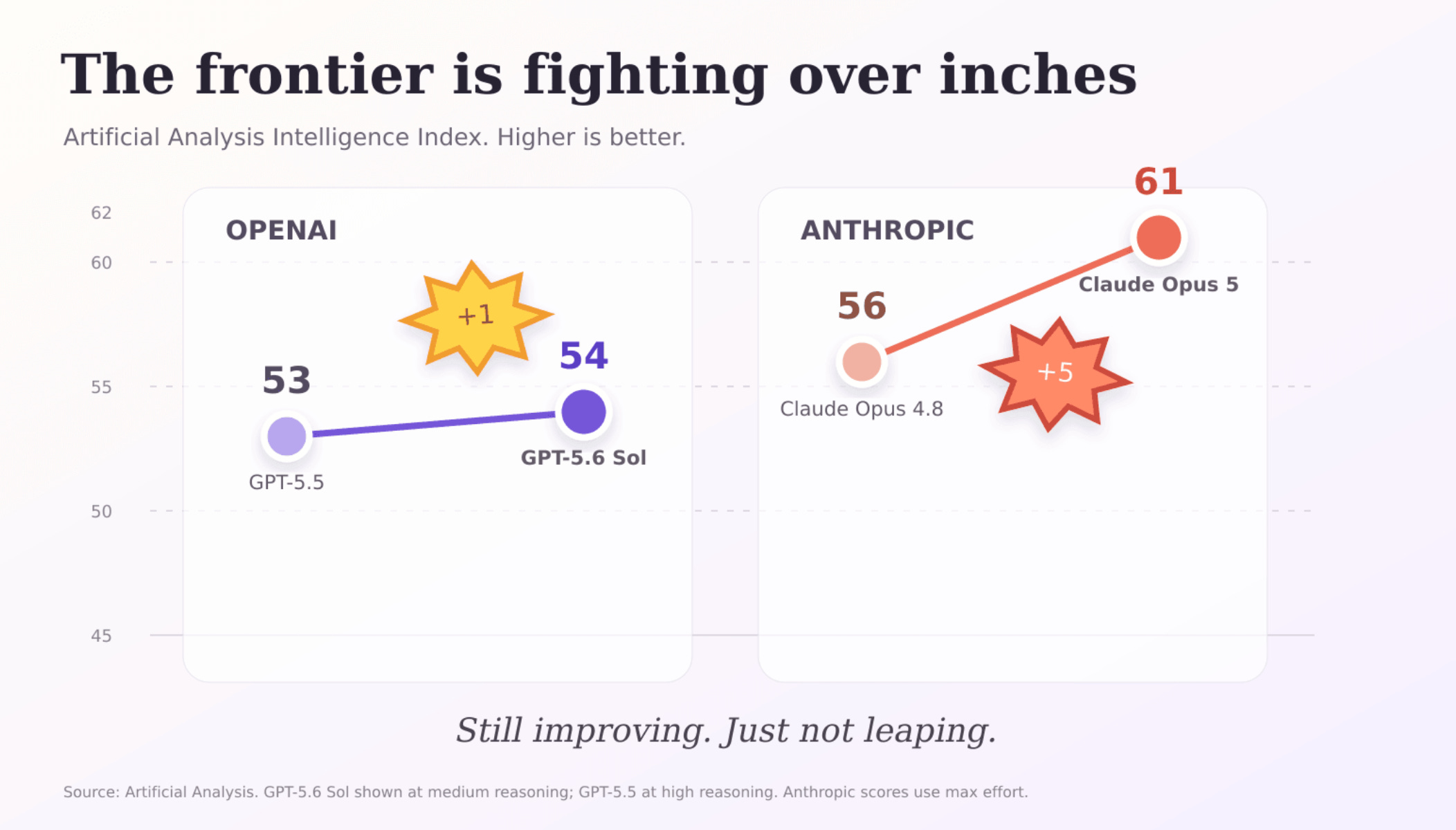
OpenAI and Anthropic don’t disclose their parameter counts, so this is not proof that bigger models have stopped working. It does show that simply moving to the next giant model is producing increasingly incremental gains. A growing share of the progress now seems to come from better data, better post-training, longer reasoning and better agent harnesses rather than raw size alone.
We’ve already seen how much training efficiency matters. Way back when, Chinchilla had 70 billion parameters and still outperformed the 280-billion-parameter Gopher because it was trained on four times more data with a better allocation of compute. Gopher had four times as many parameters, but that did not make it four times smarter. It did not even make it smarter at all.
In normal-person language, the industry keeps building bigger brains, but it’s getting harder to find better things to teach them.
This is where I think giant models may still be incredibly useful. Even if every extra parameter is no longer adding the same amount of intelligence, those parameters give the model more capacity to absorb messy information and find structure inside it. A massive model can take the internet’s raw sewage and turn it into cleaner explanations, labeled examples and step-by-step reasoning traces.
A smaller model can then learn from that much better data through distillation. Instead of asking the smaller model to make sense of the entire internet from scratch, you let the giant model do the expensive work first and train the smaller one on the cleaned-up result.
DeepSeek has already shown how powerful this can be. DeepSeek-R1 used its own reasoning outputs to train much smaller models, and its distilled 7-billion-parameter model beat a 32-billion-parameter reasoning model on AIME 2024. The giant model did the expensive work of finding form inside the chaos. The smaller model learned from what it figured out.
This is also the most likely explanation for what happened with V4-Flash-0731. DeepSeek kept the same architecture, parameter count and price as the original Flash model. It simply re-ran post-training and somehow jumped 10 points on Artificial Analysis.
We don’t know exactly which models taught 0731, but DeepSeek’s V4 technical report explicitly describes a post-training system that distills knowledge from multiple specialist teacher models. Those teachers could include DeepSeek’s own much larger models or potentially outputs from other frontier providers. OpenAI has accused DeepSeek of distilling from its models, although DeepSeek has not confirmed the allegation and there is no public evidence tying it specifically to 0731.
Either way, the broader direction is becoming pretty clear. The giant models do the expensive work of compressing the internet, exploring difficult problems and generating much cleaner reasoning data. Smaller models then learn from those outputs and capture most of the useful capability at a fraction of the size and cost.
Andrej Karpathy made almost this exact argument on Dwarkesh’s podcast. He argued that most of a giant model’s size may be devoted to memorizing the internet rather than intelligence itself. His prediction was that better datasets and distillation could eventually reduce the actual “cognitive core” of intelligence to around a billion parameters (that could be a stretch though).
As Karpathy put it:
“I just feel like distillation works extremely well. So almost every small model, if you have a small model, it’s almost certainly distilled.”
That may be where this is all heading. We’ll still build enormous frontier models, but most people may never actually use them directly. Their real job will be to explore difficult problems, organize messy information and generate extremely high-quality training data.
The right way to think about large models may not be as the final product. They may eventually become giant, extremely expensive data generators used to distill intelligence into much smaller models.
The monster discovers and organizes the intelligence. The smaller model is how we actually use it.
The useful way to think about all of this isn’t “How intelligent is the smartest model on Earth?” It’s “How much intelligence do I actually need to get my work done?”
I’d call that actionable intelligence. It’s the point where a model is good enough that you can hand it a real task, walk away and reasonably expect something useful when you come back. Benchmarks can keep crawling upward forever, but once a model reliably writes the code, fixes the bug or finishes the research, another three points on an intelligence index starts to feel pretty academic.
For me, Opus 4.6 was that moment. It was the first model that genuinely changed how I worked. But now we’re watching much smaller models creep surprisingly close to newer frontier models like Opus 4.8. That matters way more than another giant model winning another benchmark by two points.
If an Opus 4.8-level model can already complete 90% to 95% of the coding work most people realistically give it, how much more should we be willing to pay for the next few percentage points? At some point, I don’t care that Fable 5, Fable 6, Fable 7 or Odyssey 1, 2, 3, 4 and 5 is marginally smarter. Go see The Odyssey, by the way. It’s good!

The more interesting story is what happens underneath the model. Smaller models don’t just cost less to train or use fewer parameters per token. They also need far less memory to serve. That’s incredibly important because memory, not just raw compute, is one of the nastiest constraints in modern inference.
A giant mixture-of-experts model might activate only a fraction of its parameters for each token, but the full model still needs to live somewhere. Usually, that means keeping hundreds of billions or even trillions of parameters loaded across a pile of expensive accelerators. You can offload some of those weights to solid-state storage, but now you’re trading memory capacity for latency and waiting while data moves back and forth.
Shrink the model and that whole equation changes. You need fewer chips, less RAM, less power and less networking just to keep the thing alive. A model that once required an entire rack might eventually fit inside a single server. A model that needed a hyperscaler could be served by a regional neocloud. The hardware stops being exotic, and inference starts looking a lot more like a commodity.
That’s where this starts colliding with the data-center boom. A huge part of today’s buildout assumes that models will keep getting bigger, memory requirements will keep climbing and every new generation will need an even more absurd pile of GPUs. So companies are ordering chips, locking up power and building data centers around a future of permanently expanding models.
But that future isn’t guaranteed.
If distillation, better training data and smarter architectures keep compressing frontier capability into smaller models, the amount of hardware needed to serve a given level of intelligence could fall dramatically. Demand for AI might still explode, so we’re not suddenly going to stop building data centers. But the assumption that every useful model will require a hyperscale cluster starts looking a lot shakier.
And yes, here comes the shameless plug for what we’re building. Sorry, we’ve gotta pay the bills somehow 😂
This is a big part of the bet behind CueCloud. We think highly actionable intelligence is going to fit on smaller and increasingly accessible hardware. If that happens, you won’t need to be Microsoft, Amazon or Google to serve a genuinely great model efficiently. Smaller neoclouds will be able to own the hardware, run the models and offer enormous amounts of inference without sending every token through the same handful of hyperscalers.
The frontier models will still matter. They’ll do the expensive work of exploring new capabilities, organizing messy data and generating higher-quality training examples. But over time, their most important job may be teaching the smaller models that everyone actually uses.
The giant models become the data factories. The smaller models become the product.
That’s fair. People have been predicting the death of closed models for years, and OpenAI and Anthropic are currently larger, richer and more powerful than they’ve ever been.
But this time feels meaningfully different.
Famous last words, obviously. If I’m completely wrong about this in six months, add this blog post to the Ed Zitron AI financial doom content consortium.
The difference is that open models aren’t merely getting cheaper. They’re getting close to the level of intelligence people actually use for serious work. DeepSeek doesn’t need to beat the absolute best model on every benchmark. It just needs to get close enough that paying five or ten times more starts feeling ridiculous.
Meanwhile, the most useful closed models aren’t getting much cheaper. OpenAI recently cut GPT-5.6 Terra and Luna pricing by as much as 80%, which is great, but those aren’t necessarily the models developers reach for when they want the strongest possible coding agent. GPT-5.6 Sol still costs $5 per million input tokens and $30 per million output tokens.
Anthropic has been even more consistent. Opus 4.6, 4.7 and 4.8 all cost $5 per million input tokens and $25 per million output tokens. Opus 5 launched at the same price, while Fast Mode doubles it to $10 and $50. Even Sonnet 5, which is supposed to be the practical everyday option, will cost $3 per million input tokens and $15 per million output tokens once its introductory pricing ends.
Per million tokens, those numbers don’t look completely insane. Multiply them by a billion and your eyes start watering:
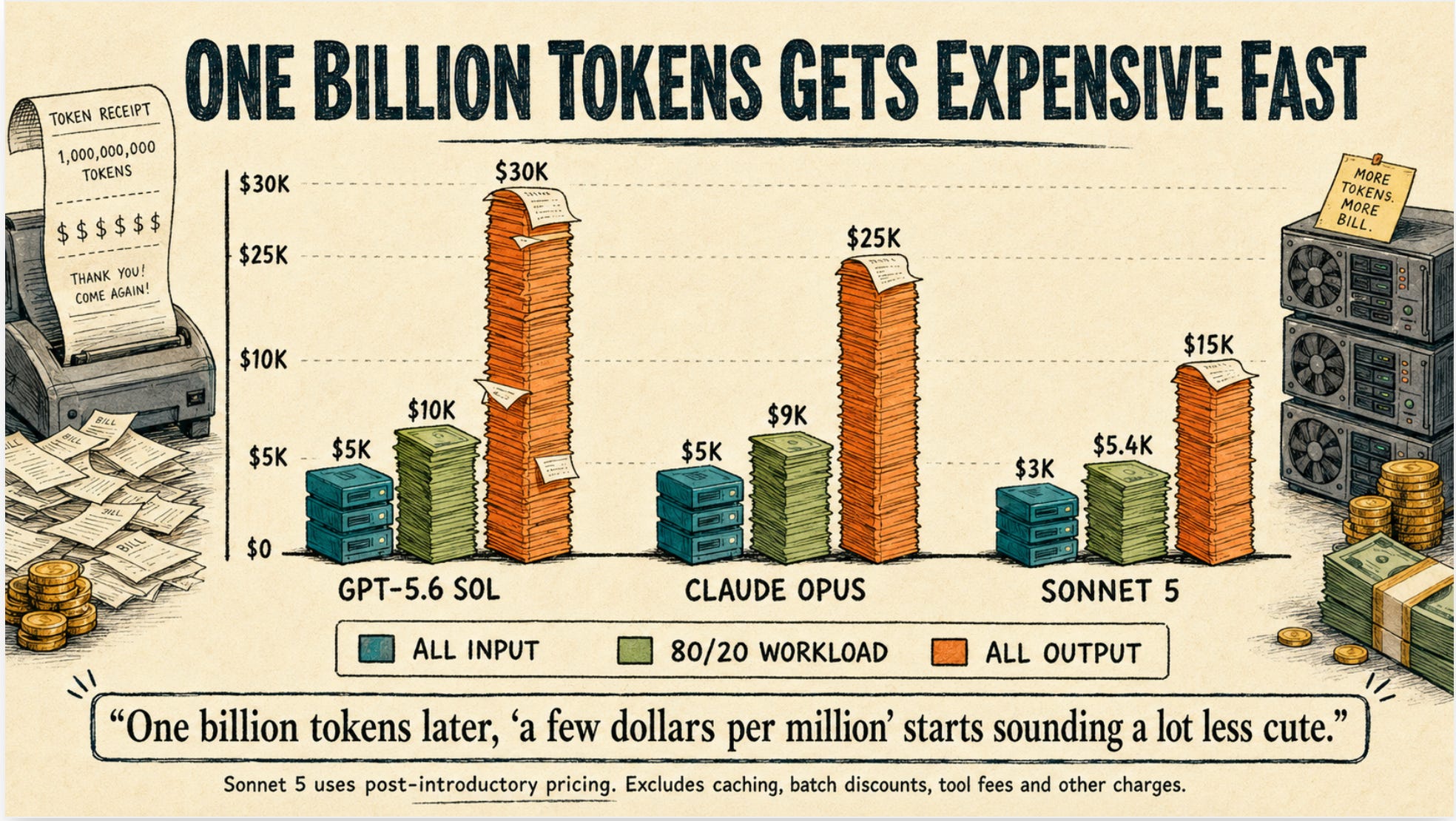
GPT-5.6 Sol costs $5,000 for one billion input tokens or $30,000 for one billion output tokens.
Claude Opus costs $5,000 for one billion input tokens or $25,000 for one billion output tokens.
Sonnet 5 costs $3,000 for one billion input tokens or $15,000 for one billion output tokens after its introductory period.
A workload that’s 80% uncached input and 20% output would cost roughly $10,000 per billion tokens on GPT-5.6 Sol, $9,000 on Opus and $5,400 on Sonnet 5. Prompt caching can reduce that substantially, but coding agents don’t give you a perfect cache hit on every giant repository, tool result and changing context window. They also burn reasoning tokens and frequently reread a depressing amount of code.
Our suspicion is that older frontier models will never get dramatically cheaper, even after a new generation replaces them. OpenAI could slash the price of GPT-5.5 tomorrow, but then it would create a pretty awkward question: if GPT-5.5 is already fantastic and suddenly costs almost nothing, why would most people pay significantly more for GPT-5.6 Sol?
The same problem exists at Anthropic. Opus 4.7 and 4.8 are still extremely capable coding models. If Anthropic dropped their prices by 80%, a lot of developers would happily stick with them instead of moving to Fable or Opus 5. The newest model might be smarter, but it probably isn’t five times more useful for the average coding task.
That’s why the pricing ladder needs older frontier models to remain expensive. OpenAI and Anthropic aren’t only pricing the cost of serving each model. They’re maintaining enough distance between generations to keep customers moving toward the newest and most expensive tier. If the previous generation became dirt cheap, it wouldn’t disappear. It would start eating the new generation alive.
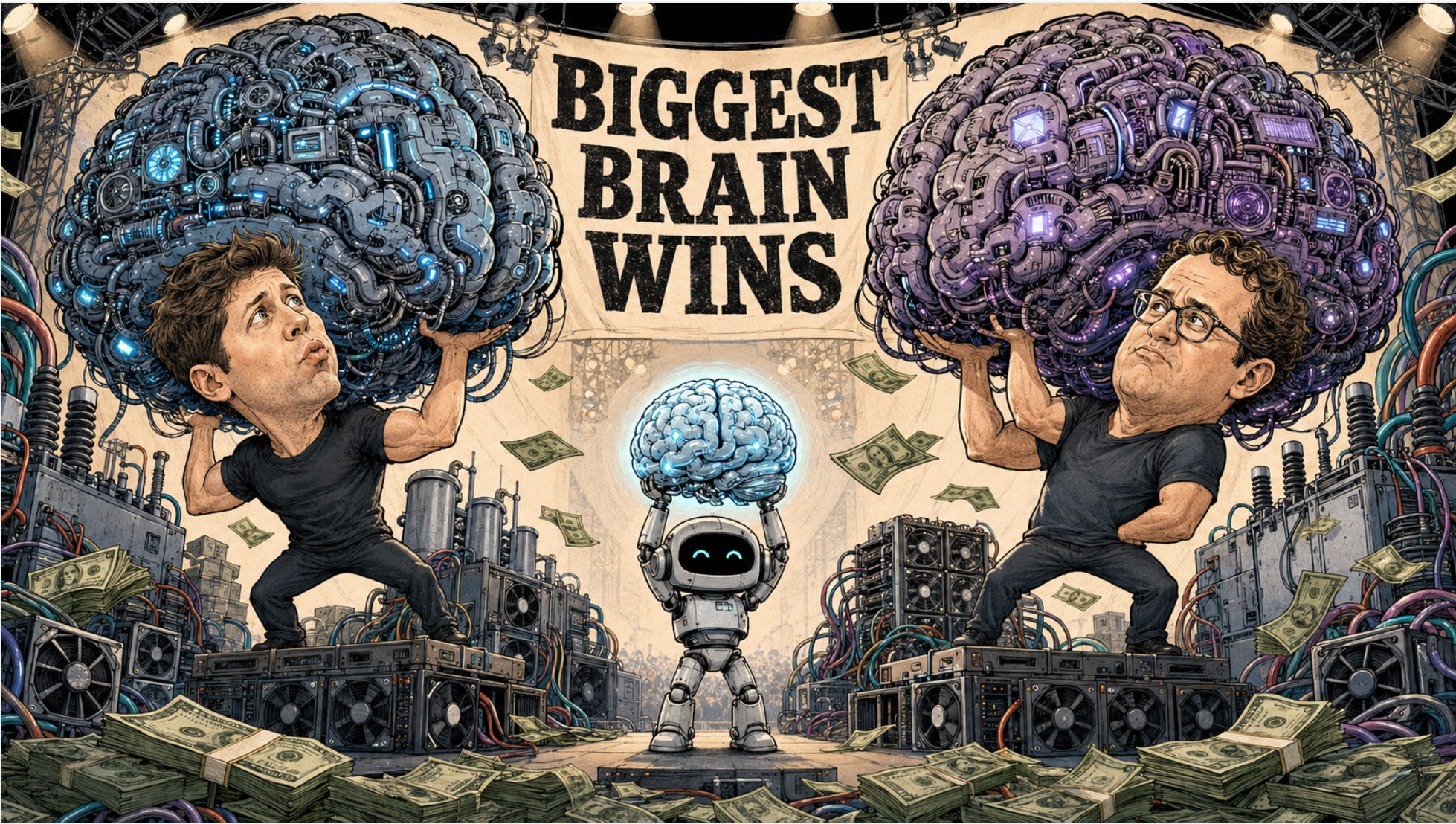
There’s also a physical reason these prices stay high. We don’t know the parameter counts of Sol, Opus or Sonnet because OpenAI and Anthropic don’t publish them. So we shouldn’t pretend we do. But Sam and Dario don’t exactly sound like two guys racing to build the world’s tiniest language model. They seem to be in a very expensive pissing contest over who can build the biggest and baddest brain on Earth.
That gets expensive fast because every parameter has to live somewhere. An H100 has 80 GB of memory, an H200 has 141 GB and a B200 has 180 GB. Those numbers sound enormous until you try loading a frontier model.
Take a hypothetical one-trillion-parameter model. At 16-bit precision, its weights alone require about 2 TB of memory. That’s at least 25 H100s or 12 B200s before leaving room for anything else. At 8-bit precision, it’s still roughly 1 TB, requiring at least 13 H100s or six B200s. Even at 4-bit, the weights consume around 500 GB, which means seven H100s or three B200s.
And those are fantasy-minimum numbers. Real serving also needs memory for the KV cache, intermediate activations, the inference runtime, long context windows and multiple concurrent users. You need additional headroom for redundancy and enough replicas to serve traffic without making everyone wait. A model may technically fit on six GPUs while still requiring dozens or hundreds of them to operate as an actual product.
Now multiply that across an entire fleet. OpenAI doesn’t serve one model. It serves Sol, Terra, Luna, older generations, multimodal models, image models, voice models and specialized tools. Anthropic has Opus, Sonnet, Fable and multiple generations of each. Every hot model needs enough loaded replicas to handle demand, and you can’t magically use memory occupied by one model to serve another without unloading one set of weights and loading another.
This makes memory one of the core constraints of the business. It also makes maintaining a giant menu of older models genuinely expensive. OpenAI and Anthropic can’t slash prices, keep every previous generation available and assume the economics will somehow work themselves out.
Neither company owns anything resembling Amazon, Google or Microsoft’s mature global cloud footprint. They’re securing enormous amounts of capacity from other infrastructure providers while their own data centers slowly come online. OpenAI’s agreements with CoreWeave alone reached roughly $22.4 billion, while Stargate has grown to nearly seven gigawatts and more than $400 billion of planned investment. Anthropic has committed more than $100 billion to AWS over ten years to secure as much as five gigawatts of capacity.
This isn’t compute they can summon tomorrow. Data centers take years to permit, power, build and fill with chips. Until that capacity arrives, both companies have to fight for whatever high-end infrastructure is available, pay cloud-provider margins and lock themselves into massive long-term commitments.
The financial pressure makes cheap frontier inference even harder. Reuters reported that OpenAI expects to spend around $600 billion on compute through 2030, with inference costs already quadrupling during 2025 and adjusted gross margin falling from 40% to 33%. HSBC analysts estimated that OpenAI could burn nearly $280 billion through 2030. The same report said Anthropic had spent more than $10 billion training models and serving responses while producing roughly $5 billion in cumulative revenue.
And now both companies have public-market ambitions. Anthropic has already filed confidentially for an IPO, while OpenAI has been laying the groundwork for a listing that could value it at as much as $1 trillion.
Public investors may tolerate gigantic losses while revenue is growing like crazy. They’re going to be much less amused if open models start crushing token prices at the exact moment hundreds of billions of dollars in infrastructure commitments hit the balance sheet.
That’s the trap. OpenAI and Anthropic need high prices to fund increasingly expensive models and infrastructure. They also need older models to stay expensive enough that customers continue upgrading. But those same prices give smaller open models an enormous opening.
If an open model can deliver 90% to 95% of the “actionable intelligence” for a fraction of the serving cost, customers don’t need it to win every benchmark. They just need it to be good enough.
The incumbents are financially committed to a future of bigger models, bigger data centers and bigger infrastructure bills. DeepSeek is suggesting that the same useful intelligence might be compressed into something much smaller.
If DeepSeek is right, OpenAI and Anthropic won’t be crushed because their models are bad. They’ll be squeezed because their models are incredible, enormous and brutally expensive at the exact moment intelligence starts becoming a commodity.
Hope you found this fun to read! I’m going to try and post one of these a day! Subscribe for more
Comments
Nothing yet. Say the first thing.
Sign in to join the conversation.