
Spring was a little late.
And Richard was a little early.
“The First Robin” by Robert Kraus was one of my favorite bedtime stories growing up.
Perhaps it was partially because it was a Richard himself who read it to me.
Maybe it was the unforgettable characters like the small robin Richard, Kindly Groundhog, Dr. Wisegrey the squirrel, and Richard’s mom. And of course with them, my stepfather Richard’s voices that brought each one to life.
Or could it have been the gentle lessons about nature and life that it taught me?
No matter the reason, I asked to hear it again and again, and yesterday morning as I listened to “Light Eaters” by Zoe Schlanger, I had to go find that little green book and read it yet another time.
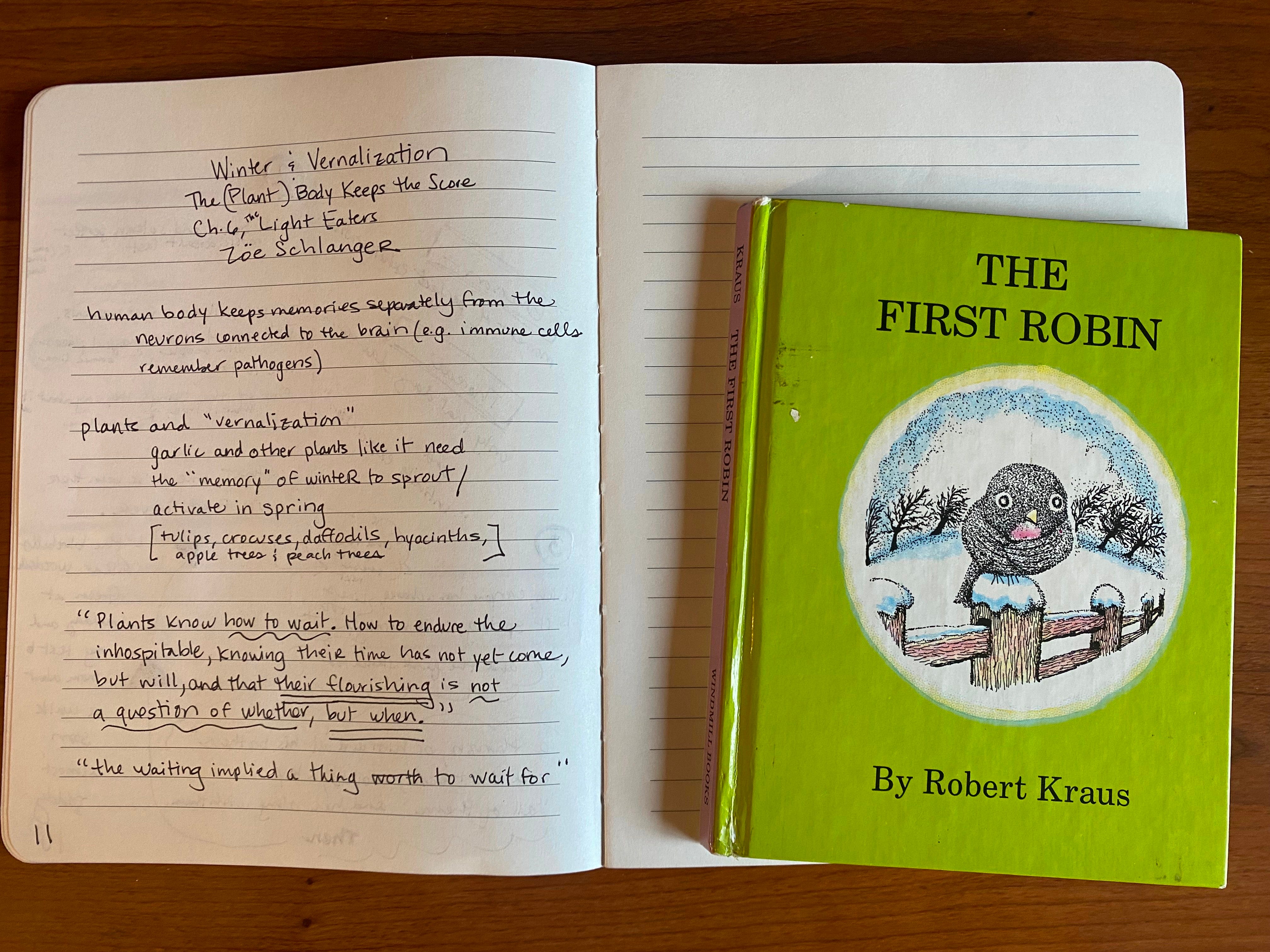
Schlanger tells us about plants and vernalization. Sharing the story of planting garlic late one fall, she considers the idea that some plants need the “memory” of winter to sprout or begin growing again in spring.
“Plants know how to wait,” she writes. “How to endure the inhospitable, knowing their time has not yet come, but will, and their flourishing is not a question of whether, but when.”
I love this.
Nature always has something to teach us, and as the temperatures plummet again here in Ohio, I need to remember the lesson.
A deep freeze is necessary not only for garlic to thrive, but to survive.

Waiting is hard.
And as society moves faster seemingly day by day, I find it harder and harder to slow down. To rest. To wait.
Like the little robin Richard, I find myself hurrying spring.
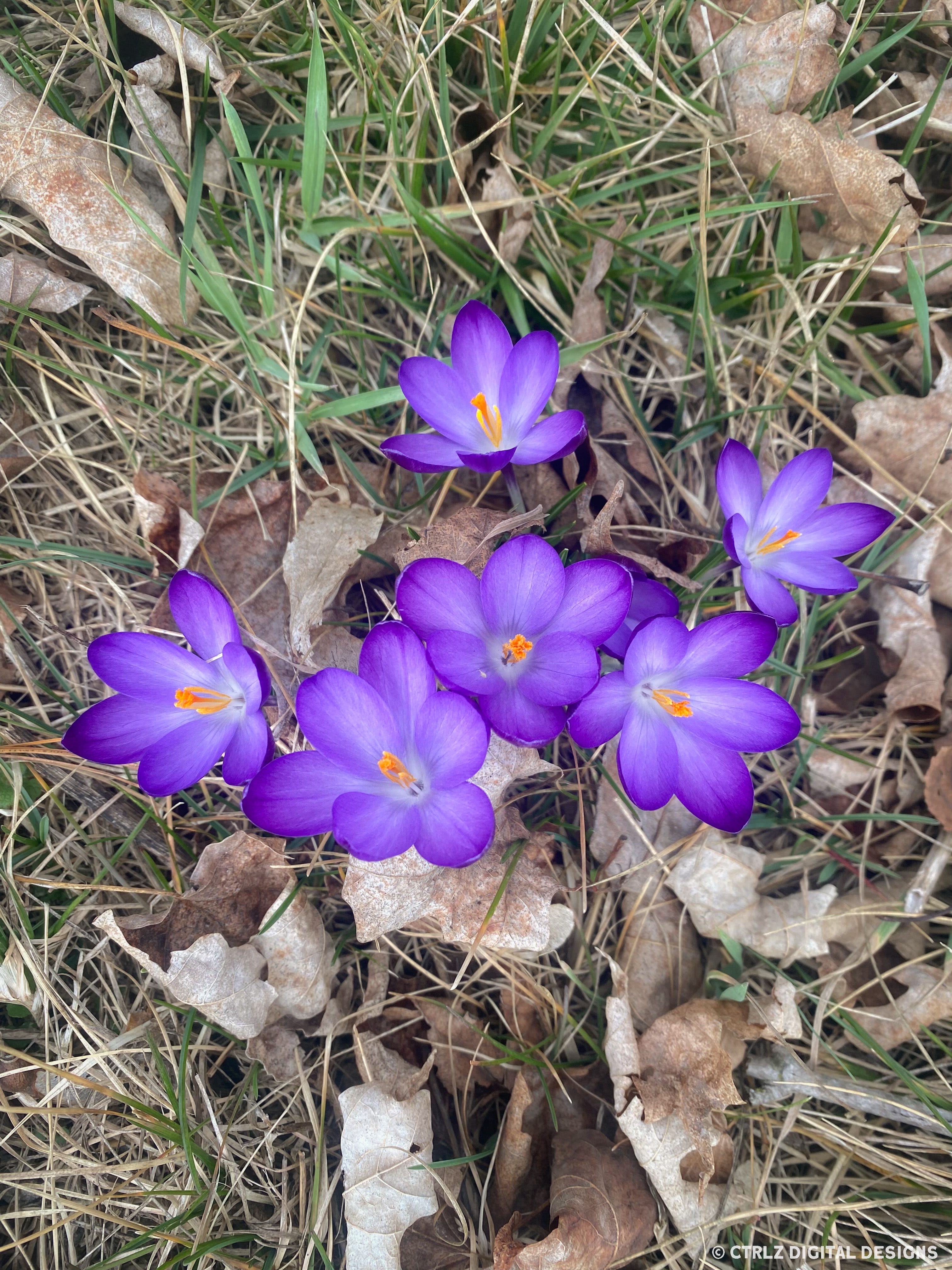
Maybe I need to find my own Kindly Groundhog to create shadows on the wall of crocuses, daffodils, raindrops and rabbits that remind me of those early days of spring.
Those crocuses and daffodils are two of the plants Schlanger mentions that require “a good long cold” for their survival.
As time has passed, we have found ways to “improve” our lives and carry on speeding ahead no matter the conditions outdoors.
Granted, I don’t want to give up my home, my heat, or my car anytime soon, but “wintering,” as Katherine May calls it, does us good.
The young Richard wants to rush the season, but spring comes in its own time.
The Kindly Groundhog and Richard’s mother are older and wiser.
Even Dr. Wisegrey, when called to assist with Richard’s fever (a consequence, perhaps, of going out before he should), shares his experienced advice:
Text within this block will maintain its original spacing when published
"Rest, rest, rest,
Is best, best, best."
Schlanger, too, sees not only the wisdom in waiting, but also the hope. It implies “a thing to wait for.”
After some good rest under the care of his new friend Kindly
Groundhog, the medicine and sweet songs of his mother, Richard gets out of bed, goes outside, and sees all the wonderful sights he’s been wishing for all along.
It was spring! …
And he was the first robin!
The End.
Comments
Nothing yet. Say the first thing.
Sign in to join the conversation.