
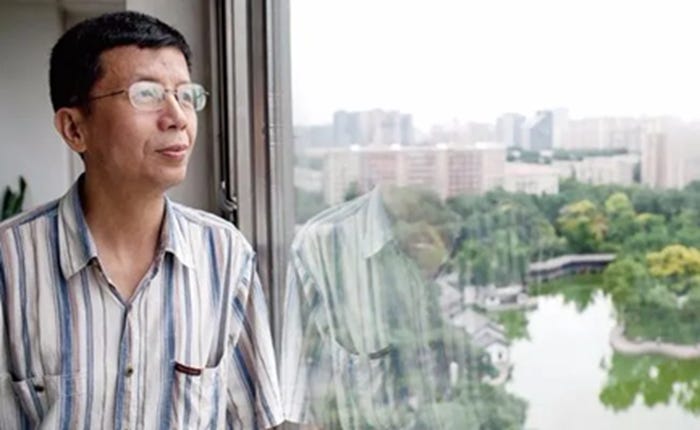
Chen Tushou(陈徒手)
Chen Tushou copied hundreds of thousands of Chinese characters by hand in the Beijing Municipal Archives(北京市档案馆). Some people would have preferred to see those files buried forever. In that sense, Chen was like a grave robber.
He spent years gathering the valuable things he had unearthed, then worked them into two books, What the People of the Old Country Thought(《故国人民有所思》) and When People Fall Ill, Does Heaven Know?(《人有病,天知否》). The books examine the humiliations suffered by intellectuals during the “Thought Reform Campaign”(思想改造运动) in the early years of the People’s Republic and trace the ideological remolding of eleven university professors after 1949.
Huang Zongying(黄宗英) once called Chen and told him, “Feng Yidai(冯亦代) read your book and cried. The people you wrote about were all his acquaintances, but he knew nothing about these things. That was why he cried.”
During the nineteen-nineties, Chen copied hundreds of thousands of characters from documents in the archive of the Chinese Writers Association(中国作家协会). “Most of them were meeting minutes,” he said, “along with letters from writers, statements of confession, and self-criticisms. Every political campaign left behind a pile of papers.”
During the Anti-Rightist Campaign(反右运动) of 1957, the Chinese Writers Association held more than twenty mass meetings to denounce the “Ding Ling–Chen Qixia Anti-Party Clique”(丁玲、陈企霞反党集团). The meetings were often chaotic. People cursed, cried, and caused scenes. At one meeting, the Tianjin writer Liu Xi(柳溪) publicly accused Chen Qixia(陈企霞) of having had an “improper sexual relationship” with her. She even disclosed intimate details from the bedroom. The entire room was stunned.
When Chen Tushou copied the minutes of that meeting, he was shaken. “That was probably the most brutal meeting of all. These people had once been old friends, yet now they were fighting to the death in front of one another, using the most disgusting things they could find as weapons.”
To bring Chen Qixia down, Liu Baiyu(刘白羽), Party secretary of the Writers Association, made a special trip to Tianjin to persuade Liu Xi to appear in person. Chen Qixia, then editor-in-chief of Literature and Art Gazette(《文艺报》), had been “a proud and stubborn man.” He collapsed almost at once.
Chen summed up the Anti-Rightist Campaign this way: “It was one battle nested inside another, one person linked to another, as though everything had been arranged.” Ding Ling(丁玲) was attacked first, followed by Feng Xuefeng(冯雪峰), and then the struggle returned to Ding Ling. At the final meeting, participants voted on whether to expel her from the Chinese Communist Party. Ding Ling herself raised her hand in favor.
The archival material used in When People Fall Ill, Does Heaven Know? amounted to less than half of what Chen had copied. Most of the information had never been made public.
In 2001, Chen “transferred” his operations to the Beijing Municipal Archives. Over time, the computer replaced pen and paper. Every historical source used in What the People of the Old Country Thought came from those archives. There was, he said, “no casual invention and no arbitrary expansion.”
Xie Xizhang(解玺璋), critic and author of A Biography of Liang Qichao(《梁启超传》), offered this assessment: Chen Tushou’s studies of contemporary Chinese intellectuals are consistently grounded in large quantities of official material and original archives. Not a single sentence lacks a source.
Born in 1961, Chen describes himself as a member of “a politicized generation.”
He was in junior and senior high school during the Cultural Revolution(文化大革命) and had very little time for ordinary study. Students attended a few classes in the morning. In the afternoon, everyone went into the streets to read big-character posters(大字报). The posters were pasted so high that people had to climb ladders to put them up. Huge black characters covered sheets of red paper. Chen would stand below and look up. After a while, under the sunlight, the red paper seemed to turn into a solid black mass.
Every morning, the teacher selected five or six students from a class of more than forty and asked them to repeat what they had read. Chen was once selected. He could not fully understand the posters. He knew only that one person or another was being denounced. He repeated the words one by one: Party secretary Liao Zhigao(廖志高) was practicing revisionism.
Later, the struggles and “movements” described on the posters became part of his own lived experience. In 1986, Chen was transferred from the Central Committee of the China Zhi Gong Party(中国致公党中央) to the Creative Liaison Department of the Chinese Writers Association. He discovered that “although the effort to restore order after the Cultural Revolution had been underway for years, the Writers Association was still extremely complicated. It had never really known peace.”
In January 1987, the Party launched a campaign against “bourgeois liberalization”(资产阶级自由化). The Writers Association also organized repeated study sessions and political campaigns. At each council meeting, representatives of the left and right rushed to speak, accusing the other side of promoting liberalization. The atmosphere was explosive.
At one congress of writers and artists, Chen took the minutes. Wang Meng(王蒙) said, “There is a problem here. You should not keep sounding the alarm to the central authorities whenever anything happens.”
“That shows that some people were constantly filing complaints,” Chen later recalled.
That winter, the Writers Association held a conference for young writers at the Jinfeng Hotel(金丰宾馆), then located in Beijing’s western outskirts. During the day, participants studied literary theory—socialism and realism. At night, they watched foreign films. The meeting continued for eight or nine days. Snow fell outside, and the sky remained dim.
During a rectification campaign at the Writers Association in the late nineteen-eighties, the secretary and deputy secretaries were removed. Every member of the Party leadership group was replaced. Liu Baiyu, already in his seventies, returned to the association and became editor-in-chief of People’s Literature(《人民文学》).
The atmosphere of the nineteen-fifties, when “everyone had to pass inspection,” returned. After the political storm, work at the association came to a halt. Staff members had little to do but play chess and cards every day.
The archive room stood next to Chen’s office. Documents brought back from cadre schools(干校) were piled in burlap sacks against the wall.
Colleagues in the archive asked Chen to help organize the files. Once the work was finished, he took documents home and copied them. He continued transcribing these “confidential” institutional archives until he left the Writers Association in 1993.
Around 2003, Chen Tushou and the historian Yang Kuisong(杨奎松) were both frequent visitors to the Beijing Municipal Archives. A few years later, Yang wrote about the transformation of Wang Yunsheng(王芸生) and Ta Kung Pao(《大公报》) after 1949. Chen began publishing articles in Idle Talk from the Central Hall(《中堂闲话》) and Yanhuang Chunqiu(《炎黄春秋》), describing how professors at leading universities, including Yu Pingbo(俞平伯) and Feng Youlan(冯友兰), underwent ideological remolding after 1949.
Archival management was inconsistent, and gaining access often depended on luck.
After interviewing Wang Lang(汪朗), the son of the writer Wang Zengqi(汪曾祺), Chen still needed the institutional side of the story. He decided to visit the Beijing Peking Opera Troupe(北京京剧团) and look at Wang Zengqi’s personnel file.
On the day he arrived, a retired member of the troupe had just died, and the senior administrators had all gone to handle the funeral arrangements. Only two young women remained. When they heard that Chen was conducting an interview, they were delighted. One of them pointed and said, “Go ahead and look.”
A heap of battered documents had been tied together with coarse hemp rope. The three characters “Wang Zengqi” were written across the top in brush and ink. The paper inside was poor in quality and irregular in size. There were notebooks, manuscript paper, and documents typed in triplicate using carbon paper. Chen felt as though he had discovered buried treasure.
Once he began copying, the head of the archive office could do little about it and eventually left him alone. The files contained more than one hundred thousand Chinese characters. Chen copied them two or three times, but he could still use only part of the material. When People Fall Ill, Does Heaven Know? quotes Wang Zengqi’s post–Cultural Revolution self-criticisms and other documents, all of which were entirely new and had never been published.
Afterward, at Chen’s suggestion, Wang Lang asked the Peking Opera Troupe to give him the files so that they would not be destroyed. The archive office refused. Family members, it said, were not permitted to see them.
The archives lacked a systematic classification scheme. File titles often had little to do with their actual contents. Simply reading the catalogue would never lead a researcher to the material he wanted.
For a time, Chen studied the architect Liang Sicheng(梁思成). He wanted to find Liang’s speeches at sessions of the Beijing Municipal People’s Congress during the nineteen-sixties. The catalogue yielded nothing. The archive’s method had been to bind all the speeches delivered at People’s Congress meetings into thick volumes. Chen had no choice but to read them from beginning to end. At last, he found several of Liang’s speeches.
Chen had read nearly every commercially available biography of Liang Sicheng. The books were attractively arranged and sold well, but they “copied one another and offered nothing new.” In the end, they all reinforced the same account of “how Liang Sicheng followed the socialist path after Liberation.”
In archives and oral testimony, Chen discovered another side of Liang, one that had never been presented to the public.
During the Anti-Rightist Campaign, Liang Sicheng was harshly criticized and thoroughly humiliated. Later, he too began attacking other people. At a meeting held to denounce the scientist Qian Weichang(钱伟长), Liang spoke fiercely: “We will use our T-squares to beat you into meat paste.”
“Beat you into meat paste” was one of the expressions commonly used by workers, peasants, and soldiers during the Anti-Rightist Campaign.
Not long ago, Wang Keming(王克明) sent Chen an email. He had read the chapter on Feng Youlan in What the People of the Old Country Thought and found it “fairly balanced.” Feng Youlan was Wang Keming’s uncle by marriage.
Zi Zhongyun(资中筠) also passed along a similar assessment from Feng Youlan’s daughter, Feng Zhongpu(冯钟璞). “Feng Zhongpu has always had very high standards. She rarely approves of other people’s writing.”
Chen’s judgment of Feng Youlan is this: “His experience has the quality of a historical specimen. He was constantly involved in political struggles, yet he also remained slightly detached. At critical moments, he knew how to withdraw. He would always catch his breath and somehow survive again.”
Chen understands Feng’s participation late in life in the “Liang Xiao Writing Group”(梁效写作组) in much the same way: “All he did was revise annotations to classical Chinese texts for other people. It was hardly a great crime, yet people later described it in the most disgusting terms.”
Even someone as decent as Lao She(老舍) instinctively tried to avoid danger.
“When the ‘rightist’ Wu Zuguang(吴祖光) was being denounced, Lao She frequently spoke at meetings and echoed the accusations. But in private, he took good care of Wu. When Wu Zuguang was later sent to the Great Northern Wilderness(北大荒) for labor reform, Lao She bought some of Wu’s paintings and gave them to Wu’s wife, Xin Fengxia(新凤霞). That was how he expressed his concern for them. When Wu later wrote about it, he said with emotion that Mr. Lao She had still been a very good man,” Chen told a reporter.
“In 1964, during the rectification campaign in cultural circles, the Beijing Municipal Party Committee wanted to protect itself, so it pushed Lao She forward as a target. In August 1966, the Red Terror was especially severe. Yet the situation eased somewhat after that month. If Lao She had not taken his own life, he might have endured it.”
Chen explains Lao She’s suicide this way: “After 1949, he had never really suffered much. When this suddenly happened to him, he could not bear it.”
“We cannot judge them too harshly. The age itself was absurd.” Intellectuals as a group shrank under the pressure of those extraordinary years, but Chen still wants to show their capacity for goodness and decency.
“Take Shen Congwen(沈从文) and his A Study of Ancient Chinese Costume(《中国古代服饰研究》). He wrote that book entirely out of a sense of respect for the country. He studied silk and handled the objects one by one. That is why the book has such weight. I deeply respect that kind of professional devotion.
“And there was Mr. Lao She. He wrote one play after another. Each would be performed a few times, and once the Great Leap Forward(大跃进) had passed, the play would disappear with it. Yet he maintained his enthusiasm for writing. It reflected the intense hopes that intellectuals of that generation once placed in the new era.”
Chen often asks himself what he would have done in their place. “Perhaps I would have behaved even worse. If the Gang of Four(四人帮) had not been overthrown, and if Reform and Opening(改革开放) had not begun, all of us who came afterward might have suffered the same fate.”
“You had to protect yourself at all costs. That is the most humiliating and heartbreaking part of the Chinese intellectual’s experience. But in that political environment, anyone might have been forced to dirty his hands. If your hands did not become dirty this time, they might the next. No one came through completely clean,” Chen said.
Source: New Three Cohorts(新三届)
No posts
Comments
Nothing yet. Say the first thing.
Sign in to join the conversation.