
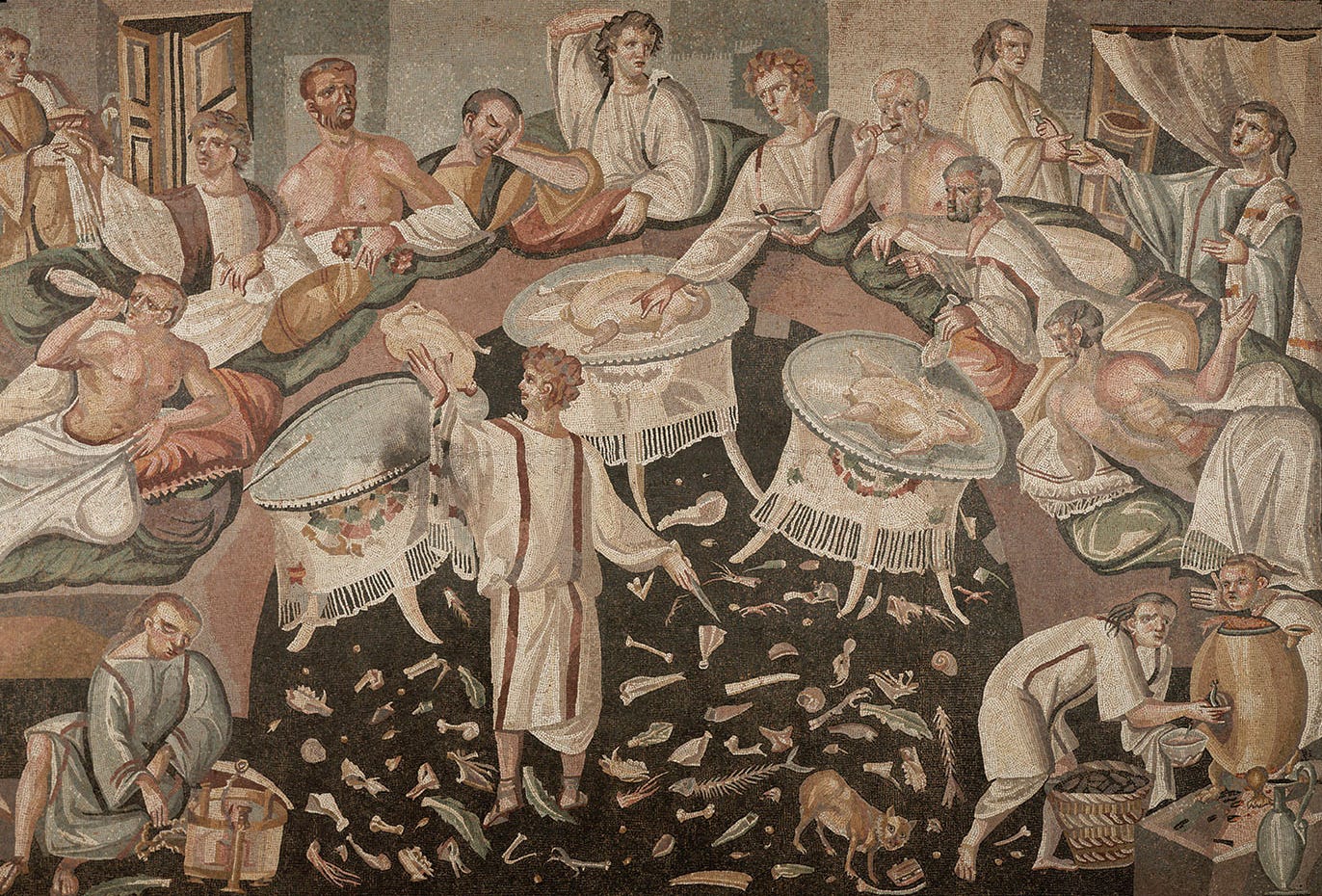
I am taking a break this week, so I'm re-sharing one of my most popular posts, all about ancient Roman food.
We live in a food-obsessed culture. We fawn over celebrity chefs and actively seek out the best restaurants, fancy food preparations, and unusual ingredients. Food is also an important societal marker for us today, as not everyone can afford a gold-laced cocktail or a Kobe beef burger, but you can still be trendy by seeking out the most delicious food truck or farmer’s market.
Despite our world’s current culinary ambitions, food as a status symbol is centuries old, and one of the most famous examples is the ancient Roman gourmand Apicius, the main character of my novel, Feast of Sorrow. Historians believe that he lived in the first century C.E., during the time of Caesar Tiberius. He was known for traveling the world for the choicest ingredients and for throwing lavish, over-the-top parties. It is also thought that Apicius wrote several cookbooks, including one on sauces referenced by several ancient chroniclers, but none has survived. However, a cookbook that bears his name has been passed down through the ages and is, ultimately, Apicius’s most important legacy. The oldest known collection of recipes is believed to have been compiled in the third or fourth century, long after Apicius lived, though some recipes were likely first developed in his kitchen. Many dishes in the Apicius cookbook are familiar to us today, such as French toast, tapenade, and even fried dough. On the flip side were the many dozens of foods and recipes that would shock the modern palate.
Here are twelve of the most unusual ancient Roman foods:
1. Garum

Garum is often described as the “ketchup” of ancient Rome because Romans used it in nearly every dish. The sauce is made from anchovies that are cut open, with their intestines left to rot in the sun for weeks on end, and the fermented juices drip down to form a sauce. Italian fish sauce, colatura; Thai sauce, Nam Pla; and Vietnamese Nuoc Nam Mhi are still made in nearly the same way today. The ancient Romans loved garum so much that they even put it in their sweet dishes.
2. Jellied meats
It might surprise many to learn that cooks developed gelatin thousands of years ago. Wealthy ancient Romans often enjoyed meats covered in jelly, made cold and firm with snow brought down in barrels from the mountains. Meats, herbs, spices, and eggs were common in these dishes. One such recipe from Apicius calls for lining a mold with vinegar-soaked bread, adding pieces of cooked chicken, egg yolks, brains of calf or lamb, plus soft cow’s cheese, pine nuts, cucumbers, and dry onions, then covering it with the jelly broth, and placing the dish in ice-cold water or snow until it gelled.
3. Pig foie gras
Most people associate foie gras with the French, who gave it the name it is known by today. But the ancient Greeks and Romans confined birds and fattened them up thousands of years before the French. In fact, the Roman conquest of Gaul probably brought the delicacy to the region now known as France. Apicius took foie gras one step further, going beyond fattening up geese and ducks. First, he starved his pigs, then let them gorge on dried figs. Afterward, he would get them drunk on as much wine as they could drink, which caused the figs to expand in their stomachs and ferment, thus killing the pigs. They were promptly slaughtered and served up on the tables of the Roman elite.
4. Flower Bulbs
Lily bulbs are a common dish in China, and in Puglia you can still find Italians snacking on lampascioni, small hyacinth bulbs. In ancient Rome, they would have fried the bulbs in oil, garum, and vinegar, then sprinkled them with cumin. There’s a modern recipe here.
5. Peacock, crane, flamingo, turtle-dove, parrot, thrush
Few, if any, animals were off-limits to the ancient Romans. The peacock was particularly prized, and Apicius tells us: entrées of peacock occupy the first rank, provided they be dressed in such a manner that the hard and tough parts be tender.
6. Flamingo, nightingale, and peacock tongues

Today, duck tongues are still eaten as a delicacy, but in ancient Rome, all manner of bird tongues were loved by those who could afford them. In his Natural History, the ancient historian Pliny tells us that “Apicius, the most gluttonous gorger of all spendthrifts, established the view that the flamingo's tongue has an especially fine flavor.”
7. Lungs
Americans would be hard-pressed to find lungs available for sale anywhere (unless you know a butcher who will sell them to you illegally). And you won’t eat them in a restaurant, even though the rest of the world still enjoys the offal. Back in 1971, the U.S. Wholesale Meat Act was passed, declaring lungs unfit for human consumption. But the ancient Romans loved to eat lungs. An ancient Apicius recipe calls for soaking them well in milk, straining them, breaking two eggs into the lung with a little salt, and mixing in a spoonful of honey. Tie off the lung, boil it, then slice it up. Yum?
8. Figpeckers
Figpeckers are little garden warblers that love to eat, you guessed it, figs. They were eaten just as the French ortalan once was, cooked in a sauce and eaten whole, tiny bones and all. One of the more decadent recipes in Apicius uses figpeckers as one of the layers in a dish that some historians think might be the precursor to what we now know as lasagna.
9. Fried dormice

In my novel, one of the treats Apicius serves his guests (from De Re Coquinaria, Chapter IX, 396) is stuffed dormice. They were generally eaten as snacks and were a favorite at tabernas and popinas (taverns and bars), but they were also popular with the upper class. Nowadays the lucky little dormouse isn't eaten (although apparently they are still in Slovenia!), but way back then they were often stuffed, fried, and eaten whole, bones and all. Below is the recipe from the cookbook that bears Apicius' name.
Stuffed Dormouse
Is stuffed with a forcemeat of pork and small pieces of dormouse meat trimmings, all pounded with pepper, nuts, laser, broth. Put the dormouse thus stuffed in an earthen casserole, roast it in the oven, or boil it in the stock pot.
They kept the dormice in a gliarium, a terracotta pot with holes and little shelves inside.

Some of you might remember that the dormouse hangs out with the Mad Hatter in Alice in Wonderland. In general, they are cute critters, as this video demonstrates:
10. Boiled sow’s vulva, womb, udder
It’s probable that the reproductive-related parts of the female pig were once eaten in many cultures, but today they are often discarded. In ancient Greece and Rome, it was a true delicacy to eat the vulva of a sow either after it miscarried or had given birth. Womb was considered best eaten when it was sterile, and some sows were spayed for this purpose. Apicius tells us that the full udder, with the paps still on, should be stuffed with spiced, ground sea-urchins, sewn up, cooked, and then served with a mustard sauce.
OMG this donkey!!
A review of the Odyssey, by a brilliant rapping professor.
If you love food and love Italy, and haven’t read IN THE GARDEN OF MONSTERS, THE CHEF’S SECRET, or FEAST OF SORROW, click the links to learn where to buy your copy! And now you can order my latest, THE HAPPINESS COLLECTOR!

Follow me here: Website | Instagram | Facebook | Threads | Bluesky | TikTok
Comments
Nothing yet. Say the first thing.
Sign in to join the conversation.