
So, I’ve only been to Naples once, coming into the train station back in 2010, on my way to Sorrento. On the way back, we hired a driver to take us to Pompeii then back to Rome, so I did not have the pleasure of visiting it again, and at the time I was grateful. The stories of it being dangerous for tourists were rampant back then, and the area around the train station was one of the dodgiest places I’d ever been. But in recent years the city has seen a ton of revitalization, fixing infrastructure, adding additional police and security, and putting in all sorts of measures to boost tourism. And they’re even renovating that dodgy train station. It’s undergoing an additional €20 million modernization project to handle over 50 million high-speed rail passengers annually, adding new glass corridors, food courts, and improved security systems. It’s one of my best friend’s favorite cities, and she has literally traveled most of the world, and she wouldn’t steer me (or you) wrong.
I’ve been wanting to return for years, and plan to soon. The good thing is that until then, I can live vicariously through fellow author Diana Giovinazzo.
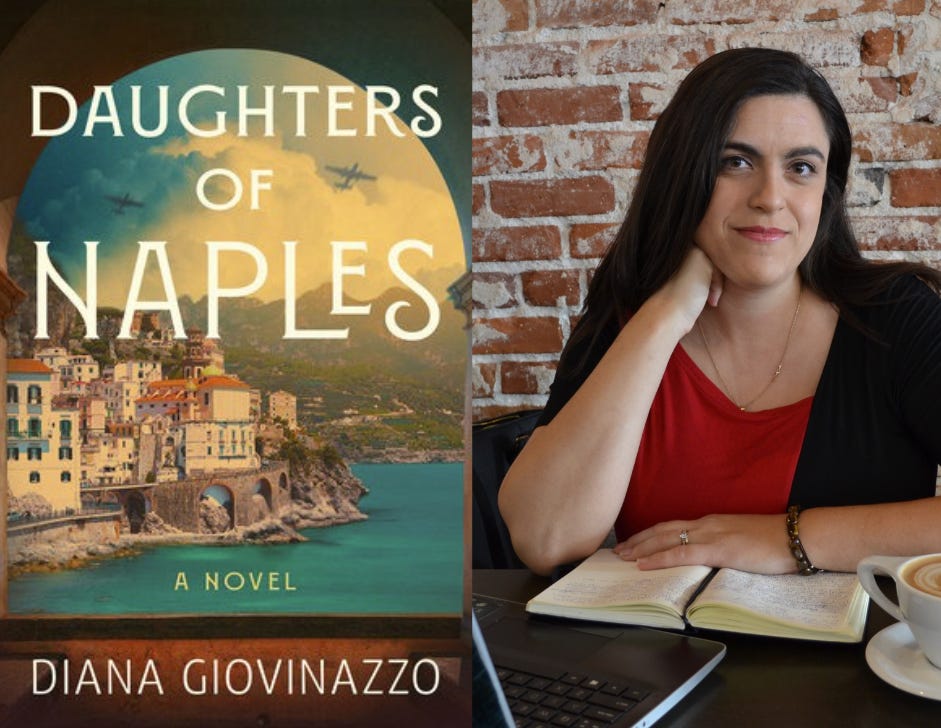
Her latest novel, Daughters of Naples is a lush, suspenseful novel set in Naples during World War II, where three sisters—Leta, Marcella, and Bianca Cozzolino—struggle to survive under Mussolini’s rule. Leta runs a dress shop while caring for her mother-in-law as her husband fights at the front; Marcella trains as a midwife, aligned with her boyfriend’s fascist ideals; and Bianca, driven by love and conviction, joins the Italian resistance. As war fractures their loyalties and tensions rise within the family, the sisters are forced to confront difficult choices about duty, love, and survival. When bombings devastate Naples and the threat of Nazi occupation looms, even Leta is drawn closer to the resistance, challenging her beliefs and risking everything. At its heart, the novel is a powerful exploration of sisterhood, sacrifice, and the courage required to endure in the face of war.
Of course, I had to pick her brain about this wonderful new book.
Your first two novels have real women at their heart. In this book, the Cozzolino sisters are invented, but you drew on real women of the Italian resistance for inspiration. What was different for you building protagonists from scratch instead of dramatizing a well-documented life of a real person?
It was definitely a learning curve for me! I didn’t have the historical road map of someone’s life to hide behind. I used to be a strict outliner, but I had let myself just write in order for the story to find itself.
Antoinette’s Sister is set in Bourbon-era Naples, and now you’ve returned, but this time to a city under bombardment. What keeps bringing you back to Naples, and did writing the first story in the eighteenth century change how you saw the new wartime one?
There is something magical about Naples. The fact that the people live at the base of a volcano, there is this constant reminder that death and life are two sides to the same coin. The result is this fascinating folklore and resiliency within the people that should be celebrated.
I think in writing the war time version of Naples, I shared in the sorrow that the people felt about the utter destruction of their city. The beautiful buildings and relics that they took pride in were either damaged or destroyed. I feel a visceral anger over the fact that the Nazi’s burned Naples’ archives as they left the city.
In the novel, Marcella’s boyfriend is an admirer of Mussolini, and in her eyes, her midwifery helps feed the regime’s hunger for more Italian sons. I can imagine that writing about a sister who believes in the Fascist project, while, at the same time, keeping her sympathetic, is hard to pull off. How did you do it?
I don’t think of Marcella as being sympathetic so much as being a part of a system. In the book, Marcella is in her mid-twenties, meaning she was a child of fascism. Mussolini took power in 1922; the fascists quickly got into schools, determining what was taught. Crafting Marcella’s character was a lot about waking up from an abusive system.
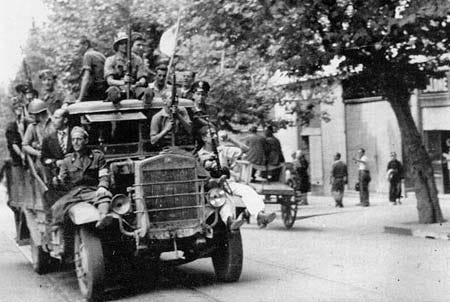
The Four Days of Naples were chaotic and largely leaderless, a brave civilian uprising by ordinary people against the German army. How did you manage to shape the scenes of scattered street fighting into something a reader can easily identify with?
It felt chaotic to research! There was a lot going on during those four days. I wanted to keep the story focused on the sisters, where they would have feasibly been during the fight. Even though, as the writer, I knew what was going on in other areas of the city, I had to put blinders on in order to direct the story in the direction I wanted to take it.
Naples under occupation was a difficult time. People were truly hungry and desperate, leading to a black market where families sold everything they owned. Was there a specific detail from your research that genuinely surprised you or shifted the direction of the novel?
Naples ‘44 was the first book I went to when I started researching this. Norman Lewis didn’t mince words about the absolute hunger that the people went through. It was something that was in the back of my mind with every food scene that I wrote; it was definitely an undercurrent for every scene. Even before the food scarcity, these were working-class people who were trying to scratch out an existence.
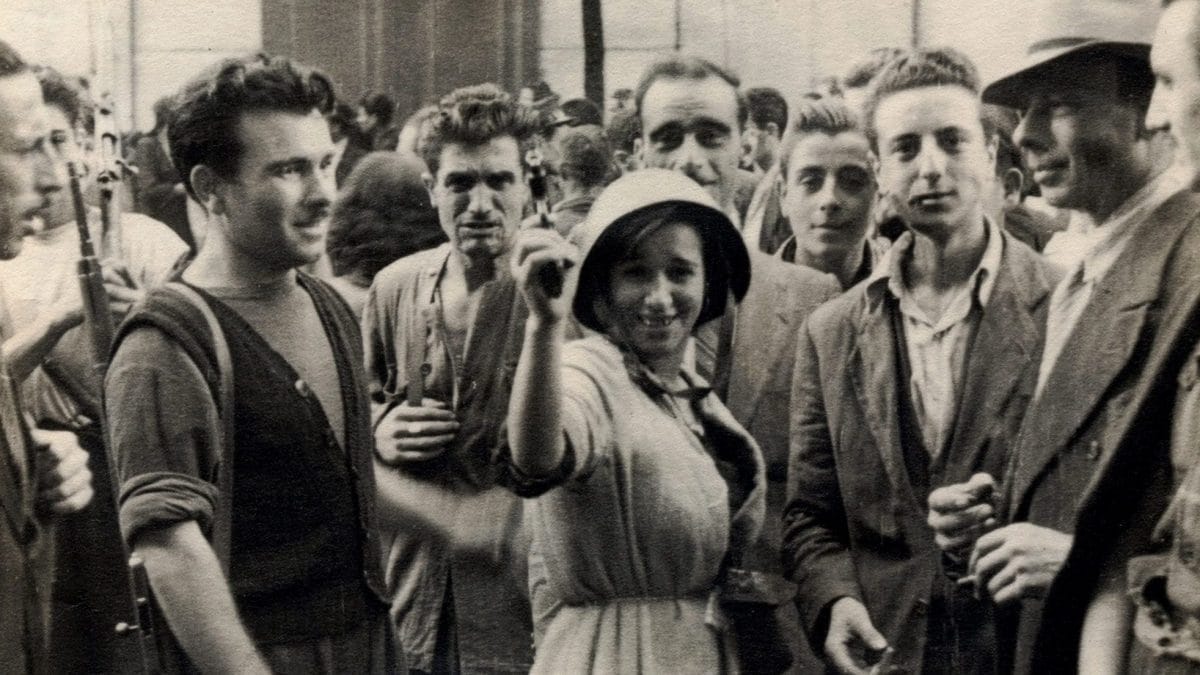
In the novel, Leta first refuses to let Pasquale use the dress shop for the partigiani, the members of the underground resistance. But she reconsiders this position. In that timeframe, sewing rooms and midwives’ bags had become actual cover for resistance work. How much did you build the sisters’ participation in the resistance out of the domestic spaces around them?
40% of the partigiani, were women. Building their resistance came from a place of everyday resistance that was rampant in the city and Italy as a whole. There were stories in my research where women weren’t just passing messages; they were hiding people in their shops, operating networks of safe houses, and forming their own markets. Even pasta became a form of resistance!
Fascists were fixated on the idea of motherhood and driving birth rates higher. In your story, you put a midwife at the very heart of the family. I’m assuming that’s a conscious choice that let you show more about how the regime reached into women’s bodies and their homes?
The one thing authoritarian governments have in common is an obsession with births. Mussolini said that the perfect Italian family would have at minimum, 12 children. With Marcella’s story, I made sure that every woman she paid a visit to had a different birthing experience. Some good, others bad. All were affected by the government’s policies about birthing, war, and disabilities. The fascist government encouraged midwives to join government-sponsored unions. These midwives were viewed as the good ones; they intern reported everything to the government.
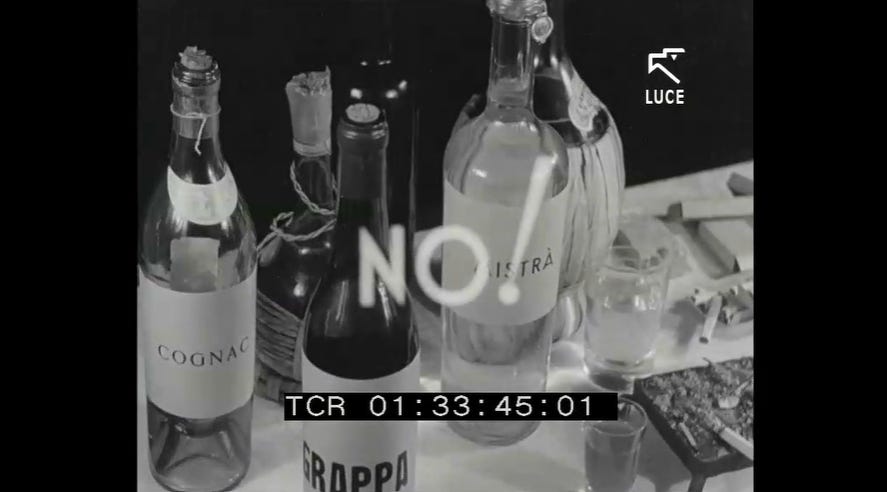
There is a film, still available online, called La Madre de domani, Alla madre d’ Italia that came out in Italy in the 1930s. This film shows exactly what fascists wanted from women, from depicting the midwife as being a despicable crone to women working in rice fields and then coming home to take care of their children. Who, if they are girls, are practicing to be mothers themselves.
Neapolitan is a language of its own, not just an Italian accent. Did you attempt to handle dialect and the sound of Naples on the page?
I actually didn’t put that much emphasis on the Neapolitan dialect. The fascist government sought to suppress all dialects under their policy of linguistic centralization. They wanted to have a unified identity like the Romans. The Italian fascist regime was obsessed with the Romans, to the point where many of the Roman tourist sites that we visit today are attributed to Mussolini.
Whether the fascists held an accurate assessment of this linguistic centralization or not didn’t factor into the story for me. The world around the Cozzolino sisters was one that emphasized any kind of difference in region. And I kind of wanted to reflect that in the language.
When we think of Naples today, we think of the rich culinary history and the incredible food which has become its identity, but this novel is set during a time of great scarcity. How did you write about a Neapolitan table when there was so little upon it?
Food is one of my favorite literary devices for conveying not just culture but also emotion and the effects of policy on what (and how) we eat. Every scene with food was intentional. Not just the type of food but the meals themselves. There is one scene in particular where Leta has made a very special dinner for her family. It was a Sunday supper, which is a serious thing in Naples, and it involved a lot of work. There is just enough food for everyone at the table until Giovani, Marcella’s boyfriend, invites himself.
That scene was so important to me because it showed the amount of work and love Leta put in for her family, and Giovani, a walking, talking poster child for Mussolini, disrupted that, causing Leta to go without. It showed how the authoritarian government inserted itself into the people’s everyday life.
The three sisters all make different choices in this novel, but none of them turns out to be exactly right. How did you handle hindsight, where the reader already knows how history turns out?
Since my first two books were about historical women, I had to really get into their mindset, not paying attention to hindsight. In some ways, I kind of had to forget about knowing what would happen in the future because the sisters certainly wouldn’t know.
A lot of World War II fiction tends to flatten Italy into a villain or to use it as a backdrop, glossing over the fact that Italy was a major Axis power that later became occupied territory. This meant that Italians were fighting Italians. What do you most want readers to understand about that Italian experience of the war?
No country or culture is a monolith. Everyday Italians made daily decisions to subvert power, no act of resistance was too small.
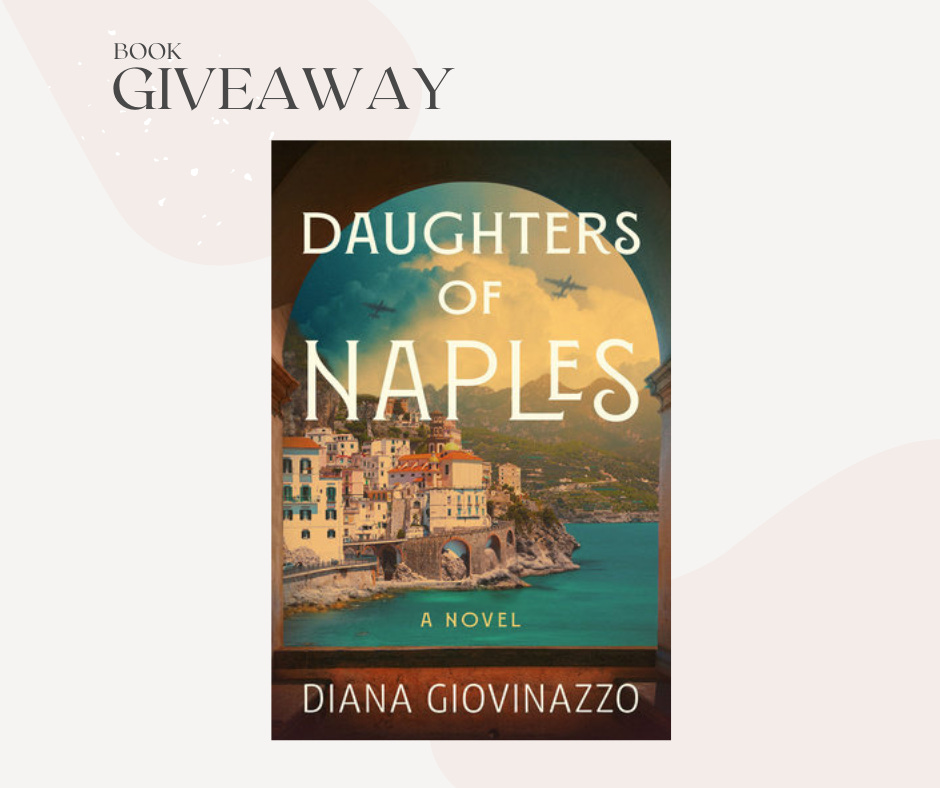
I’m happy to be giving away a copy of this wonderful novel!
To sign up for the giveaway, you can fill out this form. Your name will be thrown into the hat for a shot at a paperback copy. This giveaway closes at midnight ET on Wednesday, 08/05/26. Winners will be notified within 48 hours of the giveaway closing and announced in a future newsletter/post.
Important to Note: You must be 18+ and a United States resident (pesky international laws make it tricky to do giveaways worldwide). If you are someone who loves to read the rules, you can find the obligatory info here.
People are missing the point of The Odyssey.
I’m seeing Franz Ferdinand play next week. Hoping they play this wonderful Stranglers cover.
The novel I just finished actually has The Cure in it, in 1981, and they would have played this song at the show. Robert Smith is so young!
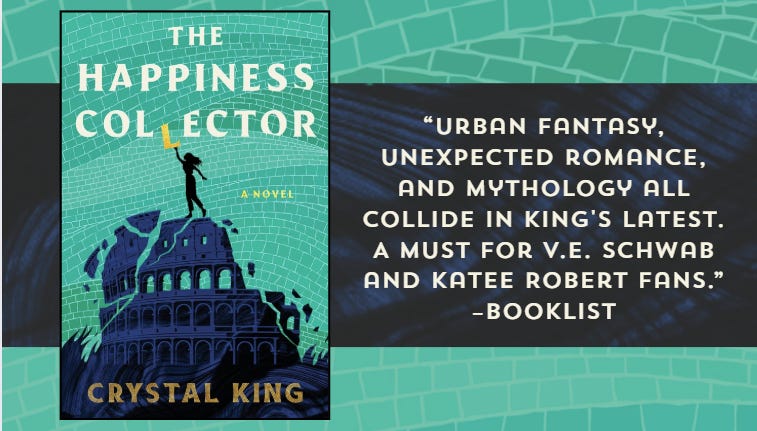
If you love food and love Italy, and haven’t read IN THE GARDEN OF MONSTERS, THE CHEF’S SECRET, or FEAST OF SORROW, click the links to learn where to buy your copy! And now you can order my latest, THE HAPPINESS COLLECTOR!
Follow me here: Website | Instagram | Facebook | Threads | Bluesky | TikTok
Comments
Nothing yet. Say the first thing.
Sign in to join the conversation.