
Crypto Super Hub — The CSH Weekly Brief | August 2, 2026
This week we noticed several SMSFs, unconnected to each other on paper, all withdrawing stablecoins to the same wallet address.
Different funds. Different trustees. One address. In super, that’s not just strange, it’s against the rules. Your fund’s crypto has to be held in the fund’s own name. It can never be pooled with another fund, another person, another platform.
So we pulled the thread. Behind that address: an offshore platform promising 20% annual returns, guaranteed. Reviews that all sound like the same person wrote them. No SMSF accounts. No names, no license, no way to find out who’s actually holding the money.
I’ve taken enough of these calls to know how this ends, and it makes me angrier every time, because it’s always someone’s retirement. This issue is the one I hope you forward to the person who needs it.
Everything I use to stay on the boring path runs on the free version of the app.
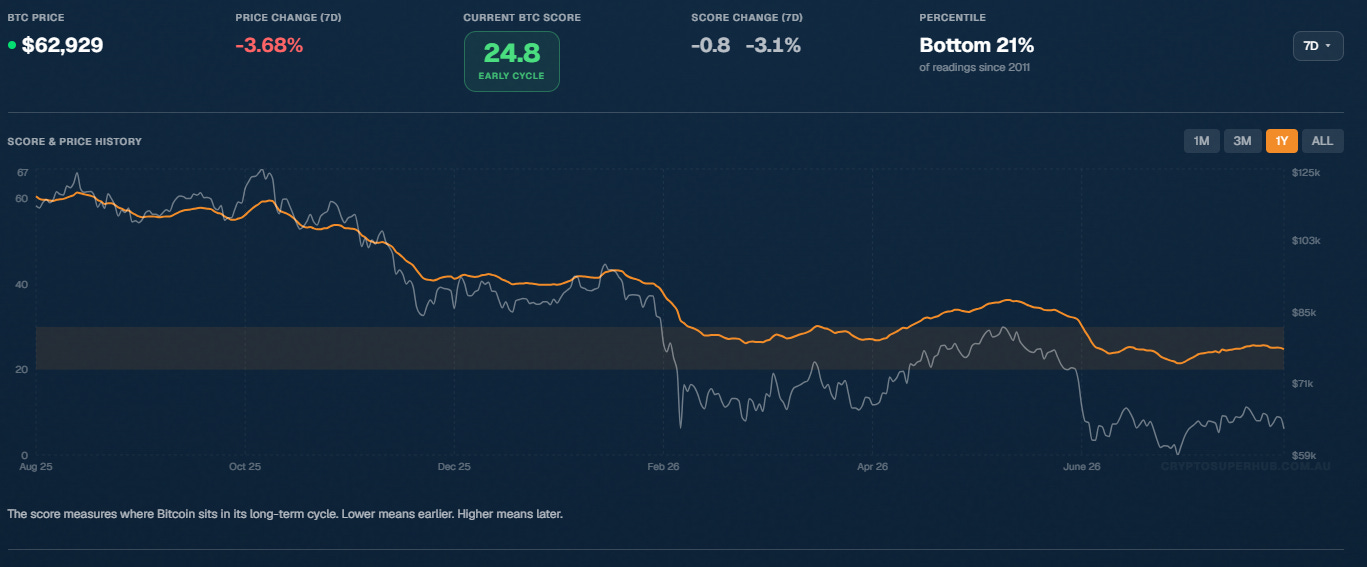
CSH Score: 24.8/100 — Early Cycle (−0.8 on the week). Bottom 21% of every reading since 2011, and roughly the 60th straight day inside the 20–30 band.
Key indicators:
BTC: US$62,948 / A$89,745 (7d: −3.6%)
BTC Dominance: 59.0%
ETH/BTC: 0.0295
TOTAL3/BTC (alts priced in Bitcoin): 0.37 — prior cycle bottoms washed out near 0.25
Fear & Greed: 27 — Fear
Total market cap: ~US$2.14T
Callback: Last issue I asked for one number: the percentage of your stack that’s Bitcoin. Only a handful of you replied, but the answers were telling. Most of you are 100% Bitcoin. A couple are holding ETH and waiting for its turn. One of you is running a full altcoin playbook. That last group is why I don’t think this reset is finished: there’s still hope in the market, and bears usually grind that out before they end. And the three things I said needed to happen before this bear could finish (issue #24)? Still zero of three.
Jake’s read: July closed positive, then the tape slipped back under the 200-week average (~US$63.5K). Reclaiming that line is the whole fight right now, and fear is picking up outside crypto too. My plan did nothing this week, on schedule.
It starts innocently. Someone sets up an SMSF, opens the account, transfers super, buys crypto. Sensible questions, careful people. Sometimes the pitch comes later, once there’s a balance worth stealing, from a “platform” a friend or a Facebook group swears by. And sometimes it’s worse: the scammer is there from day one, coaching the whole setup, the fund, the bank account, the exchange account, playing the part of the helpful expert while steering every dollar toward a wallet they control. I’ve taken calls where you can tell the person is being fed their next question over WhatsApp in real time.
The pattern is close to identical every time. Guaranteed returns, this one was 20% a year. Offshore, so no Australian license and no regulator to complain to. Glowing reviews that read like they came off a production line. And at some point, an instruction to send funds to a wallet address that isn’t yours.
That last one is the deal-breaker, and the rule could not be simpler: your fund’s crypto is held in the fund’s name, always. A wallet the fund controls is fine. The fund’s account at a licensed Australian exchange is fine. A stranger’s “platform wallet”, pooled with other people’s money, is neither, and no legitimate operator will ever ask you to send coins to one. The moment your coins land in an address like that, they aren’t yours anymore, and usually that’s the last you see of them.
Here’s the five-minute check I’d run on any platform before a dollar moves. Is the return guaranteed? Real crypto yield is variable and mostly boring; guaranteed means the return is being paid out of the next person’s deposit. Can you find the humans? A registered Australian entity, named directors, an AUSTRAC registration you can look up. Do the reviews survive a sniff test? And does your money ever leave custody in your fund's name? Any single miss and I walk. Two misses and it’s a scam, ten times out of ten.
And before anyone feels stupid for being tempted, I’ll put my own hand up. In 2022 I had money earning a “guaranteed” 19.5% in Anchor, the savings product built on Luna. It had slick dashboards, institutional backers and millions of true believers, and in May it went to zero in about a week, along with roughly $40 billion of other people’s money. So I’m not writing this from a high horse. I’m writing it as someone who knows exactly how reasonable that pitch sounds, and exactly how it ends.
When it goes wrong, there’s no fixing it. Prosecution of these platforms is close to zero. Tracing is hard and recovery almost never happens. I’ve watched people lose six figures of super this way, and those funds do not come back. Ever.
And the part that makes me angriest: nobody needed the 20%.
I went through our score history this week to put a number on it. Bitcoin from the November 2022 low to the October 2025 top did 7.9x. But forget catching the low. Across 2022 and 2023 there were 325 days where the score sat under 30, meaning Bitcoin was cheap by cycle standards. Buy on the single worst of those days, $30,019, and you were still up 4.2x at the top. The median of all 325 did 6x.
Read that again next time someone pitches you a guaranteed 20%. The most boring possible entry into Bitcoin, the bluechip of this entire asset class, quadrupled, with no counterparty who can disappear, no lock-up, no bloke on WhatsApp. History doesn’t guarantee a repeat. But if it sounds too good to be true, it is. Every single time.
Quiet week on the surface. Underneath, it’s all launch prep: the paid version opens to a founding 100, and that cap is a real number, not a marketing device. Those spots go to people already using the free version.
The plan itself did what plans do. Scheduled buys running inside my range, bigger tiers still waiting on a sub-20 print that hasn’t come, no decisions made by me in real time.
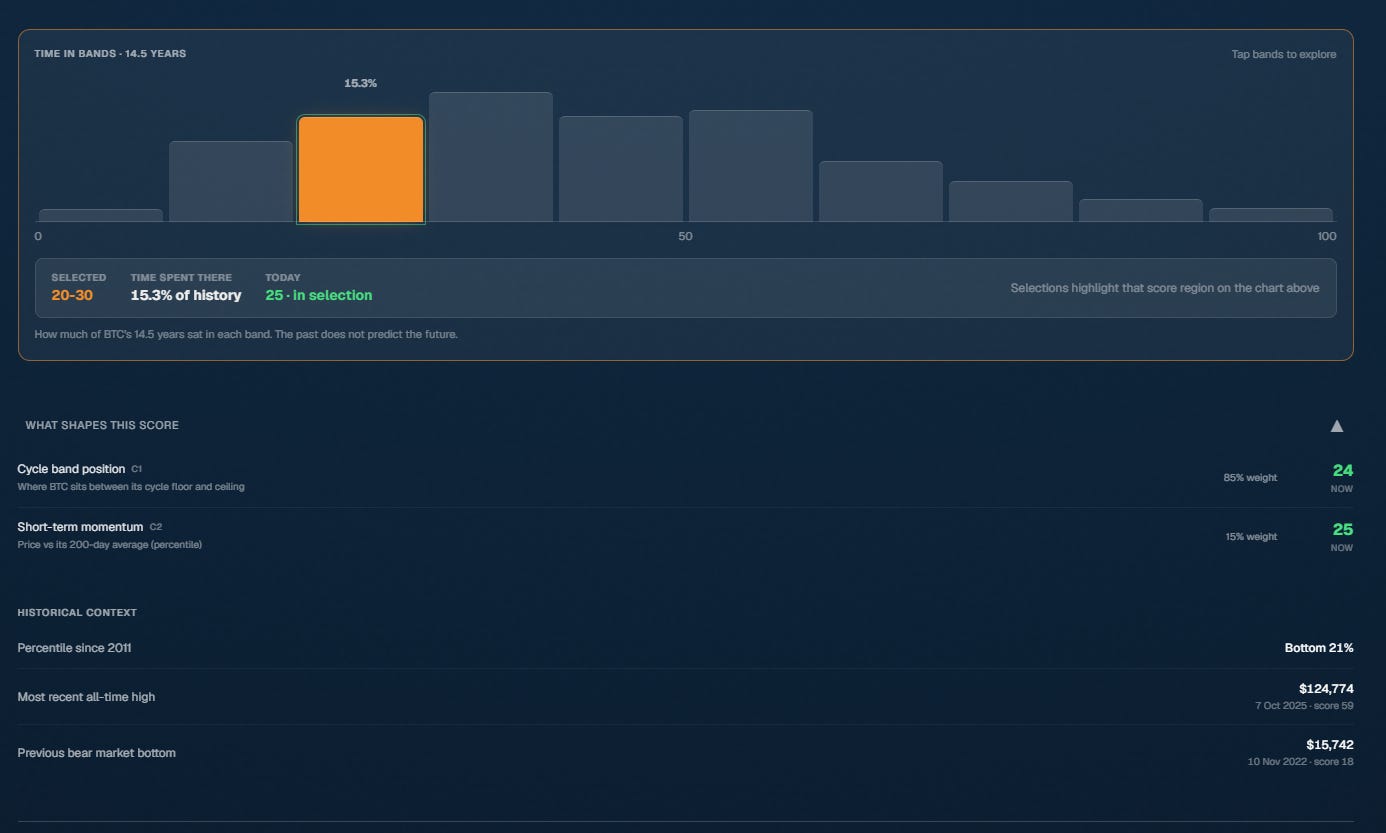
Everything above is free to try right now, including the score and Plan Builder.
The Coldcard exploit keeps growing. A flaw in how Coldcard wallets generated seed phrases let attackers recreate seeds offline and sweep wallets without ever touching a device. Since July 30, close to US$89 million in Bitcoin has been drained from more than 4,500 addresses across three separate waves, and the latest wave went after small wallets, around 0.1 BTC per victim, so being small is no protection. Who’s affected, per CoinKite’s official advisory: Mk2 and Mk3 devices on firmware 4.0.1 to 4.1.9 are the severe cases, and seeds generated on Mk4, Mk5 or Q before the fixed firmware releases are affected too, less severely but seriously enough that CoinKite recommends migrating. Ledger, Trezor, Bitkey and Jade are unaffected. Seeds created with 50 or more dice rolls aren’t at risk from this bug, and a passphrase buys time but doesn’t repair the seed. The guidance is blunt: update the firmware, generate a fresh seed, and move your funds. CoinKite’s advisory is here, and Checkonchain’s write-up is the best plain-English breakdown. So what: “just self-custody it” has been the industry’s default advice for years, and this week it was proven incomplete. The real rule for SMSFs is that the fund’s crypto is held in the fund’s name, whether that’s the fund’s own wallet or a licensed Australian exchange, and whichever model you run, custody is part of running the fund, same as the audit. As an industry we owe people better answers than a slogan.
Risk-off is spreading. SpaceX has fallen below its IPO price and sits roughly half off its post-IPO high. The 2-year Treasury yield has pushed to 2026 highs as bond markets start pricing the chance of rate rises. And while the Fed held rates in July, three of its own members voted to raise them instead, the most hawkish split on the committee in nearly a decade. So what: fear outside crypto tends to leak in. My plan doesn’t trade headlines, but it does expect them.
August and September are historically Bitcoin’s two worst months, the only two with negative average returns, and in all three prior midterm years (2014, 2018, 2022) both months closed red. So what: if red months come, the calendar doesn’t size my buys. The score does.
The clock. The last three bears ran 410, 363 and 365 days from top to bottom, and two of the three bottomed almost exactly one year after the top. This one is on day 299, and day 365 lands on October 7. A clock, not a prediction.
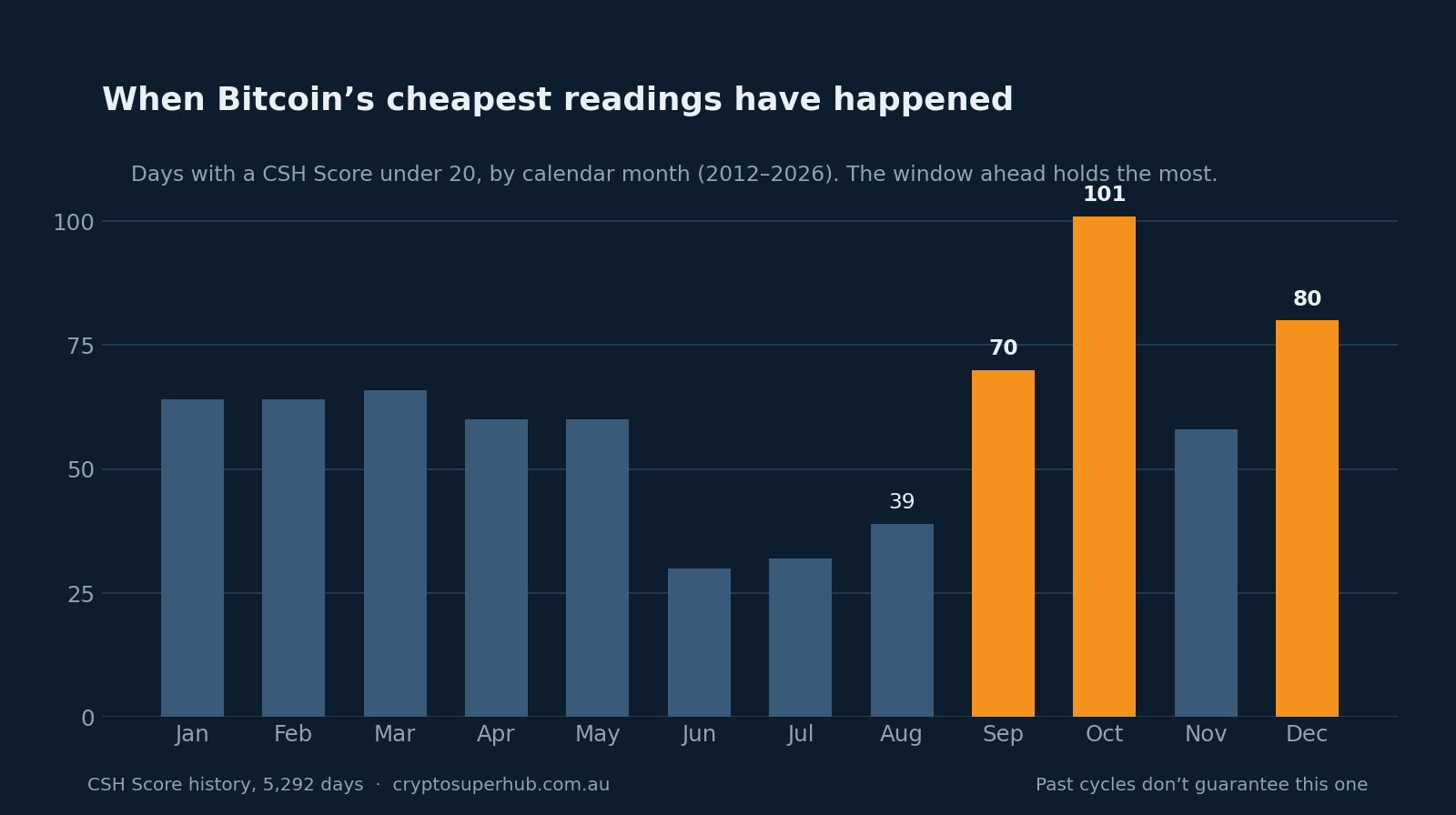
The sub-20 window. In every prior bear, the first sub-20 score printed 236 to 352 days after the top. We’re inside that window right now with zero prints, and September, October and December hold the most sub-20 days in 14.5 years of history. That print is the trigger my bigger tiers are waiting on. If it lands, you’ll hear it here first.
The 200-week line, ~US$63.5K. Price is sitting just beneath it. Weekly closes either side are the tape’s whole story.
The people who get caught by these platforms aren’t stupid or greedy. They’re mostly careful people who were sold certainty in an asset class that doesn’t have any. The honest version is slower: a system, a score, buys sized on a calm day, custody in your fund’s name.
That’s what we build. The score and Plan Builder are free:
One-word reply this week, and after the week I’ve had I’m genuinely asking: how do you hold most of your stack? Self-custody, exchange, or ETF.
See you next Sunday.
Jake
Not financial advice. This is a record of what I do with my own money and why. Past cycles don’t promise anything about this one. Scam warnings here are general in nature. Talk to someone licensed who knows your situation before moving real dollars.
No posts
Comments
Nothing yet. Say the first thing.
Sign in to join the conversation.