
Crypto Super Hub — The CSH Weekly Brief | August 9, 2026
Everyone is waiting for the window to open.
It opened in February.
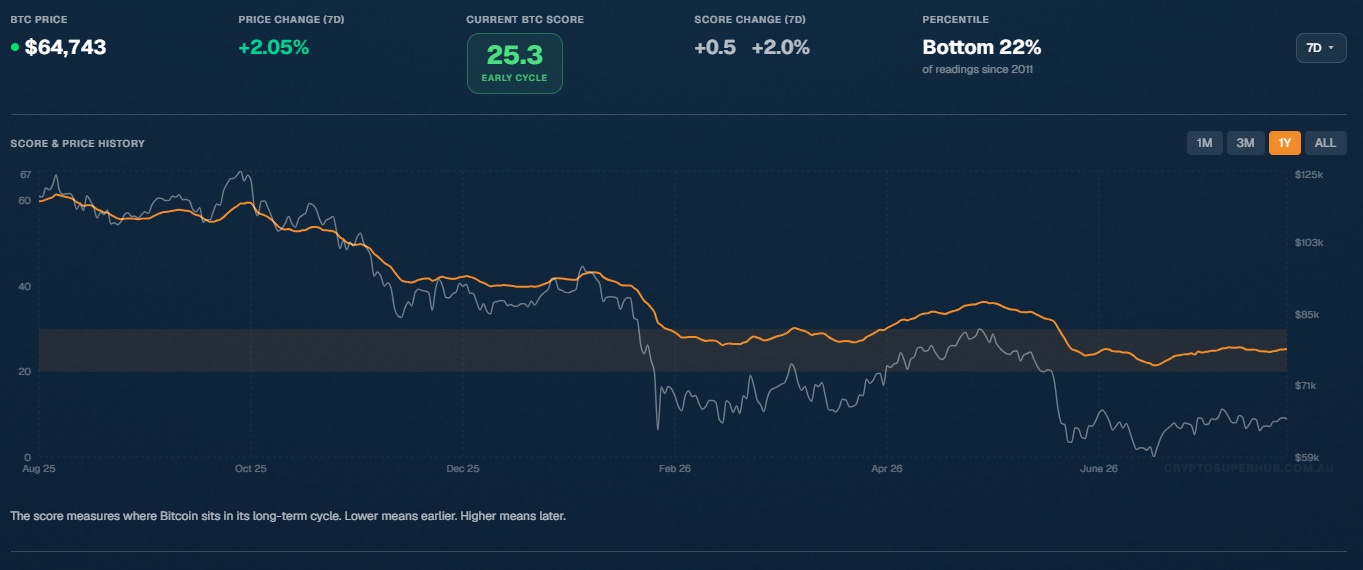
Bitcoin has been cheap for 129 days now and almost nobody noticed, because cheap didn’t arrive the way people expect. No crash. No capitulation candle. No moment where it was obvious. The CSH Score just dropped under 30, which is our line for cheap by cycle standards, one Monday in February. It’s mostly stayed there since.
That’s the problem with waiting for a signal you’ll recognise. It might not arrive.
Everything below runs on the free version of the app:
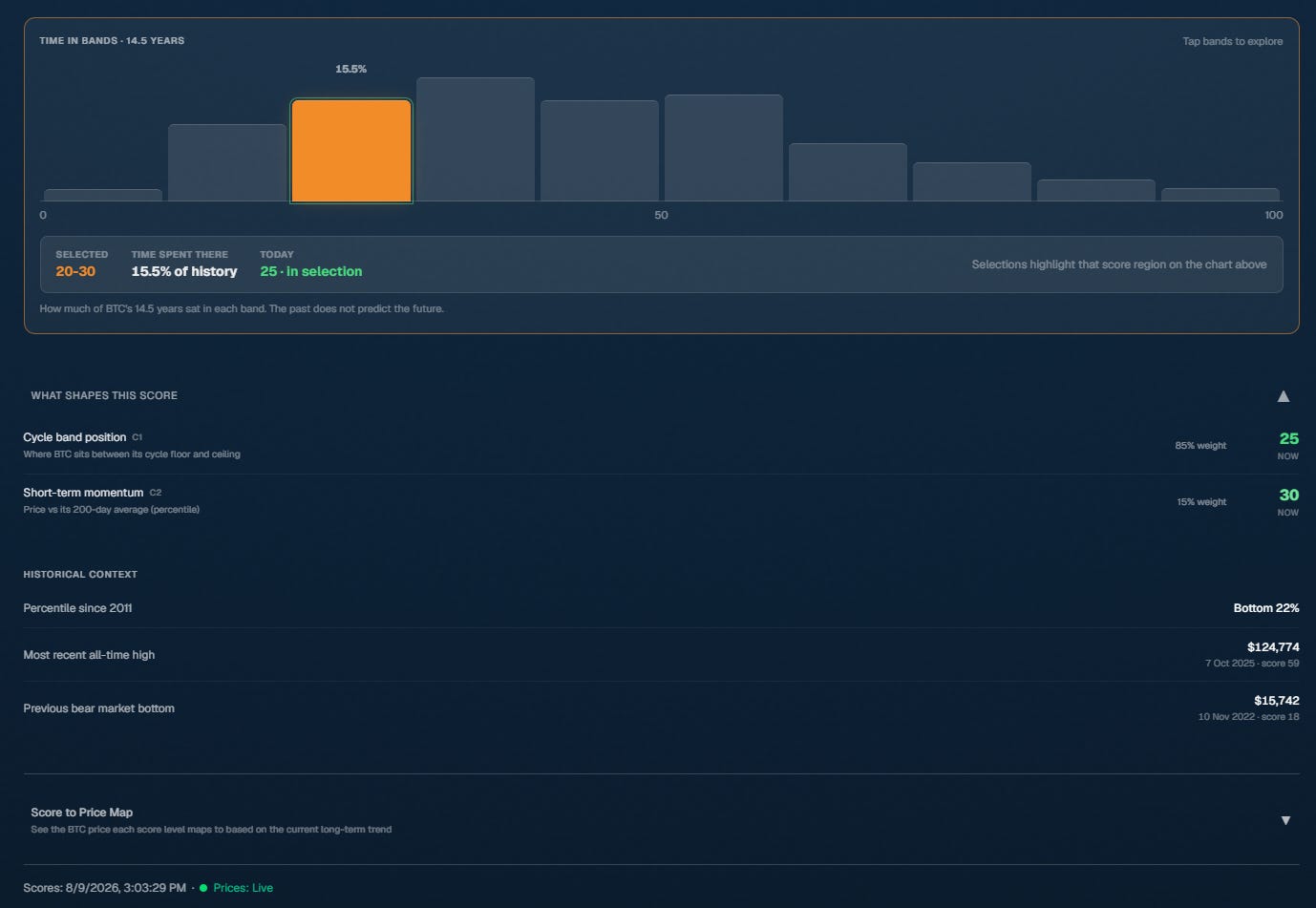
CSH Score: 25.4/100 — Early Cycle (+0.6 on the week). Bottom 22% of every reading since 2011, and the 67th day in a row with the score between 20 and 30.
Key indicators:
BTC: US$64,753 / A$92,760 (7d: +2.00%)
BTC Dominance: 59.35%
ETH/BTC: 0.0295
TOTAL3/BTC (alts priced in Bitcoin): 0.37, flat on the week
200-week moving average: ~US$63,780
Bull market support band: ~US$69,200 to US$69,330
Callback: Last issue I asked how you hold most of your stack. Self-custody won easily, and after the month we’ve just had that answer needs more detail, because self-custody on its own isn’t a plan.
Four things I’d take out of the last fortnight:
Spread it. Don’t hold everything on one device. This month proved the device can be the weak point.
Use multisig for anything you’d be sick about losing. Two or three keys held in different places means one compromised seed isn’t the end of it.
A licensed exchange account is a legitimate part of the mix, not a compromise, if it has two-factor authentication, a dedicated email address you don’t use anywhere else, and audited proof of reserves you can go and check yourself.
Write down what happens if you get hit by a bus. Nobody does this, and it’s the part that actually loses coins.
Jake’s read: July closed positive. Our base case from here is a weak August and September. Price is squeezing between two lines, the 200-week average underneath at about US$63,780 and the bull market support band above at roughly US$69,200, and they’re converging. That squeeze resolves one way or the other before long, and we’re leaning down. On timing, we think we’re around 80% of the way through this bear.
Every bear before this one made you wait most of a year to get cheap. Counting from the top to the first day the CSH Score dropped under 30: 258 days after the 2013 top, 339 after 2017, 218 after 2021.
This one took 125 days.
Cheap turned up in February around US$70,500 and never left. We’re now 129 days with a CSH Score under 30, 44 of those under 25, and not one reading under 20.
Which brings me to the question I get asked more than any other. When’s the bottom, and how do I know when to buy?
I can’t answer that. Nobody can. So I backtested it instead.
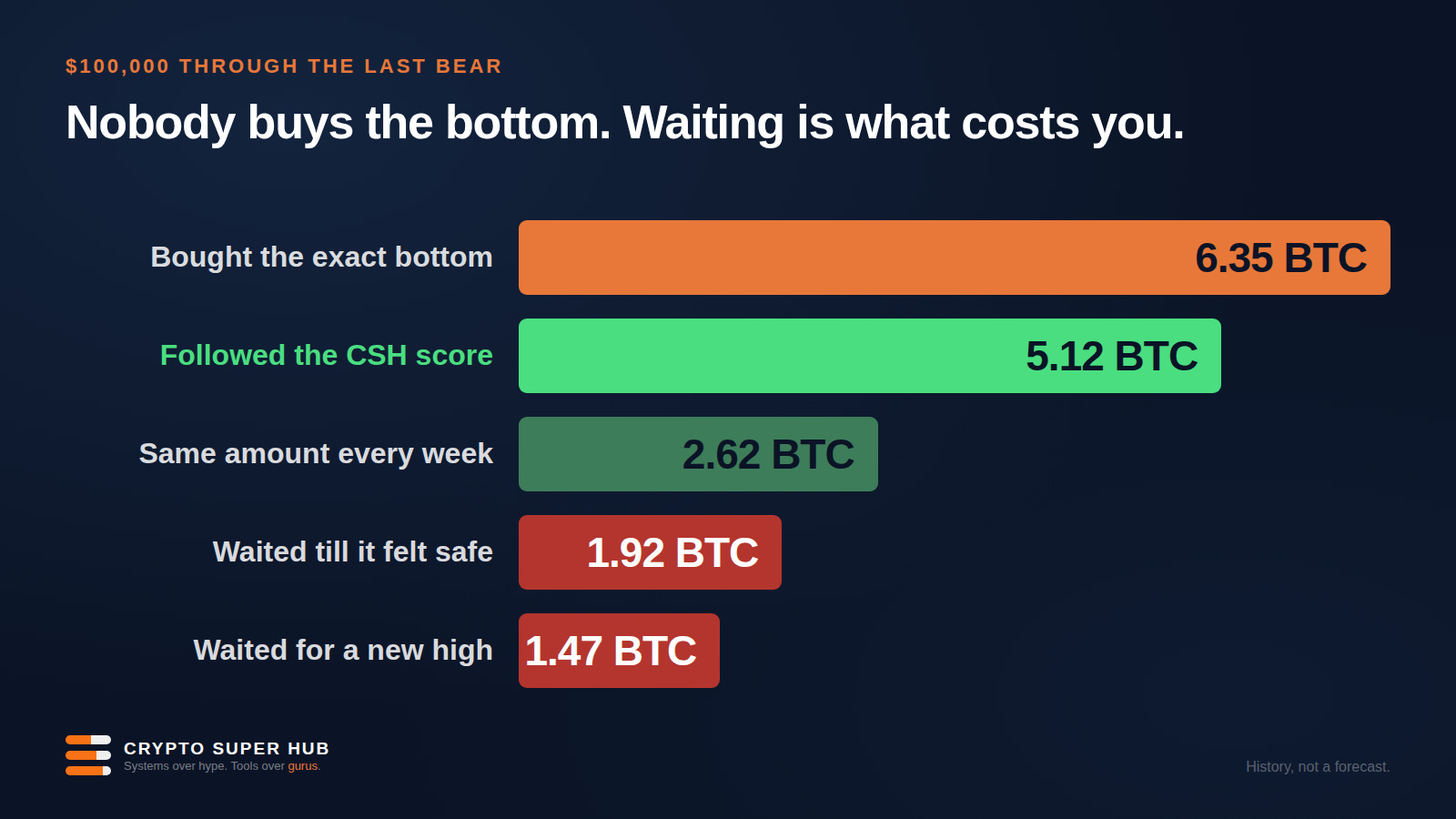
Five execution models, $100,000 each, run against our score history through the last complete bear and measured at the October 2025 top. I used $100,000 because it’s roughly the rollover size I keep hearing about, not because it’s a number I’m recommending.
Bought the exact bottom, 10 November 2022: 6.35 BTC
Followed the CSH Score, buying bigger as it fell: 5.12 BTC
Same amount every week, the whole way through: 2.62 BTC
Waited until it felt safe, February 2024: 1.92 BTC
Waited for a new all-time high to confirm it, March 2024: 1.47 BTC
Two things stand out.
The first: buying the exact bottom, which needs a crystal ball, got you 24% more Bitcoin than just following the score. So a perfect call was worth 24%. That’s it.
The second is the gap underneath. Every other model finished 49% to 71% behind the plan. And none of those are stupid decisions. They’re what careful people actually do.
Waiting until it felt safe finished with 63% less Bitcoin. February 2024 genuinely did feel safe. The ETFs had launched, price was climbing, the news had turned. That’s the problem. It felt safe because it had already got expensive.
Everyone worries about buying too early. Waiting is what actually costs you.
The CSH Score doesn’t fix that by being clever about the bottom. It fixes it by making the decision on the days you’d talk yourself out of one, and by sizing each buy to the score instead of betting it all on a single day. Small when it’s only mildly cheap, bigger as it gets cheaper, biggest at levels that barely ever print. So if the bottom does turn up, you’re buying into it instead of watching it.
That’s not perfect and I won’t pretend it is. Nobody gets 6.35 BTC without a crystal ball. It’s just a long way better than what people actually do.
Now the part that cuts against me. Holding out for a very low score did work. In that bear, buying only the days with a CSH Score under 20 got an average entry 18.7% cheaper than buying every day under 30. In the 2018 bear it was 29.8% cheaper. Patience paid.
The catch is how short that window was. In 2018 the score spent 60 days under 20, total. Miss it and you deployed nothing, which is how you end up in the 1.47 BTC row.
So my plan does both. Scheduled buys run the whole time the CSH Score is under 30, so I’m always accumulating. The bigger tiers stay locked until a reading under 20 that might never come. If it never comes, I’ve still spent 129 days buying under 30.
For what it’s worth, today’s US$64,753 is 1.9% below the average price of all 129 of those days.
Tom has set up his SMSF, and he’s going to deploy six figures of his own money into Bitcoin through it, in public.
We’ll show all of it. How the plan was built, which score bands he’s targeting, what each tier is sized at, and what actually fires. Not a backtest this time, and not a case study written up once we already know how it went. His real fund, his real money, posted as it happens.
Plenty of people will tell you what to buy. Very few show you their own execution while the outcome is still unknown, because that’s the part where you can be wrong in front of everyone.
More on Tom’s plan over the coming weeks. The Plan Builder he used is free.
The Coldcard theft is bigger than the early numbers, and the scammers have followed the fear. Analysts now put the total near 1,816 BTC, roughly US$116 million, from more than 5,200 addresses across four waves. A week ago the tally was 1,367. And a second wave has started with nothing to do with the original flaw: on August 6 a Trezor user reported losing their life savings after clicking a sponsored Google result that led to a fake Trezor page hosted on Google Sites. Trezor confirmed the page and said it was escalating internally. Their hardware was never compromised. So what: the attack moved from the device to the search bar. Bookmark your wallet site or type the address in yourself. A paid ad slot is not a trust signal.
The market is climbing a wall of worry. The S&P closed at a record on Friday, up 3.58% on the week, while three Fed officials voted to raise rates in July, the most hawkish split on that committee in nearly a decade, and US government debt keeps making highs. Gold is up 2.39% and near records too, which isn’t a combination you see in a calm market. So what: stocks at records with Bitcoin still 48% off its high won’t stay unusual forever. I don’t know which moves toward the other. My plan doesn’t need to know.
Bitcoin ETF flows turned back on, for now. Spot Bitcoin ETFs took inflows on five straight days from August 3 to 7, more than US$750 million for the week, with BlackRock’s fund taking US$479 million of the first US$626 million. Against the backdrop: those same funds ran US$5.4 billion of net outflows across the first half of 2026, their first negative half-year since launch. So what: ETF flows are the one demand signal that isn’t sentiment. One good week doesn’t reverse a bad half, but it’s the first thing in months that looks like buyers rather than sellers.
US CPI on Wednesday August 12, PPI on Thursday. July inflation, 8:30am New York time, which is Thursday morning here. These two set the tone into the September 16 Fed meeting. A hot number is the more likely source of trouble.
The squeeze. The 200-week average at about US$63,780 and the bull market support band around US$69,200 are converging, with price caught between them. Weekly closes either side of that range are the only levels I’m watching.
A CSH Score under 20. It hasn’t happened once this bear: 129 days under 30, zero under 20. My biggest tiers stay locked until that changes, and if it lands it’ll be in this dashboard before it’s anywhere else.
Getting ready is the actual work. If a low score lands while your money is still in a super fund, your SMSF isn’t registered, or your bank hasn’t been tested with a small transfer, the window closes while you’re doing paperwork. Cash where you can spend it, structure done, rails tested, plan written. Ready before cheap.
The people who did well out of the last bear weren’t the ones who guessed right. Most of them never guessed at all. They’d already decided what they’d do, then did it on the days it felt worst.
It isn’t clever and it doesn’t make for good content. It just works more often than the alternative.
The score and Plan Builder are free:
One number this week, and it’s the only thing I want to know: on a scale of 1 to 4, how ready are you right now? 1 is nothing done, 4 is cash in the account and a plan written. Reply with the digit.
See you next Sunday.
Jake
Not financial advice. This is a record of what I do with my own money and why. History doesn’t guarantee a repeat. Talk to someone licensed who knows your situation before moving real dollars.
No posts
Comments
Nothing yet. Say the first thing.
Sign in to join the conversation.