
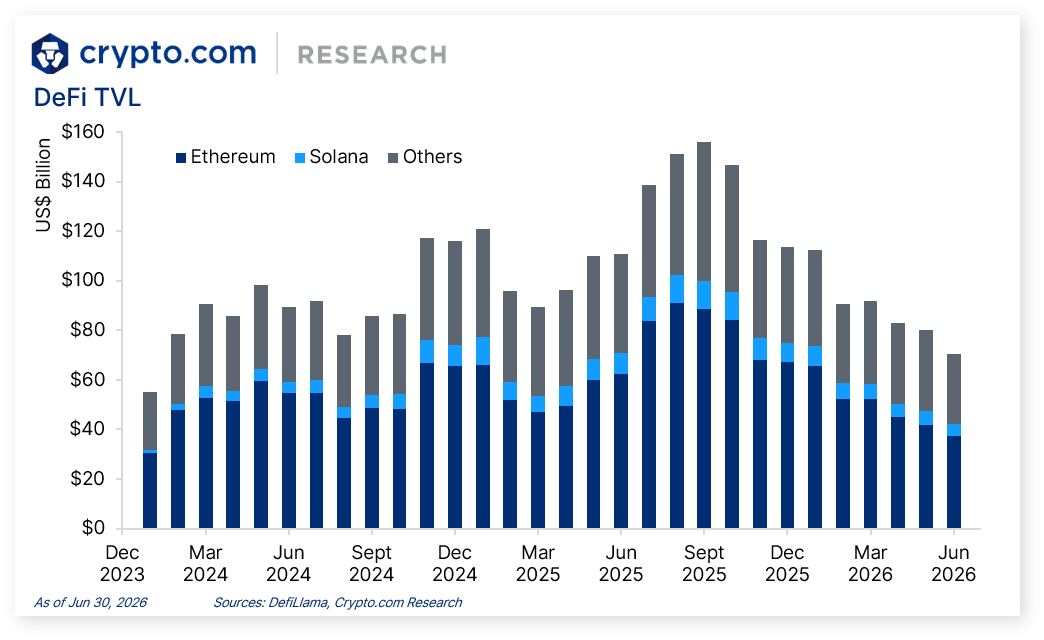
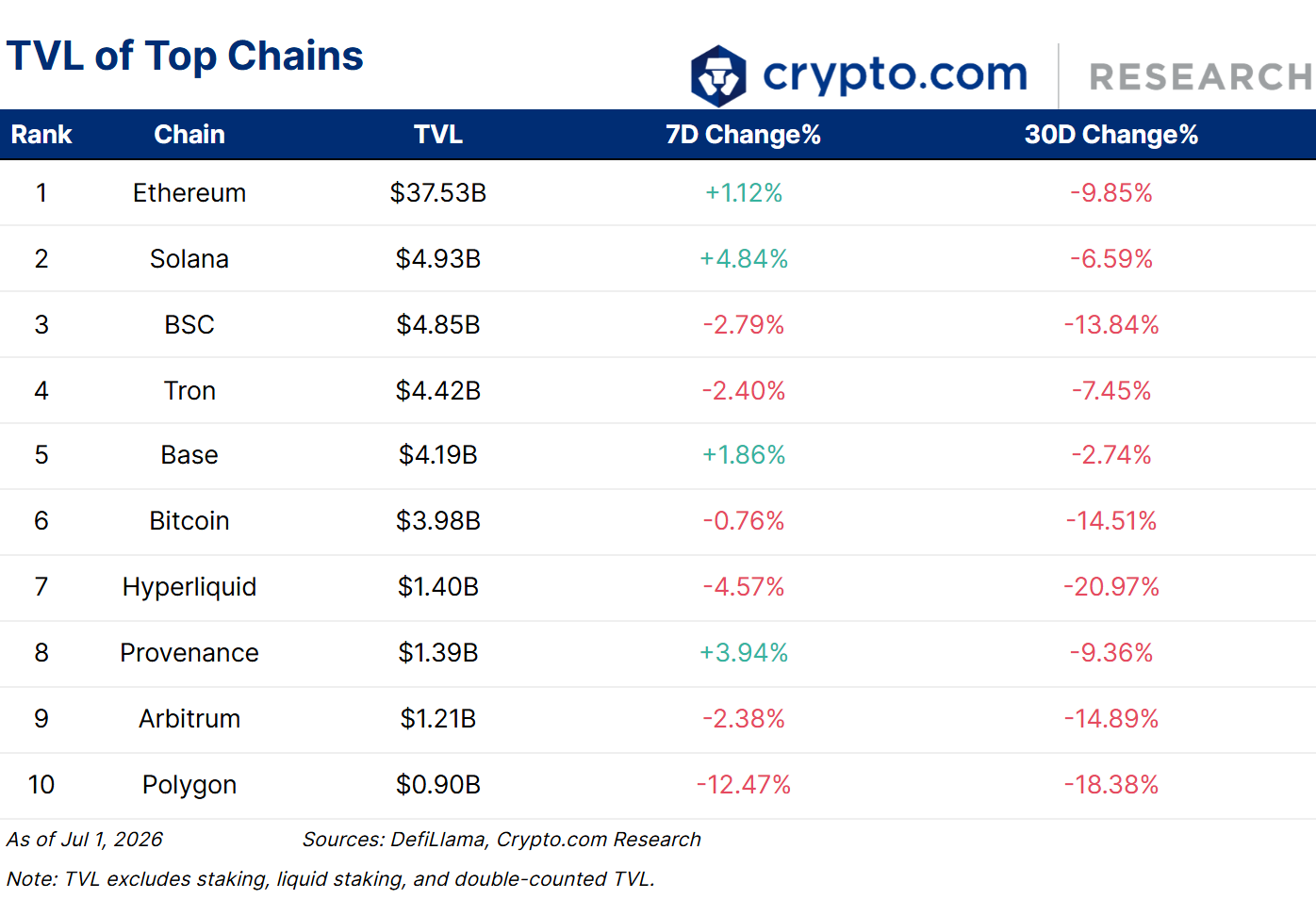
Total value locked (TVL) in the DeFi sector contracted by approximately 37% year-to-date.
A consortium of over 140 payment, banking, and crypto firms launched Open Standard and its dollar-pegged stablecoin, Open USD (OUSD).
BlackRock partnered with Ethena Labs to list the USDe synthetic dollar on its Aladdin risk-management platform.
New York Life Investment Management launched the NYLIM Anemoy fund, an on-chain, high-yield corporate bond fund strategy on the Centrifuge platform.
Bank of New York Mellon (BNY) added USDC custody, minting, and burning capabilities directly into its Digital Asset Custody platform.
European banking leader Crédit Agricole’s asset-servicing subsidiary, CACEIS Bank, rolled out ERC-20 euro stablecoin EURXT on the Ethereum mainnet.
Nasdaq joined the Pyth Data Marketplace as an institutional publisher, distributing its proprietary “TotalView” full depth-of-book equity data natively across blockchain networks.
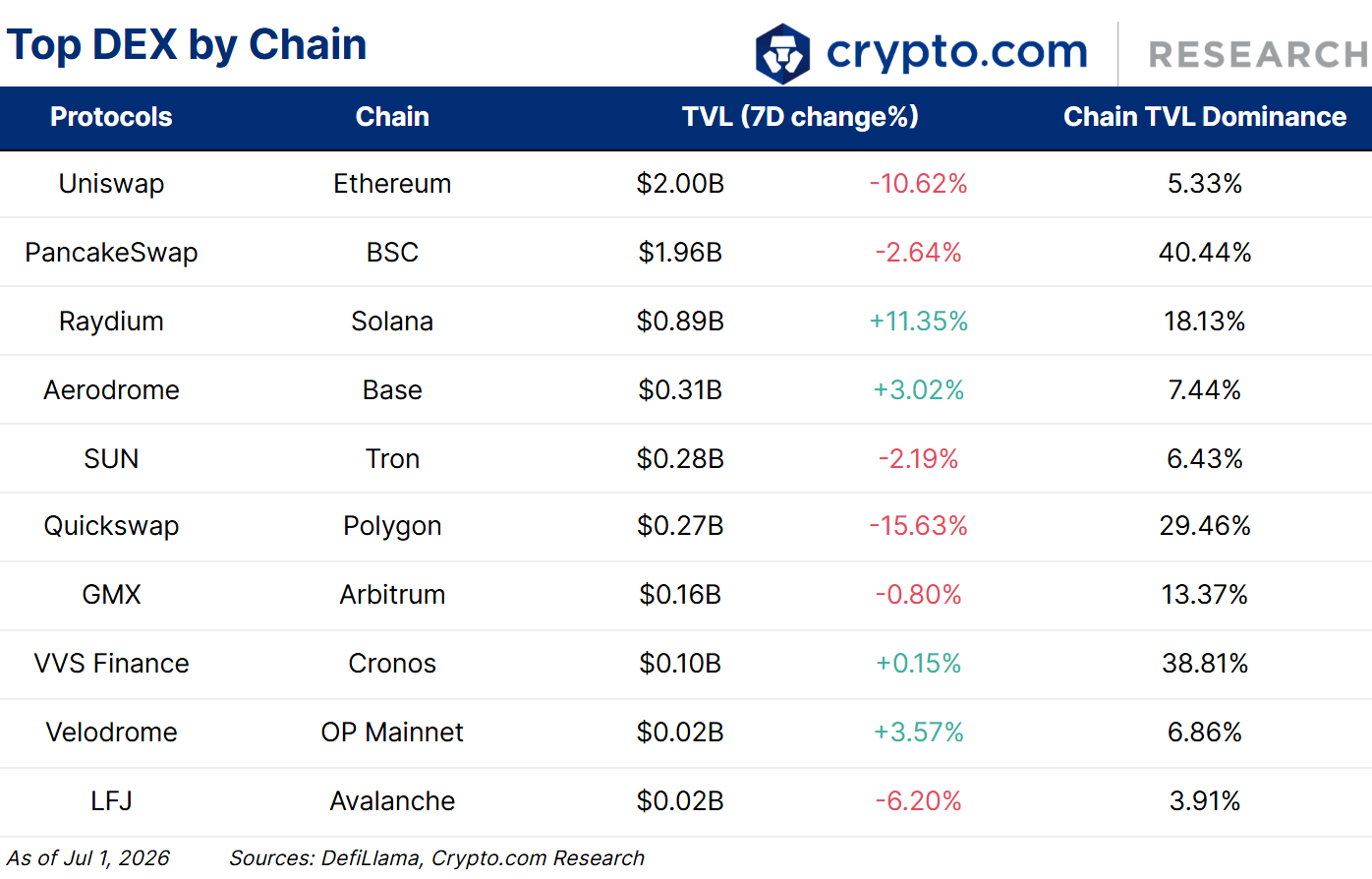
Uniswap and Spark teamed up to build a shared FX layer for stablecoins using the Uniswap v4 architecture.
The Solana network activated its on-chain validator governance module, allowing validators holding at least 100,000 SOL to propose and vote on technical upgrades.
Drift Protocol rebranded to Velocity DEX as part of an engineering overhaul following a $295 million exploit in April.
DeFi platform Abracadabra took emergency action after its crypto-collateralized stablecoin, Magic Internet Money (MIM), depegged due to thin and imbalanced liquidity in Curve Finance pools.
Cardano-based self-custody wallet platform SecondFi detailed a two-week fund-restitution plan after a deterministic nonce vulnerability allowed attackers to reconstruct private keys.
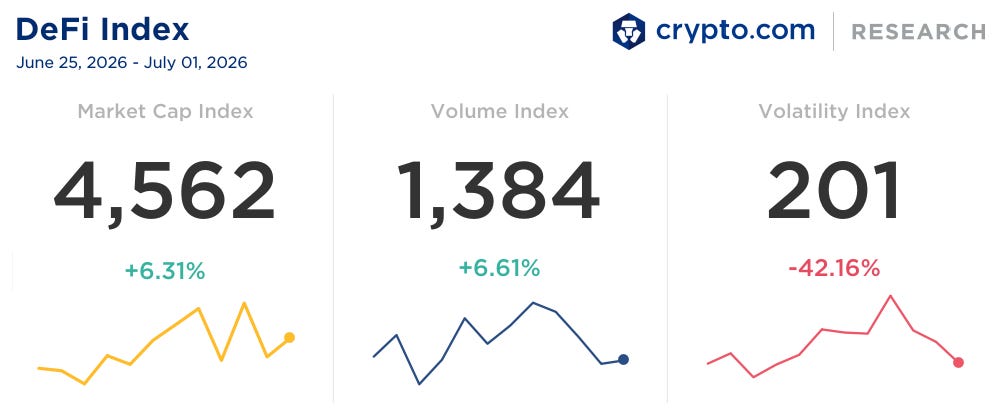
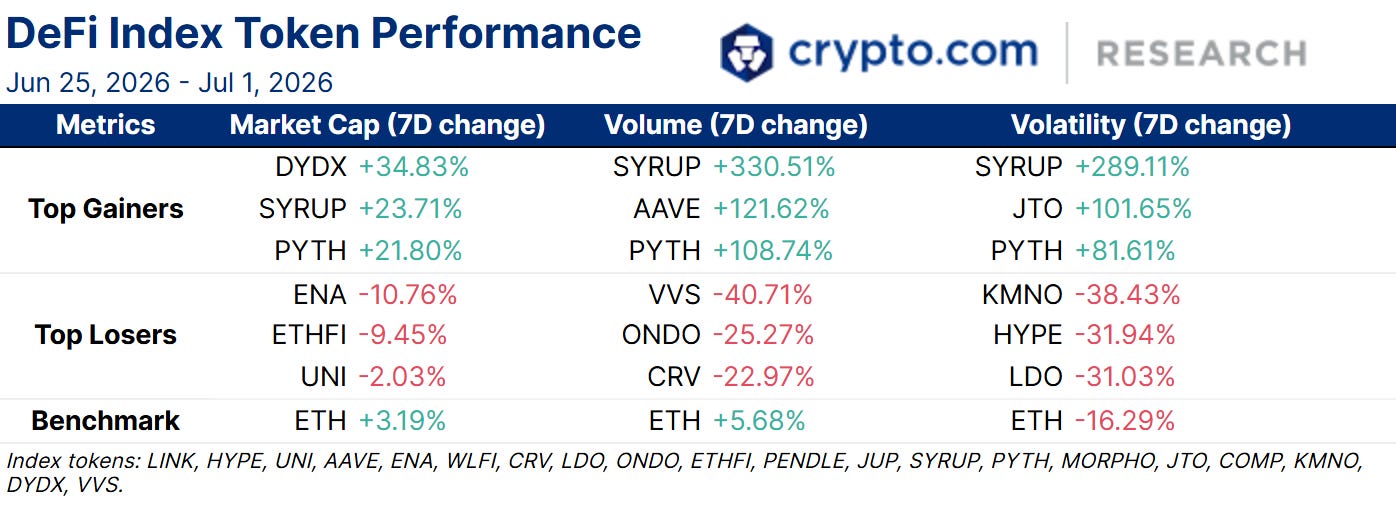
This week, the market cap and volume indices increased +6.31% and +6.61%, respectively, while the volatility index dropped -42.16%.
Nasdaq joined the Pyth Data Marketplace as an institutional publisher, distributing its proprietary “TotalView” full depth-of-book equity data natively across blockchain networks.
Uniswap and Spark teamed up to build a shared FX layer for stablecoins using the Uniswap v4 architecture. Spark is initiating the effort by migrating $150 million in liquidity to pool major stablecoins — such as Sky’s USDS, Tether’s USDT, and PayPal’s PYUSD — with the goal of allowing future issuers to plug in directly.
Ondo Finance (ONDO) introduced 24/7 minting and redemption for tokenized U.S. stocks and ETFs.
Aave (AAVE) unveiled “Aavenomics 3.0,” shifting its token buyback program from a discretionary, committee-directed model to a hardcoded, protocol-level mechanism. Under this framework, 100% of revenues generated by the Aave Protocol, the GHO stablecoin, and associated ecosystem products will be automatically routed to the DAO treasury.
Total value locked (TVL) in the DeFi sector contracted by approximately 37% in 2026, falling from roughly $112.6 billion in January to just over $70 billion in June — a level not seen since 2024. This decline stems from a broader market correction and a surge in security exploits.
By category, Liquid Staking led the drop with a 44% YTD decline, followed by Lending with a 39% decline. Conversely, RWA led with a 48% increase.
This downturn followed an October 2025 peak, when Bitcoin reached a record high above $122,000. A subsequent liquidation event on October 10, 2025 wiped approximately $17 billion in leveraged positions, triggering a deleveraging cycle across digital assets. Furthermore, the sector faced intensified hacking activity, with 121 incidents resulting in approximately $942 million in losses YTD. Q2 2026 emerged as the most-hacked quarter on record by incident count (83 exploits), although the $755 million in total value stolen remained below the historical peak of $3.56 billion recorded in Q4 2020.
A consortium of over 140 payment, banking, and crypto firms launched the Open Standard and its dollar-pegged stablecoin, Open USD (OUSD). OUSD plans to completely eliminate minting and redemption fees while redistributing reserve interest yield back to the member businesses driving its circulation.
Following the launch of OUSD, Circle CEO Jeremy Allaire published a rebuttal challenging the economic viability of OUSD’s fee-free, full revenue-sharing approach. Allaire argued that distributing 100% of yield to partners starves critical ecosystem infrastructure, while asserting that USDC’s $30 trillion in multi-year transaction volume and deep regulatory moat cannot easily be replicated by committee-led consortiums.
BlackRock partnered with Ethena Labs to list the USDe synthetic dollar on its $20 trillion Aladdin risk-management platform. Under the agreement, BlackRock’s BUIDL tokenized treasury fund will become the default reserve asset for Ethena’s whitelabel stablecoins, and Ethena will deploy a $100 million liquidity facility through Securitize to allow round-the-clock swaps out of BUIDL.
New York Life Investment Management, which manages over $800 billion in assets, made its tokenization debut by launching the NYLIM Anemoy fund, an on-chain, high-yield corporate bond fund strategy on the Centrifuge platform, with transactions settled in USDC.
Bank of New York Mellon (BNY) added USDC custody, minting, and burning capabilities directly into its Digital Asset Custody platform, deepening its strategic partnership with Circle.
European banking leader Crédit Agricole’s asset servicing subsidiary, CACEIS Bank, rolled out ERC-20 euro stablecoin EURXT on the Ethereum mainnet. Compliant with Europe’s MiCA regulatory framework, the asset was immediately used to settle a corporate subscription into a tokenized Amundi money market fund.
The Solana network activated its on-chain validator governance module, enabling validators holding at least 100,000 SOL to propose and vote on technical upgrades. The stake-weighted system requires a minimum threshold of 15% cluster support to advance adjustments.
Solana-based derivatives platform Drift Protocol rebranded to Velocity DEX as part of an engineering overhaul following a $295 million exploit in April. The platform is discarding adjacent features like Isolated Markets to relaunch as a leaner, perpetuals-only exchange settled in USDT, while entirely removing the vulnerable durable-nonce mechanism.
DeFi platform Abracadabra took emergency action after its crypto-collateralized stablecoin, Magic Internet Money (MIM), dropped 50% below its dollar peg to roughly $0.49 due to thin and imbalanced liquidity in Curve Finance pools. The platform is gradually increasing interest rates across all borrow pools (”Cauldrons”) to incentivize users to repay debt at a discount, thereby contracting the circulating MIM supply to restore parity.
Cardano-based self-custody wallet platform SecondFi detailed a two-week fund-restitution plan after a deterministic nonce vulnerability allowed attackers to reconstruct private keys. The hackers successfully drained $2.4 million (16 million ADA) across 374 addresses, while SecondFi’s emergency interventions rescued and redirected another 129 million ADA to an independent third-party custodian.

Pre-IPO Perpetuals: Front-Running Wall Street: Crypto derivatives offer retail investors a solution through synthetic pre-IPO perpetual contracts. These 24/7, leveraged financial instruments wrap expected valuations, dismantling the barriers to institutional exclusivity and enabling users to trade the trajectories of private tech companies.
Market Update (May 2026): May highlighted a performance gap between surging global equities and declining cryptos and commodities. Equity markets led with the MSCI Emerging Markets index up +9.5%, and the Nasdaq Composite gaining +8.4%. Conversely, BTC and ETH fell -3.5% and -11.2%, respectively. Bonds and Real Estate posted modest gains, while Commodities and Gold fell. Data suggests a rotation from crypto toward high-growth equity sectors.
Research Roundup Newsletter (May 2026): We present to you our latest issue of Research Roundup, featuring our analysis on Real-World Asset Perpetuals and April’s market review and outlook.
Interested to know more? Access exclusive reports by signing up as a Private member, joining our Crypto.com Exchange VIP Programme, or collecting a Loaded Lions NFT. The latest crypto market insights are also available via the dashboard.
Research and Insights Team
Disclaimer
The information in this report is provided as general market commentary by Crypto.com and its affiliates, and does not constitute any financial, investment, legal, tax, or any other advice. This report is not intended to offer or recommend any access to products and/or services. While we endeavour to publish and maintain accurate information, we do not guarantee the accuracy, completeness, or usefulness of any information in this report, nor do we adopt nor endorse, nor are we responsible for, the accuracy or reliability of any information submitted by other parties.
This report is not directed or intended for distribution to, or use by, any person or entity who is a citizen or resident of, or located in a jurisdiction, where such distribution or use would be contrary to applicable law or that would subject Crypto.com and/or its affiliates to any registration or licensing requirement.
The brands and the logos appearing in this report are registered trademarks of their respective owners.
Your feedback has always helped us provide insightful crypto market trends. Tell us how we can improve this newsletter further by taking a quick survey below (it will only take less than a minute). Thank you!
Thank you for reading! We hope you find our Weekly DeFi and Layer 1 & Layer 2 News Update enlightening!
Hungry for more? Visit our Research Hub and University to access other insightful crypto research!
Share with a friend if you like our email!
Thanks for reading Crypto Trends from Crypto.com: Market, DeFi, NFT, Gaming! Subscribe for free to receive new posts and support my work.
No posts
Comments
Nothing yet. Say the first thing.
Sign in to join the conversation.