
Eleven products in one day. Everything below is shorter and plainer than usual, on purpose—there is too much here to spend words on.
Funny story about the inspectors general primer in this batch. I happened to be reading version 13 on Saturday, closed the PDF out and thought: I wonder if it will be updated soon, the timing is right for it; fingers crossed! If I’d known I had a wish that would be granted, respectfully, I wouldn’t have wasted it on that! But it did work to lighten my reading load for today, so… comme ci, comme ça. From a professional viewpoint, the v.14 update is excellent.
This batch opens with a brand new report on the New World screwworm. The only image I’m including is a map. The images aren’t gruesome, most are just pictures of insects, but the report’s prose. The prose did me in, and my wife set a plate of meatloaf down in front of me right as I hit the worst of it. Read that report if you like. Maybe not while eating though…
Title: New World Screwworm: Background and Issues for Congress
Report No. R49124 | Type: Report | Date: August 11, 2026, version 1
CRS Author(s): Eleni G. Bickell, Analyst in Agricultural Policy; Christine Whitt, Analyst in Agricultural Policy | Official Congress.gov copy
The New World screwworm is a small, unremarkable-looking fly. Its larvae eat living tissue—cattle, horses, deer, dogs, people. The United States wiped it out everywhere but Texas by 1966, and Texas by 1982, using a method that still sounds invented: raise flies by the million, sterilize them with gamma radiation, and drop them out of airplanes. A female screwworm mates once in her life. If she mates with a sterile male, her eggs never hatch. Do that long enough and the population collapses.
What kept the fly out for the next four decades was a wall made of flies. The United States and Panama maintain a permanent release line across the Darién Gap, fed by a single plant at Pacora that turns out roughly 100 million sterile flies a week. In 2023 the wall failed. The fly moved north through Central America, reached southern Mexico in November 2024, and on June 3, 2026, USDA confirmed a case in a calf in Zavala County, Texas. As of August 10 there were 45 confirmed U.S. detections: 44 in Texas and one dog in New Mexico. Mexico and Central America have logged significantly more: roughly 185,000 animal cases and more than 2,000 human ones.
Nobody has publicly explained why the wall came down. A cattle boom in the Darién is what USDA points to—about 64,000 head in 2006, about 133,000 in 2022—along with thin producer education and unreliable supplies for fly production. Outside researchers suspect the lab strain, mass-reared since the 1950s, simply stopped competing well for mates. Since FY2024 USDA has obligated about $1 billion in emergency transfers, $726.4 million of it on a new production plant at Moore Air Base in Edinburg, Texas, designed for up to 300 million flies a week. Before the breach, the barrier ran on roughly $20 million a year.
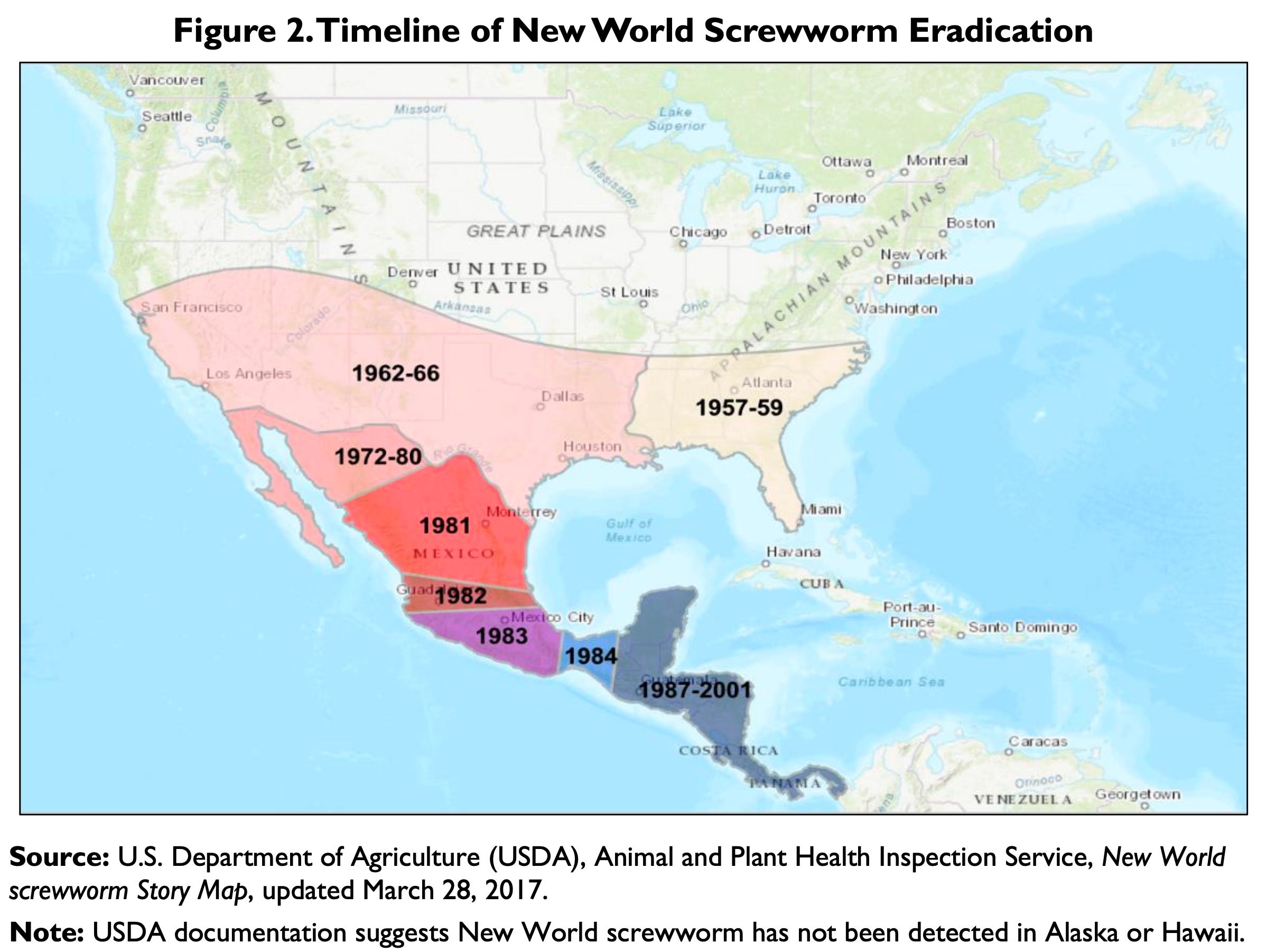
Screwworm eradication is one of the most successful things the federal government has ever done, and it worked so well it became invisible. A $20 million line item kept a continent’s livestock, pets, and wildlife safe for forty years. The response to that line item failing now runs about fifty times as much annually and has not caught up with the problem yet.
The unanswered question should worry Congress more than the price tag. If the barrier fell because a seventy-year-old sterile strain lost its edge, that is a slow and predictable failure that monitoring should have caught. If it fell because production capacity was too thin to surge when cases rose, that is a budget decision someone made. Neither one is bad luck, and a new plant in Texas does not answer which it was.
Title: Russian Hybrid Warfare Activities in Europe: Considerations for Congress
Report No. R49134 | Type: Report | Date: August 11, 2026, version 1
CRS Author(s): Andrew S. Bowen, Coordinator, Analyst in Russian and European Affairs; Sarah E. Garding, Analyst in European Affairs; Derek E. Mix, Specialist in European Affairs; Catherine A. Theohary, Specialist in National Security Policy, Cyber and Information Operations | Official Congress.gov copy
Hybrid warfare is the term for attacks that stay just under the line that would start a war. Sabotage, arson, assassination, cyberattacks, jamming GPS signals, flying drones over airports, cutting undersea cables, pushing migrants at a border. The point is not to win anything outright. It is to impose cost while keeping enough doubt about who did it that nobody has to respond.
Europe has been absorbing a lot of it. One study found Russian hybrid attacks quadrupled between 2023 and 2024; another counted at least 151 incidents from February 2022 through March 2026. The catalog here includes explosive packages planted on cargo aircraft in 2024, a cyberattack that opened the floodgates of a Norwegian dam in April 2025, an attack on 30 Polish energy facilities that December, two attacks on Polish rail lines in November 2025, 29 Russian drone incursions into Romanian airspace since 2022, and a drone carrying explosives found this month at a German airport that handles NATO logistics. Russia denies all of it, which is the design. Not everyone plays along. In November 2025 the European Union’s foreign policy chief, Kaja Kallas, called Russia’s hybrid actions in Europe increasingly brazen and said flatly that they amount to state sponsored terrorism.
Three Russian agencies run these operations alongside their regular spying: the civilian foreign intelligence service, the domestic security service, and military intelligence—the GRU—which Western officials describe as the most aggressive of the three.1 Europe expelled at least 750 Russian diplomats and suspected intelligence officers between 2022 and 2024, so the services increasingly hire out—petty criminals, recruits found online, people who are cheap and deniable and frequently bad at the work. NATO has stood up two missions in response, Baltic Sentry and Eastern Sentry, and has said hybrid attacks could in principle trigger Article 5, the treaty clause under which an attack on one member is treated as an attack on all.
Two related facts sit a page apart in this report, left unconnected. Between 2016 and early 2025, successive U.S. administrations expelled more than 100 Russian diplomats and suspected intelligence officers. Press reports in 2025 described the second Trump Administration discussing allowing some of them to return.
That is the question in this report for Congress, and it is not about Europe. Expulsion has been the main Western tool against exactly the personnel now running sabotage campaigns across the continent, and reversing it is a policy choice with counterintelligence consequences on this side of the Atlantic. The bills introduced so far—the SHADOW Act, a notification requirement in S. 4784, reporting language in this year’s defense authorization—all ask the executive branch to describe the problem in Europe. None of them requires the executive branch to tell Congress whether it is letting expelled Russian intelligence officers back into the United States.
Title: Statutory Inspectors General in the Federal Government: A Primer
Report No. R45450 | Type: Report | Date: August 11, 2026, version 14
CRS Author(s): Ben Wilhelm, Analyst in Government Organization and Management | Official Congress.gov copy
Yesterday WCSBR covered CRS’s Aug. 10 coverage of the SBA’s Inspector General.
An inspector general2 is an auditor Congress installs inside an agency and then works very hard to keep that agency from controlling. There are 70 of them. Thirty-three are nominated by the President and confirmed by the Senate, 30 are appointed by the heads of smaller agencies and commissions, and seven operate under their own separate statutes, five of those in the legislative branch. They audit, investigate, and report to two masters at once—the agency head and Congress.
The protections are almost entirely procedural. A President is required to provide Congress with 30 days’ advance written notice along with a substantive rationale before an IG can be fired. This came from a 2022 law tightening the procedural requirements in response to removals under both the Obama and first Trump Administrations. Early in the second Trump Administration, the President removed 18 of them without that notice. Asked about it, he said some people thought some were unfair or not doing their job, and called it a very standard thing to do. A federal court found the removals improper and declined to reinstate anyone, reasoning that he could simply remove them again the correct way.
Then the money. CIGIE, the council that coordinates the whole IG community, runs mostly on assessments paid out of its member offices rather than on an appropriation of its own. In September 2025 OMB declined to release its funds and the agency effectively shut down for over a month. Oversight.gov—the public library of IG reports, and where people go to report waste and fraud—went dark, along with several individual IG websites. Funding resumed in November. Vacancies have stayed high through 2025 and 2026. One analysis found some IGs issued dramatically fewer reports in the first half of FY2026 than their historical averages. And some IG offices now have political appointees in management roles beneath the IG, which CRS describes as a marked deviation from past precedent.
The structure was built for a fight over findings, not over existence. Nearly every safeguard in it—notice before removal, budget transparency, separate appropriations accounts—assumes an administration that wants to argue with what an IG concluded. It has much less to say about one that would prefer the office not reach conclusions.
The CIGIE shutdown is the clearest illustration. No law changed and nobody was fired. The money just did not move, and for more than a month the public could neither read what the watchdogs had found nor tell them about anything new. A funding structure that routes an oversight body’s operating budget through the executive branch it partly exists to check turns out to be a lever. The IG community has asked Congress to fix that before.
Title: The Alien Terrorist Removal Court: A Brief Overview
Report No. IF13285 | Type: In Focus | Date: August 11, 2026, version 1
CRS Author(s): Amin Aminfar, Legislative Attorney | Official Congress.gov copy
On July 15, 2026, the government filed an application with the Alien Terrorist Removal Court. It was the first one the court had ever received. The next day it issued its first order in thirty years of existence.
Congress created the court in 1996, in the Antiterrorism and Effective Death Penalty Act, to solve a specific problem. Lawmakers believed people removable on terrorism grounds were using ordinary immigration procedure to stall their cases, and that the ordinary procedure could not safely handle classified evidence. The court is five district judges designated by the Chief Justice, who may be the same judges who sit on the surveillance court. The Attorney General files under seal, and the judge reviews that application alone—the person it concerns never sees it. If the judge finds probable cause that the person is an “alien terrorist” and that removing them through normal channels would endanger national security, this court’s procedures take over from the immigration system entirely.
What follows is a public hearing with real rights attached. The person can attend, introduce evidence, and cross-examine witnesses, and unlike in immigration court, gets a lawyer appointed if they cannot afford one. Then come the exceptions. The Federal Rules of Evidence do not apply. The government may use the fruits of surveillance the person may never see, and there is no motion to suppress. Classified evidence goes to the judge alone; the person gets an unclassified summary only if the judge approves one. If the judge rejects the summary twice, the hearing normally ends—unless the judge also finds that letting the person remain would likely cause serious and irreparable harm and that handing over a summary would too. Then the hearing continues without one. Lawful permanent residents get a cleared attorney who may read the classified evidence and challenge it but may not tell the client what it says, on penalty of fine or imprisonment.
Thirty years is a long time for a court to sit unused, and the reason matters less than the consequence: nobody knows how any of this works. Every provision above is untested. The summary override in particular has never been applied by a judge with a real case in front of them, and it is drafted so that the failure of the safeguard becomes a condition for proceeding without it.
Appeals run only to the D.C. Circuit, which must generally defer to the trial judge’s findings of fact. The statute does not clearly give the person a place to raise constitutional objections at the removal hearing at all. Congress wrote all of this in 1996 alongside an explicit instruction to itself that the procedures meet constitutional requirements. It gets to find out now.
Title: The Office of Personnel Management’s Request to Collect Claims Data from Federal Employees Health Benefits (FEHB) Carriers
Report No. IF13284 | Type: In Focus | Date: August 11, 2026, version 1
CRS Author(s): Wen W. Shen, Legislative Attorney; Ryan J. Rosso, Specialist in Health Care Financing; Amanda K. Sarata, Specialist in Health Policy | Official Congress.gov copy
The employer is the federal government, and the request is not new. OPM runs the health insurance program covering federal workers, retirees, and their families, and since at least 2010 it has been trying to get individual claims out of the carriers that administer it. In December 2025 it published a notice saying it is collecting medical claims, pharmacy claims, encounter data, and provider data. In June 2026 it published another explaining why it believes it can.
The legal argument goes through two doors. The first is a provision from 1959 directing OPM to make a continuing study of how the program operates, and requiring carriers to furnish reasonable reports and permit examination of their records. OPM reads that as authority to require and hold the claims themselves. The trade group representing the carriers reads it as authority to ask for reports, not for every individual’s claims, and to examine records, not to possess them. The second door is HIPAA, which normally requires your permission before a health plan hands your records to anyone. There is an exception for health oversight agencies conducting oversight authorized by law, and OPM says it qualifies. Whether it does depends entirely on how the first question comes out.
Earlier versions of this request contemplated aggregate data, or data the carriers scrubbed before sending it. This one does not. The records arrive at OPM still carrying identifying information, and the stripping happens after they are inside the government. They go first to OPM’s inspector general, which passes an encrypted copy to OPM technical staff with every identifying field removed except the member ID. Those staff generate pseudonyms for the analysts to work from. Carriers have pointed out that OPM already knows a great deal about its own enrollees and their families, which makes the possibility of purposeful re-identification a real concern even for files that have been otherwise scrubbed. OPM is not itself covered by HIPAA. Its notice says the records may be disclosed outside the agency as a routine use, including to OPM contractors.
Two questions are worth keeping apart. Whether OPM should be able to analyze claims data at all is a reasonable policy argument with reasonable answers on both sides—program-wide claims are genuinely how you find fraud and pricing problems. Whether a 1959 statute about surveys and reports authorizes a permanent repository of every federal employee’s medical history is a different question, and the answer is not obviously yes.
A third question is raised at the end: whether telling carriers to do this requires notice-and-comment rulemaking rather than a data collection notice. That is not a technicality. It is the difference between a policy the public gets to argue with and one the public gets informed about.
Title: The Second Amendment at the Supreme Court: Challenges to Federal Gun Laws
Report No. LSB11108 | Type: Legal Sidebar | Date: August 11, 2026, version 7
CRS Author(s): Dave S. Sidhu, Legislative Attorney | Official Congress.gov copy
On June 30, 2026, the Court granted review in two cases and consolidated them, because they ask the same thing: whether the Second and Fourteenth Amendments guarantee a right to possess AR-15 platform and similar semiautomatic rifles. Viramontes v. Cook County challenges an Illinois county ordinance; Grant v. Higgins challenges a Connecticut statute. Both bans survived in the lower courts.
Four earlier cases got us here. Heller (2008) held that the Second Amendment protects an individual right, and noted in passing that it covers weapons in common use but not dangerous and unusual ones. McDonald (2010) applied it to states and cities. Caetano (2016) confirmed it covers weapons that did not exist in 1791. Bruen (2022) set the test courts use now: if the plain text covers the conduct, the government must show its restriction fits the nation’s historical tradition of firearm regulation.
The two appeals courts reached the same result by different routes. The Seventh Circuit leaned on precedent treating military-style weapons as not really “arms” for self-defense in the first place. The Second Circuit assumed they were arms and upheld the ban at the history step, reading Heller’s phrase “dangerous and unusual” to mean “unusually dangerous”—a reading that measures danger to the public rather than how many people own one. The challengers argue the opposite: millions of Americans own these rifles and use them lawfully, which they say is “excellent evidence” that the American people do not view the AR-15 as dangerous or unusual.
If “dangerous and unusual” means what the challengers say, popularity becomes a defense: neither how many people object to a weapon nor how many use one unlawfully counts for anything against how many bought one. If it means what the Second Circuit says, popularity is beside the point and courts weigh capacity for harm directly. These are not two readings of one rule. They are two different rules, and everything turns on two words Heller used almost offhandedly.
Whatever the Court says will set the outer boundary of what Congress can do on firearms, which is why this belongs on the list even though neither case involves a federal law. Separately, the Justice Department has a petition pending in United States v. Hembree over whether people convicted of nonviolent felonies may be barred from owning guns. The Court kept that petition alive rather than disposing of it and may act on it in September.
Title: Expiring Health Provisions: CY2026 and CY2027
Report No. R49126 | Type: Report | Date: August 11, 2026, version 3 (New)
CRS Author(s): Kirsten J. Colello, Coordinator, Specialist in Health and Aging Policy; Alison Mitchell, Coordinator, Specialist in Health Care Financing | Official Congress.gov copy
CRS keeps a running inventory of health programs with expiration dates written into them. This edition covers 2026, 2027, and the ones that already lapsed in 2025. It is three tables and almost no argument, which is the point—it exists so nobody can say they did not know.
The 2025 column already has losses in it. The enhanced Affordable Care Act premium tax credits, which widened who qualified and increased the subsidy, expired December 31, 2025. So did the five-percentage-point federal match bonus for states that adopted Medicaid expansion.
December 31, 2026 is where the pile-up is. The Community Health Center Fund and the National Health Service Corps Fund both run out that day; between them they finance the federal health center program and the loan repayment that staffs shortage areas. So do the Special Diabetes Programs for Type 1 diabetes and for Indians, implementation money for the No Surprises Act, a 2.5% temporary bump in Medicare physician payments, the low-volume and Medicare-dependent hospital adjustments that keep some rural hospitals solvent, and the national advisory committees on the medical needs of children, seniors, and people with disabilities during disasters.
2027 is quieter and larger. All four FDA user fee programs—prescription drugs, medical devices, generics, and biosimilars—sunset October 1, 2027. Puerto Rico’s elevated Medicaid funding and its 76% federal match end September 30, 2027, and $8 billion in Medicaid disproportionate share hospital cuts begin the following day.
Expiration dates are a legislative technology. Congress uses them to force itself to revisit a program instead of funding it in perpetuity, and the cost of that discipline is that a program’s survival depends on floor time it may not get. What results is a recurring year-end package bolted onto whatever vehicle is moving, usually an appropriations bill, usually late.
The FDA user fees are the item most likely to pass and least likely to be argued about, since industry wants them renewed too. The health center and rural hospital money is the item where a lapse shows up fastest as a locked door.
Title: The Congressional Budget Resolution: Frequently Asked Questions
Report No. R48284 | Type: Report | Date: August 11, 2026, version 11
CRS Author(s): Tori Gorman, Analyst on Congress and the Legislative Process | Official Congress.gov copy
Annoyingly, when I downloaded the latest PDFs after 4pm ET, this went from v.10 to v.11, for you guessed it, punctuation adjustments. Remember not to let version numbers misinform you: despite the double digits, they appear to represent only two substantive updates.
A budget resolution is an agreement between the House and the Senate about how much the federal government should spend and take in. It is not a law. The President never sees it. It funds nothing. What it does is set ceilings that are enforceable inside Congress, and—the reason anyone bothers—it is the only way to start reconciliation, the process that lets a bill pass the Senate without needing sixty votes.
The Budget Act tells Congress to finish one by April 15. Under the current timetable, in place since 1985, Congress has managed that for FY1994, FY2000, FY2001, and FY2004. Across the years it adopted one at all, the average was 91 days late, and that average hides a shift: between 1987 and 2016 it ran 39 days, and between 2017 and 2026 it ran 272. The FY2026 resolution was adopted April 29, 2026, which is 379 days past the target for a fiscal year that had started the previous October. In nine of the last seventeen fiscal years, Congress adopted no budget resolution at all.
The calendar stopped mattering partly because of a 2017 precedent holding that Congress may adopt a budget resolution for a fiscal year during that fiscal year. When there is no resolution, the House and Senate use deeming resolutions or statutory spending caps to produce the enforceable numbers instead. Neither can start reconciliation, which is why a resolution reliably appears whenever a majority wants to move a large bill on party lines.
The April 15 deadline carries no penalty, and a rule with no penalty is a suggestion. Every blank row in the report is a year Congress decided the resolution was not worth the floor time and then produced the required numbers another way.
That is the useful thing to take from an FAQ that otherwise reads like a civics text. The budget resolution has quietly stopped being an annual fiscal plan and become a procedural key, produced when someone needs to unlock reconciliation and skipped when nobody does. Read that way, the timing table looks less like dysfunction and more like a body using the tool it actually wants.
Title: Complete Streets: A Primer
Report No. R47947 | Type: Report | Date: August 11, 2026, version 3
CRS Author(s): Jennifer J. Marshall, Analyst in Transportation Policy | Official Congress.gov copy ← Neat graphics inside!
If you have ever tried to cross a five-lane road with a stroller, you have an opinion about this even without the vocabulary. A complete street is one designed for everyone using it—walking, biking, rolling, riding a bus, driving—rather than for cars with everyone else accommodated afterward. In practice that means bike and bus lanes, sidewalks wide enough for a wheelchair, curb ramps, mid-block crossings, lighting, benches, and street trees, scaled to the place. The 2021 infrastructure law was the first federal statute to define the term. It required states and metropolitan planning organizations to spend at least 2.5% of two planning funding streams, roughly $93 million, on complete streets policies and prioritization plans. It also let states opt out.
The money that builds anything is elsewhere. Safe Streets and Roads for All made $5 billion available across FY2022 through FY2026 and the Reconnecting Communities pilot another $1 billion; last year’s reconciliation law rescinded $2.4 billion in unobligated funds from the related Neighborhood Access and Equity program. The surface transportation reauthorization now moving, H.R. 8870, was ordered reported on May 22, 2026, and touches both—Section 1119 funds Safe Streets and Roads for All, and Section 1112 would let states count block grant money as their share of a complete streets plan. Nineteen complete streets bills have been introduced since 2005 and none has passed on its own, though pieces of two were folded into larger highway laws. That is where the action has always been.
Title: Introduction to Tribal Forestry
Report No. R48934 | Type: Report | Date: August 11, 2026, version 7
CRS Author(s): Mariel J. Murray, Specialist in Natural Resources Policy; Anne A. Riddle, Specialist in Natural Resources Policy | Official Congress.gov copy
There are 19.4 million acres of Indian forest land in the United States as of the last national assessment, and it is not spread evenly. A single Tribe, the Navajo Nation, holds 5.4 million acres, 28% of the total. Ninety-two percent of all of it sits in the West and Alaska. More than half is woodland rather than forest—juniper, pinyon pine, mesquite—which matters more than it sounds, because multistemmed shrubby species cannot be sold as lumber, and selling timber is how a lot of fire risk reduction gets paid for. Meanwhile 41% of these acres are rated high or very high for wildfire hazard, and that share is climbing.
The legal architecture is layered. One law puts the Bureau of Indian Affairs in charge of managing tribal forests as a trust asset, and two others let Tribes take the work back. Under self-determination contracts and compacts, Tribes now manage more than 80% of Indian forest acreage in whole or in part. A newer and narrower authority lets a Tribe substitute its own forestry regulations for the federal ones outright; four Tribes have been approved and two are operating that way. Interior extended that program to 2036 this June.
The funding gap is the number to hold onto. Congress raised the BIA forestry line from roughly $55 million in FY2020 to about $63 million in FY2024. A 2023 independent assessment concluded it would take over $200 million to bring tribal forestry to parity with Forest Service and BLM funding for comparable work, and found that fewer than half the tribal organizations it interviewed were getting the staffing money the statute already requires.
Title: Democracy in Latin America and the Caribbean: A Compilation of Selected Indices
Report No. R46016 | Type: Report | Date: August 11, 2026, version 12
CRS Author(s): Carla Y. Davis-Castro, Senior Research Librarian | Official Congress.gov copy
Once a year, four organizations grade the world’s countries on how democratic they are, and CRS collects the Latin America and Caribbean results in one place so Congress can look at them side by side. The four are Bertelsmann Stiftung, the Economist Intelligence Unit, Freedom House, and the V-Dem Institute at the University of Gothenburg. Everything here covers 2025 or earlier. CRS declines to endorse any of the methodologies, and after reading the tables you understand why.
The headline is mildly encouraging. EIU’s regional average rose for the first time in nine years, from 5.61 to 5.71, with 13 of 24 countries improving. Freedom House counted 23 of 35 countries in the Americas as free but recorded only six improvements against twelve declines. Bertelsmann found no country changed regime type, though Guatemala moved from hardline to moderate autocracy. Two countries turn up repeatedly: Bolivia improved on three of the four and moved from Partly Free to Free for the first time since 2002, and El Salvador posted the region’s steepest decline on two separate indices.
Then there is Argentina, which EIU ranked among the five most improved countries in the world and V-Dem listed as one of six countries in the region actively becoming less democratic. Both are defensible. They measure different things over different windows using different experts. That is the case for reading all four rather than quoting the one that agrees with you.
Eleven CRS products, read so you don’t have to. In Texas the federal government is building a plant to make 300 million flies a week, and honestly, they’ve built worse there… Share the good news.
Share What Congress Should Be Reading
AI Disclosure: This post was built through an iterative collaborative process with Claude Opus 5 by Anthropic. Claude ran the archive integrity and prior-coverage checks, proposed triage and tier assignments, and drafted the Synopsis and Commentary sections from the CRS source documents, working from a directive to write plainer and tighter than usual for greater information accessibility. Claude also constructed the metadata blocks, any alt-text and captions, and ran fact-checking passes against the source materials. The human author, Charlie Amiot, provided the source documents, set the tone directive, approved coverage and sequence, wrote and revised throughout, and made every editorial decision. Charlie Amiot holds final responsibility for all accuracy and editorial judgment. AI use is disclosed in every post.
Just in case it crossed your mind too and I can save you the research: No, Illumination and Universal did not change Gru’s name in the Russian-language dub of Despicable Me; if you understand Russian, apparently there are some good memes out there about it.
Plural: Inspectors General. NOT: Inspector Generals.
Comments
Nothing yet. Say the first thing.
Sign in to join the conversation.