
If I had to give this post a theme, it would be the FY2027 budget. Wait, don’t stop reading! When I started this project, I was not a fan of the budget materials. Maybe I’m still not, hard to say some days… But the following products are all easily accessible and increase one’s knowledge tenfold.
Having said that, I openly admit that R46471 unfortunately only got a professional skim from me, due to my own time constraints, and it’s one I’d love to pore over (no auditory pun intended), because water infrastructure is fascinating, critical, and incredibly vulnerable. In the funding table, an em dash means the President requested nothing. I’ve poured my attention into the commentary section.1 Pun intended.
Please enjoy learning more about who pays for the pipes under your street, a manufacturing grant program funded out of an account the same agency wants eliminated, how many people the military is allowed to have, the Navy’s first robot tanker, why Taiwan’s president cannot get a layover in New York, and what China has been buying for the last decade. I know I did!
Title: Federally Supported Projects and Programs for Wastewater, Drinking Water, and Water Supply Infrastructure
Report No. R46471 | Type: Report | Date: August 12, 2026, version 15
CRS Author(s): Jonathan L. Ramseur, Coordinator, Specialist in Environmental Policy; Lisa S. Benson, Specialist in Agricultural Policy; Nicole T. Carter, Specialist in Natural Resources Policy; Elena H. Humphreys, Specialist in Environmental Policy; Joseph V. Jaroscak, Analyst in Economic Development Policy; Julie M. Lawhorn, Analyst in Economic Development Policy; Anna E. Normand, Specialist in Natural Resources Policy; Charles V. Stern, Specialist in Natural Resources Policy; Megan Stubbs, Specialist in Agricultural Conservation and Natural Resources Policy | Official Congress.gov copy
If your water comes from a pipe, some part of the system that delivers it and carries it away was probably built or repaired with federal money. If it comes from your own well, there is a federal program for that too. This report is the catalog of all of it. It runs to sixty-two pages, covers six agencies, and the reason it exists in August of 2026 is that Congress is writing the FY2027 appropriations bills that will decide what survives.
The catalog itself is useful on its own, and it is built in two layers. Table 1 comes first and runs nine pages: every program, what it is for, whether it moves money as grants or loans or loan guarantees, what share the federal government pays, what it received in FY2026, and what the FY2027 request would give it. Behind the table is the reference section, one entry per program, each under the same five headings — purpose, how the money moves, who is eligible, recent funding, and the statute behind it. It is a document built to be looked things up in rather than read, and it is upfront about what it leaves out: irrigation, flood control, hydropower, and recreation projects, emergency drought authorities, and programs built specifically for tribes, Alaska Native villages, and colonias (the unincorporated border communities that lack basic water and sewer service).
The Bureau of Reclamation builds and helps pay for water projects in seventeen western states. The Army Corps of Engineers stores municipal water behind dams it built for other reasons and, since 1992, has been handed more than six hundred separate authorizations to help named communities, counties, and states with their pipes. The Agriculture Department lends and grants to communities of generally ten thousand people or fewer. EPA runs the two big revolving loan funds, which send capitalization grants to states, which lend to cities, which repay the state, which lends the money again. HUD’s block grants can be spent on water among many other things, and about 11% of them were, on average, over the last five years. Commerce’s Economic Development Administration funds sewer and water lines when they are attached to a job-creation project.
The report also puts a number on the gap. EPA and the states estimate that the projects eligible for those two revolving funds alone will need more than $1.2 trillion over the next twenty years.
Table 1 is where the reference document turns into a news story. It sets what each program received in FY2026 next to what the second Trump Administration has requested for FY2027, and the FY2027 side of the page is largely empty. Whole programs are requested at zero: the Corps of Engineers’ assistance to named towns and counties, HUD’s block grant fund, emergency water grants for communities hit by drought or a chemical spill, dam rehabilitation.
That last one deserves its own line. Dam rehabilitation received $3 million in FY2026 and no FY2027 request, on the stated reasoning that mandatory farm bill funding is available for watershed work. By the end of 2025, 6,782 watershed dams had reached the end of their designed lifespans.
The Administration asked Congress to eliminate the Economic Development Administration outright and give it $20 million to close down. The two EPA revolving funds — the main channel through which federal money reaches local water projects — would fall from $746.1 million to $155 million on the clean water side and from $410.7 million to $150 million on the drinking water side. The WIFIA loan program, which in FY2026 turned its appropriation into roughly $6.5 billion in lending capacity for large projects, would get enough to pay its staff and nothing to lend.
On tribal funding, the report is narrower than it looks and the news inside it is worse. CRS says up front that it does not cover programs built specifically for tribes, so what appears here is the tribal money sitting inside general programs — and that money moves in two directions at once. Reclamation’s rural water account falls from $211.5 million to $31.3 million, and the entire remaining request is operations and maintenance at two tribal projects, the Mni Wiconi Project and the Garrison Diversion Unit. Nothing is requested to build anything, for anyone. EPA’s technical assistance program for small, rural, and tribal drinking water systems, funded at $26 million, is requested at zero. Its wastewater counterpart drops from $25.5 million to $10 million.
The one place tribes hold ground is the place Congress already decided. The Inflation Reduction Act appropriated $550 million, available through FY2031, for Reclamation to fund domestic water supplies for disadvantaged communities, including a new Tribal Domestic Water Supplies Program and a parallel one for the territories. As of March 2026, $222 million of it was committed. That money does not appear in the FY2027 column because it does not have to.
Three lines go up. Two barely: the Circuit Rider program, which sends technical help to rural water systems, gains $100,000, and USDA’s water and waste loan subsidy rises while the loan authority it supports falls from $1 billion to $816.9 million. The third is real, though narrow. Small water system resilience grants, which fund efficiency and watershed work against natural hazards, would go from $6.5 million to $16.5 million.
A reference document has to list everything, which means nothing in it was selected for effect. The table’s FY2027 column is a complete picture of the situation rather than a curated one. You can read down it and see the shape of the request without anyone having to characterize it for you.
The shape is this: the programs that send money to states and cities are cut deeply or zeroed, and the programs that keep a federal office running are funded. WIFIA is the clearest case, since the request pays the staff and stops the lending. It is a budget that preserves administrative capacity while withdrawing the thing being administered.
The infrastructure act’s water money ran out with FY2026. FY2027 is the first year in six where the base appropriation is the whole appropriation, and it is being proposed at about a fifth of the prior year's clean water grants and just over a third of the drinking water grants. The $1.2 trillion figure is not a lobbying number; it is EPA’s and the states’ own survey. The gap does not close because the column is blank.
Personally, I am having a hard time holding two facts in the same 30-day period. The first is that utilities in at least a dozen states reported attacks on their operating systems in that time, in a campaign researchers and officials have linked to Iranian-affiliated groups, and that Iran, Russia, and China have all been implicated in intrusions into water systems over the past several years. The second is that this report exists to explain the funding that would help fix that, and its FY2027 column is mostly empty. What I keep failing to absorb is not any one campaign. It is the shape of the sector underneath it. Systems serving 25 to 10,000 customers make up 91% of community water systems, and they “frequently lack both economies of scale and the financial, managerial, and technical capacity to meet statutory requirements.” That means complying with drinking water rules. The sentence describes just as accurately the capacity to segment a network, replace an unsupported controller, or notice that somebody is already inside.
The programs written to close that gap are the ones in the FY2027 column. The technical assistance program aimed squarely at those systems is requested at zero. The one grant program Congress wrote to address cybersecurity vulnerabilities in water systems is open only to systems serving 10,000 people or more; it sits at $2.3 million, has never made an award, and is requested at $2.3 million again. And the drinking water loan fund, by statute, is largely closed to systems that lack the financial, technical, or managerial capacity to stay in compliance—the utilities in the worst shape are the ones least able to borrow their way out of it. Small systems are shut out three separate ways: no technical assistance, too small for the cyber program, too weak for the loan fund. I understand that budgets involve choices I am not going to agree with. I do not understand making this one now.
If you want to know where the people who decide this stand, USAGov’s directory covers federal, state, and local officials, and Congress.gov’s address lookup will find your Representative and Senators directly. If you want to know who actually runs your water, EPA collects every utility’s annual water quality report at epa.gov/ccr. The utility’s phone number is on that report, and what they are doing about network security is a fair question from someone who pays them.
Title: Small Business Administration’s (SBA’s) Manufacturing in America E2G Grant Initiative
Report No. IN12726 | Type: Insight | Date: August 12, 2026, version 2 (New)
CRS Author(s): Adam G. Levin, Analyst in Economic Development Policy | Official Congress.gov copy
The Small Business Administration is about to hand out up to ten grants worth up to $5 million each, and it plans to announce them by the end of this month. The program is called the Manufacturing in America E2G Grant Initiative. The winners will not be manufacturers. They will be organizations that train and advise manufacturers, which is how SBA has done this kind of work for decades: it funds third parties, which it calls resource partners, and they do the counseling.
The businesses being counseled have to be enrolled in Empower to Grow, the program known until 2024 as 7(j). To qualify for that, a small business has to be in a county with unemployment at least 140% of the national or state rate, whichever is lower, or be owned by someone whose family income last year was under 150% of the federal poverty level, or be eligible for SBA’s 8(a) contracting program. The grants are meant to fund hands-on, in-person training in industries the notice lists as key, including aerospace, metal fabrication, food processing, and robotics, though the notice also says awards are not restricted to those sectors.
The math does not balance. Congress appropriated $3.8 million for Empower to Grow in FY2026. Ten awards at $5 million each would come to $50 million. SBA covered the difference by reprogramming money from its broader entrepreneurial development account, which Congress funded at $330 million. For FY2027, the second Trump Administration has asked Congress for $21.4 million for that entire account, all of it for veterans outreach, on the stated grounds that it eliminates SBA programs wasting taxpayer money on failed business counseling and training.
CRS lays out three questions Congress might ask. The first is whether steering E2G money toward manufacturers is an effective or equitable use of it — the authorizing statute directs SBA to pay special attention to businesses in high-unemployment or low-income areas and to 8(a) firms, and it names no industries at all. The second is duplication. SBA already runs Small Business Development Centers and similar programs that advise manufacturers among everyone else, and Congress has asked about the overlap before. The third is the reprogramming itself, and whether appropriators should permit it.
The reprogramming is the story, and it does not require anyone to think the grants are a bad idea.
An agency told Congress that business counseling and training wastes taxpayer money. The same agency is about to spend as much as thirteen times a counseling program’s own appropriation on new counseling and training. The money came out of the account it has asked Congress to defund. Both positions can be sincerely held. They cannot both be the agency’s view of what works.
What Congress actually controls here is narrower and more useful than the policy question. Appropriators can decide whether SBA gets to move money between accounts at all. That is a dull instrument and it is the one on the table, and this is the kind of episode that tends to produce a line of bill text about it.
Title: FY2027 NDAA: Active Component End-Strength
Report No. IN12728 | Type: Insight | Date: August 12, 2026, version 3 (New)
CRS Author(s): Nicholas M. Munves, Analyst in U.S. Defense Policy | Official Congress.gov copy
Title: FY2027 NDAA: Reserve Component End-Strength
Report No. IN12727 | Type: Insight | Date: August 12, 2026, version 2 (New)
CRS Author(s): Nicholas M. Munves, Analyst in U.S. Defense Policy | Official Congress.gov copy
Every year Congress sets a ceiling on how many people can be in each branch of the military on September 30. The term for it is end-strength, and these two Insights, published the same day by the same analyst, cover the FY2027 numbers for the full-time force and the reserves.
The Pentagon asked for 40,100 more active-duty personnel than Congress authorized for FY2026, a total of 1,342,900, and 4,400 more in the reserves, for 769,300. Most of the active increase is Army and Navy. CRS pulls each service’s stated reason out of the budget documents: the Army wants people for air defense, artillery, cyber, and countering drones; the Navy and Marine Corps want an expeditionary force; the Space Force, whose 2,800 additional people are a 27% increase on a service authorized 10,400, says its mission is growing along with the space domain. For the Air Force, which asked for 8,900 more people, CRS reports it could find no explanation at all. The reserve numbers are the only ones that move in both directions — the Army National Guard up 3,300, the Navy Reserve down 1,000.
The number that carries the most weight in both Insights is a repetition. The House-passed bill and the Senate committee-reported bill contain end-strengths identical to the request. Every service, every reserve component, both chambers, no changes. That is not the historical pattern CRS lays out. Congress added 16,000 soldiers to the Army over the request in FY2017 and 8,000 to the Army National Guard the same year, and in FY2024 a Senate committee went the other direction and recommended fewer, on the reasoning that legislating unreachable end strength numbers sets the services up for failure by encouraging quantity over quality in recruiting.
Two things are worth noticing about how binding these ceilings actually are. The Secretary of Defense can already vary any service’s end-strength by up to 3% after determining it is in the national interest, which across the active force is roughly the size of the entire requested increase. And recruiting shortfalls can put a service below its authorized minimum regardless of what the statute says. The number Congress writes down is a boundary, not a headcount, and this year Congress has so far written down the boundary it was handed.
Title: MQ-25 Stingray: Background and Issues for Congress
Report No. IF12972 | Type: In Focus | Date: August 12, 2026, version 4
CRS Author(s): Daniel M. Gettinger, Analyst in U.S. Defense Policy | Official Congress.gov copy
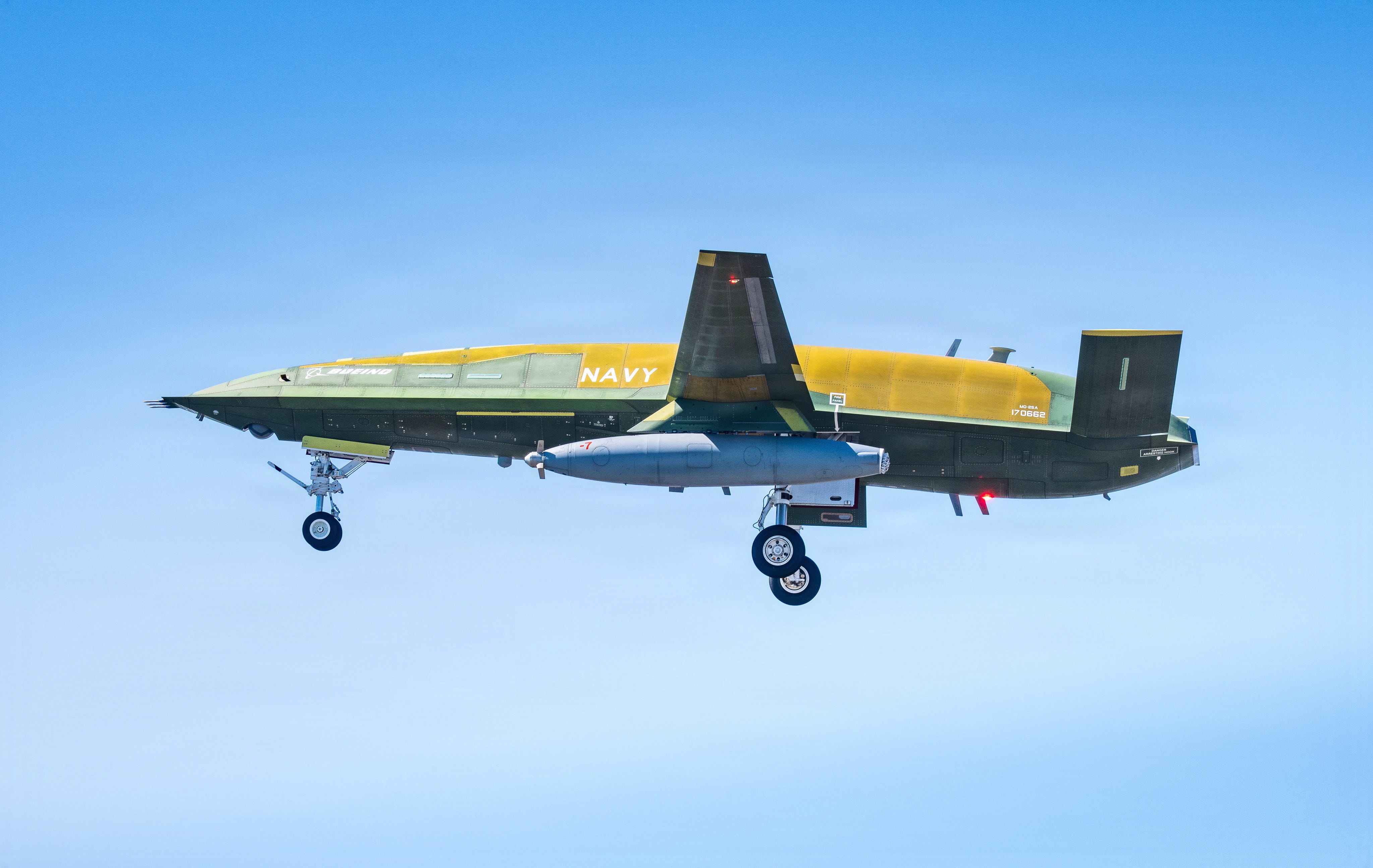
Fighter jets launched from a carrier need more fuel than they leave with, and somebody has to top them off in the air. On a carrier that somebody is usually another fighter jet with a fuel pod bolted on, doing a job it was not built for. The MQ-25 Stingray is the Navy’s plan to hand mid-air refueling to a drone. If it works, it will be the Defense Department’s first uncrewed tanker and the Navy’s first carrier-based drone of any kind.
It was not always going to be a tanker. The Navy and DARPA started down this road in 1999 trying to build a carrier-based uncrewed combat aircraft, an effort that became the Unmanned Carrier Launched Surveillance and Strike program, whose requirements DOD approved in 2011. In 2016 the Navy narrowed the mission from combat to refueling, so its Super Hornets could stop spending flight hours as gas stations. The MQ-25 still carries surveillance and reconnaissance as a stated mission alongside tanking, and Navy officials have told Congress it is a pathfinder to an air wing of the future in which uncrewed aircraft could take on various missions.
The requirement is modest by design: deliver at least 14,000 pounds of fuel 500 nautical miles out, roughly what an F/A-18E/F can pass along and less than older Navy tankers managed. Boeing builds the aircraft in Mascoutah, Illinois; Lockheed Martin builds the control software; the Navy is responsible for making the two work together and for making both work with the carrier. The Navy flew the first developmental aircraft in April 2026 and approved low-rate initial production the following month. The USS Theodore Roosevelt became the first carrier fully equipped to operate it this year.
The schedule has moved repeatedly. First flight was supposed to happen in 2021 and happened in 2026. DOD now estimates the aircraft could reach initial operational capability in 2029, four years later than originally planned and two years later than the revised plan, with delays attributed to production problems, schedule changes, and a labor strike. Flight testing is expected to run to the end of FY2029.
Cost depends on who is counting. DOD’s April 2026 acquisition report puts the total program at $19.4 billion and $255.8 million per aircraft. GAO’s 2026 assessment, which excludes military construction, puts it at $16.6 billion, with an acquisition unit cost of $218 million, up 4% from GAO's 2025 estimate. The program of record is 76 aircraft. Congress provided $1.03 billion for FY2026, $10 million under the request, plus $100 million in the FY2025 reconciliation law to speed up production. The FY2027 request is $1.75 billion for three aircraft.
Two federal watchdogs looked at the same decision and gave the same warning. The DOD Inspector General said in 2023 that starting production before finishing tests on production-representative aircraft was a risk and recommended the Navy wait or formally document why it would not. GAO repeated the concern in 2026, in the language the Pentagon uses when it means this will cost more later. The Navy started production in May.
The part that should bother an appropriator more is a sentence about paperwork. GAO reported that the Navy did not have data showing what the aircraft actually cost to build, because of how the fixed-price development contract was written, and that the program office was working to get it. A fixed-price contract protects the government from cost overruns by making them the contractor’s problem. It does not require the contractor to open its books. So the Navy is buying production aircraft while GAO says it does not yet know what a production aircraft costs to make.
Three aircraft for $1.75 billion is a decision being made in that condition, and part of what they’re getting is the pathfinder, which is to say the missions nobody has written down yet.
Title: Taiwan Presidents’ U.S. Transit Visits
Report No. IF12371 | Type: In Focus | Date: August 12, 2026, version 11
CRS Author(s): Susan V. Lawrence, Specialist in Asian Affairs | Official Congress.gov copy
The United States has not had formal relations with Taiwan since 1979. It does have a workaround, and the workaround has a specific shape: a sitting Taiwan president may stop in the United States only while traveling somewhere else. Since 1994, five of them have made thirty such trips. Taiwan treats each one as proof of American support. Beijing, which claims Taiwan and has never governed it, treats each one as a broken promise.
The rules were built out of one incident. In 1994 the Clinton Administration let President Lee Teng-hui refuel in Hawaii but not stay overnight, and Lee, insulted (CRS more tactfully uses piqued), refused to get off the plane. Congress noticed. A State Department official testified that overnight stops would be allowed going forward, and Congress passed a law that year directing that a Taiwan president who applies to come discuss certain subjects shall be admitted. In 1995 Lee visited Cornell as a private citizen, and China responded with missile launches and military exercises that became the third Taiwan Strait Crisis.2 The United States sent two carrier battle groups. Every Taiwan president since has been confined to transits.
What a transit looks like in practice: a visa from the American Institute in Taiwan, the private corporation that handles the relationship under contract with the State Department; stops in Honolulu, Guam, Los Angeles, Houston, New York; banquets with the diaspora; meetings with governors and Members of Congress but never with executive branch officials; no visits to Washington. When President Tsai Ing-wen met Speaker Kevin McCarthy in California in 2023, the highest-ranking American ever to meet a Taiwan president on American soil, China ran three days of large-scale exercises around the island.
President Lai Ching-te took office in May 2024 and stopped in Hawaii and Guam that November on his first trip abroad, with phone calls to the Speaker and the House Minority Leader. In August 2025 he reportedly sought to transit New York and Dallas on the way to Paraguay, Guatemala, and Belize. The second Trump Administration reportedly declined to approve the New York stop. Lai did not make the trip at all, and he has still never transited the continental United States. In July 2025 a State Department spokesperson said transits by high-level Taiwan officials, presidents included, remain fully consistent with longstanding U.S. policy and practice.
Two facts. The policy is unchanged. The trips have stopped.
That is what makes transits worth understanding. Nothing about them is written down as a rule that could be repealed, so nothing has to be repealed to end them. The whole practice runs on discretion, which means it can be withdrawn without an announcement, a legal justification, or a vote, and a spokesperson can accurately say the policy is intact while it is not being exercised. CRS also notes the chairmanship of the American Institute in Taiwan, the office that has historically escorted these presidents, has sat vacant since January 2025.
Taiwan’s diplomatic partners are down to twelve, which is what makes the transit rule bite: the trips have to be en route to somewhere, and there is less and less somewhere. The workaround was always a little absurd. It is a good deal less useful when the destinations run out and the layovers stop being approved.
Title: China’s One Belt, One Road Initiative: Economic Issues
Report No. IF11735 | Type: In Focus | Date: August 12, 2026, version 10
CRS Author(s): Karen M. Sutter, Specialist in Asian Trade and Finance; Michael D. Sutherland, Analyst in International Trade and Finance | Official Congress.gov copy
China announced One Belt, One Road in 2013 as a plan to build ports, railways, power plants, and fiber networks in other countries. In 2015 it changed the English name to the Belt and Road Initiative while leaving the Chinese name alone, which CRS suggests may have been meant to draw attention away from the original name’s description of what it is: a hub with spokes, and China at the hub. It went into the Communist Party charter in 2017 and into China’s current five-year plan, which runs through 2030.
The numbers are the reason to read this one, and they are much easier to hold as shares than as totals. In 2001 the United States held about a third of all the money invested across borders worldwide; China held half of one percent. By 2025 the American share was down to about a seventh and China’s was up to nearly 8%. The American pile is still the bigger one—$6.6 trillion against $3.6 trillion—but the direction has been one-way for twenty-four years. Two other figures fill in the picture. Chinese overseas construction contracts hit a record $289 billion in 2025. And a research lab at William & Mary puts China’s overseas lending portfolio at $2.1 trillion as of 2023, more than five times what the World Bank had on its books.
The structure of that lending is the part most people get wrong in both directions. These are not aid: the loans generally carry interest at market terms. They are also not ordinary commercial lending, because repayment is often secured by commitments of lease rights, minerals, or commodities made to the Chinese government, which absorbs much of the risk on behalf of the Chinese firms doing the work. Money frequently goes from the Chinese government to Chinese companies, while the host country pays the Chinese government back. When Sri Lanka could not repay in 2017, a Chinese firm took a majority stake in the operator of Hambantota port along with 99 years of operating rights. China tends to stretch loans out rather than forgive them, and its lending terms are largely undisclosed and negotiated one country at a time.
There is a security column to all this, and CRS runs down it: standards written so that civilian and military systems can work together, the BeiDou satellite network as an alternative to GPS, a Chinese bank’s lease on the Djibouti land where China built a military base. On the American side, Congress created the Development Finance Corporation in 2018 and a China-focused export program at the Export-Import Bank in 2019, and it is now debating what dismantling the U.S. Agency for International Development does to that competition. Two pending bills would require monitoring of Chinese projects and a strategy for countering them.
The headline number here is not China’s, it is America’s. In 2001 the United States held about a third of the world’s cross-border investment. In 2025 it held about a seventh. American investment abroad did not shrink — the total is far larger now than it was. Everyone else’s grew faster, and China’s grew fastest. Nobody voted on that. There is no policy with a name attached to it, no bill that did it, no administration that owns it. It is the accumulated result of twenty-four years of other people’s decisions, and a change that size would be a permanent national argument if it had ever been announced.
The lending structure explains why this is hard to counter with money alone. A loan that is neither aid nor a normal commercial transaction, secured against a country’s minerals or its ports, is an offer no development bank is set up to match, because development banks do not want the port. That is also why extending repayment terms rather than forgiving debt is the pattern. The debt is the relationship.
Congress is asking for strategies to counter Chinese influence in developing countries in the same session in which it is working out what it did by dismantling the agency that carried out American influence in those countries. Between them they would produce monitoring, a report, and a strategy. Neither would produce a counteroffer.
It's a budget post. You read it anyway. Send it to someone else who also will!
Share What Congress Should Be Reading
AI Disclosure: This post was produced with Anthropic’s Claude Opus 5. Claude checked prior WCSBR coverage, proposed the triage tiers, drafted the metadata blocks and all entry text, wrote the figure alt text and caption, and located the nonpartisan lookup resources linked in the water commentary. Charlie Amiot provided the source documents, set the coverage order and the plainer register the issues this week are written in, recursively revised at the paragraph level throughout, and made every editorial decision. Claude fact-checked the finished post against the source documents under close supervision. As the human author, Charlie Amiot holds final responsibility for all accuracy and editorial judgment. AI use is disclosed in every post.
Apparently I did well? A moment of overly curt prompting on my part caused Claude to think I requested a critical review of this post. My error, but that didn’t mean the “opinion” wasn’t generated: The water Commentary is the best thing in the post and possibly the best thing in the last month of the archive.
I’m both flattered and being insulted at the same time.
Of note, the Clinton Administration initially denied the request, but President Clinton was moved to reverse his decision when Congress voted near-unanimously (396-0 in the House; 97-1 in the Senate, with two not voting) that Lee should be admitted. The lone nay was Sen. J. Bennett Johnston (D-LA), who told the floor he had "the greatest respect" for Lee and then asked the State Department to ignore the resolution and withhold the visa anyway.
Comments
Nothing yet. Say the first thing.
Sign in to join the conversation.