
Brian Eno has two disco balls hanging in his studio, and makes a goofy voice when he does impressions. He “hates songs” and loves tribute bands. I’m not a songwriter, but I signed up for his School of Song course because I couldn’t resist spending some time on Zoom learning about creativity and making art from one of my heroes.
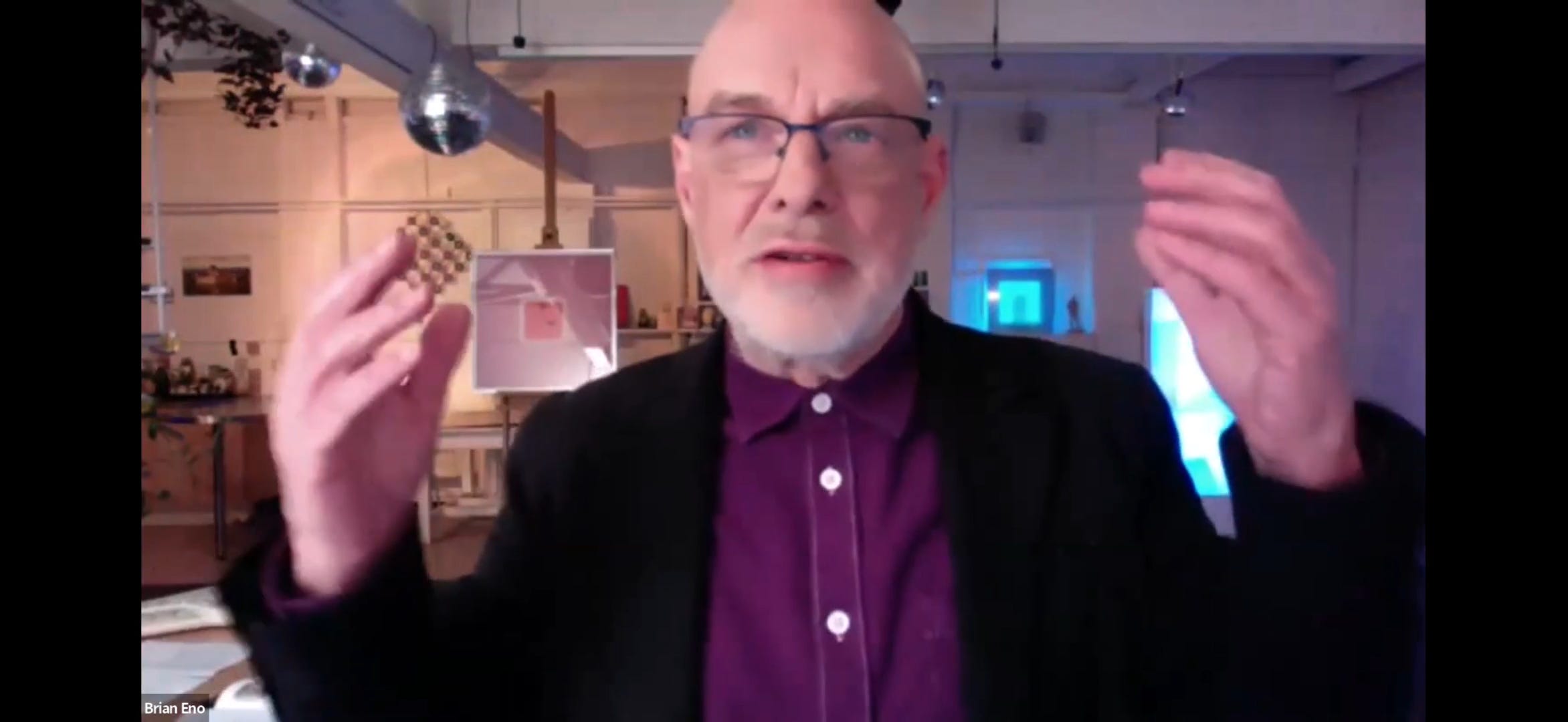
If you’re familiar with Eno’s work (is everyone?) or Oblique Strategies, or have seen Gary Huswit’s new documentary, then you already know what he’s all about. His is a conceptual music and art practice, where frameworks create space for sounds and moods to emerge. Technology, instruments, and lyrics are in service to ideas. The course largely focussed on getting into the frame of mind to be an effective artist. From Eno’s perspective, this is about managing your attention and the flow of information and inputs so that they don’t overwhelm your own perception and interests. And then you’ve got to respect and value your own interests.
I kept thinking about that classic Emerson quote:
In every work of genius we recognize our own rejected thoughts; they come back to us with a certain alienated majesty.
Brian also went deep into strategies for generating ideas and keeping ideas moving. I loved making connections between his approach to music and my own approach to design. Throwing ideas out there, being so consistently generative that the good ideas have time to stick around—and to eventually flourish. I take a similar more-is-more approach to making. He’s also big on creating rules and frameworks, and we covered a few that are relevant for both songwriters and designers, like:
Trying to make copies of great work
Making from the perspective of a persona
Using books or print media as source material for content
Building an archive of fertile ideas that you can come back to later
For your consideration, sharing a quote from David Lynch that I’ve been mulling over. This really aligns with how I think about the work of archiving, bookmarking and moodboarding:

For our final lecture, Brian shared a list of forty tips for successful songs, with examples played live. This robust library of rules and frameworks sounds corny, like lists so often are. But in practice, the list is brilliant, because it zeroes in on distinct moves that can give structure to an entire song or punctuate a key moment. It’s also high and low, blending music theory with patterns that just sound and feel sick and groovy. Some favorites:
An insistent one note bass (Sly & The Family Stone’s Everyday People)
Impossible singing (Minnie Riperton, or Emma Robinson doing that autotune thing)
Riffs and multi riffs and heterophonic riffs (James Brown, Sex Machine)
Instrument shadowing singing (”love will tear us apart again”)
Sounds from the real world
Handclap patterns
And so on. This brings me to the point of this letter today. 😈 Inspired by Brian, I want to create a similar list for design. I think it’ll be a fun exercise, and I’d love your recommendations. Send a note or drop ’em in the comments.
A few closing notes for Portlanders:
It’s the last week to see Emily Counts’ wild ceramics show at Oregon Contemporary.
Eyes and Ears: Visuals in Music 2020-2024 opens Thursday at PNCA.
Save the date for Omar El Akkad in conversation with Lydia Kiesling at Powell’s, February 25.
🖤
No posts
Comments
Nothing yet. Say the first thing.
Sign in to join the conversation.