
The institution most likely to cause me anxiety, panic, and dread is the airport. There are few places where I have to coordinate with such a vast array of people, machines, and schedules, which makes me especially fragile to the whims of luck. This web of potential misfortune looms in my consciousness from about three days out until I am taking off. When I am in the midst of a trip with multiple flights, this feeling never leaves.
Yet, the airport is a source of hope and a strange sort of calm. Falling through security into a busy departures hall, filled with the scent of burnt coffee and two dozen perfumes mixed together, I am awash with the sheer potentiality of it all. In a matter of hours the people in front of you will be scattered all across the globe. You too could scatter yourself in this place.
John Burnside, who died on May 29 at age 69, was a Scottish poet and writer. His childhood was dominated by his con-man father’s alcoholism and the family’s financial need to become Scottish migrants in England. Substance abuse followed him for some time. Eventually, though, he made it back to his home county of Fife to teach and write at St. Andrews. His work is often infused with the essence of this place, with his love for it.
But much of his poetry is also very dark, and much of this is about gaps in Burnside’s soul. “Suburbs”, for example, from his second collection Common Knowledge, is a scathing evaluation of suburbs and Burnside’s role in them:
Text within this block will maintain its original spacing when published
the realization dawns that I live in an invented place whose only purpose is avoidance, and what I would avoid, I carry with me, always.
His eighth collection, The Asylum Dance, is a fuller exploration of Burnside’s ambivalence about home. It is dominated by four long poems: “Ports”, “Settlements”, “Fields”, and “Roads”. The former two are about his adult life in Fife. From “Ports”:
Text within this block will maintain its original spacing when published
Whenever we think of home
we come to this:
the handful of birds and plants we know by name
rain on the fishmonger’s window
                                                     the walleyed plaice
freckled with spots
                               the colour of orangeade.
From “Settlements”
Text within this block will maintain its original spacing when published
— there's more to the making of home
than I ever expected:
a process of excavation, of finding
something in myself to set against
the chill of the other,
the echo you do not hear, when I stop to listen,
the stranger who wakes in the dark from a fetid dream
of ditches and milt
The third poem in the cycle, “Fields”, is about ‘the cycle of life’ and his father’s working relationship with the land of Fife. Particularly haunting is the story of his father digging mass graves for the livestock of Fife when there was an outbreak of hand, foot, and mouth disease.
Text within this block will maintain its original spacing when published
When I was five
or six
       —I can't recall—
the land for miles and miles was sick with foot and mouth
and grateful for the work
                                       my father
travelled the length of the county
                                                    digging pits
for slaughtered herds
[...]
I stood in the kitchen and watched
                                                       while my mother
fixed him his tea
amazed at how lonely he looked
                                                    how suddenly tired
a blur of unspoken hurt
on his mouth and eyes
The word ‘wanderlust’ is a favorite of travel industry marketers, usually accompanied by tan, smiling young people with roller bags near a beach. The most literal translation is ‘a desire to hike’, but it has taken on a wider meaning: A longing for travel. The general—albeit more narrow—concept is associated with the German Romantics, whose central ideal was self-realization. Attached to this was the idea that solitude in nature was a particularly good setting for self-realization. Hiking took on an existential import as the setting for the writing of the novel that is one’s life.
While English adopted the word in the early 20th century, it did not exactly adopt the word’s philosophical connotations. Many early uses of the word in English were disparaging, characterizing flighty and unreliable people. Over time, it seems to me, it has taken on a light, airy meaning. Hence the fondness of travel industry marketers.

Burnside’s “Roads” is about the romantic ideal, accentuated by Octavio Paz’s Mexican existentialist variation. The poem is broken into five parts. Its epigraph, unlabeled, comes from Paz’s “Two Gardens” (Burnside quotes the original Spanish; I’ve included Eliot Weinberger’s English translation):
Text within this block will maintain its original spacing when published
transcurrir es suficiente,
                                           transcurrir es quedarse
to pass through is enough,
                                               to pass through is to remain
The first three parts are self-contained—indeed, a version of the poem was published in the LRB that just contained the first three parts—and is about leaving and then coming home. The first part, called ‘Driving to Mirtiotissa’ (a beach on Corfu), starts with a familiar traveling experience: Gaining partial navigational understanding.
Text within this block will maintain its original spacing when published
We learned to avoid the village
to drive through the olive groves
                                                          evading
children and dogs
                                and old men with sodden voices
calling to one another through the trees
It quickly turns more contemplative by channeling the feeling of being a stranger in a strange land.
Text within this block will maintain its original spacing when published
You were reading a book about angels
the way they appear on the road to the unsuspecting
wingless
               yet ringed with light
                                                   they could pass
for locals:
                 men in boots and cotton shirts
a girl in a printed dress
                                         beside a well
and though we imagined
we couldn't believe in such things
if anything was there
                                     in that black light
we knew it would be lost
                                            in no man's land
After more exquisitely haunting descriptions of Corfu, the theme of alienation returns.
Text within this block will maintain its original spacing when published
though we guessed that the angel of roads
or the panic of standstills
was less than the weight of ourselves
being lost or found
The second part, ‘Kidnapped,’ is about traveling with nowhere to go back to. In its middle is an italicized cutout in the voice of someone on the run—‘they were still on my scent’, it begins. It ends with an extortion of pure alienation from place.
Text within this block will maintain its original spacing when published
I'm travelling still: my name on a borrowed passport
sleeping between the graves in an upland church
foraging for eggs and spills of grain
living caesura, less than the sum of my parts
I'm waiting for the limbo of a life
that goes without saying:
a circle in the woods of mint and coal
where someone has stopped before now
to light a fire
This is one of the threats of wanderlust: That you lose a place to come back to; that you live caesura, in a break between meanings. Burnside quickly reaches a verdict about this threat for him.
Text within this block will maintain its original spacing when published
— almost
but not quite right:
illusion
            like the one who stays at home
lost in the warmth of butter and cherry tea
and wanting for nothing
                                           immune to the smell of fairgrounds
Part III, ‘Pilgrimage’, is about coming home. It is not optimistic, although I’d like to think it is written from the perspective of a tired wanderer who has finally made it back to a house with a lock that fits his key.
Text within this block will maintain its original spacing when published
illusory
                                                    as all these journeys are:
home after dark
                             on a late bus
                                                    or waiting alone
at the station
                        the platform light
suddenly all there is for miles around
...
there's nothing here to understand or claim
nothing to grasp
                            nothing to think of
as true.
...
I have driven this road too often
                                                         and come too far
losing the taste for home:
                                             its standing warmth
the gravities and shifts
we dwell upon
Home is easy. You know where everything goes, you’ve learned all of the navigational tricks. You know home so well that it stops being worth knowing. Despite this, reentering home after being a traveler can be jarring; it can cast doubt on both the traveling and being at home.
Text within this block will maintain its original spacing when published
                            — so when I reach the hollow of the stairs
intruder on the dream you've shifted from
I'm glad of the silence
                                      glad of the distance between us
the blackness of the country roads I have smuggled in
on my shirtsleeves
                                 the flavour of rain
and nothingness
...
— though speaking for myself
                                                    I'd want to say
this nothing is why I am out on a starless road
learning the true extent of no man's land
the night wind threading my eyes
                                                           and nowhere to go.
Octavio Paz’s influences on “Roads” are many. The epigraph quoted above is from Paz’s “Two Gardens”, itself a poem about self-realization and wandering. While the epigraph are the only words from “Two Gardens” to appear in “Roads,” the formal structure of “Roads” mirrors the structure of “Two Gardens”.
Text within this block will maintain its original spacing when published
For his funeral,
Chuang-tzu asked heaven for its lights,
                                                                      the wind for its cymbals.
We asked the neem to marry us.
A garden is not a place:
                                         it is a passage,
a passion.
                  We don't know where we're going,
to pass through is enough,
                                               to pass through is to remain
Despite the obvious inspiration, Paz’s poem is more propitious. It is about becoming oneself as a preparation for death. It ends:
Text within this block will maintain its original spacing when published
                                                   The garden sinks.
Now it is a name with no substance.
The signs are erased:
                                     I watch clarity.
Part IV of “Roads” draws on a second Paz poem, and is written in memoriam of Paz. It draws its title from Paz’s “Ida Y Vuelta”, naturally translated as “Round Trip,” although Weinberger translates it as “Coming and Going”. While “Two Gardens” is expansive, “Ida Y Vuelta” is sparse. While “Two Gardens” is hopeful, “Ida Y Vuelta” is harsh. It is about the darksides of searching the world for meaning.
Burnside’s “Ida Y Vuelta” picks up the theme by synthesizing the progression of the first three parts. The problem with wanderlust at extreme doses is that it makes you a stranger everywhere while at the same time fueling your desire for a niche.
Text within this block will maintain its original spacing when published
How terror is always shifting
                                                   between the glow
of home
              and the chill of departure
Immediately following this stanza we get one of Paz’s (again, I’ll put the Spanish version used by Burnside, followed by the translation).
Text within this block will maintain its original spacing when published
Yo atravesé los arcos y los puentes,
yo estaba vivo, en busca de la vida.
I crossed through arches and over bridges,
I was alive, in search of life
What follows this is the most brutal part of “Roads”. Burnside generalizes the problem from meaning-making via travel to meaning-making writ large (note the formal switch to match Paz’s “Ida Y Vuelta”).
Text within this block will maintain its original spacing when published
and love is something learned
like dancing:
knowing the steps
but moving without desire
in a partner's arms
Ouch. More Paz:
Text within this block will maintain its original spacing when published
Yo estaba vivo y vi muchos fantasmas,
Todos de carne y hueso y todos ávidos
I was alive and saw many ghosts,
all made of flesh and bone, all of them greedy.
Burnside replies:
Text within this block will maintain its original spacing when published
or how a life
can never quite be seen
in this measure of rain
a bruise of kisses
seeping to the bone
and waiting there
to flower as a word
Part V, ‘Eternal Return,’ is about the shape of Burnside’s personal wanderlust. It starts with our last Paz.
Text within this block will maintain its original spacing when published
Yo estaba vivo y fui a buscar la muerte.
I was alive and went in search of death.
What follows is an explosion of description of the struggle to make meaning.
Text within this block will maintain its original spacing when published
— an algebra
                      a science of goodbyes
somewhere beyond the absence implicit in grammar:
lost
      and
found.
The road
               or the town's last street
when they worked all afternoon to build
a fairground
                      men in boots and cotton shirts
rigging a world of candy-floss and diesel
and setting it alight so I could dream
of running away
                            becoming the competent son
you would never imagine.
Burnside’s trigger is a hallmark the world over of summer disillusionment. The traveling fair, pulling into town when it’s too hot and people have grown bored of it. Its very essence an exercise in failed travel—just one field after another, one set of people willing it to be more than it is after another.
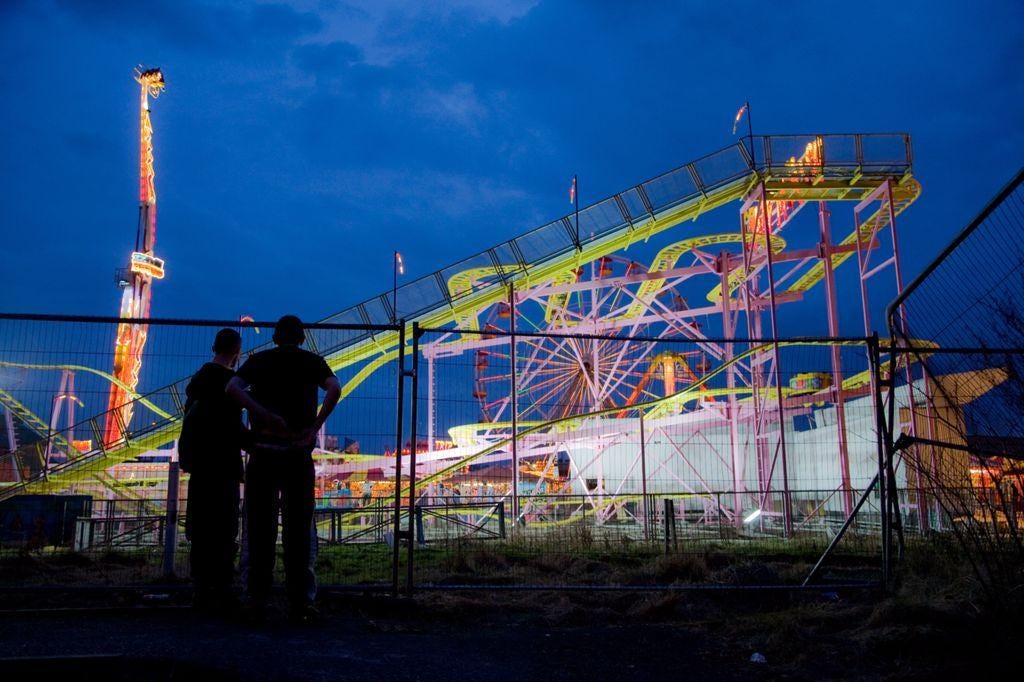
With this we start on poem’s final turn, where Burnside confronts his wanderlust more directly.
Text within this block will maintain its original spacing when published
there are times
                           coming home
when everything seems richer for my absence:
car parks around the airport
perfectly ordered
                               the crowd at the gate
with labels or startled joy
for the newly arrived
….
Stop moving
                      and another life begins:
the motion of the tide conceals
                                                       the caress of erosion
or how the beginning of autumn is quietly gloved
in August
the first bright sugars turning to gold
in locust trees and false acacias.
Perhaps home is not so bad. In contrast to part III, here the familiarity of home provides satisfactory understanding. And perhaps home plays a different role in the writing of our stories. To stop moving is necessary to prepare for death—Paz would agree. Of course, here this is precisely the threat to Burnside, and for most of us. As Beauvoir quipped, ‘for every man his death is an accident.’ Or Don Draper’s reverse corollary: ‘We don’t know how long it will last, but we know it always has a bad ending.’
This brings us around the final turn and into the very direct confession of an ending.
Text within this block will maintain its original spacing when published
I've wanted so many lives
                                            such otherness
and so much less than anything we have:
some garden of broken stones and aquilegias
a shoal of angel fish in makeshift graves
unscheduled stops
                                 in no man's land
                                                              or Tulsa
and yet
             forgive me this:
I never really mastered coming home
skilled in that childhood-for-years of travelling light
forgive me:
                   I still can't resist
the sound of a fair in the distance
                                                           the new-crushed grass
those sixties songs
                                 the heat of the machines
I still can't resist the girls on the promenade
walking the front in lipstick and brand-new hairdos
the boys from the caravan parks come out
to stand in the bars all night
                                                 like their father's ghosts
sullen and proud
                             and as lost in the world they inherit
as stray dogs
                       or mink
and forgive me
                          that I cannot leave or stay
that I'm only a moment away
                                                  from being unseen
forgive me
                  being not the man I seem
not lost or found
                              but somewhere in between.
Travel, for Burnside, is an attempt to fill a gap, a gap that he glimpses when the diesel hangs in the heavy summer air and the county’s young people flock in an attempt to manufacturer some fun. Where one lives doesn’t always feel like a true home, with a spot carved out in one’s exact shape. The wider world can take on a shimmer in one’s imagination; it can appear ripe with meaning. Wanderlust is the drive to see if this shimmer is the result of trick lighting.
This shimmer is a promise and a threat. Paz focuses on the promise in “Two Gardens,” Burnside the threat. As Paz says at the very beginning:
Text within this block will maintain its original spacing when published
A house, a garden,
                                are not places:
they spin, they come and go.
                                                  Their apparitions open
another space
                         in space,
another time in time.
To find the meaning wanderlust pushes us towards is to self-realize in the Romantics’ sense. Once we discover that meaning, we take it with us. Burnside doesn’t disagree, exactly. He does not deny that he encounters angels. The threat—or one threat—is that the lust involved in wanderlust is unquenchable. And the shimmer is contrastive: With each new shine, the place where one lives grows duller, the people content with it more deluded:
Text within this block will maintain its original spacing when published
illusion
             like the one who stays at home
This is how life’s great values work. Their possession is not guaranteed yet their siren call is irresistible. Even when you get them, you can’t predict their effects. Wanderlust is but a special case of our drive to weave ourselves into the world’s value. Its object is place and its internal logic can seem twisted. It seems to push us to make our homes where we know we can’t. Burnside will never be from Corfu and Paz never from Dehli.
This needn’t be the logic of wanderlust. It pushes you not to make a home in the foreign, but to spread the boundaries of yourself to incorporate the wonders of the world. If this goes wrong, you are alienated from everywhere. If it goes right, you create another space in space, another time in time.
Comments
Nothing yet. Say the first thing.
Sign in to join the conversation.