
Bruce Springsteen: The Jersey Shore prophet. One of America’s greatest artists, one of the greatest artists of America. He manages to be cool in a distinctively American way while at the same time eviscerating the nation’s contradictions—indeed, cool in virtue of this evisceration.
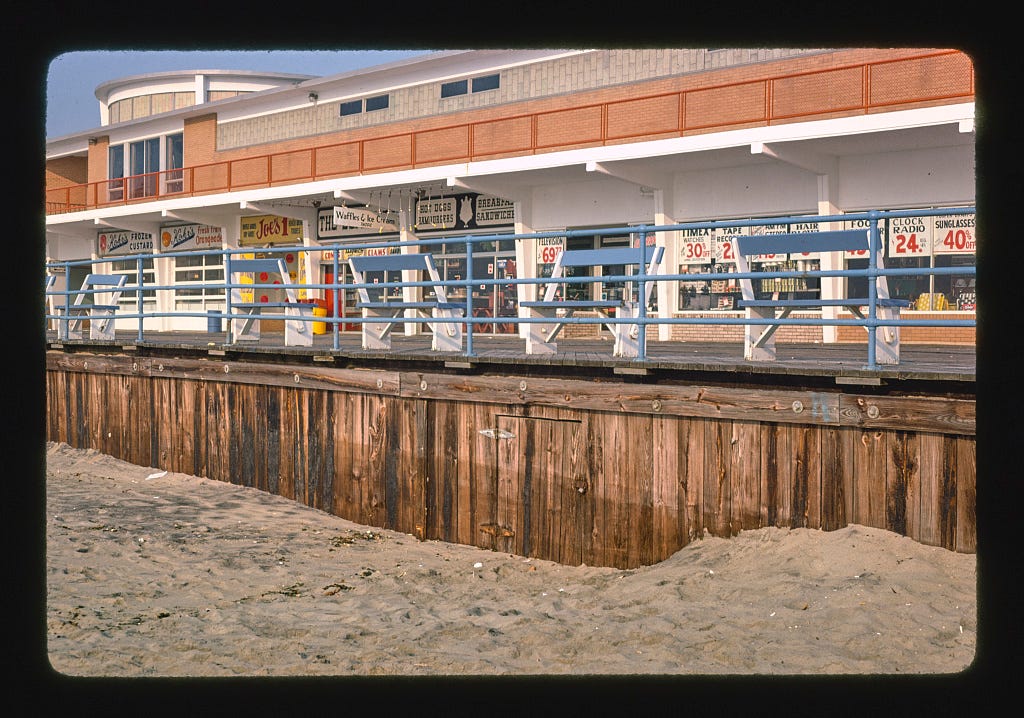
The Jersey Shore is the perfect setting for such a project; it is cool like a movie set but writhes in its shabbiness. This is true even now, after a few decades of corporate targeting and incessant attention from the sort of B-list PR firms that American states hire. It was even more the case it Springsteen’s 1970s heyday. Like its concrete-and-glass cousin to the north, it was well on its way to dereliction.
Springsteen initially made his name locally by playing with a variety of bands in the New Jersey club scene of the late ‘60s-early ‘70s. His lyricism impressed; he was eventually signed to Columbia Records by the same producer that signed Bob Dylan. His first two albums were liked by critics but didn’t sell well. That changed with 1975’s Born to Run, an album that perfectly encapsulated the post-Vietnam existential dread felt most keenly by America’s young people. It does this with a healthy dash of American hopefulness.
All of these themes are present in the album’s first track, ‘Thunder Road’. The song is introduced by an upbeat duet of piano and harmonica. The story takes place in front of a house. The narrator is in his car, and a woman has come out of the house to consider the narrator’s invitation to run away with him.
Text within this block will maintain its original spacing when published
The screen door slams, Mary's dress sways
like a vision she dances across the porch as the radio plays
Roy Orbison singing for the lonely
Hey, that's me, and I want you only
Don't turn me home again
I just can't face myself alone again
The narrator is at a breaking point and has decided to try to make a run for it. Mary is not so sure, and the narrator is keenly aware of her uncertainty. She is unsure, we find out, because she is weary.
Text within this block will maintain its original spacing when published
Don't run back inside
Darling, you know just what I'm here for
So you're scared, and you're thinking
That maybe we ain't that young anymore
Show a little faith, there's magic in the night
Assuming that the narrator is a proxy for Springsteen, Mary’s worry about age seems off. Springsteen was in his mid-20s when the song was written, an age ripe for running away. But the summer of 1975 was ominous. The US had just exited the Vietnam war a few months earlier, its bubble of military invincibility well and truly burst. Mary and the narrator would have felt this in a personal way; Springsteen avoided the war himself because he failed the physical. The result is that the future of summer ‘75 didn’t look bright.
Mary has romantic worries, as well. She is looking for something better.
Text within this block will maintain its original spacing when published
You can hide 'neath your covers and study your pain
Make crosses from your lovers, throw roses in the rain
Waste your summer praying in vain
For a savior to rise from these streets
The narrator is not promising to be her savior. Instead, he’s offering her companionship in adventure.
Text within this block will maintain its original spacing when published
Well now, I'm no hero, that's understood
All the redemption I can offer, girl, is beneath this dirty hood
With a chance to make it good somehow
Hey what else can we do now?
Except roll down the window
And let the wind blow back your hair
Well the night's busting open
These two lanes will take us anywhere
We got one last chance to make it real
To trade in these wings on some wheels
Climb in back, heaven's waiting down on the tracks
Oh-oh come take my hand
We're riding out tonight to case the promised land
Oh-oh Thunder Road oh Thunder Road oh Thunder Road
Lying out there like a killer in the sun
Hey, I know it's late, we can make it if we run
Oh, Thunder Road, sit tight, take hold
Thunder Road
They thought they had it bad in summer ‘75. Nearly 50 years later, we look close to the bottom of the valley below the post-war peaks. The American experiment in government looks like a failure. The most democratically legitimate branch of our government is paralyzed with toxic stupidity. The executive’s powers keep growing, both in reaction to the failure of the legislature and in service of narcissism. And the head of the third branch—the most democratically dubious for most of the nation’s history—has fully embraced their role as Supreme Sophists, wrapping their repugnant power grabs in the cloak of legalese bullshit. Per the historical norm, our mythology will be used to facilitate our downfall. All is wise if it is ‘Constitutional’ or even ‘American.’ Until it is not.
Still, our power persists. We have a lot of money and guns. But, despite the constant fights over nominal funding for the arts, our romantic power lies largely in our cultural influence. Most of the world can’t help look up to us because of our music, movies, and novels. Without people like Springsteen, we’d just be the big bully. With them, we’re cool despite being a big bully.
One of the magnetic aspects of our cultural products is that they so often embrace running away. This is no accident, obviously. The whole nation is founded on running away, first from Europe, and then surely across the North American continent. Our art is filled with people high-tailing it to take what they want. The freedom involved is intoxicating, especially for bystanders.
Much of Springsteen’s prophecy is about this freedom. It is perhaps most eloquently put in the fifth verse of ‘Thunder Road’.
Text within this block will maintain its original spacing when published
Well I got this guitar, and I learned how to make it talk
And my car's out back if you're ready to take that long walk
From your front porch to my front seat
The door's open but the ride it ain't free
And I know you're lonely for words that I ain't spoken
But tonight we'll be free, all the promises'll be broken
American freedom is the freedom involved in running away, unilaterally unshackling oneself from one’s promises.
Mary is still not convinced. The final verse presents the narrator’s final argument, one that appeals to how embracing the freedom to run is itself desirable.
Text within this block will maintain its original spacing when published
There were ghosts in the eyes of all the boys you sent away
They haunt this dusty beach road
In the skeleton frames of burned out Chevrolets
They scream your name at night in the street
Your graduation gown lies in rags at their feet
And in the lonely cool before dawn
You hear their engines roaring on
But when you get to the porch they're gone on the wind
So Mary, climb in
It's a town full of losers and I'm pulling out of here to win
Mary’s time at home has run its course. The locals have proven unworthy. The narrator is not promising to be better than them except in one way: He’s willing to partner with Mary to explore the alien. He aims to make himself a winner somewhere else.
Stagnation is what America fears the most. This fear has pushed us to amass all that money and all of those guns. It is also what pushes our art forward. The world is repulsed by the former but entranced by the latter. There is something deeply compelling about Springsteen’s vision in Born to Run, even if its wellspring is the very same set of compulsions and neuroses that push us to hate each other and everyone else, to boot.
The problem is that we don’t always have someplace better to run. Sometimes winning shouldn’t be your goal, stagnation not so bad. An artist of Springsteen’s caliber of course knows this; he knows that America’s mythology has the usual limitations of mythology—take it too literally at your own peril. This comes out explicitly in Born to Run’s anthemic title track, where Mary is replaced by Wendy.
Text within this block will maintain its original spacing when published
The highways jammed with broken heroes
On a last chance power drive
Everybody's out on the run tonight
But there's no place left to hide
Together, Wendy, we can live with the sadness
I'll love you with all the madness in my soul
Oh, someday girl, I don't know when
We're gonna get to that place
Where we really want to go, and we'll walk in the sun
America: There is no place left to hide and the time has come to live with the sadness. Stagnate with love. Someday, perhaps, we’ll get to where we really want to go.
Comments
Nothing yet. Say the first thing.
Sign in to join the conversation.