
Beauty has had a rough time lately. It’s easy to read the last two centuries as mere conduits of alienation. The zenith of this was the slaughter of millions of Jews and hundreds of thousands of Japanese civilians—prompting Adorno to declare that ‘poetry after Auschwitz is barbarism’. We should not sell other parts of these times short. At the dawn of the 20th century, capitalism perhaps was earning its keep, lifting millions into a substantially better quality of life, fueling the sort of development that ends up in hospitals and schools. Since then, it has catapulted into an ever elaborate and twisted quest for growth, turning our entire lives into opportunities for the mining of data, attention, accounts to bundle and sell.
We can see beauty’s downfall escalating very early in the 20th century, in an unexpected place. As the century got going, it became increasingly clear that, at the smallest level, the universe was not in order. Our faith in organization was debunked; the random ruled the day. As the first wave of slaughter was coming to a close, laying the groundwork for the zenith, this was confirmed. That this discovery became so intimately intwined with the fire that engulfed those Japanese civilians is the sort of irony that would soften even the most ardent Platonist.
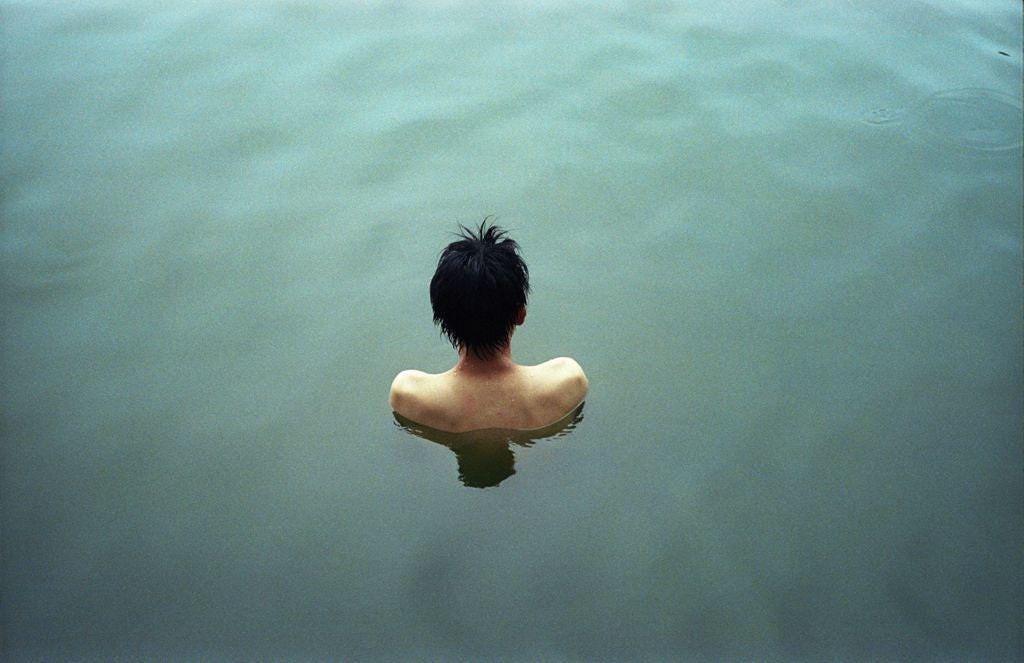
Anne Carson’s “1 = 1” is about swimming.1 It is also about a swimmer; who this is, we do not know. It begins enigmatically: “She visits others.” We don’t know who these others are, either. The visit is an excuse for our narrator to swim. The second sentence is also enigmatic; this time, in form.
Before they’re up, dawn, she walks to the lake, listening to Bach, the first clavichord exercise, which she plans to have played at her funeral someday, has had this plan since she first heard the music and, thinking of it, she weeps lightly.
These two sentences together startle. This is not an ordinary story. The swimming comes next.
She peels a swim cap onto her head, goggles, enters the water, which is cold but not shocking. Swims. High waves in one direction…There is a pressure to swim well and to use this water correctly. People think swimming is carefree and effortless. A bath! In fact, it is full of anxieties. Every water has its own rules and offering. Misuse is hard to explain.
Swimming is of great importance to our narrator, something that imitates something important about life. She immediately elaborates.
Perhaps involved is that commonplace struggle to know beauty, to know beauty exactly, to put oneself right in its path, to be in the perfect place to hear the nightingale sing, see the groom kiss the bride, clock the comet. Every water has a right place to be, but that place is in motion. You have to keep finding it, keep having it find you. Your movement sinks into and out of it with each stroke. You can fail it with each stroke. What does that mean, fail it.
Swimming is dynamic. It demands movement as a constitutive matter. Its connection with life, “perhaps,” is that it involves the attempt to know beauty, itself dynamic, itself involving a striving towards something that is always at least a bit unstable. The first section ends in a final enigma: A question without a question mark.
Carson is used to putting the reader on defense. She is a classicist by training but best known as a poet. Most of her writing defies categorization. Her books are compendiums of genre bending pieces; some scholarly, some essays, some poems, all at least sometimes looking like something else.
The swim enters a new stage.
After a while, she climbs out over stones, puts on small flippers, reënters the water. The difference is like the difference between glimpsing a beautiful thing and staring at it. Now she can stream into the way of the water and stay there. She stays.
Flippers make it easier to swim. Of course. They also do something more puzzling. They let her “stay.” They let her enter a new relationship to the thing she is seeking—the difference between glimpsing and staring. And then, immediately, another swerve.
She is one of the most selfish people she has ever known, she thinks about this while swimming and after, on the beach, in her towel, shivering. It is an aspect of personality, hard to change. Generous gestures, when she attempts them, seem to swipe through the lives of others like a random bear paw, often making matters worse. And she finds no momentum in sharing, in benevolence, in charity, no interaction with another person ever brought her a bolt of pure aliveness like entering the water on a still morning with the world empty in every direction to the sky.
She seems blind to a part of the word, insensitive in action to the needs of others. She is also aware of this in a surprisingly detached way. This bundle—her selfishness and the awareness of it—is again in contrast to swimming.
That first entry. Crossing the border of consciousness into, into what? And then the (she searches for the right word) instruction of balancing along in the water, the ten thousand adjustments of vivid action, the staining together of mind and time so that she is no longer miles and miles apart from her life, watching it differently unfold, but in it, as it, it. Not at all like meditation—an analogy often thoughtlessly adduced—but, rather, almost forensic, as an application of attention, while at the same time, to some degree, autonomic. These modes do not exclude each other, so swimming instructs. There is a stoniness. Water is as different from air as from stones, and you must find your way through its structures, its ancientness, the history of an entity without response to you and yet complicit in your obstinate intrusion. You have no personhood there, and water is uninterested in itself, stones don’t care if you tell their story nicely. Your bowels, your miraculously lucky life, your love of your mother, your well-crafted similes, all are lost in the slide from depth to depth, pure, impure, compassionless. There is no renunciation in this (cf. meditation), no striving to detach, all these things, all the things you can name, being simply gone. Meaning, gone.
“Her visits ends.” She is home the very morning she swam, looking at the newspaper. It is late 2015 at the height of the Syrian refugee crisis in Europe.
front-page photos of a train car…jammed floor to door with escaped victims of a war zone farther south, people denied transit. Filthy families and souls in despair pressed flat against one another in the grip to survive, uncountable arms and legs, torn-open eyes, locked in the train all night waiting for dawn,
The comma at the end is not a typo. The sentence’s end is crucial enough to highlight. She says that what the newspaper depicts is
a scene so much the antithesis of her own morning she cannot enter it.
Anyone who has made it this far knows this feeling. It is anxiety provoked by the inexplicable contradiction between beauty—especially beauty close by— and suffering and evil.
What sense it makes for these two mornings to exist side by side in the world where we live, should this be framed as a question, would not be answerable by philosophy or poetry or finance or by the shallows or the deeps of her own mind, she fears.
Einstein provoked crisis by demonstrating that the physical world is random. Worries about the ethical randomness of the world go back much further. The enlightenment ushered in serious handwringing about what Mara van der Lugt calls dark matters. Schopenhauer, no doubt with some irony, pushed the point most poetically.
…after [all the philosophical systems] have completed their demonstrations and sung their song of the best world, then at last comes, in the back of the system, a late avenger of the illusory, like a ghost out of the grave, like the stone guest to Don Juan, the question of the origin of evil, of monstrous, nameless evil, of the terrible, heart-breaking misery of the world:—and they fall silent, or have nothing but words, empty, resounding words, in order to close such a heavy account.
One aim of philosophy—and the sciences it spawned—is to account for the world, make it explicable, understood. Schopenhauer thought this a fool’s errand precisely because evil cannot be made explicable. It is, to use Mark Johnston’s phrase, “that which categorically should have never been.” Evil is a cosmic mistake. If so, it is hard to see how to account for it. What could make sense of that which should have never been? We are only left with “empty, resounding words.”
This problem of evil is the forerunner for beauty’s decline. For a very long time, beauty was thought to be not only a core value, but also a core part of the explicability of the world. The world itself is a beauty, and in virtue of that it is explicable. As Robert Haas brilliantly explains Plato’s version of the idea in a recent poem about the problem of evil.
Plato’s idea, I think, was that beauty
Was an ordering of elements the world offered
The world is beautiful, for Plato, because it is harmonious; its harmonious order makes it explicable—cue Einstein.
Not only that, but discovering this harmony is the path to virtue. Haas continues.
And that the harmonies in that order
Taught the soul the good.
Cue Schopenhauer. Or Carson’s labyrinthine channelling of Schopenhauer: The disharmony between our narrator’s swim and Syrian anguish, “should it be framed as a question,” is not answerable by “philosophy, poetry, or finance.” She finishes the subsection with a version of Schopenhauer’s point about empty words.
Words like “rationale” become, well, laughable. Rationales have to do with composite things—migrants, swimmers, the selfish, the damned, the plural—but existence and sense belong to singularity. You can make sentences about a composite thing, you can’t ask it to look back at you. Sentences are strategic. They let you off.
To this point “1 = 1” is philosophical poetry—hence the constant need to quote. True to her war against genre, it has few elements of story; “She visits others” and “Her visit ends” notwithstanding. We finally get more narrative trappings in the final section, where we are introduced to the only named character, Chandler. The descriptions of Chandler and his relation to the narrator are downright bizarre.
He lives in the back of the house somewhere, speaks not much, draws a lot.
…
You hardly ever see Chandler enter a room, he’s just there, or leave a room, he seeps away, small tide of person, noticed as a retraction.
…
Once they had a conversation, extending over many months, in broken bits, about mushrooms. He’d said the thing he hated about being in prison was the mushrooms. For several days, she wondered if he meant the food, but it didn’t make sense they served mushrooms in prison often enough to be a problem, or if he had a damp cell with fungus sprouting in the corners, but this, too, seemed extreme, and gradually she understood him to mean he had been able to see a patch of mushrooms, boletus, from his window and he used to go hunting for those in the woods with his mother when he was a kid and it made him sad. Not a mushroom fancier herself, she didn’t have anything subjective to say at the time, so she told him John Cage was a mushroom hunter, too, and wrote a book about it, a sort of mushroom guide, that she could lend him. Chandler didn’t answer. She wasn’t sure he read books or knew who John Cage was.
Chandler is an artist, who is, on this day, creating chalk drawings near the house. First there is a pear tree that the narrator wants to “lean down and bite.” But then, as evening descends, he starts drawing a fox; “He likes a fox at the end of the day.”
She leaves Chandler to go back into the house, where the ruminating begins again. The wording is so precise, the form so startling, that it demands full quotation.
Upstairs, she finds herself thinking again about the failure to swim. It can be quantitative as well as qualitative. Imagine how many pools, ponds, lakes, bays, streams, stretches of swimmable shore there are in the world right now, probably half of them empty of swimmers, by reason of night or negligence. Empty, still, perfect. What a waste, what an extravagance—why not make oneself accountable to that? Why not swim in all of them? One by one or all at once, geographically or conceptually, putting aside gleaming Burt Lancaster, someone should be using all that water. Across the level ocean of her mind come floating certain refugees in a makeshift plastic boat so crowded with passengers they are stacked in layers and dropping over the sides. She has seen this picture. She has read that larger ships might sail very near, that they might stop to consider the woe and the odds, then keep going. Sometimes bottles of water or biscuits were tossed from the larger ships before they started their engines again.
The swimmer lives a demanding life. Each bit of water makes its call. For the swimmer, the call can feel like an obligation. Reverence for the water means that one must swim.
Evil intrudes. That which should never have been has the most piercing details. Her mind boggles again.
What could she put against the desolation of that moment, watching the ship start its engines again. What is the price of desolation, and who pays. Some questions don’t warrant a question mark.
Iris Murdoch wrote passionately about the importance of attention to mature love. For Murdoch, love demands that we pay attention to the reality of one’s beloved, to see them for what they are. The object of this attention is “an individual reality”. Paying attention to individuals is the “proper mark of the active moral agent.” Retreating to abstractions, generalities, dealing with people as merely members of parties or statistically interesting collections is, to echo Carson, strategic, an attempt to be let off.
Often, to attend to the reality of an individual requires us to wage a battle against ourselves; this is a battle against our tendency to cloud the other in our interests, perspective, resentments. In order to lovingly attend to another person requires an “unselfing.”
Murdoch follows Plato in thinking that experiencing beauty plays a role in becoming virtuous—attributing to Plato the view that “beauty is the only spiritual thing that we love by instinct.” Experiencing beauty, especially natural beauty, is a way to unself. In a famous passage in “The Sovereignty of the Good,” she writes:
Beauty is the convenient and traditional name of something which art and nature share, and which gives a fairly clear sense to the idea of quality of experience and change of consciousness. I am looking out of my window in an anxious and resentful state of mind, oblivious of my surroundings, brooding perhaps on some damage done to my prestige. Then suddenly I observe a hovering kestrel. In a moment everything is altered. The brooding self with its hurt vanity has disappeared. There is nothing now but kestrel. And when I return to thinking of the other matter it seems less important. And of course this is something which we may also do deliberately: give attention to nature in order to clear our minds of selfish care.
Our narrator’s day comes to end with Chandler ringing the doorbell—the doorbell to his house—and gesturing for her to come to the street.
The finished fox drawing is under a streetlamp. It glows. He has used some sort of phosphorescent chalk, and the fox, swimming in a lucent blue-green jelly, has a look on its face of escaping all possible explanations. She stares at the blue-green. It has clearness, wetness, coolness, the deep-lit self immersedness of water. You made a lake, she says, turning to him, but he is gone, now it is night, off to wherever he goes when he is absolved.
The lake in the evening plays a similar role as the lake in the morning. It draws her away from herself. But she can’t help reflect once again on the anxieties of her day.
She stands awhile, watching the fox swim, looking back on the day, its images too strong, and yet the soul—how does it ever get peace in its mouth, close its mouth on peace while alive. To be alive is just this pouring in and out. Find, lose, demand, obsess, move head slightly closer.
To live is to search, to attend. What one looks at, how one looks at it, makes all the difference.
Try to swim without thinking how strong it looks. Try to do what you do without mockery of our heartbroken little era. To mock is easy.
To swim without thinking how strong it looks is to unself, to focus on individual realities in that “commonplace struggle to know beauty, to know beauty exactly.” A similar attitude is needed in order to do what one does without mockery, without inserting one’s own self-importance into contemptuous interpretation. Nature brings her back to depicted nature.
She feels a breeze on her forehead, night wind. The fox is stroking splashlessly forward. The fox does not fail.
The fox does not fail at what? The two activities of thought that seem central to Carson’s message—knowing beauty and unselfing—seem out of the fox’s reach. Of course the fox does not do what he does in mockery of our heartbroken little era; nor does he think of how strong he looks while swimming. But he is also not in the contrasting states. He does know the beauty of swimming exactly, nor does he do what he does with loving attention. He just does.
The end of the story looks right, maybe even feels right. It seems like you are stopping in a location you were destined to get to; an impression that well crafted stories inculcate. But once you stop there, you start to sink. Carson doesn’t want this to turn out like a well-crafted story, just as she doesn’t want the sentences to look right. Perhaps, like the fox’s face, she wants the story to “[have] a look [that escapes] all possible explanations.”
Or maybe the narrator’s fox is like Murdoch’s kestrel. What it succeeds at is pushing the narrator outside of herself. Just as it does for Chandler in creation, attention on the fox absolves our narrator from her self-absorption. It sets her free from it. Unlike her composite thinking and her sentences (her “well-crafted similes”), attention on the fox shows her “existence and sense” and helps her see it elsewhere, especially in people. This experience is the experience of knowing beauty exactly.
Does this somehow make up for or redeem evil? Does it somehow pay the price of desolation? Surely not. But perhaps those are the wrong questions. We can’t pay the price of desolation, or at least most desolations. We can try to be let off by retreating into composite rationales—a path to mockery—or we can try to see the sense that resides in singularity. Does that mean beauty can save the—our—world.
Some questions don’t warrant a question mark.
Comments
Nothing yet. Say the first thing.
Sign in to join the conversation.