
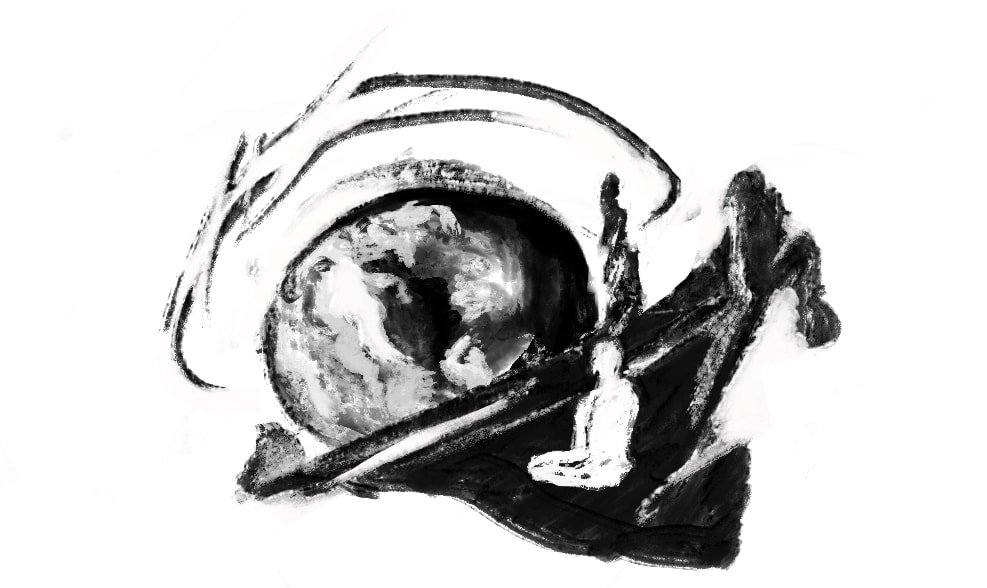
This week’s Crisis and Transition post, “Usufructuary Rights,” explores one of the most enduring questions shaping human society: what does it actually mean to own the world around us? Through examples drawn from Finland, Indigenous traditions, and the social philosophy of Prabhat Ranjan Sarkar, the post invites readers to reconsider assumptions about ownership that have become deeply embedded within modern economic and legal systems.
The reflection begins with Finland’s Everyman’s Right, a tradition that allows people to respectfully enjoy forests, lakes, and other natural places regardless of who owns the land. The post then broadens the conversation through Indigenous traditions of stewardship in North America, where usufructuary rights recognized people’s ability to use and benefit from land and resources without claiming absolute ownership. Together, these examples remind us that private ownership is only one way societies have understood humanity’s relationship with the Earth.
At the heart of this reflection is Sarkar’s concept of cosmic inheritance. As the post explains, “everything is the patrimony of us all.” It is a remarkably different starting point. Rather than viewing the Earth as a collection of assets to be owned, bought, sold, and accumulated without limit, cosmic inheritance begins with the understanding that the wealth of the universe ultimately belongs to everyone. Individuals have the right to utilize these resources to meet their genuine needs, but that right is inseparable from a corresponding responsibility to ensure that their use contributes to the wellbeing of the larger community and of future generations.
Reading this, I found myself reflecting on how deeply our ideas about ownership shape the systems we create. Property laws, economic institutions, and patterns of governance often appear fixed, almost inevitable. Yet they emerge from deeper beliefs about human nature, responsibility, and our relationship with one another and the living world. It reminded me that systems do not emerge in isolation; they grow from the values and assumptions that shape how we understand the world.
What stayed with me most was not simply the concept of usufructuary rights, but the shift in perspective it represents. The question is no longer simply, Who owns this? It becomes, How should this be cared for? The conversation shifts from possession to stewardship, from accumulation to responsibility, and from individual rights toward a deeper recognition of our obligations to one another, to future generations, and to the Earth itself.
One aspect of the reflection I especially appreciated is that it does not stop with philosophy. The post explores how ideas such as usufructuary rights, the commons, and the principle of maximum utilization might become practical expressions of a different worldview. Stewardship is not presented as an abstract ideal but as something that can be expressed through the institutions, economies, and communities we build.
This reflection also reminded me that the systems we build are never simply technical or economic. They reflect deeper assumptions about who we are, how we relate to one another, and how we understand our place within the living world. If those assumptions begin to change, the possibilities for organizing society begin to change as well.
For me, the deepest contribution of this reflection is that it gently shifts the conversation from ownership toward relationship. If we begin by asking not simply what belongs to us, but how we relate to the Earth and its resources, stewardship becomes a natural expression of that relationship. Viewed in this way, usufructuary rights are not simply a different approach to property. They reflect a different understanding of our place within the living world.
That may be the enduring invitation of this reflection. The ways we organize our economies, our institutions, and our communities all grow from the assumptions we hold about the world and our place within it. What does it mean to own the world around us? Or is there another, more important question we should be asking altogether?
Read the full post here.
Toward a more just and loving world.

No posts
Comments
Nothing yet. Say the first thing.
Sign in to join the conversation.