
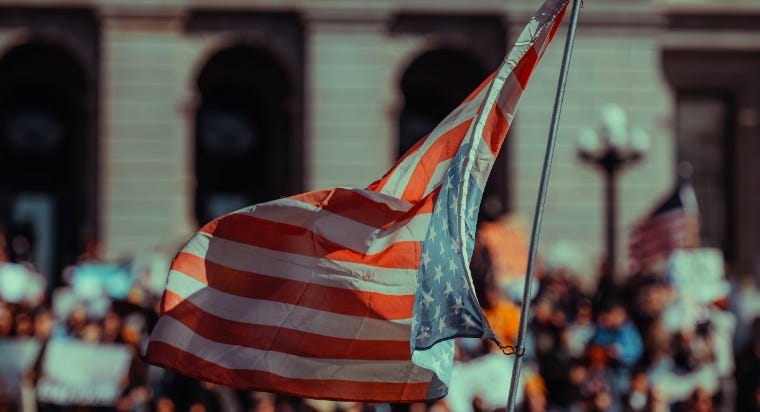
In class, when you learn about the threats of fascism and how dictators rise to power, it always starts the same way: targeting a group—any group. Jews, immigrants, queer people, dissidents, communists—the names change, but the formula for extermination remains the same. Once public rhetoric and fear-mongering persist long enough, hardening enough of the population, the government can do whatever it wants to “the group.”
This is the slippery slope of allowing polling and public sentiment to dictate our narratives and strategy. What is popular—like the anti-immigrant sentiment that has dominated polls for over a decade—is also what lays the foundation for kidnappings carried out by the U.S. government.
I’m guilty of this myself, working in politics. In short-term campaigns, you read the polls. You analyze what works, what doesn’t, and you choose your angles. Winning often takes precedence over the worldview you’re shaping in your community and beyond. If immigration is unpopular, the thinking goes, it’s acceptable to lean into (or not defend against) light anti-immigrant rhetoric—as long as you don’t govern that way.
But what are the real costs?
Human beings are being abducted by the U.S. government without due process. They are being targeted for their beliefs, sent to violent prisons, and abducted to countries they barely remember or have never even visited. Laws and norms don’t matter when a population is so hardened by its views of “the other” that it no longer believes in enforcing them.
This is why our goal must always be to change polling, not be driven by it. The dangers of anti-immigrant sentiment are well-documented. It is a known precursor for authoritarianism and has been rising in this country year-over-year. Yet instead of investing in massive education campaigns and reinforcing the fact that immigration is, objectively, what makes America great, we capitulated to rhetoric that has now become violent actions against our neighbors.
Ultimately, our failed moral calculation will cost innocent people their lives and freedoms.

National Security Advisor Mike Waltz (among others) is in the hot seat this week for using the commercial messaging app Signal to plan, in detail, the bombing of Houthi fighters in Yemen. He was found out because Atlantic Editor-in-Chief Jeffrey Goldberg was somehow accidentally added to the top-secret chat. // @melodystandfordmartin
Trump signed an Executive Order this week to dismantle the Department of Education blaming failed curriculums and student performance and indicating we should give power back to the states. This, of course, is ludicrous since standards and curriculum are controlled by the state while the Department of Education mostly oversees funding for poor and disabled students to ensure they have all the resources they need. This cost will now be passed to the states. // guacandpico
This week, Rachel Cohen a lawyer at Skadden Law Firm, quit her job this week after her law firm offered President Trump $100 million in legal services after succumbing to pressure from the administration to drop cases against the administration and cases where they were defending of vulnerable populations. // @cohen489
A Tufts PhD student, Rumeysa Ozturk, was approached by ICE agents and taken into a van to be deported. She was not shown identification until she was already detained. // @grifftomaino

The Trump administration is beginning to realize that it’s harder to play the cool outsider when you’re in charge. This week the White House tried to outflank independent media network Meidas Touch by using the power of the executive office to promote their own chosen networks using a podcaster’s row. This is just one of many continued flagrant violations by this administration to promote for-profit entities using public office (Tesla promotions) (Trump’s business entanglements).
India has committed a billion dollars to “jumpstart the creator economy”. These government investments in such an unregulated space (one that is already rife with misinformation) are certainly worrying. If nation-states can peddle any talking points they want to an unwitting public without regulated disclosures or fact-checking, commitment to fact-checking and combatting disinformation in creator spaces becomes not just important, but imperative.
Algorithms that encourage division and extremism don’t have to be the norm! Or at least that’s the theory posed in this paper authored by the Knight-Georgetown Institute, Better Feeds: Algorithms that Put People First.

Ashton Hall’s viral video this week has led to dozens of mocking videos and reinterpretations. His video is cringe - but the more disturbing element of the video is the way his (presumed) partner is used. She preps his food, meals, and cleans up after him to support this strange lifestyle - relegating women further into the background in service of men.

We met this week with a wonderful communications director in Paris looking to start a Creator Congress styled organization of his own! It’s thrilling to see our work being recognized and finding opportunities to inspire each other around the world.
If you are a Creator and have not yet filled out the application, please do. Link here.
Thank you for subscribing and we’ll be back in two weeks!
In solidarity,
Rynn
No posts
Comments
Nothing yet. Say the first thing.
Sign in to join the conversation.