
This week, the creative economy kept returning to one consequential question: who gets to participate in the value that culture creates?
From actors negotiating backend compensation and brands reconsidering how they value influence to auction houses competing for cultural archives, the stories shaping culture were also stories about ownership, leverage, and control. We are also introducing Artist in Focus, a new weekly feature celebrating the independent artists whose work reminds us that supporting culture begins with supporting the people who make it.

Christie’s and Sotheby’s are battling for a $60 million collection. The two auction houses are reportedly competing to secure the remaining collection of the late Herbert Lust, including roughly 300 works and a major Giacometti sculpture, for the November sales. Lust had already donated hundreds of works to museums before his death.
The CMC Perspective: The fight isn’t simply about one collection. In a selective market, access to exceptional estates and fresh-to-market inventory becomes a competitive asset itself—and relationships with collectors can determine who controls the next major sale.Christie’s is putting American fashion history on the auction block. The auction house announced Bill Blass: American Elegance, featuring more than 100 sketches, letters, garments, and archival materials from the influential American designer. The September sale will coincide with New York Fashion Week and include physical exhibitions in New York.
The CMC Perspective: Fashion archives are increasingly being treated as cultural assets rather than ephemera. When sketches, correspondence, garments, and provenance enter the auction ecosystem, a designer’s legacy becomes something that can be preserved, exhibited—and monetized.The Rose Art Museum opened Jenna Gribbon’s first major museum survey. Entwined, which opened August 19, brings together more than 40 paintings spanning 25 years of Gribbon’s practice, including new work produced specifically for the exhibition.
The CMC Perspective: Museum surveys do more than recognize an artist’s career. They create scholarship, provenance, institutional validation, and historical context—the infrastructure through which an artistic practice can move from contemporary relevance toward long-term canon formation.

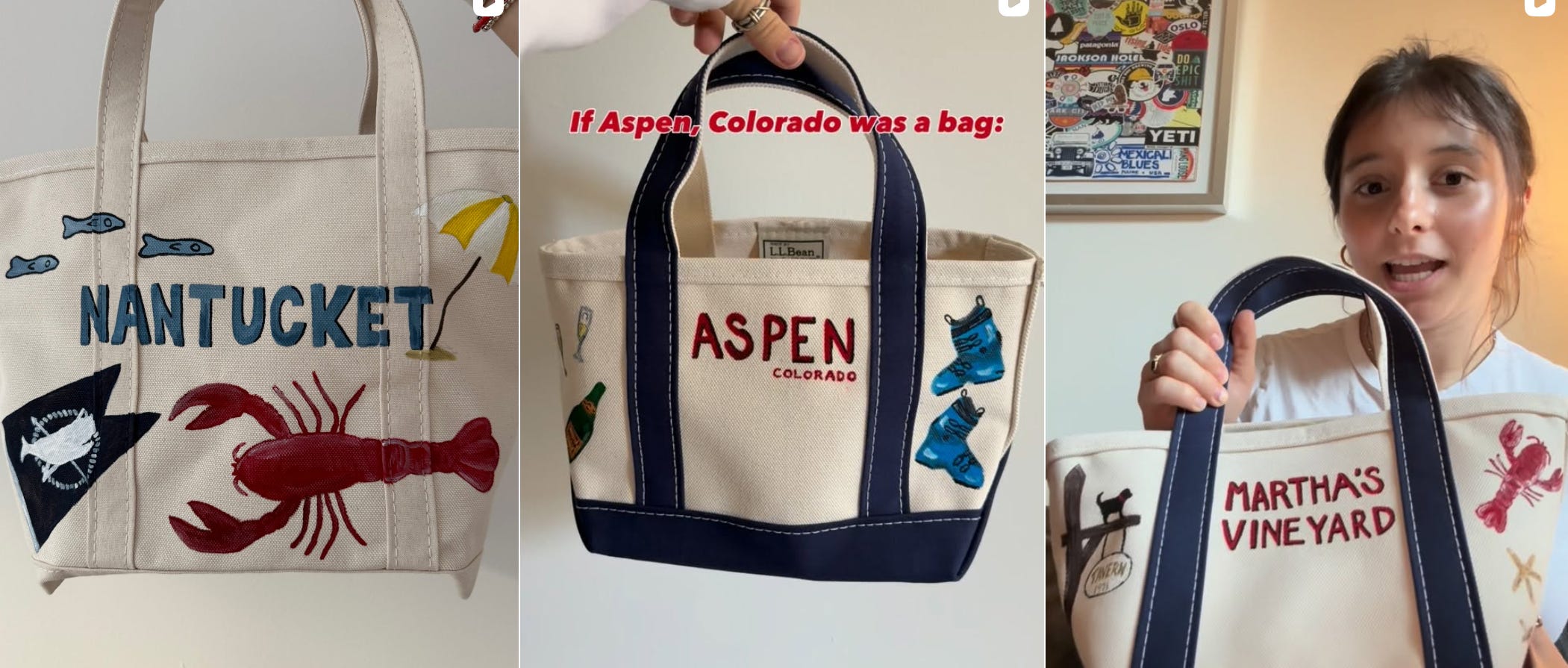
I recently discovered J Grey Studio on Instagram and immediately fell in love with Jocelyn’s custom, hand-painted bags. Naturally, I ordered one.
My bag has already arrived at the Creativity Meets Capital office in New York while I am still on the Cape, which means it has officially made it back to the city before I have. Although I have not opened it yet, I could not wait to share Jocelyn’s work because these may be the perfect summer bags: practical, personal, and made by an independent artist whose creativity deserves to circulate far beyond an Instagram feed.
Jocelyn transforms an everyday object into something expressive and collectible. The bag becomes a canvas, personal memories become visual motifs, and functional design becomes art you can carry.
The CMC Perspective: Patronage does not always begin inside a gallery. Sometimes it looks like commissioning an object directly from an artist and helping fund the materials, time, and creative infrastructure that allow their practice to continue.
Follow J Grey Studio on Instagram or visit jgreystudio.com to discover Jocelyn’s work and inquire about a custom bag.

Tom Holland’s Spider-Man payday could exceed $100 million. Following the extraordinary performance of Spider-Man: Brand New Day, Holland is reportedly positioned to receive more than $80 million in backend compensation on top of a $20 million salary. The film crossed $2 billion globally in less than three weeks.
The CMC Perspective: This is ownership economics hiding inside a celebrity-payday headline. Holland’s upside isn’t coming primarily from a larger salary; it’s coming from participation in the success of the asset. Creative talent negotiating backend is fundamentally different from creative talent selling labor for a fixed fee.Bloomberg is launching a show specifically about the collapsing boundary between Hollywood and the creator economy. Announced August 19, Post Credits is being produced with Ensemble, a HOORAE Media company, and will feature creators and executives—including Issa Rae—discussing how algorithms, creators, studios, and new gatekeepers are reshaping entertainment.
The CMC Perspective: When a financial-media institution begins treating the creator economy as a serious entertainment-business beat, that’s a signal. Creator-led media is moving out of the margins and becoming part of the infrastructure through which mainstream entertainment is financed, distributed, and understood.

Creator partnerships are getting more intimate—and harder to measure with old marketing metrics. Vogue reported this week that brands including Mango, J.Crew, Gucci, and Rhode are rethinking the traditional influencer trip, favoring smaller groups, organic storytelling, community sentiment, earned media, and longer-term brand affinity over immediate conversion alone.
The CMC Perspective: Influence is increasingly being valued as a relationship asset rather than a single-post metric. For creators, that makes audience trust—and the ability to move culture over time—more commercially important than simply producing impressions.AI companies are offering creators serious money—and creators are discovering that not all money is equal. Business Insider reported this week that some AI sponsorships can reach seven figures or include longer-term contracts, while creators and their managers are increasingly weighing those checks against audience backlash and reputational risk.
The CMC Perspective: Audience trust belongs on a creator’s balance sheet, even if accounting standards don’t put it there. A lucrative partnership that damages credibility can destroy more long-term enterprise value than the campaign creates.

ABC took the FCC to court over editorial independence. ABC filed a First Amendment lawsuit challenging the FCC’s early review of eight broadcast licenses, arguing that the process was being used to punish the network for its editorial decisions and programming. FCC Commissioner Anna Gomez publicly supported the challenge on August 18, characterizing the dispute as one involving government pressure on broadcasters.
The CMC Perspective: Media infrastructure is also power infrastructure. The case raises a much larger question than what appears on ABC: how much independence can a cultural or media institution exercise when its ability to distribute depends on government-controlled licenses?

The line between cultural influence and financial participation keeps disappearing. Holland’s reported backend compensation ties talent directly to asset performance. Brands are valuing creators for long-term cultural affinity rather than individual posts. Bloomberg is devoting programming to the intersection of creators and Hollywood. And AI companies are discovering that access to trusted audiences commands a premium.
The CMC Perspective: The next stage of the creative economy isn’t simply about creators getting paid more. It’s about creators understanding what they’re contributing, what they own, what they’re risking, and where they should participate in the upside.

If there was one word underneath this week’s stories, it was participation.
Who participates in the upside when creative work succeeds?
Who controls the archive after a creative career ends?
Who owns the relationship with an audience?
Who determines which artists enter institutional history?
And who controls the infrastructure through which culture reaches the public?
For decades, creative industries were largely structured around exchanging labor and talent for access: the artist needed the gallery, the actor needed the studio, the creator needed the brand, and the broadcaster needed the license.
Those relationships aren’t disappearing. But the economics around them are becoming more visible.
And that may be the more important shift.
Because the conversation in the creative economy is slowly moving from “How much will I be paid?” toward a much more consequential question:
“What am I participating in?”
I don’t believe in starving artists.
I believe in under-structured ones.
The difference between creative struggle and creative success is rarely talent—it’s systems, pricing, and clarity.
The Capital Studio is where we build that together.
The next cohort begins September 9, 2026.
If you’re ready to move like an owner, not just a creative, you should be in this room.
Comments
Nothing yet. Say the first thing.
Sign in to join the conversation.