
There is a tendency to judge artwork by its final form.
We stand before a painting, a drawing, or a textile and instinctively ask: What does it mean?
Far less often do we ask another question:
What did it take to become this?
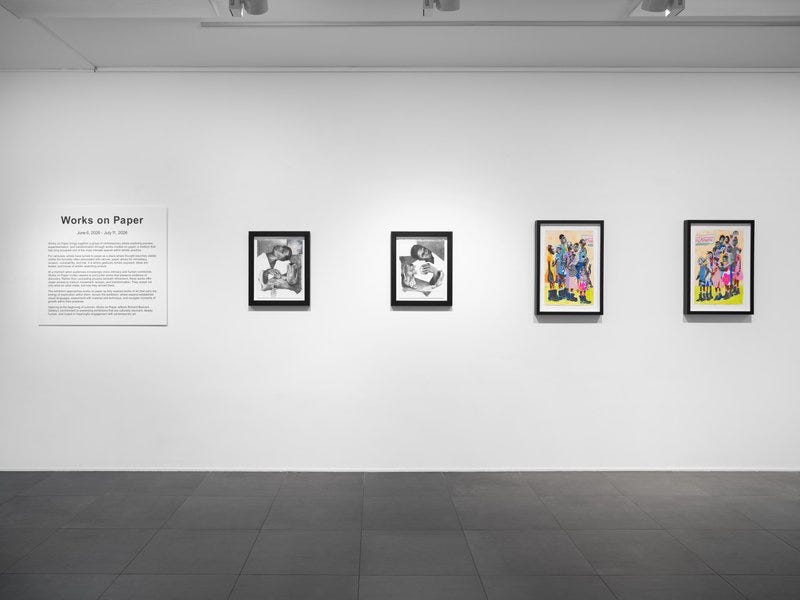
Last week, I had the privilege of moderating a panel discussion at Richard Beavers Gallery alongside artists Justin Robinson, Telvin Wallace, and Quasim Johnston as part of the gallery’s Works on Paper exhibition.
The exhibition itself examines the remarkable versatility of paper—not merely as a material, but as a site of experimentation, revision, and discovery. Long before a painting hangs on a gallery wall or a sculpture enters a museum collection, paper is often where ideas first take shape. It is where artists sketch, question, edit, and reconsider. It preserves process just as much as product.
There’s something fitting about these conversations taking place within Works on Paper. By the end of the evening, I realized the exhibition was about everything that happens before a work becomes finished.
Going into the panel, I expected conversations about technique.
Oil versus acrylic.
Composition.
Color.
Material.
Instead, what emerged was something surprisingly universal.
Despite working in entirely different mediums, all three artists described the act of creating in remarkably similar ways.
None of them begin with an audience.
None of them begin with collectors.
None of them begin with the market.
They begin with themselves.
In an era where creative work is increasingly measured by algorithms, engagement metrics, and commercial viability, it felt almost radical to hear three accomplished artists admit they aren’t thinking about viewers while making the work.
The studio, as each described is a place of solitude.
A place to process. A place to listen. A place to remember.
The audience arrives later.
As I listened to the conversation unfold, I realized hearing three different versions of the same invisible practice—the emotional, intellectual, and spiritual labor that precedes every finished work. That invisible labor, more than any single artwork on the wall, became the real subject of the evening.
One thread surfaced almost immediately.
Music.
Every artist spoke about music as an essential part of their practice—not something passively playing in the background, but something that creates the emotional atmosphere necessary to begin working.
Equally striking was what they don’t do.
None of them intentionally create while angry. None of them chase emotional chaos in the hope that it will somehow produce better work.
Instead, they pause. They process. Only then do they return to the studio.
We often inherit the image of the artist as someone who creates in the middle of emotional turmoil—as though great work is born directly from suffering. Listening to these artists complicated that narrative.
What I heard instead was a commitment to clarity. Their work was arriving after emotion had been understood, processed.
If you’re interested in collaborating with Nina or Creativity Meets Capital—whether through editorial work, speaking engagements, or strategic partnerships—you’re welcome to share more details below.
Each inquiry is considered thoughtfully and in alignment with the long-term vision of the platform.
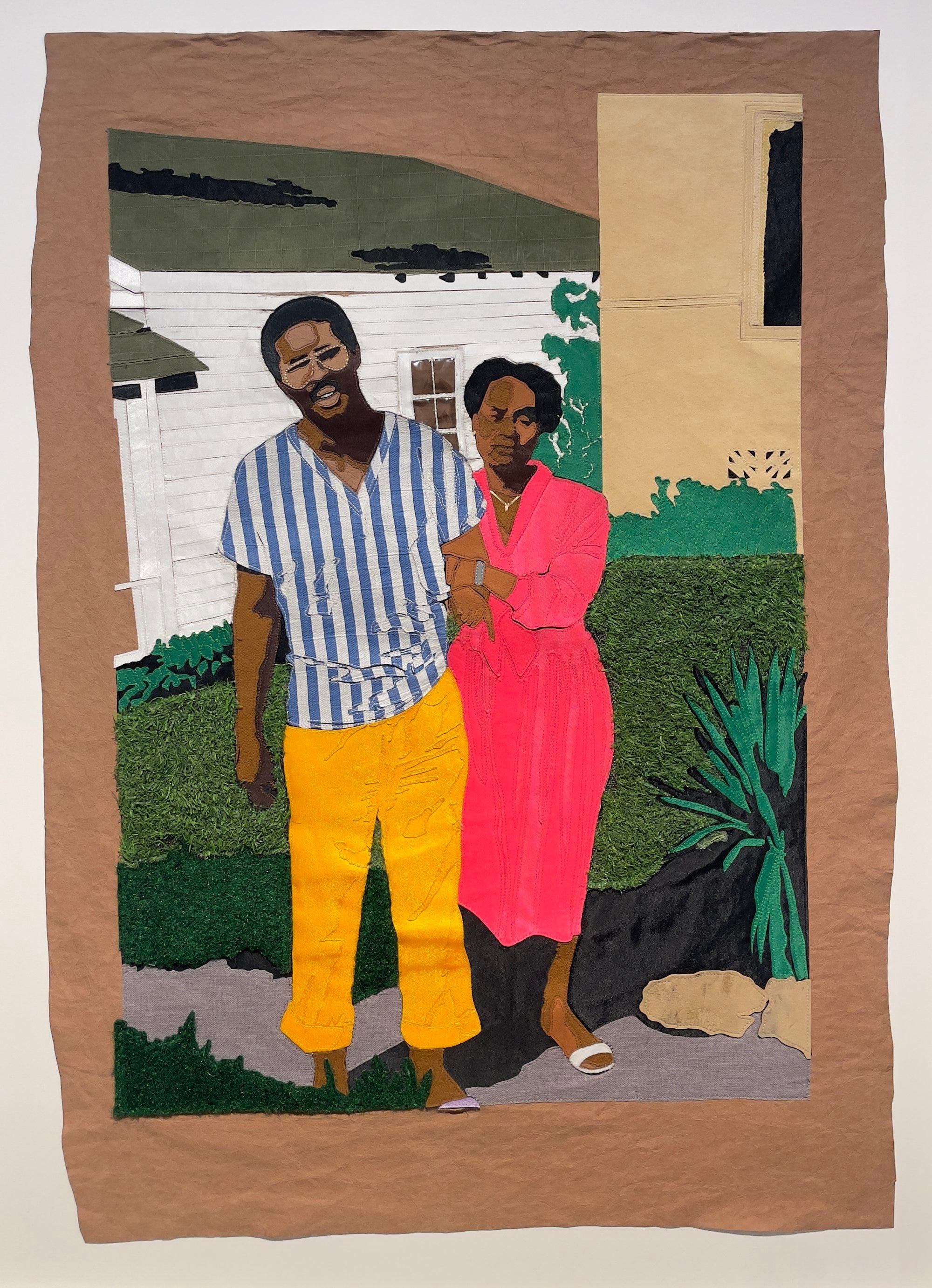
That same instinct—to create from clarity rather than urgency—became especially moving when Quasim Johnston discussed one of the textile works currently on view.
The piece is inspired by a photograph of his parents taken during an earlier chapter of their lives, when they were still building financial stability and raising a young family.
As he described his process, one detail stayed with me.
He spent extraordinary amounts of time ensuring he captured their faces accurately.
Not for collectors.
Not for critics.
For himself.
He wanted to recognize his parents when he looked at the finished piece.
I found myself thinking that perhaps this is one of art’s quietest acts of love—not simply remembering the people who shaped us, but taking extraordinary care in how we remember them.
His answer transformed the work for me.
Johnston’s medium makes that commitment even more remarkable. Unlike paint, fabric cannot be blended. You cannot soften an edge or remix a color once it has been cut. Every piece must be selected deliberately. Every line must be intentional. There is very little room for correction.
The precision required mirrors the care with which memory itself is preserved.
Johnston, who also works as a fashion designer, approaches textiles with the patience of both an artist and a craftsman, reminding us that fabric can carry history every bit as powerfully as oil paint.
Telvin Wallace approaches memory differently.
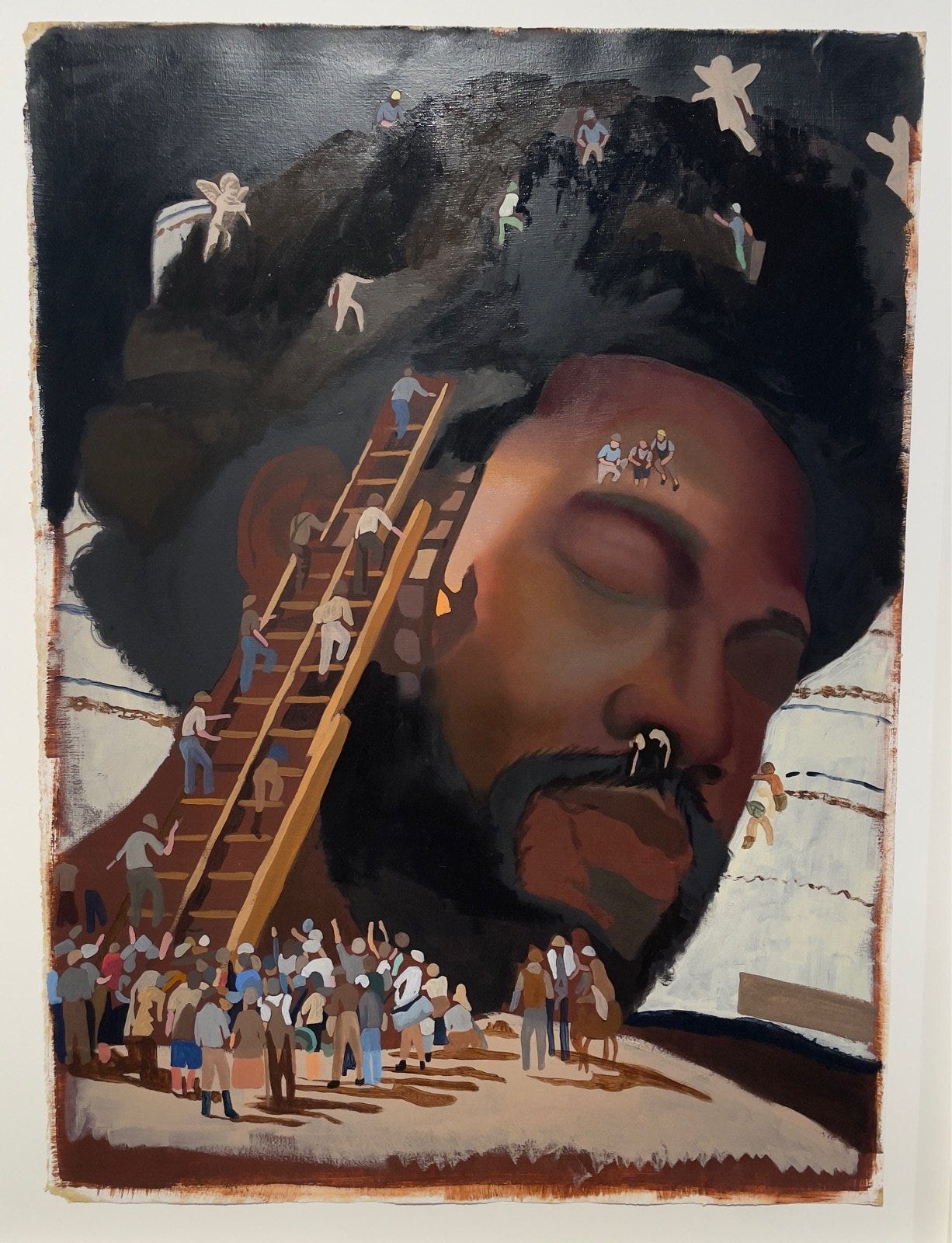
His paintings draw from Baroque and Neoclassical traditions—not to replicate them, but to expand them.
During our conversation, he explained that he became fascinated by these historical techniques because he rarely saw Black figures occupying those visual worlds.
Rather than rejecting centuries of artistic tradition, he chose to study them. To master them. Then to insert Black narratives into spaces where they had historically been absent.
His work is about insisting on a more complete version of history.
What also became evident throughout the evening was the depth of scholarship informing his practice. Wallace spoke with the curiosity of someone who has spent years reading, researching, and questioning. He shared that much of this intellectual foundation began with his mother, a librarian, whose influence nurtured a lifelong relationship with books and learning.
You could hear it in the way he answered questions. Every response felt researched. Considered. Connected.
It reminded me that artistic rigor often looks remarkably similar to academic rigor. Research. Observation. Revision. Study.
One of my favorite moments of the evening had nothing to do with painting itself.
Wallace spoke about collaborating with an art conservator to better understand how paintings survive generations.
As someone who spends much of my time speaking with collectors, galleries, and advisors, that answer lingered with me.
The art world spends enormous energy discussing acquisition. Far less discussing stewardship.
How do we preserve artwork? How do we care for it? How do we ensure it survives long enough to become someone else’s inheritance?
These questions become even more urgent as more Black collectors enter the market and begin building collections intended to outlive them. Buying the artwork is only the beginning of stewardship. Understanding how to preserve it is what allows that cultural inheritance to endure.
Collecting begins a relationship with an artwork. Conservation ensures it continues.
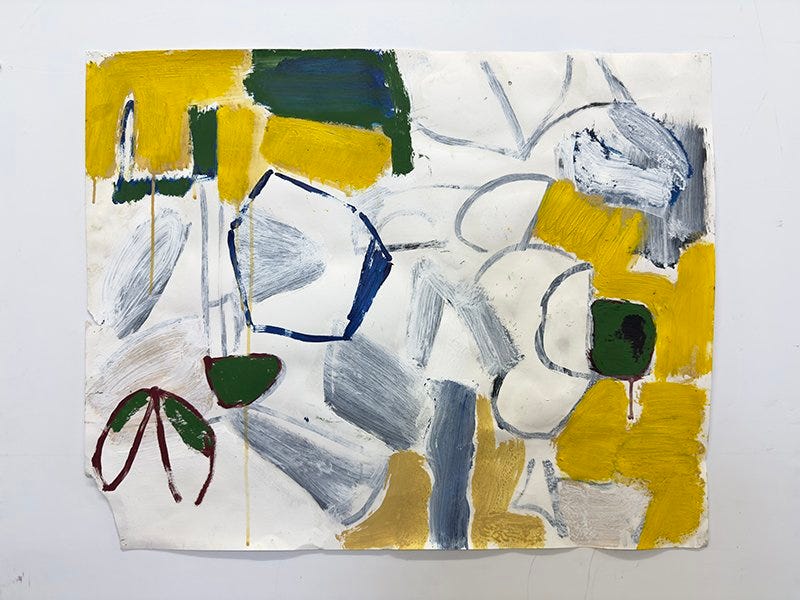
Justin Robinson’s relationship with memory unfolds through abstraction.
His paintings don’t attempt to recreate specific memories. Instead, they recreate emotional landscapes.
He spoke about beginning with structured sketches before allowing intuition to guide the painting somewhere unexpected—a balance between discipline and surrender.
Film and music remain constant companions in his practice. One recurring touchstone is Woody Allen’s Annie Hall, a film he returns to not because he is illustrating scenes from it, but because it helps establish an emotional rhythm before he paints.
That distinction reframed the work for me. His influences aren’t visual references so much as emotional architecture. The film isn’t something to imitate. It’s something to inhabit.
His paintings become less about depicting memory than recreating what memory feels like.
As someone who spends much of her time writing about cultural infrastructure, I often find myself examining what audiences see—the exhibitions, the markets, the institutions, the collectors.
Moderating this conversation reminded me to pay closer attention to what audiences never see.
The reading.
The waiting.
The music playing quietly in the studio.
The hours spent researching forgotten histories.
The decision not to make work until the mind has settled.
The extraordinary patience required to honor a family photograph with pieces of fabric.
Creative practice, I realized, is less about production than preparation. The finished artwork is simply the most visible part of a much longer conversation.
As I reflected on the evening afterward, I realized something unexpected.
None of the most memorable moments had anything to do with the finished works themselves. Instead, they centered on what happens before the artwork exists. These are the parts of artistic practice the public rarely sees. Yet they may be the most important.
Perhaps that’s the quiet lesson of Works on Paper.
Before every painting hanging on a gallery wall, there was uncertainty.
Before every finished composition, there was revision.
Before every confident brushstroke, there was study.
Before every act of preservation, there was memory.
And before anyone else ever encounters the work, an artist has already spent countless hours in conversation with themselves.
When I accepted Richard Beavers Gallery’s invitation to moderate this panel, I assumed I would spend the evening asking questions about finished artworks.
Instead, I left thinking about invisible labor. Not the kind measured in hours or invoices, but the quieter labor of becoming.
The reading that shapes an idea. The music that settles the mind. The family photograph revisited dozens of times before the first piece of fabric is cut. The centuries of art history studied before a painter decides where a Black figure belongs within its canon.
Perhaps that is the greatest gift conversations like these offer. They remind us that the work hanging on a gallery wall is never the whole story.
It is simply the first part we are invited to see.
The Works on Paper exhibition at Richard Beavers Gallery has been extended through July 18, 2026. If you’re in New York, I encourage you to spend time with the exhibition—and, perhaps more importantly, to consider the invisible conversations that made each work possible before it ever reached the wall. Email info@richardbeaversgallery.com for art exhibition and purchase inquiries.
Nina Orm is the founder of Creativity Meets Capital, a media and advisory firm at the intersection of culture, creativity, and commerce. Reach her at nina@creativitymeetscapital.com. For partnership inquiries and speaking engagements fill out the form below:
Comments
Nothing yet. Say the first thing.
Sign in to join the conversation.