
I use AI, as, I dare to say, we all do. I use it to write formal emails, as I can find myself paralyzed in not being able to find the right tone. I use it to experiment with its features and see what it can do. I use it to create summaries of bodies of text, such as open-ended responses in interviews I conducted, or to get an insight into how my own writing can be recapped and condensed.
In this process, I have discovered some things about its usefulness in creative work and in communicating about creative work.
So, I experimented with three AI tools to see how it would create a newsletter logo.
I started with Copilot, and then went to Gemini and ChatGPT. My starting point was to give it some guidelines. I love squirrels. They are ingenious in tasks relevant to them (getting to food!) and they are also just the cutest. If you love squirrels too and want to see them master obstacle courses designed with spectacular human creativity, check out Mark Rober’s Squirrel Olympics YouTube videos.
Also, I mentioned that the newsletter is about creativity and that it might be fun to have the squirrel interact with a Rube Goldberg-like contraption.
After Copilot generated its first couple of images, I made additional specifications. With more experimentation and reframing, I ended up with the following prompt that I then used in a new Copilot chat, and also Gemini and ChatGPT:
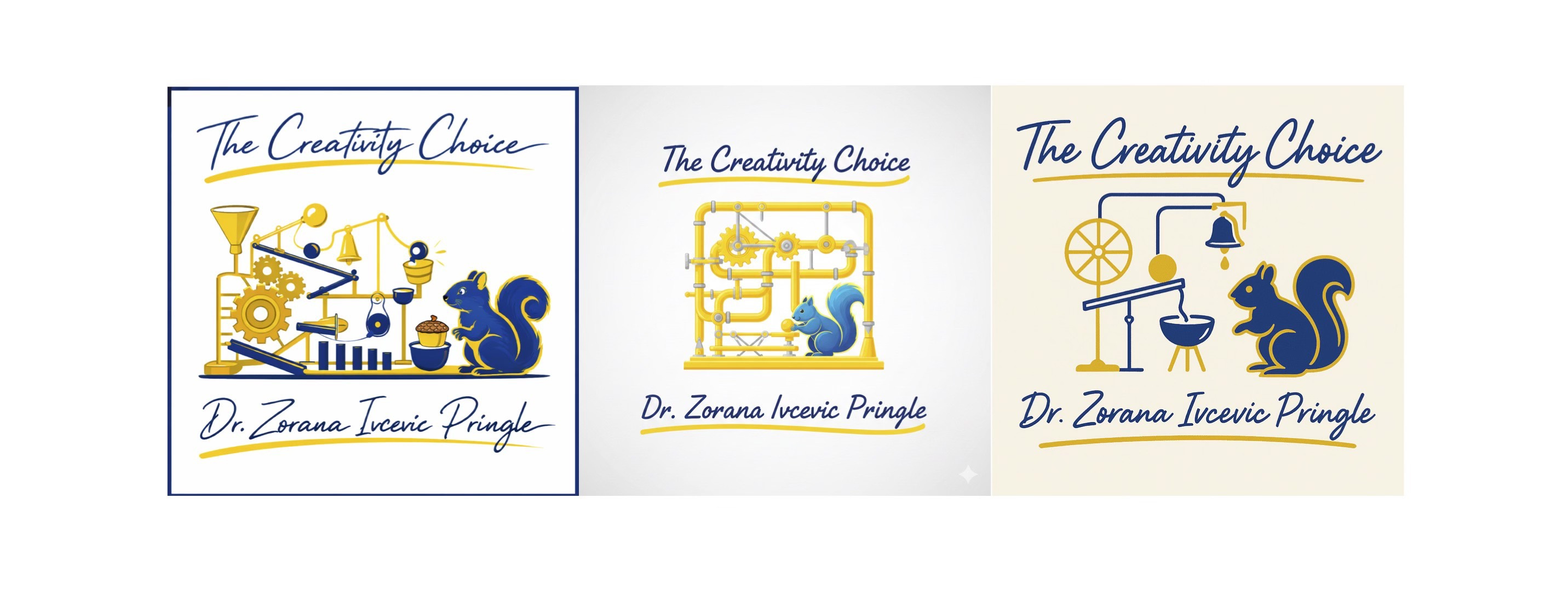
I am looking to design a new logo for my newsletter. I would like it to be square and include the following elements: 1. On top, the words “The Creativity Choice” in sleek contemporary signature handwriting style, blue font, underlined yellow; 2. In the middle, a picture of a Rube Goldberg-like contraption in yellow and a blue squirrel (with yellow outline); 3. Below the picture, the words “Dr. Zorana Ivcevic Pringle” in sleek contemporary signature handwriting style, blue font, underlined yellow.
Here are the outcomes, in my order of preference:
As I was playing with earlier versions of the design, I ran into the issue of the machine not understanding or testing reality. After three tries to get a different handwriting-like script, neither Gemini or Copilot delivered. They said they made the change to the script, but they did not. Something that would have been very easy for a human to both spot and change. They offered language about the kinds of different scripts they could try, and even when I used the language they suggested, no change happened. And that was frustrating.
In my personal preference, ChatGPT came on top. It was most responsive and I thought most nuanced (the contraption is delightfully odd, while being squirrel-relevant with an acorn). Copilot comes last in my ranking. Rube Goldberg would have found the device rather lacking, and the squirrel looks dazed and not present.
I got these logos quite quickly. They were not bad.
But definitely not great. They are clearly limited by my (lack of) expertise in design and best practices in logo creation. I am a faithful listener of 99% Invisible and loved grading of US state flags on YouTube (which of course, reminded me of Fun With Flags on The Big Bang Theory), so I know enough to be clear that these are not great. Even if it was a good exercise and a lesson in what these tools can do.
The AI can do a lot, but how creative its output is will depend on the creativity (for the particular kind of task) of the person working with it. Human creativity remains crucial.
I write about having ideas and then not always following up on them. I had an idea of analyzing the content of all my guest appearances on podcasts to summarize what questions are commonly asked. But I never followed through. Then, Mark Blackwell (thank you again, if you are reading this!) did something similar in preparation for our interview on his podcast, Arkaro Insights. He provided NotebookLM with links to 27 of my podcast appearances up to that point and asked it to summarize the key lessons. Mark also graciously shared the prompts and outputs with me.
The response started with core points:
· Creativity is a process of decision-making towards outcomes that are both original and effective—not a gift reserved for the few
· 70% of people believe creativity requires complete freedom, yet research shows constraints actually enhance creative output
· Teams that spend 53% of their time on problem framing rather than idea generation produce the most creative solutions
· Different moods serve different creative purposes: positive energized states fuel divergent thinking; subdued or pessimistic moods sharpen critical evaluation
· Weak network ties drive exploration and new perspectives; strong ties support development and refinement
· AI performs at average human creativity levels but cannot match top human creative performance—nor can it identify problems or take initiative
· Three leadership actions: explicitly ask for creativity, leverage emotions strategically, and build psychological safety through permission to explore
So far, pretty good. The only one that I would highlight as being a bit much is oversimplifying a study showing that successful problem solving teams spent 53% of time focusing on problem finding, rather than generating new ideas. When NotebookLM described this in more detail, it went so far to call it The 53% Rule. Caution needed. One study obtained that number. One study does not make that number magical. Rather, the research shows that much of the time should be spent on problem finding (that could mean 53%, 58% or maybe 64%).
When NotebookLM elaborates on individual insights, its tendency to get overly certain when we should be talking about likelihoods become apparent.
Another example. One of its headline insights stated, “The Freedom Fallacy: Why Constraints Enable Creativity.” Very polished sounding, very social media-ish. Not false, but firmer than it should be.
Constraints can and often do benefit creative ideas. But they do not do so always. Details about constraints matter. Constraints benefit creativity when they can focus thinking and direct it in more original directions. One of my favorite studies showed that people come up with more creative greeting card rhymes when they have to incorporate unusual words (e.g., writing an I love you message including the word ‘vest’).
We have all seen constraints of the “do more with less” kind that can break people. So, not all constraints are created equal or helpful.
In summarizing lessons about the social side of creativity, NotebookLM stated, “The Network Effect: Weak Ties for Exploration, Strong Ties for Development.” Indeed! But it also missed something else that is crucial – the importance of climate for creativity (especially when we are talking about work contexts) and psychological safety as the basis for such climate. I don’ t know why it missed this, but the list of insights seems to be focusing more on the quick, simply, and immediately actionable, rather than something(s) that need to be built through time and consistent effort.
That on the other hand, is not just an AI bias, but I would say our societal one too. Of course, AI got its biases from the corpus that reflects the culture in which it was generated.
We all use AI. The question is not whether we are going to use it. The question is how. Are we going to use it reflexively, on autopilot, like other imposed shoulds we pick up because we get swept into doing what everyone else seems to be doing? After emerging from my own year of burnout, I am more mindful of personal decisions and the question of why do something and how.
As I grapple about bigger questions of life, I figured to recommend a book from a connection that started on LinkedIn and grew into the real world.
Most productivity advice tells you to do more, optimize more, and hustle more. If that does not work for you, you are not alone. My friend spent years figuring out why that approach leaves us burned out and empty.
In Unhinged Habits: A Counterintuitive Guide for Humans to Have More by Doing Less, Jonathan Goodman shows how to break bad habits and build a rich life by mastering the art of strategic subtraction. It will get you thinking. And experimenting.
Speaking of what AI can and cannot do. If you find this newsletter helpful or intriguing and have checked out The Creativity Choice, I would be grateful (as in really really really grateful) if you would be up for leaving a book review. It makes a big difference.
For more details on the topics above, check out The Creativity Choice:
Constraints and creativity: Chapter 4
Problem identification and construction: Chapter 5
Network effects on creativity: Chapter 9
Climate for creativity: Chapter 10
Comments
Nothing yet. Say the first thing.
Sign in to join the conversation.