
I spent a good ten minutes on this sentence to make sure it conveyed exactly what I wanted it to convey. I know what I wanted to say, but making sure my writing intention matches the end written result perfectly can often be two different things.
Right now, I am in the editing stages of my forthcoming memoir “Getting Over It.” In this section (look at the photo), you’ll see the first sentence with yellow highlights. When I talk about “recognized,” it’s an action that already happened, such as “I ate yesterday.” Yesterday, I ate and that action is done. I will do it again today, but for yesterday, I am completely done.
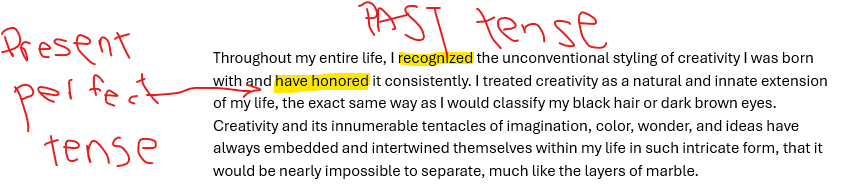
The fact that I chose “I recognized” instead of “have recognized” is tricky and brings with it some subtleties worth mentioning. I started off my sentence saying “throughout my life” and the next word would be grammatically correct as “recognized” because I did it once and the action was completed. However, it might also imply that I only recognized something once and not many times, which is what I actually intend.
What saves me from grammatical redundancy in this instance is that I already establish my positioning by my word choice in the beginning. By saying “throughout my life,” I’m already telling the reader that any action or description I’m about to include took place “throughout my life” which implies things that happened more than once.
Knowing I could get away with “recognized” in the first sentence, I was careful to make sure the next verb displayed an action that happened more than once. I “have honored” instead of “honored” indicates that the act of honoring is a continuous one, which means I still do it today.
As a pro writer and aspiring book author (“Getting Over it” will be published in the summer of 2026), I appreciate the subtleties of language because meanings can be interpreted in so many different ways. I always treat language as a malleable shapeshifter that conforms to my wishes, like a word-based genie on command.
I love playing around with language and getting it to do exactly what I want. This is a fun and rewarding exercise in creative writing because the writer can both tell the reader exactly what they want as well as create Easter eggs and deeper meanings.
No posts
Comments
Nothing yet. Say the first thing.
Sign in to join the conversation.