
All illustrations created with loving care using Adobe Fresco by the author #byhumansforhumans
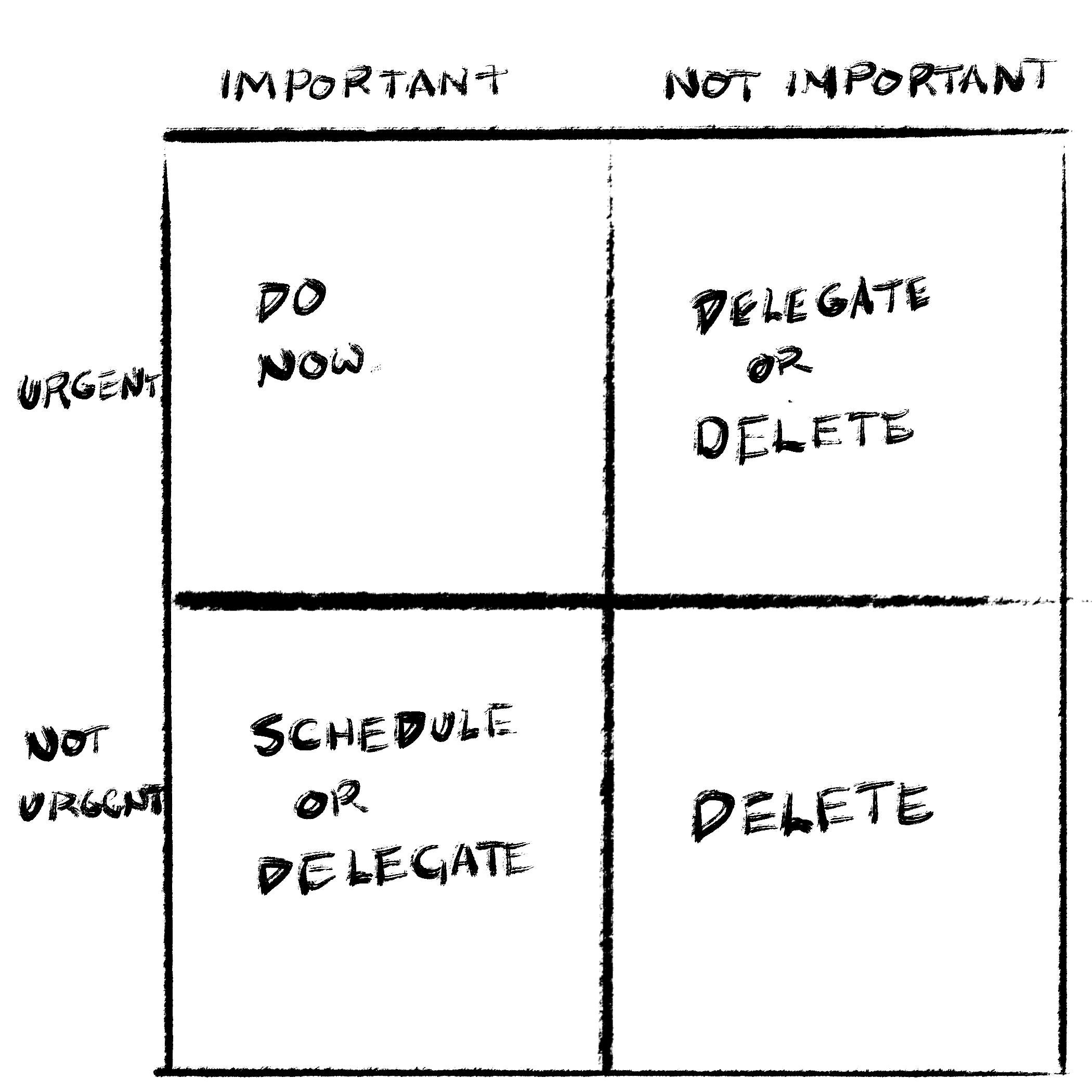
Much has been written about the Eisenhower Matrix as a productivity and prioritization tool. It’s a pretty simple layout, with two columns and two rows. Across the top are “Important” and “Unimportant” labels, and down the side are “Urgent” and “not urgent.”
The idea is to categorize each task you have by these two criteria, which will then help you figure out what you really should be doing:
Important and urgent: do it, duh.
Important and not urgent: schedule a time to do it, or delegate it to someone you trust.
Not important and urgent: delegate it or delete it.
Not important and not urgent: just delete it.
Named after General-and-President Dwight Eisenhower, it’s a popular too because there is a comfort to the grid, of suddenly knowing where everything belongs and what you are supposed to be doing.
There are some problems, though. Not everything fits in a binary category; some things may be important or urgent to certain people, but not to others.
I’ve found that there are some other matrices that are more useful in different situations or phases of life.
I apologize; I don’t remember and cannot find where I first learned about this particular set of criteria.
The idea of measuring the “impact” of a task is a common project management tool, but it’s usually paired with “effort”, and I’ve found that pretty useless, as capacities tend to vary — so a task that might take a lot of effort to complete Thursday afternoon may be absolutely effortless on a Tuesday morning.
However, as someone who works a lot with distributed teams, I often have tasks that other people are waiting on — and those should have the priority. Combining “level of impact” with “People waiting?” is sometimes the best way to categorize my tasks:
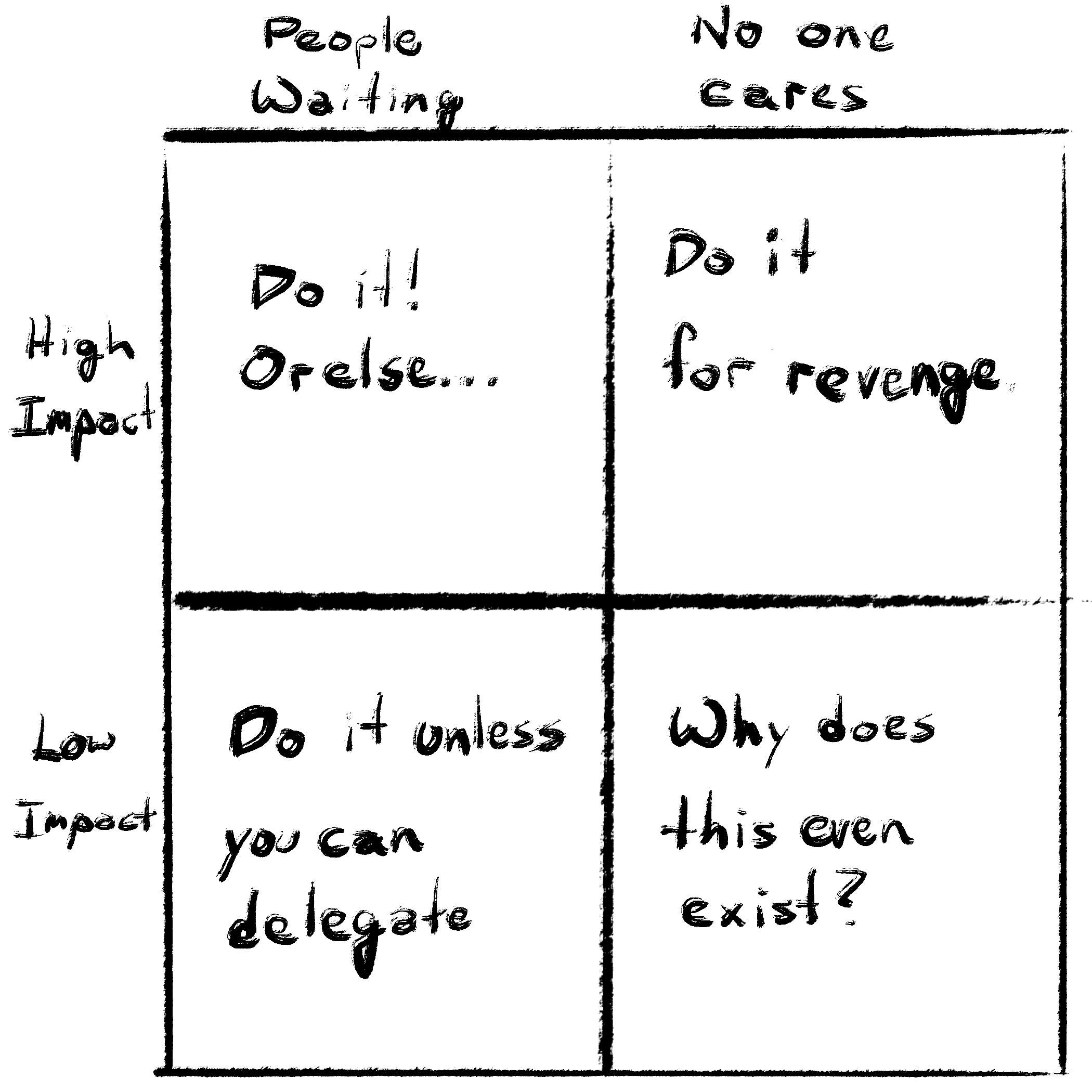
People waiting — high impact: Do this thing — or else!
People waiting — low impact: Do it, unless you can delegate it to someone reliable.
No one cares — high impact: Do it, because success is the best revenge, and no one will see you coming.
No one cares — low impact: Seriously, why does this even exist? Get rid of it!
I can tell you exactly where I learned this concept — first from a workshop, and then refined in a one-on-one consult, with the bullet journal/productivity YouTuber @SimieIriarte
Simie brought up the idea of “10x vs 2x” tasks in her journaling workshop, but I believe she herself first learned of it from the book by Dan Sullivan and Dr. Benjamin Hardy, but it’s honestly too techbro a title for me to provide a link.
But the idea is prevalent across a lot of areas, and breaks down into something pretty simple: some things are ten times more effective at accomplishing your goal, whatever it is, and some things are only two times as effective.
Most writers on the subject will talk about your “one goal” (the authors use Michel-frickin’-angelo for their first example of “10x” work, because sure, we’re all artists living in Renaissance Florence, that’s relatable) but I personally have trouble with that concept. The reasons why are probably the subject of a future essay, but I can give a personal example of how it applies to one of the practices I’m trying to establish:
If I carry around a little notebook and occasionally take it out and draw, that’s a 2x progression in my sketch practice.
If I dedicate an hour every morning to deliberate practice and one evening a week to the Madison Atelier life drawing sessions, that would be 10x.
Why don’t I automatically do the latter? Because it requires a significant sacrifice of time, energy, and attention, which means saying “no” to a lot of other things I enjoy.
Again, that’s all the subject of a future essay. The real breakthrough that I found with this matrix, though, was when I was talking with Simie about how I’ve reached a point where pretty much everything that is a available goal feels about the same level of importance — as in, I can choose sketching, or music, or dance, or a language, or coding, or painting, or handlettering, or…whatever, and it’s easy to figure out how to “10x” it.
But what is the point? I’m not trying to make a living at it — I make a living just fine, lucky person that I am, so that’s not an issue. What is truly worth doing?
You may have a ready answer, but I didn’t. And I asked Simie if she could help.
What she told me absolutely stunned:
Well, if all other things are equal…do the thing that excites you the most.
Optimize for…fun? Joy?
Excitement?!?
My Judeo-Christian-work-ethic-raised pioneer-spirit bootstrap-entrepreneur hustle culturalist mindset went into freeze mode at this unexpected threat, before gibbering off in flight down into my subconscious to continue its malevolent work. Meanwhile, I looked at the matrix that would be created if I evaluated the things I could do based on “10x” and “Whee!”:
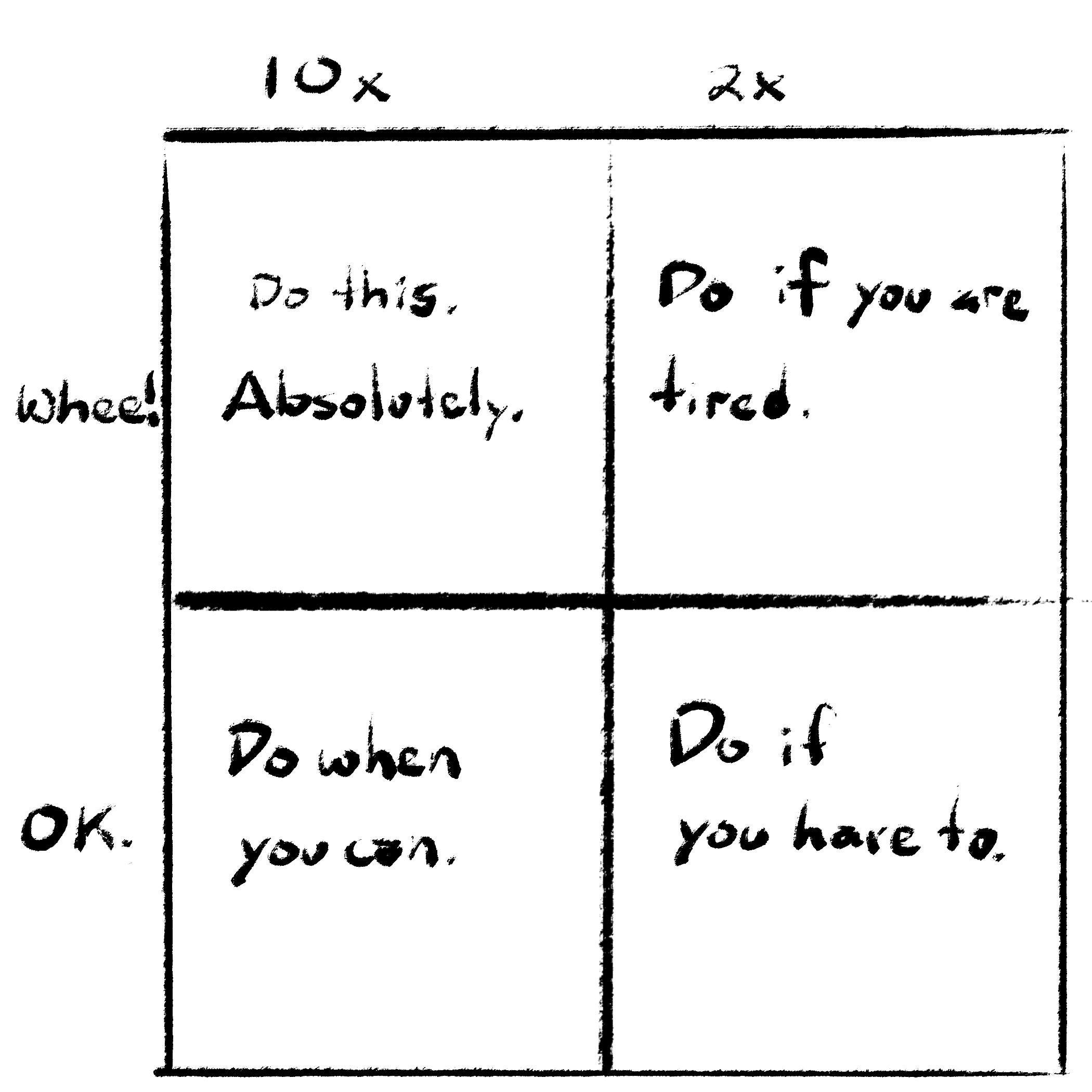
10x — Whee! Do this. Absolutely. If you do nothing else, do this.
10x — OK. Not so fun, but you understand it has to get done? Fine. Do it when you can.
2x — Whee! Do this when you’re tired! It won’t get you far, but it’ll recharge you, and be fun!
2x — OK. Do this, if you really, really have to.
Now, this is a different kind of matrix, because unlike the first two no tasks are delegated or cancelled; you don’t get out of doing anything, really. It’s a matrix that understands: you can’t “10x” all the time. The cat box needs to be cleaned out, the toilet paper roll changed, those quarterly invoices sent out.
But it also makes it clear where your priorities should be. Yes, get things done that need doing. Michelangelo had to sharpen his chisel some time (or whatever counts as mundane in Renaissance Florence. See what I mean about unrelateable?).
And as the companion to the 10x-Whee! Matrix, allow me to present:
Some of us (cough) have trouble saying no to things. Or people. Or impulses. Or cookies, brownies, fine cigars, good bourbon…ok, perhaps it’s just me.
But in case you, too, find yourself in times of your life that you really need to just say no (thanks, Nancy), this matrix is for you.
Full disclosure: I utilized ChatGPT 4.0 to figure out a way to make this final matrix by having it generate a series of two-word phrases that absolutely meant “no.” The phrases were edited and re-arranged, and all writing (both typed and illustrated) has been #byhumanforhuman.
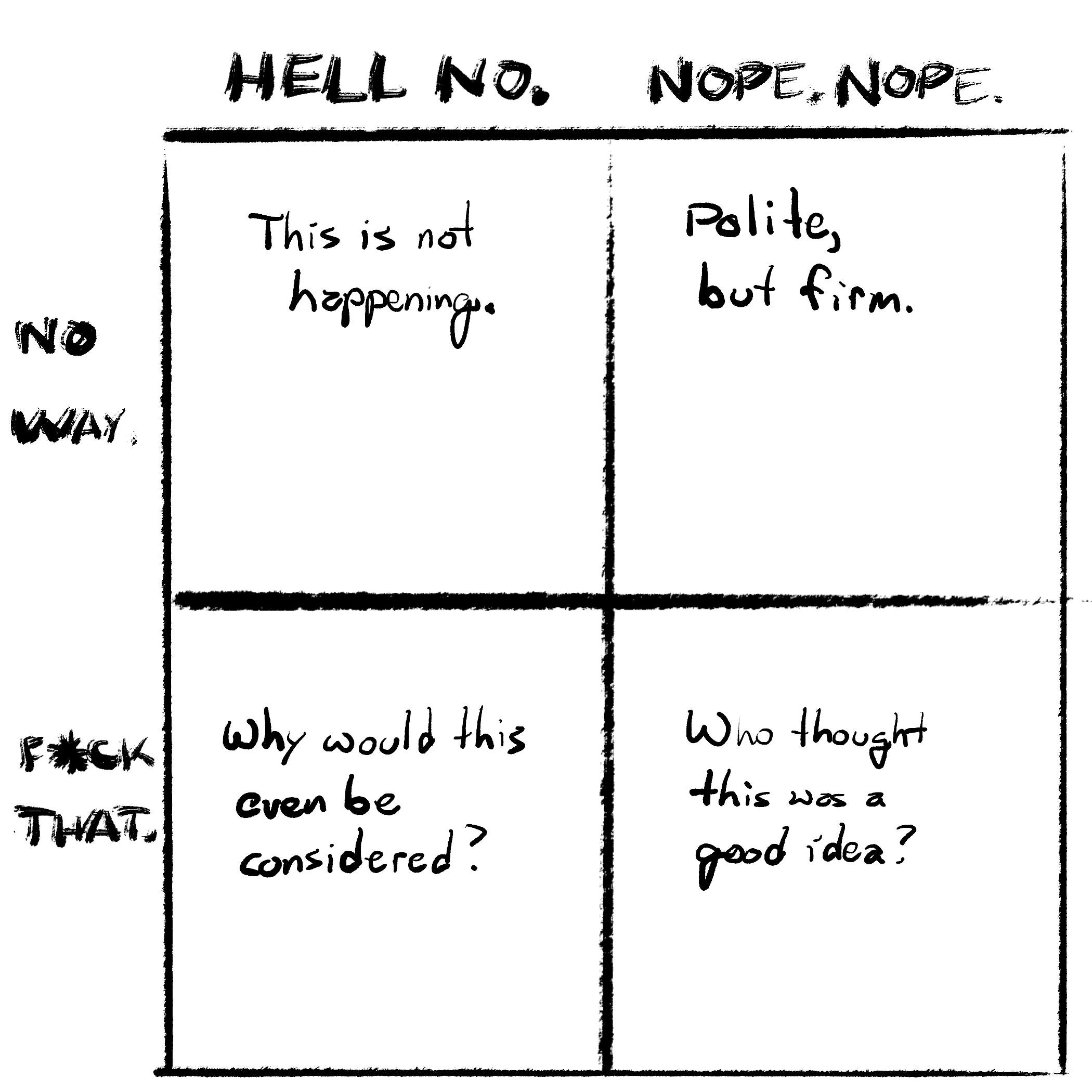
Hell no. No way: This is absolutely not happening.
Hell no. F*ck that: Really? Why would this even be considered? You gotta be kidding.
Nope. Nope. No way: This is absolutely not happening, but more politely.
Nope. Nope. F*ck that: Come on. Who ever thought this was a good idea?
As you will see, this will not add anything to your to-do list, but simply adjust the internal and/or external intensity of your “no.”
I believe that this particular matrix should probably be used sparingly, but as someone with a chronic “yeah, sure, I can do that” problem, I may not be the most reliable judge.
If you think the whole idea of a matrix is too limiting, or just ridiculous, I get you. I’m not at all convinced that living in a quaternary state of mind is any better than a binary (there are only two kinds of people, after all, and most of them don’t know it).
What you may not realize — and what caused me to take a more serious look at the whole concept — is that even if you are not using a matrix to decide on your actions, someone else is using one for you. This may be KPI’s or SMART goals or just what ads you see on your socials, but there are much more complex tables than 2x2 that are out there determining many aspects of your existence, because this is a powerful tool that has proven effectiveness.
It’s worth asking: what would the matrix of you look like?
Comments
Nothing yet. Say the first thing.
Sign in to join the conversation.