
Every few years, Americans get trapped in the wrong frame. They watch a president, a strike, a headline, a tweet, and assume history has suddenly lurched off course. It has not. The actors change. The control systems do not.
The deepest logic of national security is older than any administration. People need calories, fuel, and a medium of exchange. If an adversary can control those three things, it controls growth, politics, and survival. That was true in the ancient world. It was true in the Cold War. It is true now.
The most important weapon in geopolitics is not the one that explodes fastest. It is the one that can quietly determine whether populations eat, heat homes, finance trade, and maintain order. A country can survive a bad quarter. It can survive one reckless politician. It struggles to survive if rivals can control food, energy, and money.
I think most commentary on Iran misses the point. People ask whether Trump is insane, whether this week’s move was tactically smart, whether fertilizer prices will rise, and whether we should have spent the money on healthcare instead. Those are real questions. They are not the first question.
The first question is this: who controls the essentials over the long term?
It’s not the next frontier. It has always been the frontier.
Postwar American strategy understood this. When the United States emerged from World War II with unmatched productive capacity, it did not just build carriers, bombers, and institutions. It also translated agricultural abundance into strategic architecture. Eisenhower signed the Agricultural Trade Development and Assistance Act in 1954, which laid the foundation for Food for Peace. By 1960, he described food for peace as “our chief weapon in the worldwide war against want and hunger.” Later presidents kept the same logic. Johnson argued that hunger and want, wherever they existed, were enemies of all mankind. Reagan described Food for Peace as a program that expanded agricultural markets and helped turn potential allies into stronger allies for freedom. (World Food Program USA)
You miss the plot when you reduce strategy to one president’s personality. Presidents come and go. They change very little that was not already changing. The strategic DNA remains. The muscle memory of national security is food, energy, and finance. A president can move five degrees left or right. He does not rewrite the underlying physics of state power. Trump matters tactically. He does not repeal the fact that open access to food and energy sits near the center of American power.
The American advantage was never just force. It was architecture. The U.S. used agricultural abundance, open sea lanes, dollar settlement, technology, and decentralized innovation to make famine less common and markets more open. The point was not charity alone. The point was to create a world in which coercive control over food became harder to sustain. A world with fewer famines is not just more moral. It is more compatible with open markets, private investment, and the kind of decentralized innovation at which the United States is best.
This is the real distinction between America and many of its rivals. The American model, at its best, assumes that growth emerges from distributed intelligence. Farmers, shippers, scientists, engineers, insurers, traders, and entrepreneurs respond faster than a ministry can. Open markets transmit information. Freedom creates variation. Variation drives innovation. That is the superpower. Life, Liberty, and the Pursuit of Happiness.
Other systems often default toward centralized leverage. They think in terms of chokepoints, state tolerated gray markets, command over payment systems, and political control over supply. They do not need to out innovate the United States in every category. They only need to gain enough leverage over essentials to make openness more expensive.
If you want to be a world power, you need to control food or deny control of food.
The Iran question cannot be reduced to whether this week’s move raises oil prices or whether next month’s fertilizer bill goes up. Those matter. But the larger question is whether the United States allows a rival network to deepen control over energy chokepoints, sanctions evasion routes, payment workarounds, and the political leverage that comes with them. The strategic risk of doing nothing is not zero. It is cumulative.
Action is dangerous. Inaction is also dangerous.
BRICS is not shy about talking in the language of food security and agricultural coordination. The bloc’s own 2025 declarations put food security at the center of cooperation, and BRICS officials say the member states account for 42 percent of global food production, 33 percent of agricultural land, and 39 percent of water resources. At the same time, the U.S. China Economic and Security Review Commission warns that China is facilitating Russia’s and Iran’s ability to evade sanctions and withstand economic pressure. Reuters reported this week that Russia’s deputy energy minister said Moscow would keep supplying energy without regard to Western sanctions and offer “mutually acceptable payment practices” with partners.
None of that means every BRICS food initiative is sinister. It means serious states understand that food, energy, and finance are strategic terrain. They understand that if they can build enough parallel capacity outside U.S. visibility and outside U.S. pressure, they gain leverage even if they never fully replace the existing system.
The Strait of Hormuz is the reminder in plain sight. On a typical day it carries about one fifth of the world’s crude oil. In the current Iran war, AP reports that traffic has been sharply constrained while Iran has still managed to export well over 16 million barrels of oil since early March, largely to China, even as broad shipping through the chokepoint has come under pressure. That is what leverage looks like. Not total closure. Selective access. Enough control to raise prices, reward friends, punish enemies, and remind everyone that dependence has a cost.
Trump matters tactically. Strategically, he is operating inside a much older system. This is why I am not especially interested in the daily emotional theater around Trump. I am interested in whether the United States preserves a world in which no bloc can weaponize scarcity over the next twenty years. If you think that sounds abstract, imagine the opposite. Imagine a world where an Iran, Russia, China aligned system can selectively tighten energy flows, tolerate food coercion, and weaken the institutions that keep trade open. “We should have spent this money on healthcare” stops sounding like a complete argument when the alternative is a structurally less free and less stable system for the next half century.
In that sense, food power is healthcare, just on a different time scale. Healthcare treats people within a society. Food security keeps whole societies from breaking down. One prevents disease. The other helps prevent famine, inflation shocks, forced migration, political extremism, and war cascades. Serious states have to price both.
Europe often struggles here, not because Europeans are stupid, but because consensus systems tend to prioritize short-term internal stability over external power projection. That leaves them tempted to free ride on American action while criticizing American tactics. The pattern is old. Someone else bears the cost of maintaining the perimeter. Europe debates process. America gets blamed either way. Fine. That does not change the strategic arithmetic.
The better question is not whether one likes the current president. The better question is whether the long-run structure remains intact: open food markets, open energy flows, resilient finance, and relentless innovation. If those hold, the American system retains its edge. If they erode, daily politics will not save us.
So how should people think about this without getting lost in the noise?
First, watch chokepoints, not headlines: Pay attention to Hormuz, Black Sea grain routes, fertilizer feedstocks, maritime insurance, and shipping access. Ask whether these flows remain broadly open or increasingly selective. The moment essentials start moving through narrow political gates, leverage shifts.
Second, watch the network under the network: Pay attention to sanctions evasion routes, shadow fleets, payment workarounds, bilateral commodity deals, and agricultural coordination outside Western visibility. Power increasingly travels through tolerated gray channels, not just official treaties. If a rival bloc can move food, fuel, and money while bypassing pressure, it is building real strategic depth.
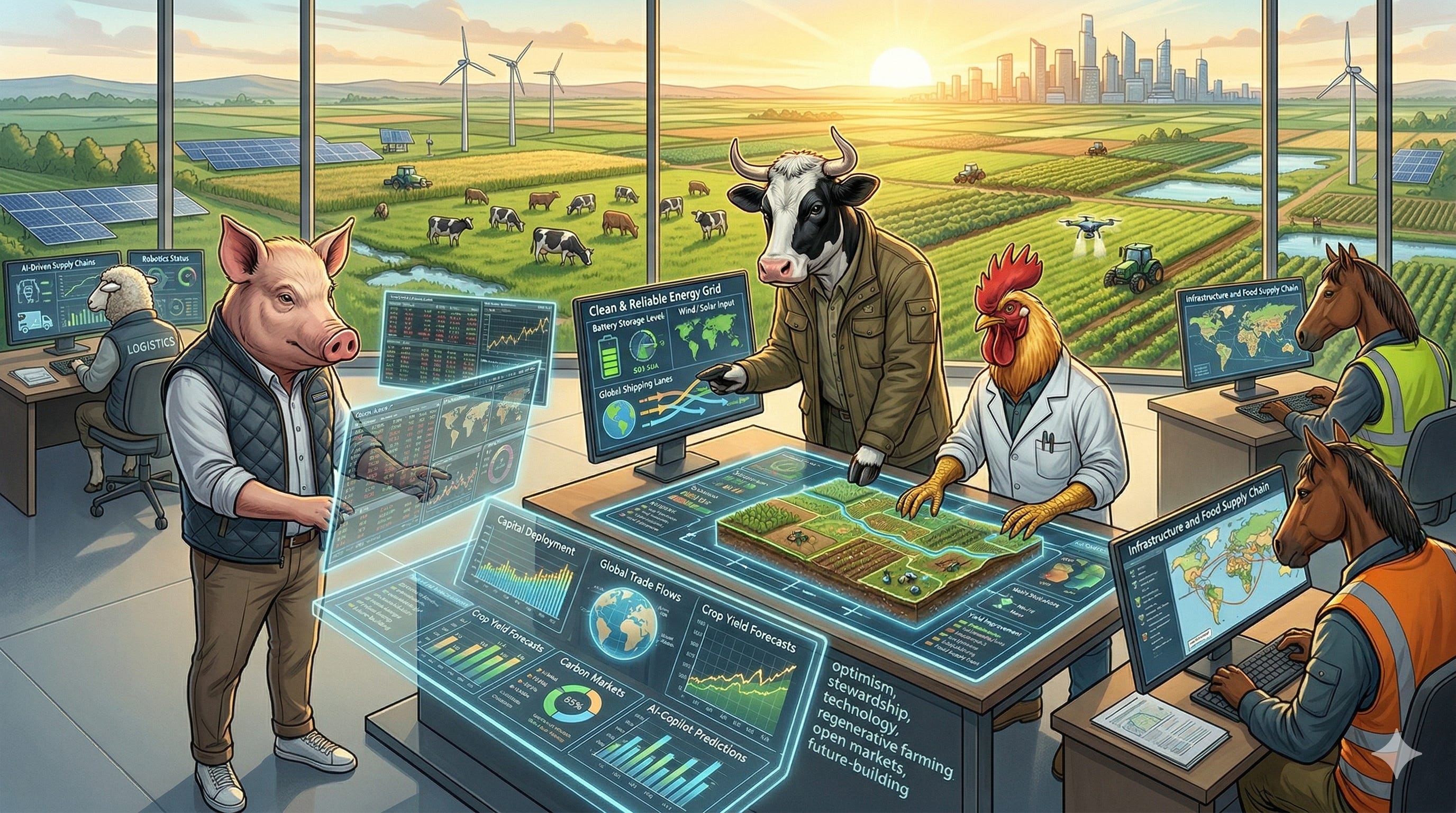
Third, watch where innovation compounds: The real American superpower is not a speech. It is the ability of open markets to produce better seeds, better logistics, better energy systems, better pricing signals, and eventually healthier food at lower cost. The country that can make abundance cheaper than coercion wins the century. It is no surprise that we chose now to deal with Iran. AI for abundance, protect the flanks of energy, food and finance.
That is the frame.
Not Trump. Not one strike. Not one tweet. Not next week’s fertilizer cost forecast.
The durable contest is over whether the world remains open enough that innovation, not coercion, allocates essentials.
Presidents are ephemeral. Food power is not.
If you want to judge what is happening in Iran, or Russia, or China, or Europe, start with food, energy, and finance.
Comments
Nothing yet. Say the first thing.
Sign in to join the conversation.