
Jack Dorsey fired 4,000 people and published a manifesto explaining why.
The popular reading is that AI replaces middle managers. That is the least interesting interpretation of what happened. Dorsey just made the first large-scale public bet on an organizational architecture that Friedrich Hayek described in 1945 and Claude Shannon formalized in 1948. He does not cite either of them. But the logic is identical.
And the GDP data shows why it matters.
Pull up the Maddison Project data on long-term GDP per capita by country since 1810. Plot it on a log scale. Every major economy shows the same pattern.
Rapid growth as industrialization takes hold. Then a gradual convergence toward a steady-state growth rate that sits roughly 1 to 2 percentage points below that of the United States.
Japan surged from the 1950s through the 1980s. South Korea from the 1960s through the 2000s. China from the 1980s through the 2010s. Each hit a growth ceiling and leveled off. The U.S. just keeps compounding at roughly 1.95% annually, decade after decade, for over two centuries. A straight line on a log chart for 200 years.
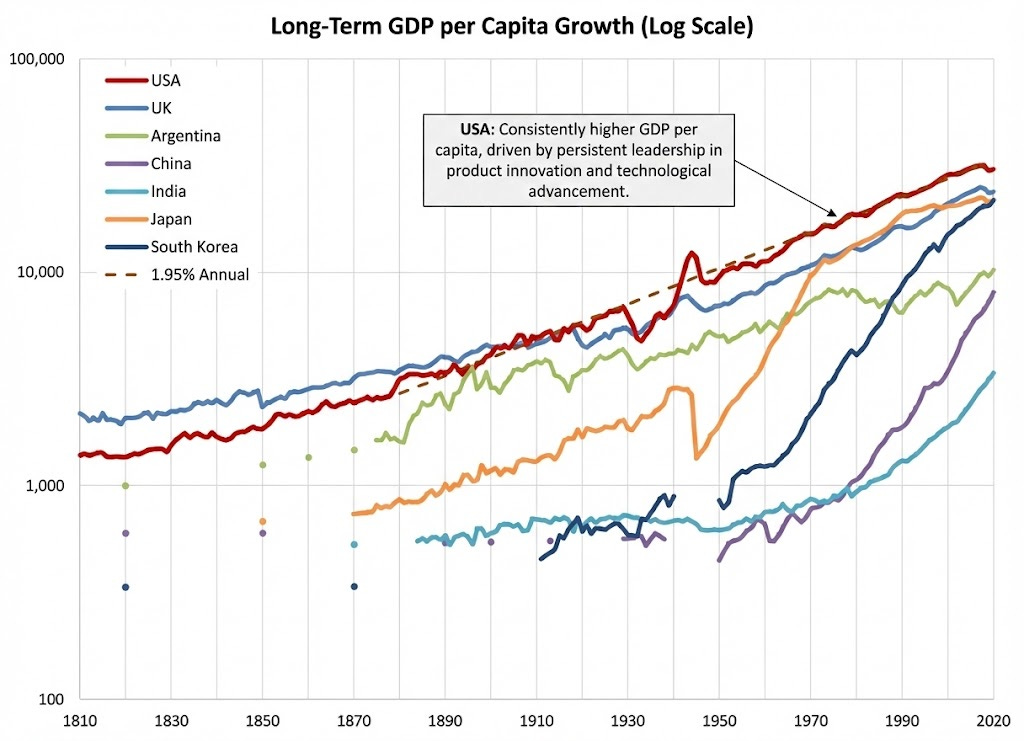
The standard explanation is that these are copycat economies. They take product innovations developed in the U.S. and optimize production. Japan perfected lean manufacturing. Korea mastered semiconductor fabrication. China scaled everything. Process innovation is valuable. It raises living standards enormously. But it has a ceiling.
Product innovation has no ceiling because it creates entirely new categories of value. The iPhone was not a better Nokia. Amazon was not a better Sears. Tesla was not a better GM. These were new architectures that redefined their markets. System C.
The U.S. advantage in product innovation is not cultural mysticism. It is structural. Weak central authority. Strong property rights for ideas. Deep capital markets. And 250 years of institutional practice at realigning the information layer to let entrepreneurs detect and act on market signals. No king. No industrial ministry. Just a system that lets the person closest to the problem attempt a solution.
The question is not why the other countries plateau. That part is straightforward. The question is what organizational architecture sustains product innovation at scale? What happens when that architecture reaches the end of its useful life? And what replaces it?
Before Alfred Sloan, American corporations ran on genius and instinct.
William Durant assembled General Motors by acquiring everything he could reach. He kept the critical information in his head. When the stock market broke in 1920, he was leveraged to the point of ruin. What the du Pont family inherited was a corporation with $84 million in unsold inventory and a cash position nobody could accurately state because the divisions kept separate books.
Henry Ford had the opposite problem. One car, one color, one price point. The knowledge required to run Ford Motor Company existed in one mind. When that mind could not process a changing market, the company stalled.
This was System A. One brain trying to hold all the information. It worked when businesses were simple enough for a single mind to coordinate. The Roman Army ran on the same logic for 2,000 years: nested hierarchies, but still dependent on individual commanders at each node. The whole structure existed to route information through human bandwidth.
System A hit its limit when the information required to coordinate a continental enterprise exceeded the capacity of any single human brain.
Alfred Sloan fixed General Motors with two principles. Each division operates semi-autonomously with its own P&L. A central office coordinates what the divisions cannot coordinate themselves. The genius was in the interface: operational decisions went to the divisions, policy decisions went to the center, and the boundary was defined by who possessed the relevant knowledge.
He then built the information system to make it work. Standardized accounting. Uniform financial metrics. Return on investment as the universal measure. Non-overlapping market segments.
In 1921, GM held 12 percent of the market. Ford held 56 percent. By 1927, GM passed Ford. By the mid-1930s, General Motors was the largest corporation on Earth. Every major company copied the model. By the 1960s, it was the dominant organizational form worldwide.
This was System B. The firm as coordination technology. It solved what Hayek called the coordination problem: the relevant knowledge is dispersed among millions of individuals, no single mind can hold it all, and the question is how you coordinate action when the information required to act is scattered across people who cannot easily communicate.
Sloan’s divisional model was a knowledge-routing architecture dressed up as an org chart. Enterprise software is its digital encoding. SAP, Salesforce, Oracle, Workday, Epic. These are not merely tools. They are the coordination layer of American business. When a hospital installs Epic, it is not buying records software. It is committing to System B.
System B powered U.S. GDP growth of roughly 4 percent from the 1940s through the 1960s. It was the organizational engine of the American century.
But System B has a design flaw.
Shannon published “A Mathematical Theory of Communication” in 1948. The core insight: every channel has a capacity, and every relay introduces noise. The more intermediaries between signal and receiver, the more information degrades.
Shannon was writing about telephone circuits. The math applies to organizations.
In a System B corporation, a customer complaint reaches a sales rep, gets logged, aggregated by a regional manager, rolled into a divisional report, and lands on the executive committee’s desk. At each stage, the signal loses context. The specific customer, the specific failure, the urgency. All stripped away, averaged, delayed, formatted to fit the reporting template.
By the time the signal reaches the person with authority to change the architecture, it is no longer a signal. It is a statistic.
This is not a bug. It is the architecture. Sloan designed the system to filter. Filtering was the mechanism that made coordination at scale possible. But filtering is lossy. Shannon’s math guarantees it. And the information that gets filtered out is systematically biased toward novelty: the signal that does not fit existing categories, the customer need that does not map to an existing product line, the competitive threat from outside the recognized industry.
Rebecca Henderson proved this in 1990. Established firms fail at architectural innovation not because they lack talent but because their organizational structures are tuned to the old architecture. The channels process old signals efficiently and new signals as noise. The organization does not reject the new signal consciously. It cannot see it. The structure makes it invisible.
Sloan built the filter. Shannon explained its cost. Henderson proved the cost is structural. And the cost shows up in the GDP data.
As System B ossified, U.S. growth dropped from roughly 4 percent to 2.5 percent. The difference, compounded over decades, is the difference between an economy that doubles every 18 years and one that doubles every 28 years. Ten years of compounding, lost. System B is not broken. It is at the end of its S-curve. It has reached its natural limit and is protecting its position with rent-seeking rather than innovation.
Getting back to 4 percent requires a new architecture.
On March 31, 2026, Dorsey and Sequoia’s Roelof Botha published “From Hierarchy to Intelligence.” Dorsey’s argument starts where this essay starts. The hierarchy exists to route information. It was the best tool available for 2,000 years. Each layer adds latency and noise. Shannon’s math at work.
Dorsey’s move is to replace the layers with what Block calls a “world model”: a continuously updated picture of everything happening across the company. Every decision, every customer, every transaction, every bottleneck. In real time. No status update. No weekly sync. No manager to translate what is happening on the ground into language the executive can understand. (BTW I have been building a world model for Food is Health over the last few weeks).
When the world model carries the information, you do not need the layers.
Block now runs on three roles. Individual contributors who build. Directly Responsible Individuals who own specific outcomes for a fixed period. Player-coaches who develop people while still doing the work. No permanent middle management layer. The system handles coordination. The humans handle the work.
In his Sequoia interview, Dorsey said he wants all 6,000 remaining employees reporting directly to him. That sounds absurd in a System B frame. In a System C frame, it is logical. If the world model carries the context that managers used to carry, the span of control constraint dissolves. The bottleneck was never the number of people. It was the information bandwidth between them.
What Dorsey gets right, and most commentary misses: he is not automating what managers do. He is removing the relay from the communication chain. The signal from the customer reaches the person who can act on it without passing through four layers of lossy transmission.
His essay traces the history of organizational hierarchy from the Roman contubernium through the Prussian general staff to the American railroad org chart. Two thousand years of the same architecture, optimized but never replaced. Block is attempting the replacement.
Whether Block succeeds is an open question. Current and former employees say 95 percent of AI-generated code still requires human modification. Regulated financial services limit how much decision-making you can delegate to AI. The experiment may break at scale.
Don’t let it escape you that Dorsey is the rumored inventor of Bitcoin and BlockChain. And the DAO is the logical architecture for System C Managment.
But the direction is right. And the direction is what matters for GDP.
System A was one mind trying to hold all the information. It hit a coordination ceiling.
System B was Sloan’s hierarchy. A structured filter that routed information through layers. It solved the coordination problem for a century. Enterprise software encoded it. Management science optimized it. Business schools trained people to operate within it.
System C is what happens when AI collapses the coordination cost that justified the hierarchy.
Hayek argued that the entrepreneur is the quirky resource who detects a pattern others miss. Not through superior processing power, but through a different way of seeing. There is a reason dyslexia over-indexes among entrepreneurs. Dyslexic thinkers process sentences before words. They see the shape of the problem before the details. They solve by synthesis, not analysis.
Shannon argued that the solution to signal degradation is not a faster relay. It is fewer relays. Compress the chain between signal and action, and you preserve the information that matters.
System C compresses the chain. The customer signal does not need to travel through four management layers to reach the engineer. The patient’s biomarker data does not need to travel through three clinical departments to reach the person who can change the diet. The farmer’s soil data does not need to travel through two supply chain intermediaries to reach the food scientist who can reformulate the product.
AI does not speed up System B. It replaces the architecture. Instead of routing information through hierarchical filters, AI agents connect signal to action directly. The coordination layer that once required massive capital investment and years of implementation can now be assembled dynamically. The novel signal, the cross-domain connection, the insight that does not fit the reporting template, all of it reaches the person who can act on it with context intact.
This is the Sloan model going atomic. And it maps directly to the three derivatives of innovation.
The first derivative, the rate of experimentation, accelerates because System C removes the organizational friction that slows iteration. When an individual contributor can access the full context of the company through a world model, the cycle time between insight and action compresses.
The second derivative, the depth of architectural change, increases because the filters are gone. Henderson showed that System B organizations cannot perceive architectural innovation because the filters destroy the signals. System C removes the filters. The organization can finally see what it has been filtering out for decades.
The third derivative, the creation of entirely new coordination capacity, is where System C diverges from every previous model. When agents coordinate with other agents across organizational boundaries, the firm is no longer the unit of coordination. The network is. An engineering agent at one company negotiates specifications directly with a supply chain agent at another. The organizational middleware between them becomes overhead, not infrastructure.
Shannon’s semantic structure meets Hayek’s distributed knowledge. The network finds the signal. The entrepreneur discerns its meaning. The organization executes without waiting for permission from seven layers of middleware.
If AI removes the information friction that gave the U.S. its coordination advantage, do the copycat economies close the gap?
Not quite. AI is very good at processing bulk intelligence. Pattern recognition, optimization, translation. These are signal-processing tasks. An AI model trained on enough data can match or exceed human performance on structured problems.
But product innovation is not a structured problem. It requires what Hayek identified and System C preserves: the ability to detect signals that do not fit existing categories. The network of trust, reputation, shared context, and informal knowledge that lets ad hoc teams form around emerging opportunities. These networks operate on merit rather than authority. They are built over decades of interaction. And they are nearly impossible to replicate by fiat.
China can build faster models. But a model needs a network to operate in. The U.S. economy has been building innovation networks for 250 years. The muscle memory of decentralized coordination. The instinct to form teams around problems without waiting for permission. The cultural tolerance for failure and iteration. These are features of the operating environment, not the AI system.
The countries that move to System C fastest will be the ones that pull away on the GDP chart. The U.S. has the structural advantage because it already operates closest to Hayek’s model. AI does not neutralize that advantage. It amplifies it.
India, Southeast Asia, and Africa will line up over the next century to improve process, just as Japan, Korea, and China did before them. The great copycats will do well against the world. But the gap between product innovation and process optimization persists because the gap was never about processing power. It was about the ability to coordinate innovation in a system with limited central authority.
System C makes that system more powerful, not less. The path to abundance runs through the countries that adopt it first.
Watch for the emergence of agent-to-agent protocols. Right now, AI tools are mostly human-to-agent interactions. The real shift happens when agents coordinate with other agents across organizational boundaries without human intermediation. When an engineering agent at one company can negotiate specifications directly with a supply chain agent at another, the organizational middleware between them becomes overhead. The protocols and trust frameworks that enable this will be the railroads of the next economy.
Watch the enterprise software vendors. The ones who survive will accept their role as standards infrastructure rather than toll collectors. There is a difference between a standard and a monopolist who controls access to the standard. AI creates the ability to rapidly adapt around standards, building dynamic interfaces on the fly. The vendors who embrace this will thrive. The ones who fight it will join Lotus 123.
Watch the total factor productivity data by sector. If this thesis is right, TFP should begin accelerating in sectors beyond tech. The chart of TFP by industry has shown technology and software at the top for decades, with agriculture, healthcare, education, and construction barely moving. System C applied through network-centric coordination should start bending those other lines upward. Not because the technology is new, but because the coordination architecture finally lets the technology reach the edges of the economy where the biggest productivity gains remain.
The disruption I am tracking is not in replacing Salesforce, but in connecting a farmer’s soil data to a food scientist’s recipe to a patient’s biomarker to an insurer’s risk model. All without anyone picking up the phone.
That is the path to abundance. That is how you break 4 percent.
System C is coming.
Comments
Nothing yet. Say the first thing.
Sign in to join the conversation.