
So much to do, so little time (and money).
At 127 years old, my house could benefit from any number of projects. Several windows need replacing. At any moment, the electrical wiring will need a top-to-bottom refresh. And I’d love to wallpaper the drab front vestibule. But one project we are seriously considering right now is renovating the small downstairs bathroom.
We want to make the room bigger; take out the old, small tub and put in a standing shower; and install a vanity with storage space in place of the pedestal sink. Some stylish tiles would be a bonus.
With this project, as with every potential project, I’m paralyzed by the question: Can we afford it?
If I spend a big chunk of my savings on this project, what if we need that money for something else? How long will it take me to replenish those savings so I can relax?
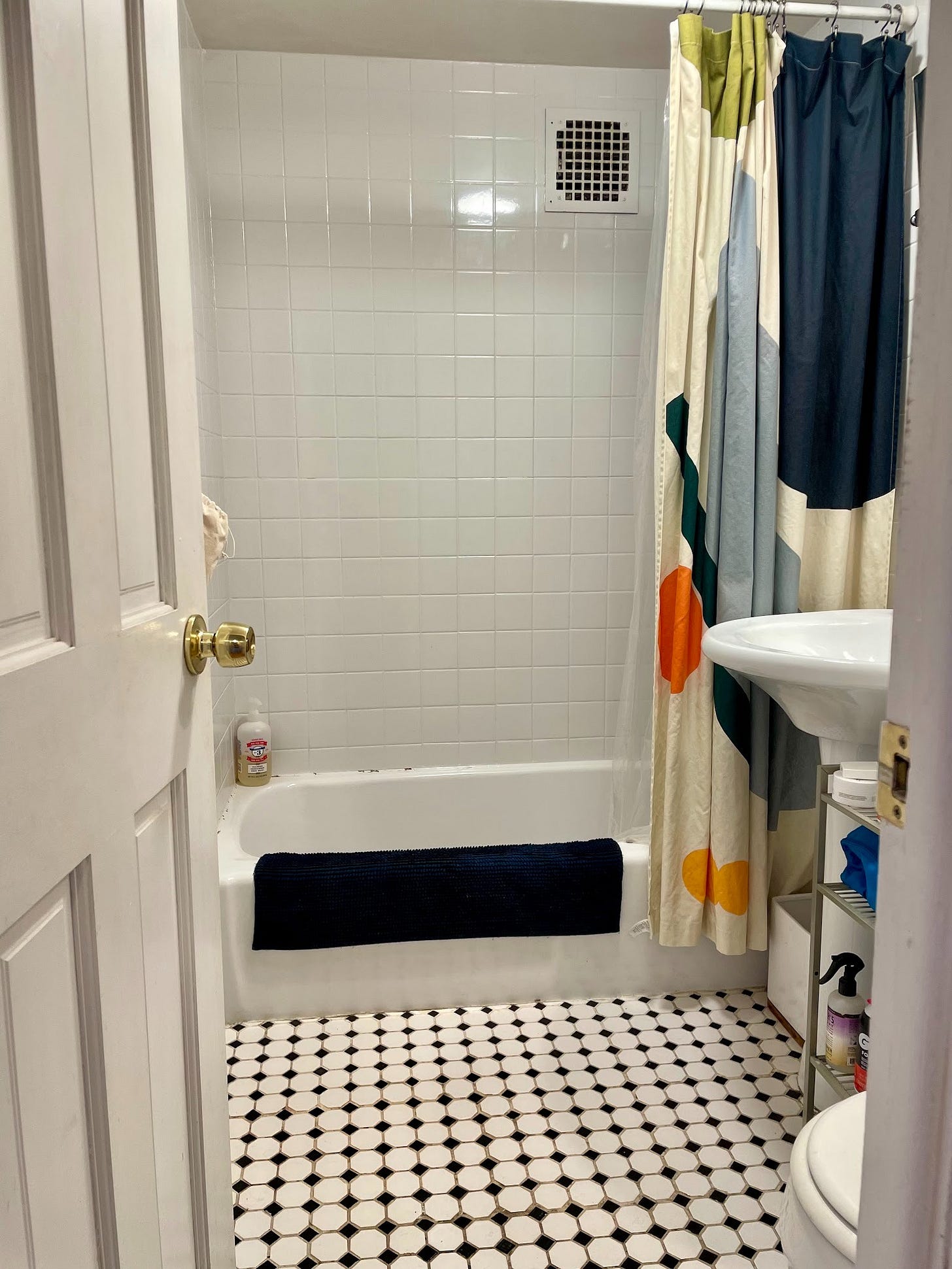
We want to make this bathroom bigger and update the fixtures.
Just when I think I’m in a position to squirrel away part of my paycheck, new, sizable expenses pop up, like camp tuition or the kids’ sports for next year. These expenditures are signs of a good life, and I’m happy to have them. But everything’s a tradeoff.
So maybe the question is partly about budget and partly about building confidence in how to spend wisely.
Instead of going in circles, I turned to personal finance expert Jean Chatzky, host of the HerMoney podcast and New York Times bestselling author of the forthcoming book The Forever Paycheck. The book focuses on retirement (and planning for it), but it specifically delves into the idea of learning to actually use the money you’ve saved—responsibly and without stress.
Here are five tips from my conversation with Chatzky that should help any homeowner gain financial clarity on reno dreams.
Chatzky urged me to make a list of foreseeable home improvement projects and a timeline for when we might need to complete them. If we know we will definitely need to replace those windows within two years and that we need a new roof in, say, seven, that helps clarify whether spending a hefty sum on a bathroom renovation this year makes sense.
This exercise forced me to organize my thoughts around projects and consider wants versus needs. It also motivated me to get some numbers on paper.
“Once you know what all these other things are going to cost and when they’re likely to hit, then you probably will be able to figure out how much you want to spend on this bathroom—and if it’s worth it,” Chatzky says.
I’m not gonna lie, my roadmap is a little frightening. It includes five big-ticket repairs or replacements (plus less pressing projects). At least two of these should be done within the next year or so.
There is something liberating about Chatzky telling me that homeowners actually should expect to spend about 1 to 2 percent of their home’s value per year on repairs and upkeep. “Your house is an asset that has to be kept up,” Chatzky says.
She pointed to a report from Harvard’s Joint Center for Housing Studies on the importance of upkeep and warned that if I don’t spend that 2 percent or so one year, the costs will catch up to me. Now, my potential bathroom renovation falls into the optional category at this particular moment. I’m not making an urgent repair. But the principle is the same: Our house is an important asset that needs continual investment.
Contemplating a bathroom renovation (or a big vacation, or any other large expenditure) starts with taking the pulse of your overall financial situation, Chatzky says: “When you look at where the money for [a project] might come from, the question to ask yourself is, ‘Where are we right now in terms of what’s coming in, what’s going out, and where it’s going? As we move month to month in our financial life, are we saving or are we spending?’” Are you accumulating assets at the rate you want, or are you adding debt?

Chatzky recommends a separate savings account just for home upkeep. “Having a designated house fund is really important because it gives you license to spend that money on your house.”
I have savings that I keep telling myself are for sprucing up our home, but I haven’t actually set an intention for this pot of money (because I also tell myself we might use it for other things). Which brings me to an important point from Chatzky: “I think the question [to ask yourself] is, if I don’t do this, then what am I doing with the money? Because, whether you’re conscious of it or not, you’re making a choice.”
With a HELOC (home equity line of credit), you borrow what you need, when you need it. A home equity loan, on the other hand, is fixed; you generally get the money all at once, explains Chatzky—and you start paying interest on all of it all at once. “Most people these days use HELOCs and not home equity loans,” she says. “Shop around, because rates vary pretty widely.”
Chatzky recommends that if you have the savings to pay for the project, you should use it and not borrow, unless you can earn more by keeping that money invested or in savings than you would pay in interest.
I did the math, and it makes sense for me to pay for the bathroom renovation with savings. For other circumstances where paying out of pocket is not possible, I could consider a HELOC.
After talking to Chatzky, I’m still not sure if the bathroom renovation is a go. But I have some clarity on how to wrap my head around it. I also feel like I have starting points for how my husband and I can talk through our priorities for the house and our family life. I like thinking more concretely about how to be a good steward of this old house of ours.
Maybe we’ll put a stamp on it with an updated bathroom. Maybe we’ll decide new front windows are just the right way to spruce her up. Or maybe she’ll tell us we need to update the electrical sooner than we thought, and we’ll have no choice but to follow her lead.
After all, she’s the boss.

The best ductless air conditioners, for rooms that can’t accommodate a window unit.
Colorful luggage that’s easy to spot at baggage claim.
Mortar & pestle sets for muddling herbs for summer-cocktails.
The best pressure washers, no matter your budget.
Want your car to last 200,000 miles? We have expert advice to put you on the right track.

Comments
Nothing yet. Say the first thing.
Sign in to join the conversation.