
Dear Friends,
When we’re engrossed in a movie, most of us aren’t paying close attention to all the ambient sounds that make the film feel “real”: a door closing off-screen; a car starting in the distance; footsteps crunching through snow. But from the earliest days of cinema soundtracks, Foley artists have been creating these layers of sound by hand (and foot), using everyday objects, practiced movement, and deep listening to give audial life to footsteps, fabric, weather—even tension itself.
In today’s featured story, Craftsmanship’s Contributing Editor, Jeff Greenwald, takes us behind the scenes at Outpost Studio in San Francisco, where a father and son team of Foley artists demonstrate how Foley is traditionally created, why it is critical to good filmmaking, and which parts of their craft can’t easily be replaced by digital tools.
We hope you’ll enjoy reading “Making Noise: The Endangered Craft of Foley Sound” written by Jeff Greenwald.
We always welcome your thoughts and suggestions, which you can offer in a comment, a Substack Note, or via email. Thank you for reading and sharing our stories, for supporting our work with a paid subscription if you can, and for being such a loyal part of the Craftsmanship community.
Sincerely,
Todd Oppenheimer
Publisher & Editor-in-Chief, Craftsmanship Magazine
by Jeff Greenwald, Contributing Editor
Imagine you’re watching a film. A small band of plotting pirates rows toward a galleon. They hit the side of the ship. Orders are barked, and they climb up the hull on rope ladders.
Here’s the problem: The on-set microphones only picked up the dialogue. Your challenge is to compose, using physical objects and digital tools, every sound the audience expects to hear in the background.
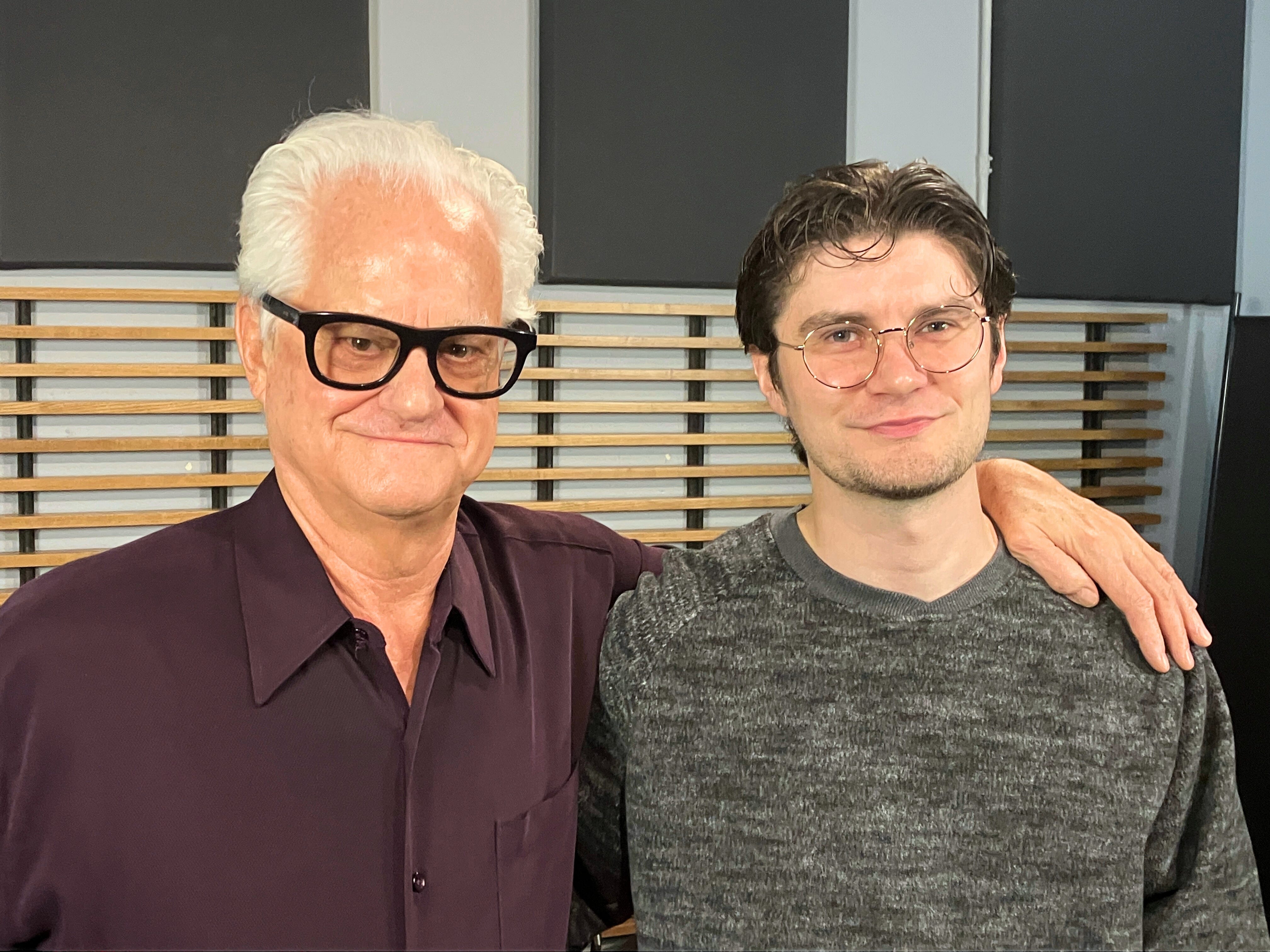
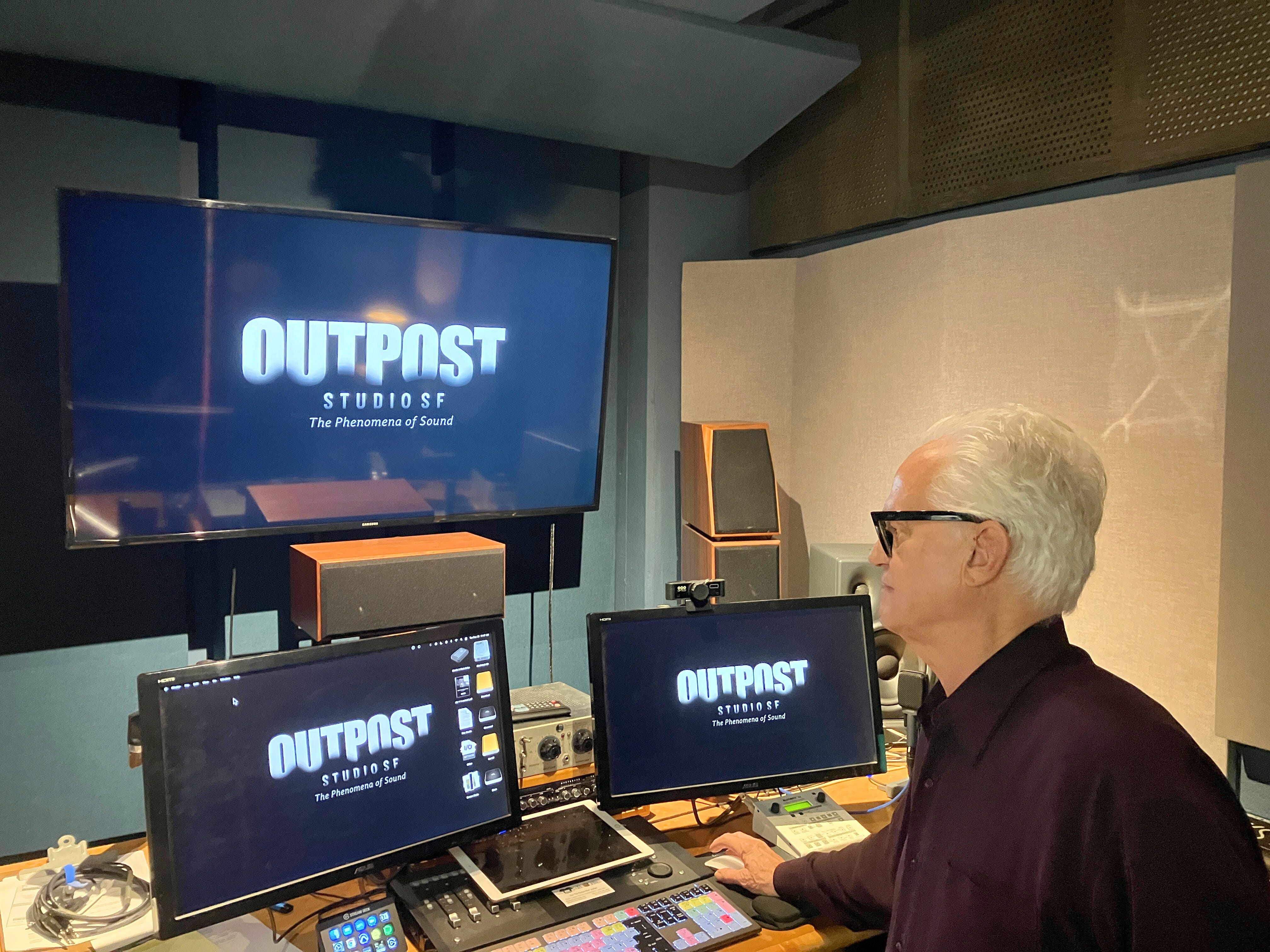
Where do you even begin? Sound engineer Dave Nelson’s expertise—working with his son and business partner, Karl, at San Francisco’s Outpost Studio—lies in finding (or creating) those sounds. This is the craft of a Foley artist.
“First you look for rope sounds,” Dave says, “the focus of the scene, and the sound their small boat would make as it hit the side of the ship.” Dave has worked as a sound engineer and Foley artist since 1989, and his mind is wired for such challenges. “Then you would do their feet on the side of the ship, along with the rope ladder. We would likely record all their clothes and gear. Meanwhile, you'd also be hearing the sound of the ocean around them, and the sound of the ship moving in the water.”
Jack Foley, a sound artist at Universal Studios, developed a way to create and synchronize such effects with films—a discovery that transformed cinema, and is still used in nearly all films (as well as radio plays). Whether it’s the roar of Godzilla, a group of kids in a playground, or lovers on a squeaky mattress in a cheap hotel, a Foley artist is behind those sounds.
In the early days of “talkie” cinema (as well as in early 1920s radio dramas), sound effects were often added to suggest background noises. Huge sheets of metal were shaken to emulate thunder; coconut shells clomped along as horse hooves; crinkling cellophane was a crackling fire. Jack Foley, a sound artist at Universal Studios, developed a way to create and synchronize such effects with films—a discovery that transformed cinema, and is still used in nearly all films (as well as radio plays). Whether it’s the roar of Godzilla, a group of kids in a playground, or lovers on a squeaky mattress in a cheap hotel, a Foley artist is behind those sounds.
During its 30-plus years in San Francisco, Outpost has provided effects for hundreds of films, from “Dreams with Fishes” to Werner Herzog’s “My Best Fiend.”
Foley artists and sound engineers work together, the former deciding what’s needed and supervising the Foley recording session. “I’ll be working on a film,” says Dave, “and there’ll be a sound missing: a car door closing, or a car driving away. Sometimes it might be [the sound of] putting a glass down on a table. But even putting a glass down is not always just putting a glass down. It could be poison; then putting the glass down is significant. So you might want to record it slightly differently, to make people aware of it.”
This short clip from “The Visit,” written and directed by Mitchell Linden, shows a variety of the Foley sounds Outpost Studio created for the film. (Copyrighted material; All Rights Reserved.)
Jennifer Myers, a former Foley artist who left the craft after more than 30 years to become a psychotherapist, was Dave’s longtime colleague and helped train Karl in Foley performance. She has worked on hundreds of films, including “The English Patient” and “Good Will Hunting.” She shared some of her trade secrets with me, like the way cornstarch gives a blend of soft dirt and sand the “squeakiness” of walking through snow.
A character’s wardrobe is also critical. “That coat you’re wearing makes a lot of noise,” says Dave, nodding at my rain shell. “Sometimes Foley artists refer to cloth as ‘the glue that holds Foley sounds together.’ All of these Foley effects actually help define a character.”
One place where Foley is essential is the foreign market. To make a profit, American films need to sell overseas. “This means dubbing,” says Dave. “But when the voice track is removed from the soundtrack, things like footsteps are also lost, because the walking sounds might be attached to the voice in the original production recording.”
A project that requires every sound but the dialogue track is called a “fully formed” M&E, requiring both music and effects—a task that seems almost unimaginably complicated.
This excerpt from a United Airlines commercial contains some clever examples of Foley sound. (Copyrighted material; All Rights Reserved.)
“When I worked on the Foley for ‘Lost in Translation,’” Dave says, “we did an awful lot of background scenes. Bill Murray would be talking, and a crowd of Japanese guys would come by. So we had to do all those background feet.”
There are thousands of sounds we take for granted in films, but register when they’re absent: paper grocery bags being carried to a door; the thump of a desk drawer door closing; the shuffling of crowds. Among Jennifer Myers’ favorite props is a 1950s-era roller skate (which can evoke a moving wheelchair) and a seasoned old leather jacket, which, layered with that roller skate and other props, creates the rattle of a leather belt with a holster, gun, handcuffs, and nightstick: what scripts refer to as “cop jingle.”
“The challenge,” Myers says, “is always, ‘What can I find in my bag of tricks that will evoke that sound?’”
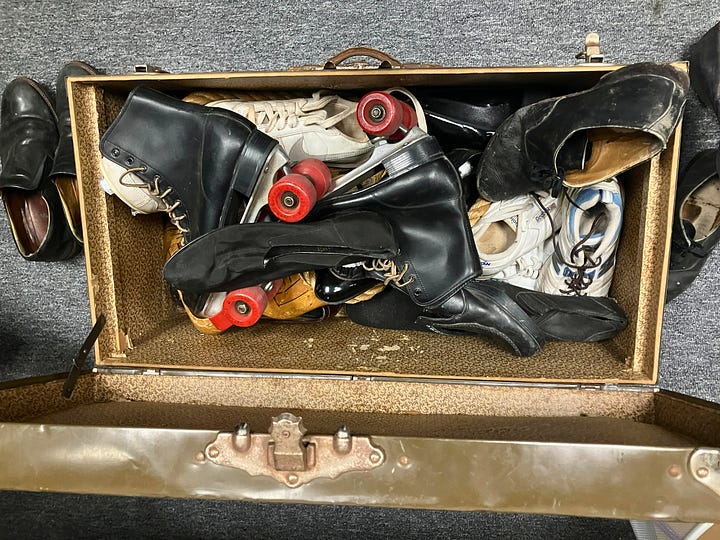
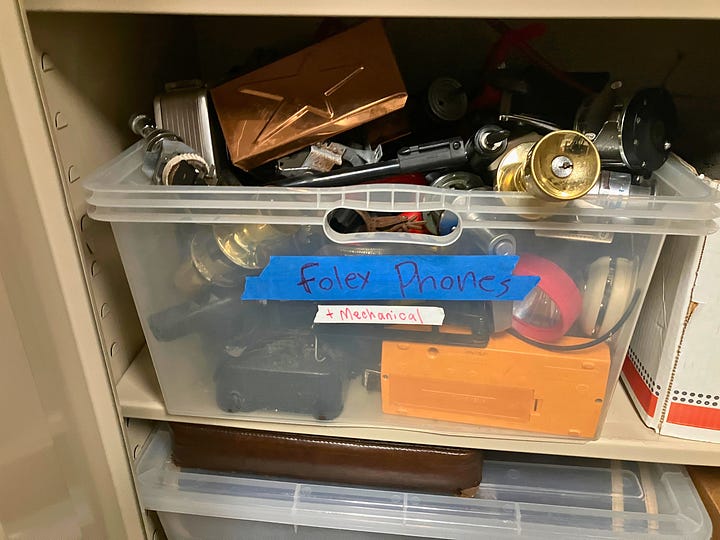
Dave shows me the Foley prop room, where bin after bin of helpful sound effects objects, from doorknobs to Mason jars, await possible use. As walking is a frequently desired sound, there is a huge selection of shoes. He hands a pair to Karl, who’s also a Foley artist and sound engineer.
Karl demonstrates how Outpost’s sound effects stage, or “Foley pit,” works. The floor of the room offers a number of different textured surfaces, including cement, leaf litter, and carpet. “In a full-fledged production,” Dave says, “we could pull out a dozen different surfaces to walk on, including the wood of the floor and the staircase. “
Highly sensitive microphones stand on tripods, and a double-paned window keeps external sounds out. As Karl crunches a pair of leather shoes across the leaf surface, the effect is transmitted up to Dave in the recording room with high definition and accuracy. “So as the engineer, here I might say to Karl, the Foley artist, Let’s back off the mic a little bit.”
“Three things make the walking [sound] believable,” says Dave. “The shoes the character is wearing, the position of the mic, and the surface.” Jen Myers also had a special talent for this. “I was a dancer before Foley,” she told me, “so the rhythmic part, and the ability to inhabit somebody else’s movements, came naturally to me.”
All of the recorded Foley effects will be added to the soundtrack, along with whatever other sounds and music are needed.
Karl points out some of the Foley elements he used in this ad for LinkedIn—you can watch the final version here. (Contains copyrighted material; All Rights Reserved.)
What Karl showed me is considered traditional Foley. These days, Foley artists and engineers are seeing an increase in competing digital software on the market. Many of today’s sound engineers also use software like Soundminer (which allows them to quickly search, organize, manipulate, and audition vast libraries of sound effects, music, and dialogue) and Krotos Studio, which has its own library in many categories of Foley and film-related sounds.
Hiring a traditional Foley artist, Dave says, runs around $2,000 per day. Most films need five to 10 days of work—a substantial sum, especially for independent documentaries. “The budgets are really low, and it’s not always feasible to bring a Foley artist in.”
Still, every film involves many decisions that software programs can’t tackle. The project Outpost is working on now, for example, needs the sound of ”snakes in a wicker basket” (a problem previously solved using live eels).
“What happens to the eels afterwards?” I couldn’t help but ask.
“Well, you could cook them,” Dave said, “...all in the pursuit of sound.”
Melding the best of both worlds, Dave embraces a hybrid approach: sourcing sound effects from both traditional Foley and digital Foley tools. “Rather than one or the other, let’s use both. Take a scene, for instance, where your main character is walking down the street, and there are all kinds of ancillary characters walking behind her. I could digitally record some of those background sounds. At the same time, the Foley artist records the main character’s footsteps.”
“No Foley artist on Earth is going to like this,” Dave said. “But this is the world that we live in right now. It’s about keeping this art alive, but doing it in a way that we can survive.”
Comments
Nothing yet. Say the first thing.
Sign in to join the conversation.