
Fast Break is a CPGSPN spinoff where I transition from cold emails and power rankings to the CPG stories that matter most to me.
Today’s subject: The Food Pyramid
For decades, America has been told how to eat by the government.
Grains at the base, fats at the top, the impact of sugar barely mentioned at all. Schools taught it. Brands built around it. Families were guided by it. And we trusted it, because it came stamped with the authority of Harvard scientists, USDA insiders, and the most respected public health institutions in the country.
But there’s an interview behind our dietary guidelines that most people have never seen. An interview that had never been published. Until this week.
➡️ Let’s dive in.

It begins in a nursing home in 2005, where Dr. Mark Hegsted, one of the architects of the U.S. dietary guidelines, spent his final years reflecting on his contribution to the nutritional advice that shaped generations.
An interview was recorded by Emily Kaplan and left untouched for over two decades. A deathbed-style confession that complicates the origin story of modern nutritional guidance.
➡️ But first, who was Dr. Mark Hegsted?
In terms of nutrition and dietary policy, Dr. Mark Hegsted wasn’t a bench player. He wasn’t even a role player. In the literal sense of it, he was a superstar at the center of American nutrition for more than fifty years.
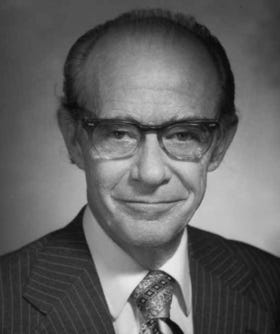
Born in Idaho in 1914, he earned a PhD in biochemistry and ended up at Harvard’s School of Public Health in the early 1940s. By the 1960s, he was conducting studies and publishing what became known as the Hegsted Equation. This equation argued that saturated fats raised cholesterol levels, monounsaturated fats had little to no effect, and polyunsaturated fats lowered cholesterol levels. The research resonated and helped push the country toward a low fat, high carb way of eating.
This body of work eventually pulled him out of the lab and into DC. Hegsted helped draft the original 1977 Dietary Goals, which became the Dietary Guidelines that have shaped federal advice ever since. Well, I guess up until the MAHA movement of today.
In 1978, he led nutrition programs at the USDA, and in 1982, he was hired by Harvard Medical School, all the while publishing hundreds of papers and advising every major health agency you can name.
➡️ For decades, America was guided by a nutrition story he helped write. This influence is important to note for later in this article.

At the time of the interview, Emily reported for the Las Vegas Review-Journal and freelanced at Jane Magazine, where she focused on stories involving unethical practices by doctors…including this one.
She then moved on to ABC, where this story stayed on the back burner until this week.
Since then, Emily has had a decorated career spanning stints at The Boston Globe, Boston Magazine, and CrossFit.
Today, she is the CEO of The Broken Science Initiative and Principal at The Kleio Group, a PR firm that focuses on strategic communications.
➡️ Let’s take a look at the history of America’s dietary guidelines from 1916 to present day.
Here is the arc of America’s nutrition advice over the last century.
Emphasized fruits, veggies, and milk as “protective” against nutritional deficiencies. Fats and sugars were deemed necessary for energy in moderation. Measurements used were cups, spoons, and weight.
Milk and Meat
Cereals and Starchy Foods
Fruits & Vegetables
Fats & Fatty Foods
Sugar & Sugary Foods
Everything about this era was about cost-to-nutrient efficiency and the absolute minimum nutrition needed for survival at the lowest possible cost.
Milk
Potatoes and Sweet Potatoes
Dry Beans, Peas, and Nuts
Tomatoes and Citrus Fruits
Leafy Green and Yellow Vegetables
Other Fruits & Vegetables
Eggs
Lean Meat, Poultry, and Fish
Flours & Cereals (including cornmeal & macaroni)
Butter
Other Fats (including oils & lard)
Sugars (including molasses & syrups)
The number of food groups changed from 5 to 12 and then back to 7.
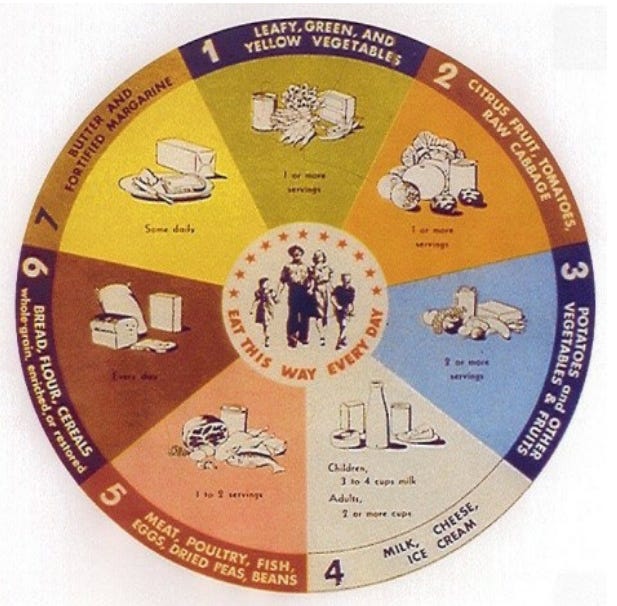
Leafy Green & Yellow Vegetables
Citrus Fruit, Tomatoes, and Raw Cabbage
Potatoes and Other Fruits & Vegetables
Milk, Cheese, Ice Cream
Meat, Poultry, Fish, Eggs, Dried Peas, Beans
Bread, Flour, Cereals (whole grain, enriched, or restored)
Butter & Fortified Margarine
You guessed it. We’re moving the major food groups again. This time 4.
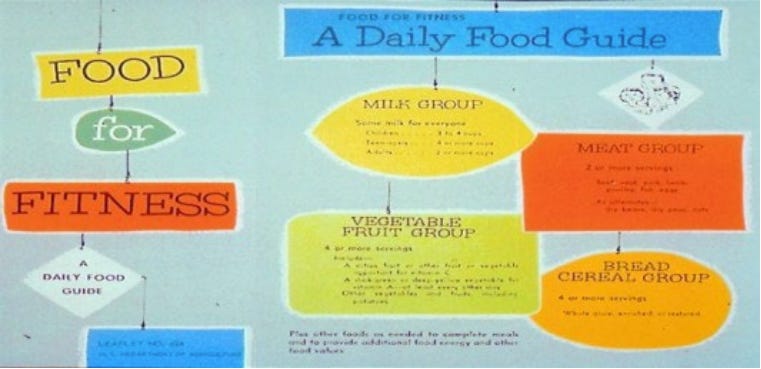
Milk
Fruit & Vegetable
Meat
Bread & Cereal
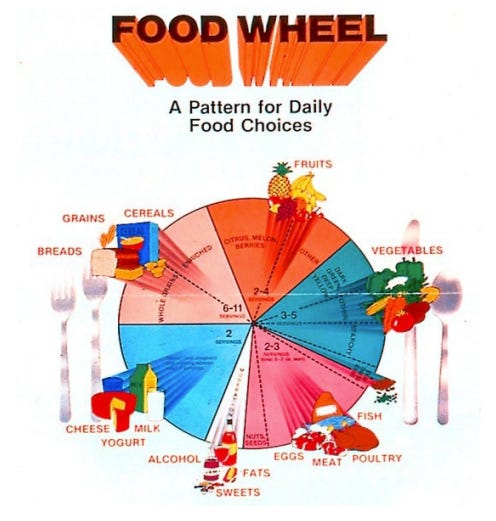
This is the first guide that was created after Dr. Mark Hegsted’s contribution to The 1977 Dietary Goals for the United States. This is where they added a 5th group that targeted fats, sweets, and alcohol.
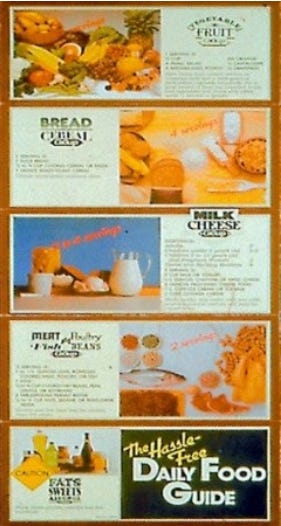
Fruit & Vegetables
Bread & Cereal
Milk & Cheese
Meat, Poultry, Fish & Beans
Fat, Sweets, & Alcohol (CAUTION)
The first time servings are suggested. Coincidentally, the same timeframe that High Fructose Corn Syrup hit mainstream and the obesity epidemic began.
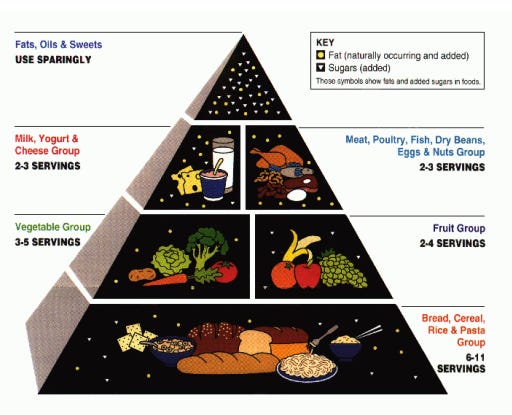
The pyramid that all 90s kids remember. The one that was likely even printed on the actual packaging of the food you bought!
I have absolutely no recollection of this one. Zero. Zilch.
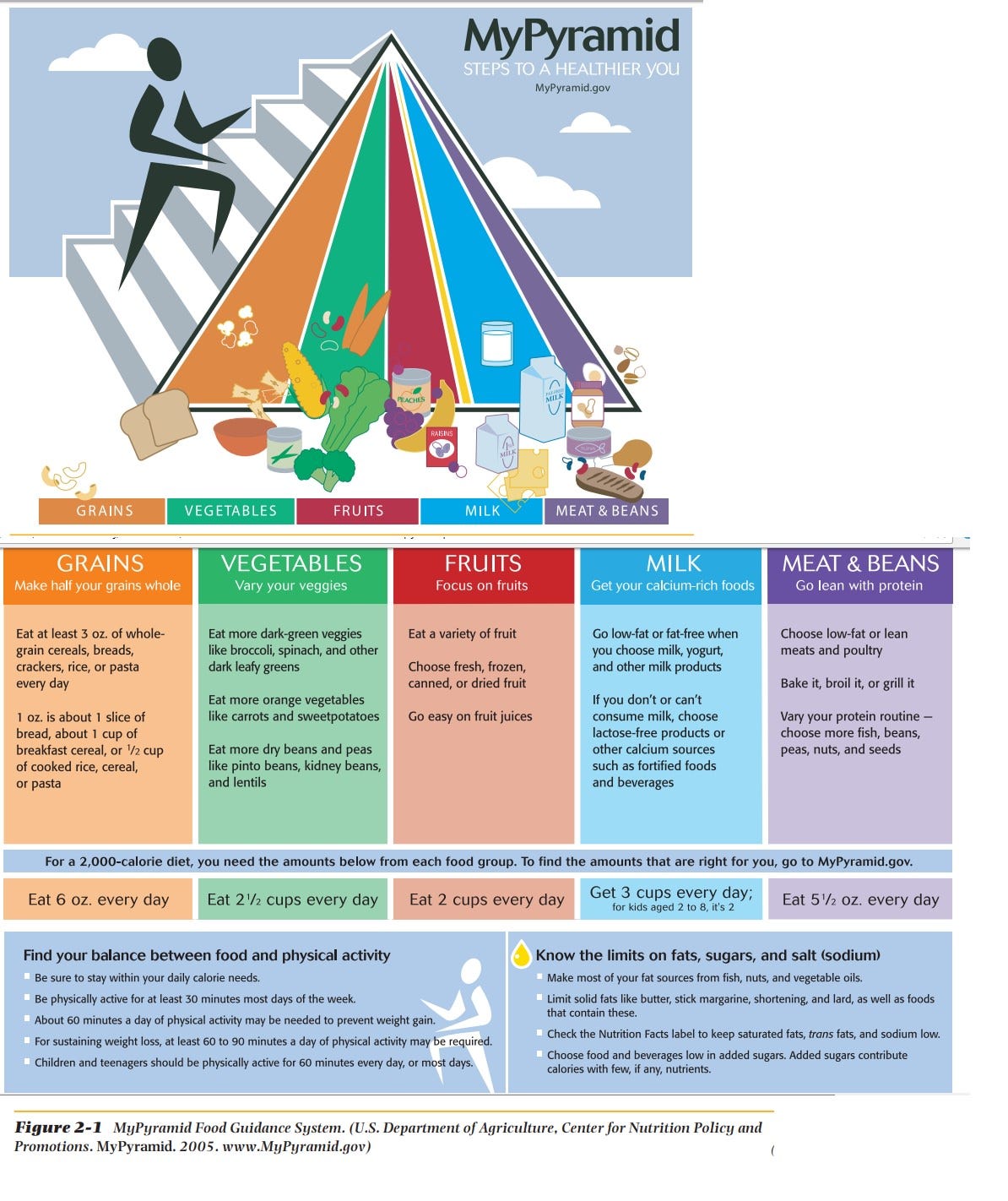
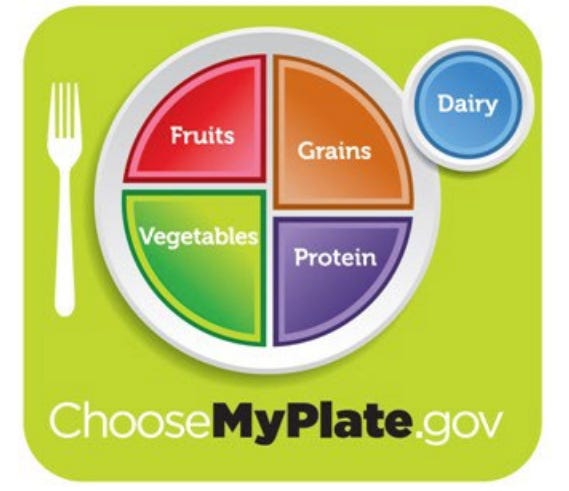
Same, but rebranded and donning a shorter web domain.
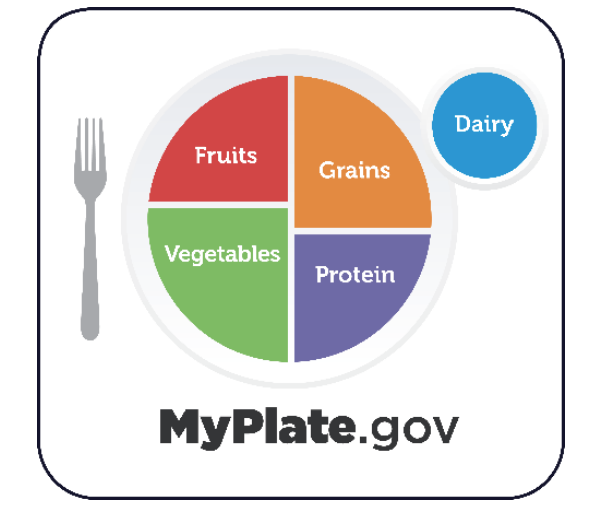
A beautiful step in the right direction.
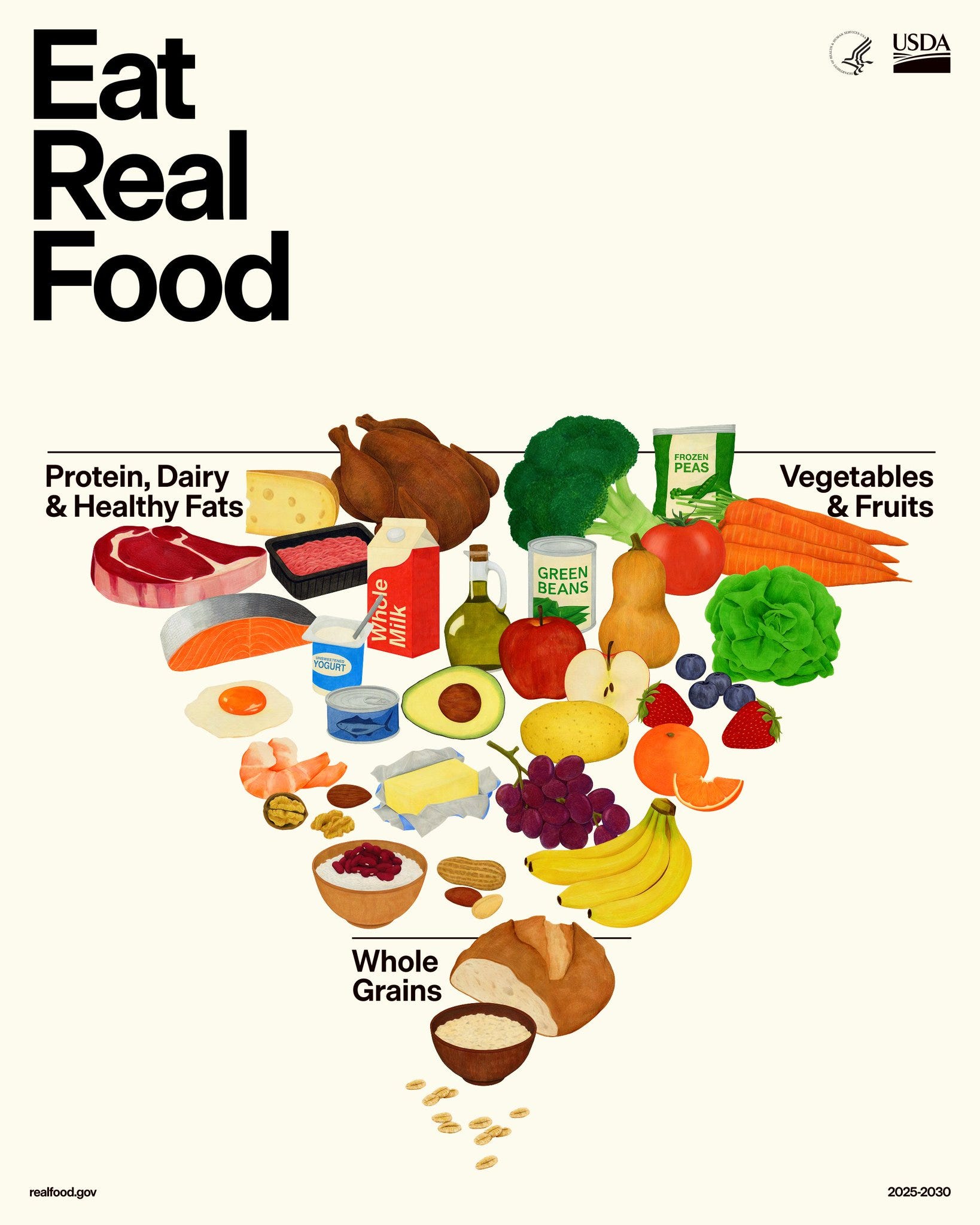
➡️ And here’s where the whole story flips.
During that interview, Hegsted admitted he wished he had done two things differently.
Namely, the “eat less fat” guidance had two side effects:
Americans reduced meat consumption
And they were never told to reduce refined flour and sugar
⬇️ It can be argued that Dr. Mark Hegsted’s research, guidance, and stances over the years are, in large part, attributable to the American metabolic health epidemic that we face today. This serves as a stark reminder. Sometimes “trust the science” means trusting the doctors who accepted the cash.
And that has always been a losing proposition.
America didn’t choose a high carb diet. A handful of men chose it for us.
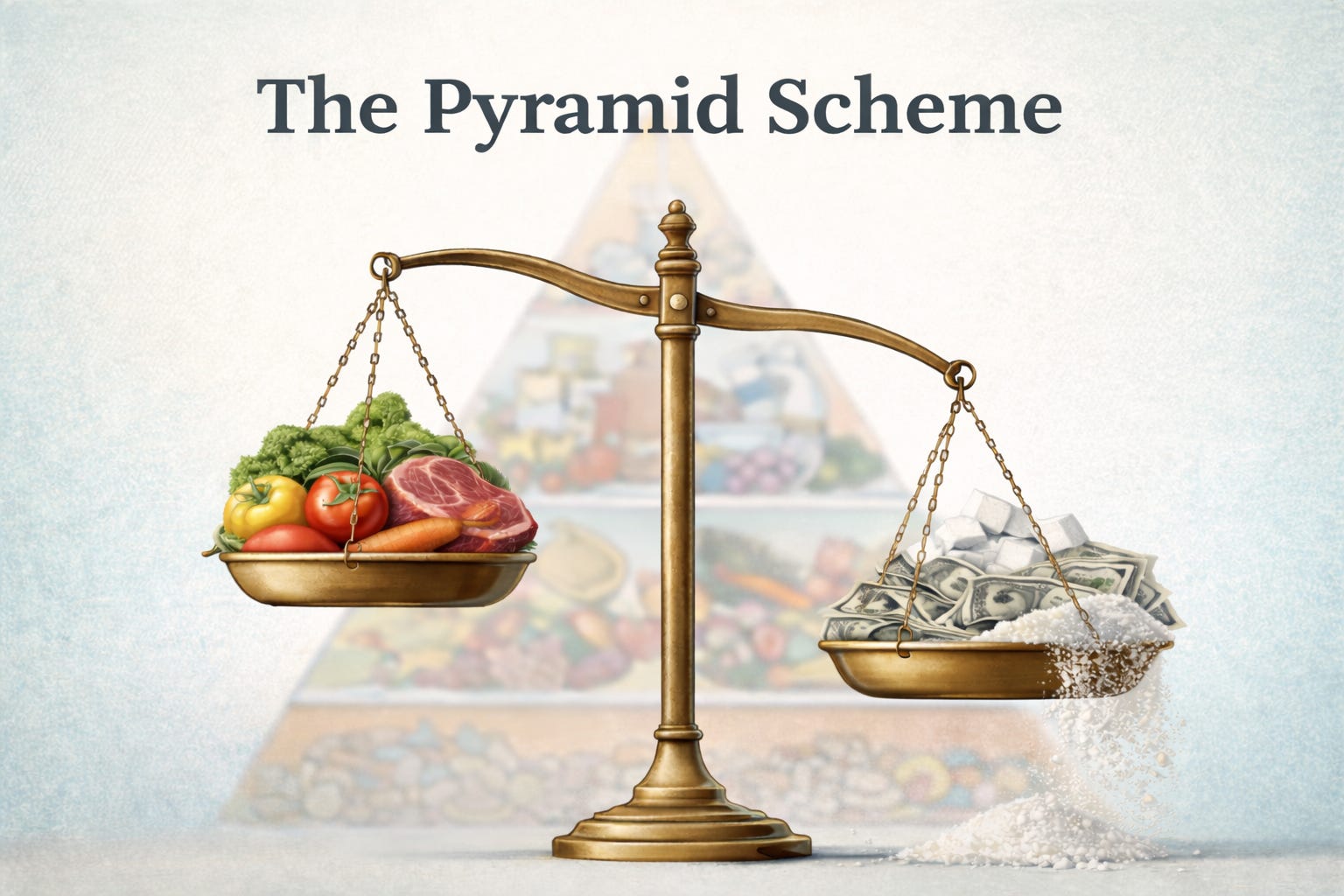
Dr. Mark Hegsted is one of the three Harvard scientists bribed by the sugar industry, through the Sugar Research Foundation, who wrote a piece in the prestigious New England Journal of Medicine stating that fat, not sugar, was the cause of coronary heart disease.
This conspiracy was uncovered in Harvard’s basement (literally) in 2016 by Dr. Cristin Kearns after decades of being concealed. She found that Dr. Hegsted and Dr. Robert McGandy, under the purview of Dr. Frederick Stare, were paid the equivalent of over $50k in today’s dollars to discredit studies that implicated sugar as the reason behind coronary heart disease.
“Kearns said the papers, which the trade group later cited in pamphlets provided to policymakers, aided the industry’s plan to increase sugar’s market share by convincing Americans to eat a low-fat diet.” - Melissa Bailey
We traded fat for sugar, whole foods for starch, and we are paying for it in real time. Nearly half of America is diabetic or pre-diabetic. Over 100 million Americans are pre-diabetic, and most have no idea.
As the government rewrites the pyramid again, we need to ask who has our best interests at heart and who is getting paid to sell us out?
Right now, there’s promise. An emphasis on protein, dairy, healthy fats, fruits & vegetables, and the reduction of highly processed, refined carbs that have previously been coined “empty calories.”
To the refined sugar apologists out there…cane sugar is not the hero ingredient you think it is. And stevia and monkfruit are not the enemy you make them out to be.
Cane sugar had its half-century at the top. It can sit the next one out.
The Journal of the American Medical Association
The Sugar Conspiracy, The Guardian, (2016)
A Brief History of the USDA Food Guides
Pure White, and Deadly: How Sugar Is Killing Us and What We Can Do To Stop It, John Yudkin, (1972)
Sugar: The Bitter Truth, Robert Lustig, (2009)
The Low Carb Healthy Fat Dietitian
Sugar industry secretly paid for favorable Harvard research, Melissa Bailey, (2016)
New England Journal of Medicine (1967)
CPGSPN is free to you because my marketing agency, Growthbuster, funds my time.
And companies like Relish fund this newsletter. I use Relish for retail launches for both Perfy and Growthbuster. My favorite part is how turnkey it is and how much time it saves the team. No back and forth on creator contracts and deliverables. Just provide a proper marketing brief, and you’re off to the races.
MORE ABOUT RELISH:
Relish is a platform for creator-led commerce, built to help Restaurants, Retail, and CPG brands drive foot traffic and in-store discovery through authentic, local creator campaigns.
Their fully managed, local creator marketing platform supports multi-market brands with hyper-local content that drives real traffic, sales, and brand loyalty.
I’m currently partnering with them on some new offerings that I’m really excited to share in the coming weeks. Hit them up, and tell them Vasa sent ya!
Building Perfy: a low sugar soda that doesn’t spike blood sugar, with a mission to eradicate cane sugar and high fructose corn syrup from the food supply.
I’ve also been running Growthbuster since 2017, a CPG and local marketing agency focused on food & beverage for humans and pets. We’ve worked with brands like Magic Spoon, Lemon Perfect, Outer Aisle, and more. We handle organic social, email, SMS, as well as branding and consulting projects.
Comments
Nothing yet. Say the first thing.
Sign in to join the conversation.